Do Horses See Well In The Dark?

Unlike human eyesight, the equine eye is especially adapted to seeing well in the dark—that's when many predators would attack their wild ancestors. The equine eye is so well adapted that a normally sighted horse under a partial moon or bright stars can see as well as a human does in full daylight!

Horses require about 15 minutes for their vision to completely adjust between differently lit environments. This process be seen by stalled horses' reactions to having the barn lights turned on in pre-dawn hours: they squint and blink repeatedly as their eyes try to adjust.

Though it may make some riders anxious, there is no reason to restrict riding to daylight hours. Open fields and lightly wooded areas can be traversed easily in the dark. Dense woods or pitch-black nights aren't ideal, but a horse in familiar territory is just fine if the rider lets him choose his own path. Caution should be taken when leading a horse out of a brightly lit barn to ride—his eyes need time to adjust, so starting slowly and remaining on known paths at the beginning of the ride is a must.

Read more at EQUUS magazine.

The post Do Horses See Well In The Dark? appeared first on Horse Racing News | Paulick Report.

Source of original post

‘You Get A Taste Of That And You Want More’: Recent Success Has Amoss Moving In New Direction

In a “been there, done that” kind of career, Tom Amoss has seen a lot of highs around the famed Fair Grounds Race Course & Slots oval. The New Orleans native and LSU graduate has won the local trainer's title an amazing 11 times, to go with countless local stakes as well, and he was voted into the Fair Grounds Hall of Fame in 1998. But even for someone with Amoss' gaudy resume, the recent tear he's been on has been otherworldly, and it has him in contention for title number 12.

Amoss last won the Fair Grounds trainer's title in 2014-15, and, after a 2-for-16 start to the meet, he didn't figure to seriously threaten atop the standings as 2020 turned to 2021. The landscape changed in a hurry, however, as the New Orleans native is now in the midst of a wild 11-for-23 streak which began on December 18.  Following his win in the Saturday finale with Defeater, his second of the day, Amoss snagged a tenuous one-win lead over four-time defending champion Brad Cox.

“Obviously, you have some hope going into the races, but racing luck can play a lot into the outcome of races,” Amoss said. “I think, in the end, as a trainer, you'd like to get rid of those peaks and valleys and kind of steady somewhere in between, but it doesn't work like that. So, when the barn is clicking it's just time to get out of the way. When it's not going well—and it was not going well at the beginning of the meet—you have to do what you always do when you get in one of those kind of sour streaks; you've got to continue to do the job as you always would, enter, and not hit the panic button.”

My Boy Gus is the type of horse Amoss built his career on, and the type that helped him win 11 local titles, as he claimed the 3-year-old for $40,000 out of his debut at Churchill Downs and immediately won right back with him. But as time has moved on, so have the goals of a stable that grown by leaps and bounds. Amoss won Churchill's Kentucky Oaks (G1) with Serengeti Empress in 2019 and last year's Woody Stephens (G1) at Belmont Park with No Parole. After tasting success at racing's highest level, there's little wonder he wants more.

“We're moving in a little bit of a different direction,” Amoss said. “Don't get me wrong; claiming has always been our bread and butter and will continue to be so. But you get a taste of a horse you develop like Serengeti Empress and one trip to that winner's circle on Kentucky Oaks Day and to that infield—a place where they don't take any win pictures except the Derby and the Oaks—you get a taste of that and you want more.”

With a stable that now plays on the national scene, winning his 12th local title wasn't on top of the “to do” list as 2021 dawned. Amoss looked back fondly on when he was in the midst of building his local Hall of Fame resume, then pondered how another plaque on the wall of the barn would feel.

“If you asked me that question—what would winning the Fair Grounds title mean—10-to-15 years ago, I would have told you it means a lot—because it did,” Amoss said. “Fair Grounds was our major emphasis in the winter and the bulk of our horses were down here. And it was a great motivator to our barn, which works so hard all meet. But a lot has changed since then and what kind of stable we have. If we win the training title it's great, but it's not going to have the meaning it once did. And I don't mean to take anything away from something that would be an accomplishment for sure, but it's not an emphasis.”

No Parole fits the profile of the new-age Amoss horse. Purchased for $75,000 as a yearling, he won on debut here in his lone start at 2 and then went on to much greater heights at 3. Last year, the newly minted 4-year-old Louisiana-bred son of Violence won the LA Bred Premier Night Prince Stakes at Delta Downs in February then tried Triple Crown hopefuls in Oaklawn's Rebel (G2) a month later, where he was eighth. Amoss cut No Parole back and he won an optional-claimer there in April before winning the Stephens at Belmont to announce his presence as one of the top sophomore sprinters in the country. No Parole was ninth in the Allen Jerkens (G1) at Saratoga in August and sixth in the Stoll Keenon Ogden Phoenix (G2) at Keeneland in October before Amoss decided he needed a break. He's worked twice since, including a 4-furlong move in a local 48.20 January 2, which has Amoss looking forward to a big 2021.

“He worked very well and showed he's getting ready very quickly,” Amoss said. “It would not be surprising to see him in the entry box sometime at the end of January or the beginning of February. He was great for us as a 3-year-old. He won a grade 1 in New York but horses, specifically sprinters, it's hard to keep them at the top of their game year-round. He tailed off, and that's not unusual, so it was time to give him a rest and get him ready for his 4-year-old year.”

While No Parole set the bar mighty high winning a grade 1 last year, Amoss has a slew of young horses he's looking forward to this year. He won with first-time starter Save here New Year's Day and sent out the highly-regarded Defeater to win the Saturday finale. The 3-year—old son of Union Rags was a $210,000 yearling purchase and ran to that price tag when he ran down a heavily favored Godolphin blueblooded entry. Prior to the race Amoss wasn't sure Defeater would win on debut, which only speaks to his talent, and his future.

“Defeater is a very, very nice colt but he comes with some difficulties for a trainer,” Amoss said. “He's not a precocious gate horse. Any of the young horses that are coming up like him, these are developing young horses and no matter how hard you try, you can't rush that development because a lot of that is getting physically bigger and stronger, as well as mentally understanding the racing. But make no mistake about it, Defeater is a runner.”

And Amoss, is a winner.

The post ‘You Get A Taste Of That And You Want More’: Recent Success Has Amoss Moving In New Direction appeared first on Horse Racing News | Paulick Report.

Source of original post

Pick 5 Carryover Spurs Brisk Wagering On Saturday Night Meadowlands Program

Handle reached remarkable heights and Let It Ride N stamped himself as the top harness horse currently in training on an eventful Saturday night at The Meadowlands in East Rutherford, N.J.

Wagering on the 15-race program totaled $4,562,477, which topped the “non-event” 2020 best of $4.1 million on June 20, when there were 18 races on the card. The average per race was $304,165, a number not seen since Hambletonian Day, when an average of $358,163 was put in play.

From the get-go Saturday, the action was fast and furious, as $565,076 was bet in the first race, thanks to $314,217 in “new money” wagered into the 20-cent Pick-5, which saw a total pool of $360,948 after the carryover of $46,731 was added in.

Another $468,040 was wagered on the sixth race, due in large part to an Early 50-cent Pick-4 pool of $120,947. The Late 50-cent Pick-4 was predictably popular as well, with $102,248 in action leading to $351,354 in total play. The single-race $350,000 barrier would be broken four times during the night.

RIDE, RIDE, RIDE: The incredible early success of the Nifty Norman-trained Let It Ride N continued in the featured $28,000 Open/Preferred Handicap for pacers, as the 8-year-old gelded son of Rock N Roll Heaven-Love A Gamble stayed perfect in five North American starts since his arrival from Australia in late November.

Driver Dexter Dunn didn't ask Let It Ride N for big speed at the start, settling in seventh along the rail from post nine in the nine-horse field around the first turn. Searching for a second consecutive score, Harambe Deo set a fast pace, hitting the quarter in :26.1.

Before the half, Dunn had Let It Ride N racing on the rim, following the first-over Rock Diamonds N as Harambe Deo paced the half in :53.2. Nearing the five-eighths, Rock Diamonds N started to back up in the 1-2 favorite's face, so Dunn had to move three-wide likely earlier than he would have liked.

It didn't matter.

“He had no choice [but to move him],” said Norman of Dunn's aggressiveness. “But the horse has a huge kick and seems to be able to carry his speed a long way.”

Let It Ride N gobbled up ground while three-wide around the far turn and collared Harambe Deo shortly after they straightened up in the stretch before blowing his foes away in a thoroughly dominant performance, scoring by 2 lengths over the late-rallying Hesa Kingslayer N after pacing his final quarter in :26.1. Vettel N closed for third. Highalator, the 9-2 second choice, finished seventh, with Harambe Deo (7-1) eighth.

“He really amazed me,” said Norman of his prized pupil. “He doesn't seem to have any bottom in him. I'm in shock again tonight. He's got an amazing brush. What impressed me the most, is once he passed Harambe Deo, he kicked off again like he had another gear.”

Let It Ride N, who won at The Meadowlands on Dec. 12 in 1:48.4 and now has three wins at the mile oval, lowered his lifetime best to 1:48.1. He's now won 23-of-59 lifetime starts and earned $360,958 for owners Enzed Racing Stable Inc.

“He's 8 years old,” said Norman. “You don't expect 8-year-olds to do this. All I've done is put him on Lasix, so he must have been bleeding back home. Next, I'll take him to Yonkers to see if he can get around a half-mile track. We might try the [Borgata] series there. I'm going to have to stake him to some races this year. He looks like he can be a Grand Circuit horse. I have to give him that chance.”

A LITTLE MORE: Dunn and Yannick Gingras picked up right where they left off in 2020, as each won three times on the card. … Norman had a training double, as did Stacy Chiodo. … Racing resumes Friday at 6 p.m. … The Big M will race every Friday and Saturday from now through Hambletonian Day, Aug. 7.

The post Pick 5 Carryover Spurs Brisk Wagering On Saturday Night Meadowlands Program appeared first on Horse Racing News | Paulick Report.

Source of original post

NYRA Reports 19 Percent Increase In Daily Average Wagering During Pandemic-Shortened Year

The New York Racing Association, Inc. (NYRA) has announced that its 2020 race meets conducted at Aqueduct Racetrack, Belmont Park and Saratoga Race Course generated all-sources handle of more than $1.8 billion.

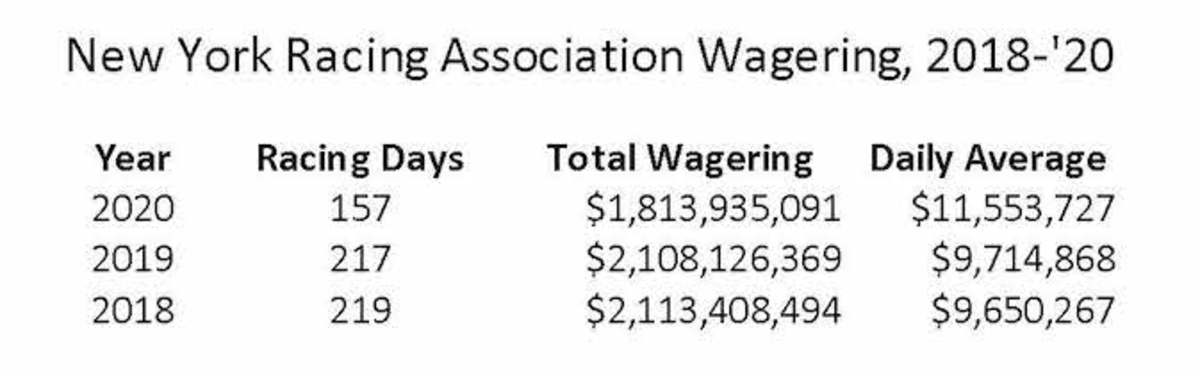
Total handle over the 157 race days contested in 2020 was $1,813,935,091 for an average daily handle of $11,553,727, a 19 percent increase over 2019. Average field size for the 1,507 races completed in 2020 was 7.82, a six percent increase over 2019.

Since the resumption of live racing on June 3 through the end of 2020, all-sources handle totaled $1,586,344,888, a $7,059,402 increase over the same period in 2019. Average daily handle from June 3 through the end of 2020 was $13,443,601, marking a 16 percent increase over the same period in 2019.

Despite the loss of 43 race days to the impact of the COVID-19 pandemic, which resulted in 27 percent fewer race days and 25 percent fewer races than in 2019, all-sources handle declined year-over-year by just 14 percent compared to the $2,108,126,369 generated in 2019.

At the outset of the pandemic, NYRA voluntarily suspended live racing operations on March 19 to devote all resources, energy and attention to maintaining the health and welfare of the backstretch community. Live racing resumed June 3 when NYRA opened the Belmont Park spring/summer meet to mark the return of professional sports in New York. Since June 3, all NYRA tracks have been operated without spectators and with only a limited number of essential personnel, horsemen and owners on-site.
The abbreviated 25-day Belmont spring/summer meet generated $15,466,198 in average daily handle from all sources, a 42 percent increase over the 2019 spring/summer meet. Despite running 23 fewer days than in 2019, a 48 percent decrease, all sources handle during the spring/summer meet declined by just 26 percent for a total of $386,654,955.

The June 20 Belmont Stakes Day card, which featured 12 races and six graded stakes, highlighted by Tiz the Law's victory in the 152nd running of the Grade 1, $1 million Belmont Stakes, generated all sources handle of $67,753,336.

NYRA held its 2020 summer meet at historic Saratoga Race Course as scheduled and without interruption. All-sources handle for the 2020 summer meet totaled $702,535,468 compared to $705,343,949 wagered from all sources on Saratoga in 2019. Average daily handle for the 40-day meet was $17,563,387.

The 2020 fall meet at Belmont Park generated $9,923,813 in average daily handle from all sources, marking a 33.6 percent increase over the 2019 fall meet.

Despite running 10 fewer days than in 2019, the all sources handle for the Belmont fall meet totaled $267,942,961, just 2.5 percent lower than in 2019. Due to the continued impact of the COVID-19 pandemic, NYRA adjusted the fall schedule by adding a one-week break following the conclusion of the summer meet at Saratoga. Consequently, the 2020 fall meet was contested over 27 days compared to 37 days in 2019, a 27 percent decrease in race dates.

The recently concluded Big A fall meet, which ran from November 6 through December 6, generated $9,261,276 in average daily handle from all sources for a 12.8 percent increase over 2019. Conducted over 18 race days, the Aqueduct fall meet generated all sources handle of $166,702,976. The 2019 fall meet, which was conducted over 25 race days, generated all sources handle of $205,249,710. A total of 175 races were run during the Aqueduct fall meet in 2020, equating to 58 fewer than the number of races run in 2019.

NYRA conducted a total of 127 stakes races in 2020, not including New York-bred and NYSSS races, accounting for 25 percent of all stakes run in the United States. Of the 127 stakes, 95 were of the graded variety, representing 25 percent of all graded stakes run in the United States. NYRA hosted 33 Grade 1 stakes in 2020, or 35 percent of all Grade 1 races run in the United States. Due to the myriad impacts of the COVID-19 pandemic and the reorganization of the stakes calendar, 36 stakes races scheduled for 2020 were not run, with 17 of them graded.

The post NYRA Reports 19 Percent Increase In Daily Average Wagering During Pandemic-Shortened Year appeared first on Horse Racing News | Paulick Report.

Source of original post

Verified by MonsterInsights