No chance. I mean, you just had to take one look at the guy. The tattoos, the words tumbling nervously through gaps in his teeth, the sheer damage he's soaked up. You didn't have to look up his record. It was like he had an invisible ball and chain. So, no, thank you very much for asking, but we don't need any help right now. He could be someone else's problem.
No chance? Not even one? That was all Chris Courtney wanted: a single opportunity to break the cycle, a single precarious plank to bridge the abyss dividing a convicted felon from the world of work; from consuming taxes to paying them. Turns out, one chance was all he needed.
“He kept calling me,” Jeannie Larkin remembers. “I kept saying, 'I'm sorry but I'm just so busy right now, I really don't have time to sit down.' And he finally just said, 'I'm coming.'”
First impressions being what they are, he can't have seemed any more promising in person than he must have sounded on the phone.
“Okay,” Larkin said. “Can you just walk with me while I finish up work here?”
“Because we had to get ready for a show the next day,” she explains now. “He came out at 5 p.m. and I thought, 'At this point I'm still going to be in this barn at 10 p.m.'” She pauses and smiles. “We were done by 7.30 p.m. Chris had two horses bathed and shining in no time. All these farms he'd been to, nobody had let him touch a horse. And when I said, 'Okay, you take this one and I'll take this other one and we'll turn them out,' he got to the edge of the barn and started crying. It all came out: it was just like that, letting go of everything. A new start.”
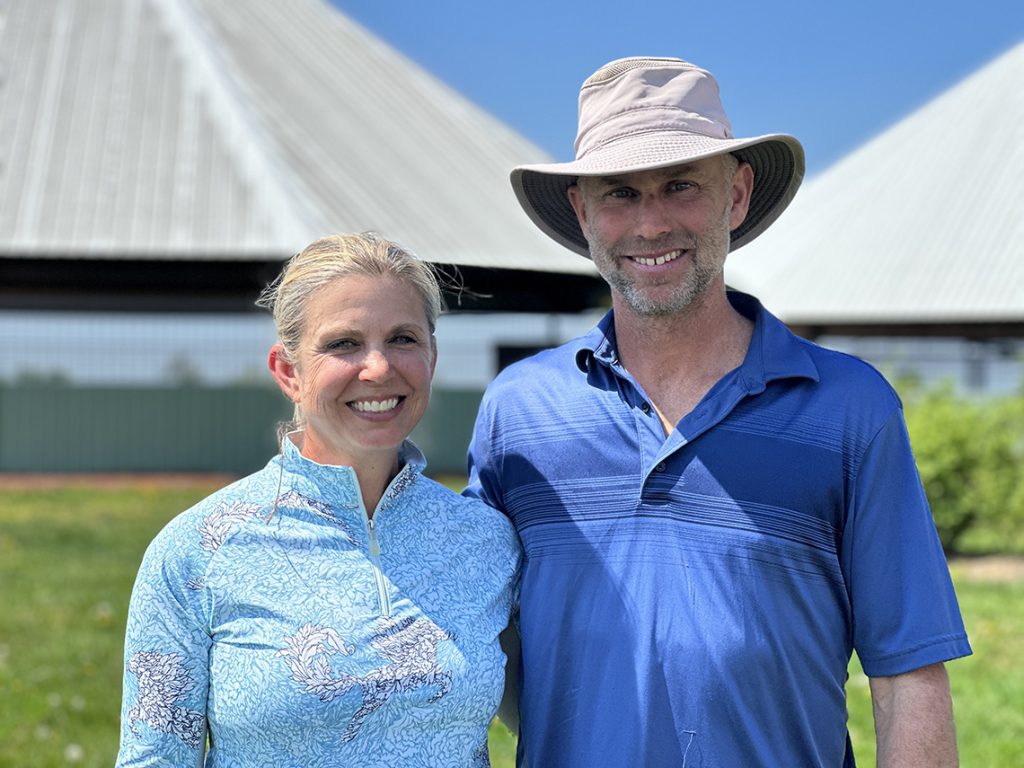
Jeannie and Nick Larkin from Wainui Farm | Sue Finley photo
That was two years ago, and today Courtney remains a diligent employee at Wainui Farm near Paris, Kentucky. He has seized his one chance.
It has been a long and winding road. His dream had been to be a jockey, like his dad. But he fell into bad company on the racetrack and, trying to keep his weight down, became dependent on cocaine.
“I can't count the jockeys I got high with in the parking lot,” Courtney admits. “I was at Ellis Park, living in the tack room on the backside. My dad had brought a rider in, he called me over there and I couldn't believe it, all these guys sitting there doing their thing right before the race. Next day my dad's horse got beat in a photo finish and he said, 'What were you on?!' It was the jockey that couldn't finish, not the horse.
“A lot of bad stuff went on at the racetrack in the 80s and 90s. I've been everywhere. River Downs, Latonia, Beulah. If I stayed in one place too long, I would get in trouble and had to go on the road again.”
In the end, his addiction became so desperate that he held up a series of motels. He was sentenced to 10 years for armed robbery.
“I didn't hurt anybody,” he stresses. “But let me tell you, doesn't matter how often you see it on TV, when you're in that courtroom and your final judgement comes, and you're looking around and see people that you love and they can't do anything for you, and then they put you in handcuffs and walk you through that door, and it bangs shut behind you, it's scary. You're thinking, 'Wait a minute, is this really happening?'”
And the following years, similarly, introduced him to all the nightmares of prison life. For the first five and a half years he was in a high-security prison, his brutalization measured by a transformation of the 90lbs track rider into 270lbs of misery, barely able to tie his laces.
“They turned me into an animal,” he says. “They put me in this cage, shut the door, walked away, leaving me to fend for myself. Because of my crime, having a weapon, I was classified as violent. So they wouldn't let me go into any rehab, which is what I needed.”
He came out believing that the system had no true interest in reformation, when reoffending would only lock in profit for prison operators. He was grateful, however, to complete his time at the low-security Blackburn Correctional Complex near Lexington, and to excel in the TRF program there. Nonetheless the lack of solid pathways back into society, at that time, left anyone with his history all too vulnerable to relapse.
“I've been good, though, I haven't been back,” he says. “But I was bad when I first come home, I was lost. My dad and my brother both died on me while I was in the joint. I came home and everything I knew was gone. Nobody would hire me. And this is all I know how to do.” He gestures at the barns. “I can't even wash dishes. For two years I tried to find a job. Sometimes I'd get hired but at the end of the [first] day they'd call me in the office and say, 'Well, Mr. Courtney, you're a convicted felon and we run tours here: we can't have you in the barn, out in public.' There was always some excuse.
“Statistically, you will go back. About 80 percent do. Some of them I saw come in three times. And that little gap, between being released and trying to find where you fit in, you get mad, you get frustrated, you try to relieve it with drugs or alcohol, and then it just spirals.”
As things have turned out, however, his love of horses has now restored the trapdoor it opened in his youth–thanks to the intervention of Laurie Mays at the Kentucky Chamber of Commerce. As project manager of the Agriculture and Equine Talent Pipeline, Mays was determined to dovetail a labor crisis on Bluegrass farms with a route back into society for released prisoners. Those plans were still evolving when she put Courtney in touch with Larkin and her husband Nick at Wainui Farm.
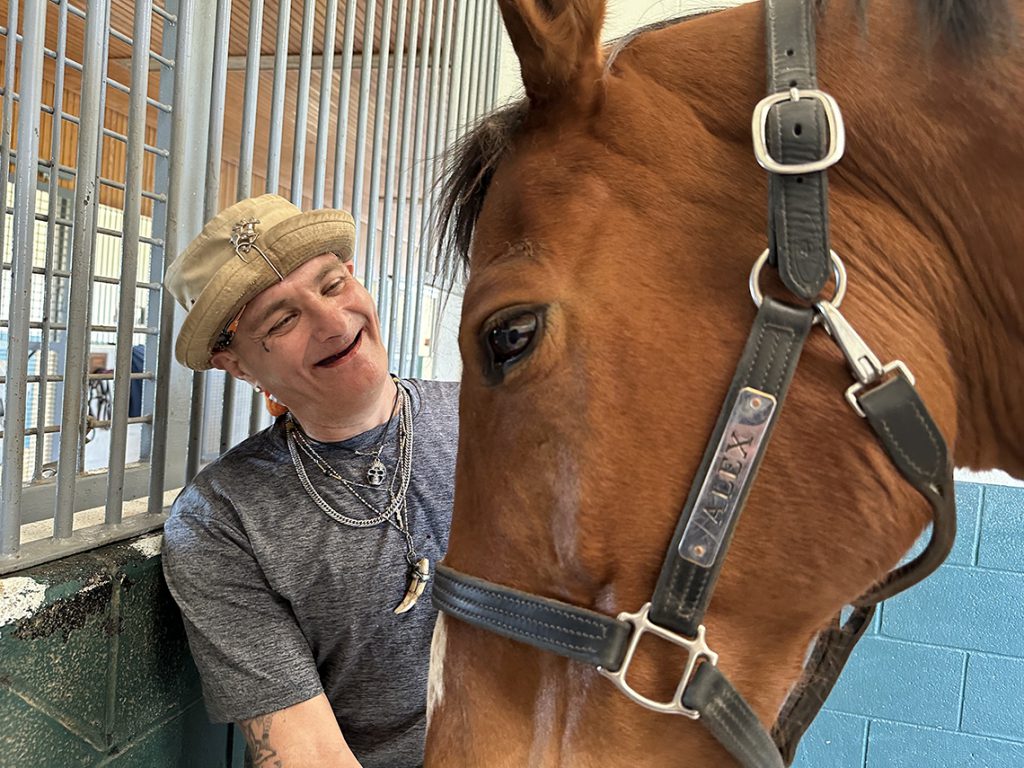
Chris Courtney in the stall with `Alex' | Sue Finley photo
“We've had a farm for over 20 years,” Larkin says. “And we've had a lot of people come through and work for us. And I have to say it's just a handful that have truly cared about the horses. We've had highly educated people wanting to do horses, people with PhDs. But compassion and caring is what it really comes down to. And Chris has a natural ability. Even from a distance he can look at a horse and see when something's wrong. From the start, he was somebody we could depend on. We trusted him immediately. He's been through a lot, but we're just looking to the future, and beautiful days with the horses.”
“I thank God every day that Miss Jeannie trusts me to be out here,” Courtney says. “I mean, look at this!” He surveys the rolling paddocks, the shades of green altering with the breeze, and laughs. “I'm being paid right now! Can you believe that? I ought to be paying them. I came through that gate and have been here ever since. I never had a job this long in my life. I'm 50 years old, and sometimes I've had three jobs in a week. I'm happy every day I come here. I feel my heart full. They've taught me to be human again.”
He relates how another troubled creature, a mare named Miss Cocoa, had also found sanctuary on the farm about a month previously.
“She was a really nervous one,” he says. “She'd pace and work herself up in a frenzy. But she has finally started to come around. And today I walked through the field and said, 'Hey, Cocoa.' And she raised her head up and started walking towards me, paid no attention to the other horses, came over on her own. And I told Miss Jeannie, 'You know what, that's the moment in a horseman's life when you know you got that horse. This is 'my' horse: she's comfortable, she trusts me, and I trust her.”
The parallels are too obvious to require stating. The question is whether these redemption tales, the kind that united Miss Cocoa and her groom, could be emulated elsewhere? After all, this is an industry nearly as lacking in skilled and willing labor as Chris Courtney had been lacking opportunities to provide just that.
'It's about Breaking down That Stigma'
The fervent ambition of Mays, back at the Kentucky Chamber, is that people sharing this kind of odyssey might now find their path to a brighter future better signposted.
“We now have a pipeline from Blackburn straight into the industry,” she explains. “Whereas Chris came in a roundabout way, now we work very specifically with the instructor and the warden to make sure when guys are coming out, we know exactly where they're going.”
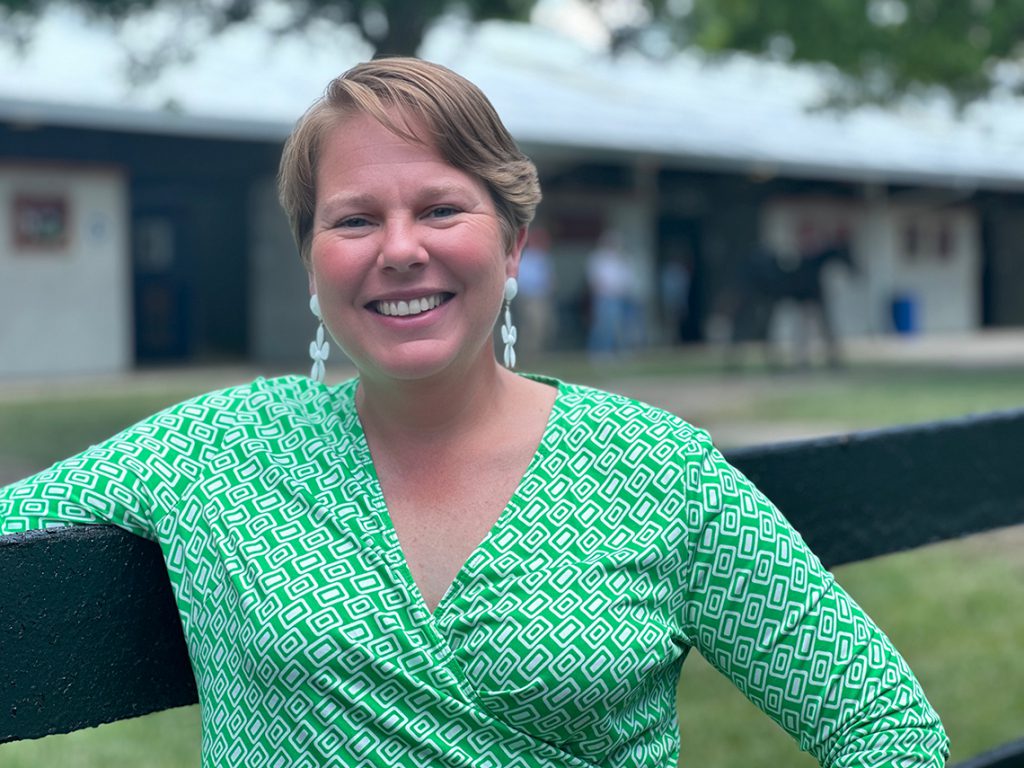
Laurie Mays | Sue Finley photo
Many who enter the TRF program at Blackburn have no previous experience with horses; nor will they tend to know a great deal about the surrounding region and its premier industry. At the same time, many potential employers know little more about the program than they might have glimpsed from the interstate. So a connection had to be fostered from both sides.
“Within the prison system, we help with resumé writing, cover letters, interview skills,” Mays says. “A lot of gentlemen, if they've worked jobs before, maybe in manufacturing or construction, don't know how their skills transfer into the equine industry.
“And then on the flip side, we educate. Oftentimes, they've hired people with a criminal record, but they've not done it on purpose. So we're helping them figure out how to be good employers.
How can you support that population? A lot of times, these justice-involved individuals come out with needs outside of the scope of work. Housing. Transportation. If they're in any type of recovery program because of a substance-use disorder, how can employers support their recovery so that they are the best employee that they can be?”
Though Covid delayed things, the next initiative was to invite potential employers to visit the program.
“Employers would tour the facility, and basically do working interviews with the guys, they could see their skills,” Mays explains. “Once employers could put faces to stories, it was a lot easier. It wasn't just 'an inmate', it was 'Steven'. And that really helped with the stigma we had seen in the industry.”
Mays liaises with the prison's re-entry co-ordinator and equine instructor. When they advise her of an inmate nearing release, with an interest in offering the industry the skills he has acquired (and these may be in masonry or maintenance, for instance, as well as in the equine program), she will circulate his details to potential interviewers. These employers can either come to the campus or interview remotely.
“Our goal is that they're hired before they leave Blackburn,” Mays says. “That way, when we know they're going to a certain farm, we can then work with the re-entry coordinator to make sure they have housing, transportation and all of the things that might present as barriers. Our goal is for them to start work within three days of release.”
This is only one of several channels–others include high schools and foster care–opened by the Chamber to supply a labor deficiency in the agricultural sector. But it's proving so successful that the model is now being adopted by other prisons at a higher level of security. Numbers have so far been relatively low, but should keep growing along with the confidence of employers. Over 70 released prisoners have now been placed, so far without a single report of recidivism.
To promote empathy among potential employers, for those leaving prison and/or addiction rehab, the Chamber offers a re-entry simulation.
“All employers are given an identity of someone who's just been released from incarceration,” Mays explains. “And you have all these things you have to do within a certain time limit, and with a certain amount of money. That way employers truly understand what justice-involved individuals are up against, and it really is eye-opening. Employers finally understand why this population often fails, because the deck is stacked is against them.
“A lot of the guys have been incarcerated for a very long time. And to go from 20, 25 years' incarceration, to being out and about within an hour is scary, and hard. A lot of prep work needs to be done. Just grocery shopping can be very overwhelming.”
Some employers have responded by maintaining zero tolerance on failed drug tests while also assisting entry into recovery programs, for instance, or with legal consequences.
Stable Recovery pairs people in recovery with jobs in the equine industry | Stable Recovery
“And so the employers are helping employees to navigate the system,” Mays says. “Employers will say, 'You can come back to us [once clean] and there will be a job here for you.' This support significantly increases the likelihood of success in recovery, and opens the door for the return of a valued employee. So that learning curve, on the employer side, is really helping to alleviate the `one-and-done' mentality. They see the barriers this population faces.”
Mays has gathered 45 farms into her Thoroughbred collective: a solid base, if still only a fraction of the Bluegrass total. But they extend from small family outfits to some of the biggest in the business, and the word should continue to spread as success stories proliferate. Farms that have embraced the program, moreover, tend to make themselves available to mentor those nervous about doing so.
“I think there's been a culture shift,” Mays adds. “It's been about breaking down the stigma. Over the last 18 months, we've seen a huge uptick in involved employers. Because a) they're desperate, and b) they're starting to really understand the benefits of hiring this population, and that it's doable. But I'll be honest, it's an upward climb.”
Because the reality is that there will, of course, be failures. Not every story ends with everyone living happily ever after. “You are going to have people that relapse or recidivate,” Mays acknowledges. “But that doesn't mean they're a lost cause.”
Often the best outcomes reflect best practice. One large show-jumping farm has promoted a Blackburn graduate to professional groom, but had to match his exceptional competence with exceptional commitment. They worked with parole officers, to allow him to accompany horses out of the state, and diverted a portion of his pay into a savings account to fund the purchase of a car.
The one environment of which the program remains wary is the racetrack, which tends to be too volatile for those vulnerable in early recovery. But farms and veterinary clinics have given purpose and engagement to many troubled characters trying to retrieve a foothold in society. Mays says that studies demonstrate a huge reduction in reoffending among those who secure not just a job, but “meaningful” employment. And the key player here, very often, is the horse itself.
“We talk with the guys all the time about how horses have helped them with trust, empathy and understanding responsibility,” Mays says. “A lot of them will tell you, 'I don't trust anybody because of my history and my background, and I was never responsible for anything.' But having been assigned horses, program attendees have to work as a team, with the horses and each other. They build a lot of interpersonal skills that they didn't have before.”
The point is that farms are short of “help” when that is precisely what some of these people could really use. Mays is trying to bring those needs together. But if the Bluegrass community needs to hear the same message from one of its own, then they do not have far to seek. Because one of its premier farms has launched an exemplary rehab program, from the ground up, through a tremendous commitment of both moral and financial resources.
'The Best Thing I've Ever Been Involved In'
“There's been literally miracles happen,” Frank Taylor says. “Guys that would be dead. Guys reunited with their families. A bunch that are now employable and sober. I didn't even dream it could go as well as it has.”
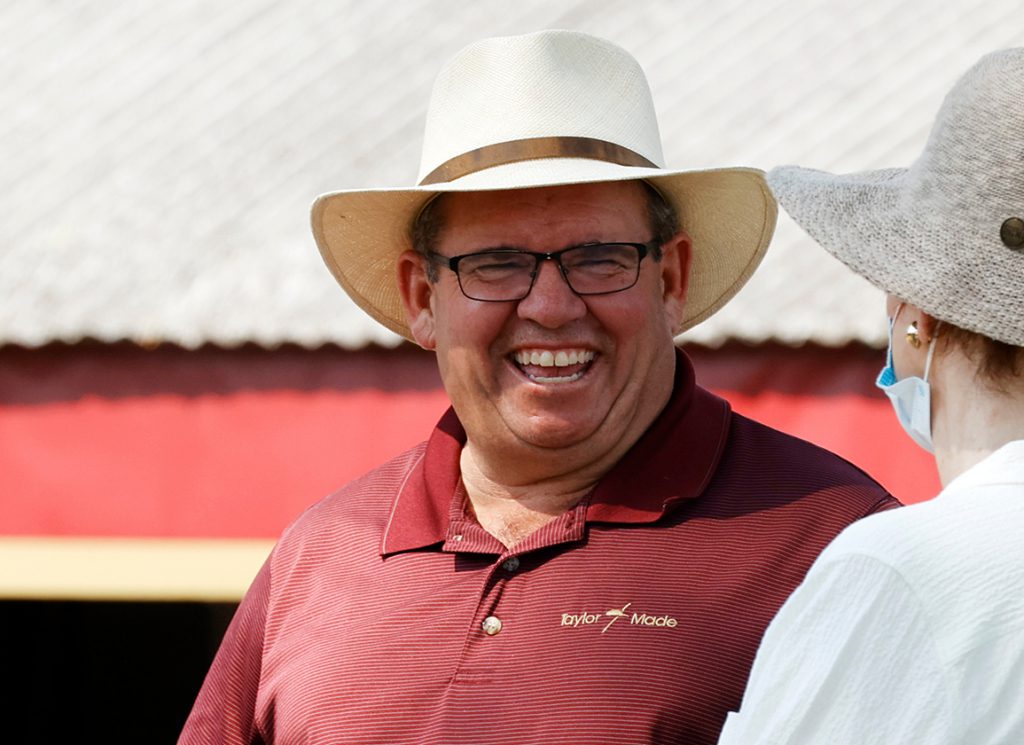
Frank Taylor | Keeneland photo
With the cooperation of his brothers, since 2021 Taylor has helped as many as 40 recovering addicts back onto an even keel through their Stable Recovery program at Taylor Made. At the moment, he has 20 housed together in downtown Lexington, with another dozen sharing a smart residence on the farm.
Responding to a chastening challenge within his family environment, two and a half years ago, Taylor renounced the bottle himself and reset his whole lifestyle. And he resolved to match this spiritual renewal with a hugely practical walking of the walk.
On the one hand, like so many others, Taylor and his brothers were finding it increasingly difficult to hire reliable help. They did muster a score of “super people, very hard workers” through the H2A Visa program. But then Taylor went to see Rob Perez, whose two DV8 Kitchens in Lexington are staffed by recovering addicts.
“What do you think?” Taylor asked. “Could this work in the horse business? Tell me what you've learned doing this.”
Perez replied that you do it, first and foremost, because it's the right thing to do. Other fulfilments, notably finding yourself a useful employee, are incidental. And he warned that there would be a lot of groundwork. DV8 starts with 90 days' training, half of which is spent patching things up: hauling people to doctors, dentists, lawyers, parole officers.
“But Rob said that once you get somebody through that fire, you'll find they start to develop all the characteristics you look for in an employee or team member,” Taylor explains. “They're honest, loyal, hardworking, grateful, and they work well with others. And I've found that to be totally true. When you bring these guys together, it forms a brotherhood like nothing I've ever seen.”
Stable Recovery addresses the exact same gap highlighted by Chris Courtney and Laurie Mays. Because even when addicts manage the resolution and good fortune to get onto a 30-day detox, they will often drop straight off a ledge once back out in the world.
The Taylors started by dovetailing their School of Horsemanship with the work of Shepherd's House in Lexington, but Stable Recovery only came together once they hired Christian Countzler.
“He was a coal miner and then a soldier,” Taylor relates. “Went to Afghanistan and Iraq, saw a lot of bad stuff. Got into addiction. That took over his life, he lost his family, his wife, his finances. He lived under a bridge here in Lexington for four years. And then he went to Shepherd's House and got sober there. That was five years ago, and now that's what he lives for: to help people get sober, and stay sober.”
The Taylors put Countzler in charge of a program they were bankrolling at arm's length. It was to have financial independence: there would be no Taylor on the board, which instead recruited the likes of Dan Pride from Darley and former University of Kentucky quarterback Freddie Maggard. This was not to be perceived as any kind of private benefit, for the farm, but something that other donors could get behind.
Anybody who comes to Stable Recovery has made a vital first step. They have admitted to themselves that they're in a corner, and need to be lifted out. They start with the detox, gathering basic tools of recovery. But then comes the game-changer: a structure, a navigable path.
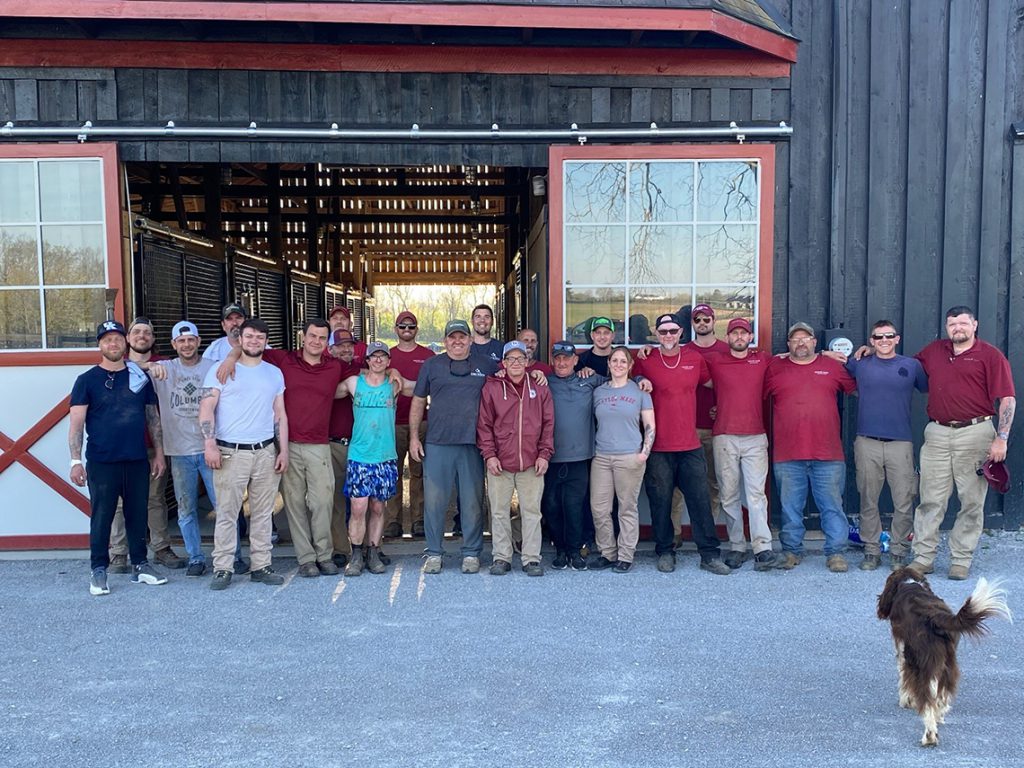
The Stable Recovery Workers at Taylor Made | Stable Recovery
“In Stable Recovery, they're around people that are trying to do the exact same thing as them, 24/7,” Taylor explains. “Now, the first 90 days they're going to all these appointments, doctors, therapists. So we only work them about 30 or 40 hours a week. But once they've gotten through all that, they start their typical day at 5 a.m. They make their beds, their rooms have to be spotless. They get something to eat, and have to be ready for an AA meeting in the house at 6.15 a.m. And then, 6.50 a.m., everybody hits the barns. They work until 4 p.m. and then come back, do chores, eat dinner. Then usually they have another meeting, and by that time they're ready for sleep.”
In other words, no free time. No idle hands for which the devil might make work. They do get a chance to lie in, every week or so, just to avoid burnout. But otherwise they don't leave those tramlines. There's sweat, but not the sweats. Countzler sets unsparing standards, and knows how to dish out a military bawling. He won't abide a bad apple. But so long as his guys are putting it all in, they'll be tired but safe.
“The other thing, in their first 90 days, is that they can never go anywhere without another guy,” Taylor adds. “So it's a buddy system. You can't go off to the store or do something by yourself. What's great is that when you can get somebody sober, the only way they can stay sober is by helping another person get sober. So if you get one sober, and he gets 10 sober, and they each get 10 sober, you can start changing this.”
Nobody pays a dime until they get a paycheck. Once they're getting their minimum 15 bucks an hour, they pay $160 a week for board, lodging, utilities, some clothing. Taylor belongs firmly in the school that you don't give a man fish to eat but instead teach him how to use a rod. But he's animated primarily by his faith, and a Christian duty to those in need.
“I think if everybody woke up in the morning and said, 'What can I do to make this world better?' and then took action on doing that, this place would turn around pretty quickly,” he says. “Not overnight, maybe, but pretty quickly.”
As it is, he's distressed to see young people in the thrall of fentanyl; and incensed by the greed that has nourished opioid addiction.
“The way I acted, when I was young, I might not have made it if I'd been born in this time period,” he says. “But look, the thing is that 70 to 80 percent of the people in jail got there because of addiction. And then you take how much it costs to keep a prisoner, when you're just housing them, not rehabbing them. What if you shifted all those funds into a bunch of things like this?
“What we're doing, the government ought to do. Because basically we're taking people that have become criminals on the dole, because they're addicted; we're getting them off the stuff; and we're making them employable. Now they're taxpayers. They go from costing $50,000 a year to paying $15-20,000. And they'll raise better kids too.”
Everyone on the program has started work at Taylor Made but several have graduated elsewhere: a couple placed at Spy Coast, a couple at Rood and Riddle, one at Darley. And Taylor wants them to aim high. One of the first on the program had never been anywhere near a horse in his life. He turned out to be a natural.
“And now he's a broodmare divisional manager for us,” Taylor says. “He's making a good salary plus utilities, car, insurance and a place to live. And his kids are moving out of inner-city Lexington. So it's just awesome to see that. And I've another guy that took over my maintenance, did the same thing.”
When he meets resistance from industry peers, Taylor tells them straight. “Basically, when you're hiring at that groom level, you're not going to get some Harvard graduate come in there,” he argues. “And basically the group you're hiring from is composed of two people: the ones that are addicted and not treated, and the ones that are addicted and treated.”
Okay, that might be overstating the situation. But if you're anything like the Taylor brothers, who toiled so hard to get where they are today, you definitely want someone that works as hard as you do.
True, when Taylor first proposed mining this unpromising seam of labor, there was pushback even from his brothers: “What if somebody ODs out here? What if they kill a horse? What if they steal everything?” And he replied: “Yeah, but what if you save somebody's life? Or get a family reunited?”
Recently they had a bunch of their guys in a winner's circle and counted up something like 37 felonies in the picture.
“But I trust those guys, I really do,” Taylor says. “They feel so good when they actually start working, start doing something positive. And then we haven't even talked about the secret ingredient in the whole operation. Because it is amazing how therapeutic those horses are. When you see these guys, down and out, in bad shape, and then they get to handle a horse? As they say, there's something about the outside of a horse that's good for the inside of a man. We've got all these things, but then, boom, put the horse in there, it's like icing on the cake.”
That should resonate across an industry with many affluent participants and patrons. As Taylor says, addiction is today so prevalent that he doesn't know one person whose life hasn't been in some way affected, through family or friends. Some donors have already supplemented the Taylors' own contribution, which was recently boosted by a six-figure dividend from the John Hall Memorial golf day, staged for the farm's late yearling manager. But Taylor believes that funding is all that prevents exponential growth of this venture.
“If we had the housing and the money, we could have 150 to 200 in the program in 60 days,” he avows. “I've been dreaming big. In five or 10 years from now, you could have a Stable Recovery with 100 people at Belmont Park, 100 at Churchill, 100 in Ocala. And starting in Ireland, England, all over the world. I think it just works so well and, if you can keep the human tendency to screw up out of it, and stay focused on what God wants done, I think it will grow like that. I just think it's a no-brainer. And it's a no-brainer for anybody trying to build a workforce. Our taxes are paying able-bodied people not to not work, and that's crazy.”
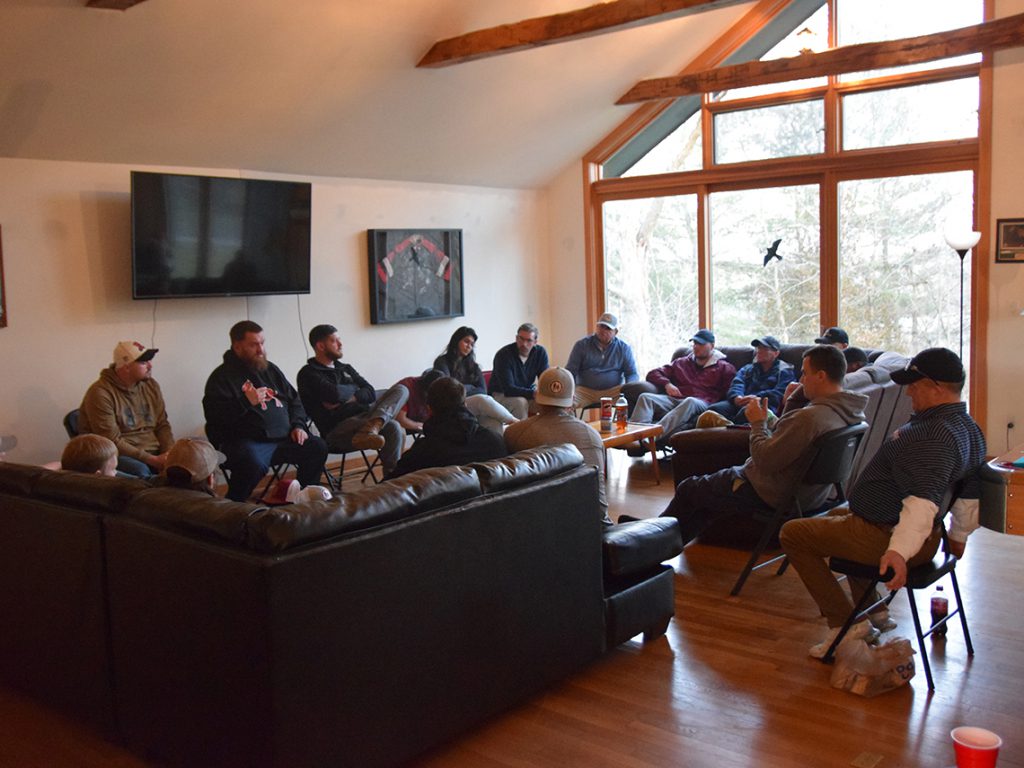
A meeting at Stable Recovery | Stable Recovery
Not everyone who enters the program will walk out the door as another miracle. Taylor remembers one tragic case: couldn't see it through, went away and drank himself to death. But even he bequeathed moments of enrichment.
“We're all sitting around this campfire, the sun's coming up,” Taylor recalls. “We're talking about how you don't need to be judging other people. And he goes, 'You ever heard that saying, that you need to walk a mile in a man's shoes before you judge him? Well, I think that's great. Because at least you're a mile away from that sonofabitch–and you got his shoes.'”
Taylor's laughter is laced with sorrow. But overall he is astounded at the extent and degree of reformation his program is achieving. He refuses any credit, instead reproaching himself that he should have tried something like this decades ago.
“This is literally the best thing that I've ever been involved in,” he says. “These guys, I love them. I mean, they've become so close to me. If you hear their stories, and what they have been through, to see them come out of it, see the joy and happiness, man, it really is awesome.
“There's one guy in there, he's been addicted for 32 years. Drugs, alcohol, everything. Had a good family, grandkids, lost it all. For 32 years he's been in and out, hadn't been able to do anything. Now he's been sober 10 months, he's earning a good living, and he's a model employee. He is now running one of the recovery houses and helping a lot of men get and stay sober. He's spiritually strong, he's made a connection with God, he's a totally different person. And the other day, while we're out there working, out of the blue he comes up and gives me a big hug and says, 'Thank you for saving my life.' And you sell a horse for $10 million, it's not even close to what that means.”
The post `They’ve Taught Me To Be Human Again’ appeared first on TDN | Thoroughbred Daily News | Horse Racing News, Results and Video | Thoroughbred Breeding and Auctions.