Proposed Berkeley City Council Ordinance Threat To Golden Gate Fields

A proposed Berkeley City Council ordinance has been introduced that, if passed into law, would put Golden Gate Fields' future in serious jeopardy.

The proposed ordinance makes it illegal to keep a horse stabled for more than 10 hours a day and requires that every horse has access to a minimum of one-half acre pasture turnout.

While reaffirming state and federal laws surrounding animal abuse and cruelty, the proposed ordinance also makes it a crime to conduct training and racing under a “reasonable expectation” that it could substantially injure or harm the animal.

“Such reasonable belief would be based upon substantial evidence, which may include, without limitation, the animal's physical condition, indicia of pain or suffering, musculoskeletal limitations, age or other relevant factors,” the ordinance states.

“Obviously we're concerned,” said Craig Fravel, chief executive officer at 1/ST Racing and Gaming, a company under The Stronach Group (TSG) umbrella, which owns Golden Gate Fields.

Fravel said that he was alerted to the ordinance on Friday. As such, TSG has not yet had a chance to conduct a legal analysis of the ordinance, or to plot a clear response, he said.

“I'm not going to over-react at this point, and just try to be constructive in our approach,” said Fravel. “There will be some time to engage and I think educate people on our safety record and our protocols and efforts that we go through.”

The proposed ordinance, introduced by Berkeley City councilmember Kate Harrison, has been referred to the Council Health and Life Enrichment Committee for hearings. The ordinance would need a recommendation from the committee before being taken up by the Berkeley City Council.

Harrison declined an interview, saying that she was on vacation. Harrison added, however, that she would discuss the proposed ordinance when committee discussions begin.

The nine-page proposed ordinance is specifically focused on horseracing and excludes other facilities within city limits where animals are housed, including animal rescue and adoption agencies.

It makes, however, several glaring misrepresentations and distortions of the Thoroughbred racing industry. This includes an erroneous suggestion that Thoroughbred racehorses, on average, live to only three to five years of age.

“Many fatalities in horseracing are euthanizations after horses suffer catastrophic injuries, cutting their lives unnaturally short,” the ordinance states. “When CBS Bay Area reported on the most recent horse death at GGF in May of this year it cited the fact that 'live into their 30s, but the average age of is [only] three to five years old.'”

The ordinance also states that “horse deaths continue to rise at the horse racing tracks within City limits.”

According to the Jockey Club Equine Injury Database, race-day equine fatalities are declining nationwide. Last year saw the lowest statistical equine fatality rate since 2009, when record keeping began–1.29 fatalities per 1000 starts.

When it comes to Golden Gate Fields, the track's equine fatality rate has been consistently below the national average since 2017. Last year, the rate was 0.56 fatalities per 1000 starts–a number less than half the national average.

“I'd like to push back pretty solidly against some of the suppositions,” said Scott Chaney, executive director of the California Horse Racing Board (CHRB), who added that the CHRB is “aware and certainly concerned” about the ordinance.
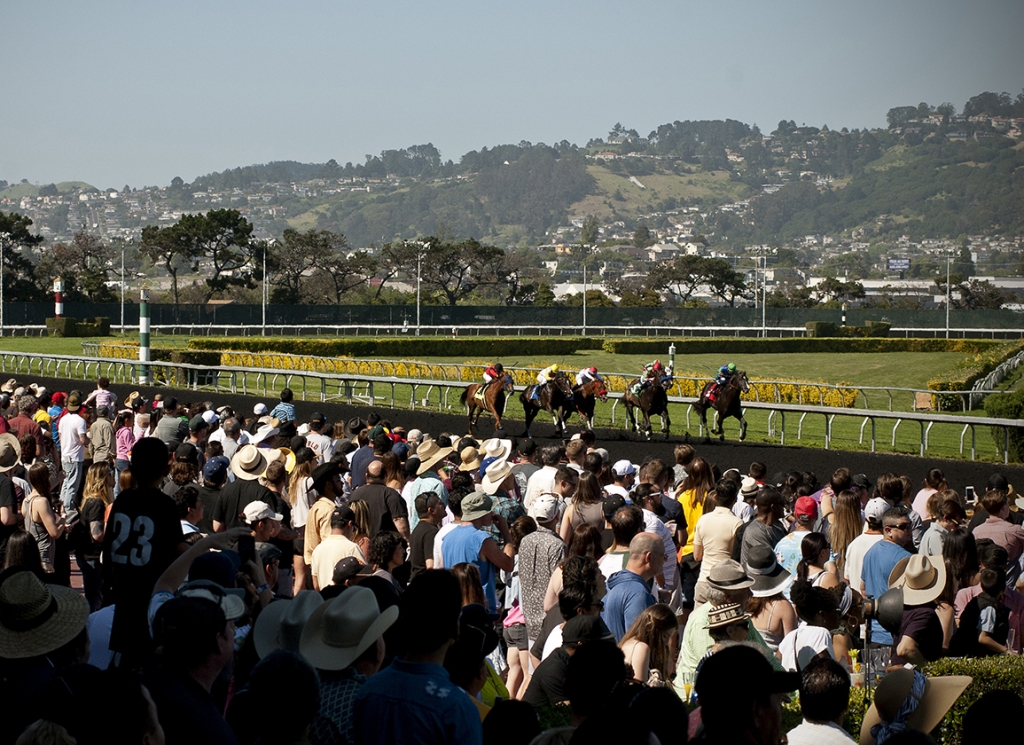
Golden Gate Fields | Vassar Photography

“Fatalities are not on the rise at Golden Gate Fields. The opposite is true,” said Chaney. “And while it is true that racehorses generally race from three to five, that is not their average life expectancy.”

The ordinance argues that the City of Berkeley, a charter city, has the legal authority to “establish regulations” and the jurisdiction to “protect and promote the public health, safety and welfare by establishing safeguards for animals” as long as those regulations don't conflict with state and federal law.

“It is in the public interest to adopt an ordinance prohibiting inhumane or abusive treatment of animals held, owned, used, exhibited or otherwise kept for sport, entertainment or profit within the City limits,” the ordinance states.

Chaney is less sure of the city's ability to establish such a law. “I believe that there would be some major legal hurdles in attempting to pass such a thing,” said Chaney.

He added, however, that the CHRB hasn't yet conducted a thorough legal analysis of the proposed ordinance to identify what those legal obstacles might be.

One possible hurdle would presumably concern how Golden Gate Fields straddles two adjacent cities, Berkeley and Albany.

The ordinance outlines a set of tough penalties, beginning with minimum fines of $5,000 per animal, per violation, per day, or imprisonment for periods between 30 days and one year.

In explanation of the proposed requirement to provide racehorses access to open pastures for a good portion of the day, the ordinance argues that how colic, laminitis, and pleuropneumonia are issues worsened by excessive confinement.

“Confining a 1200-pound animal to a 12×12 stall is akin to confining an elephant to a box car or a killer whale to a swimming pool. Equine veterinarian, Dr. Kraig Kulikowski, compared this to locking a child in a 4×4 closet for 23 hours a day, abuse punishable by law,” the ordinance states.

In recent years, Golden Gate Fields has found itself the target of animal rights activists.

In March of 2021, protestors disrupted racing by running onto the track before lying in a circle with interlocking pipes.

The protestors belonged to animal rights organization, Direct Action Everywhere, which seeks to see Golden Gate Fields shut down.

The post Proposed Berkeley City Council Ordinance Threat To Golden Gate Fields appeared first on TDN | Thoroughbred Daily News | Horse Racing News, Results and Video | Thoroughbred Breeding and Auctions.

Source of original post

Wong Suspended for Metformin; `Our Game Has Been Hijacked’ Says Attorney

by Sue Finley and Stefanie Grimm

The Horseracing Integrity and Welfare Unit has provisionally suspended trainer Jonathan Wong after one of his horses tested positive for a banned substance last month.

Heaven and Earth (Gormley) broke her maiden at Indiana Grand June 1 but subsequently tested positive for the prescription drug metformin, a type 2 diabetes treatment.

Wong was notified that his horses will need to be moved to the care of another trainer and potentially faces up to a two-year suspension and a $25,000 fine.

While metformin is a permitted medication by the U. S. Anti-Doping Agency (USADA) for humans in athletic competition, the National Institutes of Health published a study indicating it has an effect on athletic performance. In a study of 10 men, they determined that “time to exhaustion was significantly higher after metformin than placebo ingestion,” and that “metformin improved performance and anaerobic alactic contribution during high-intensity exercise.”

Wesley Ward is currently serving a 15-day suspension for a metformin positive in a July 15, 2022 race at Monmouth. His attorney, Drew Mollica, said that the Monmouth stewards did not impose a significant fine or suspension because they agreed the metformin positive was the result of contamination.

Wong has retained attorney Alan Pincus.

“Jonathan Wong has a prescription for metformin,” he said. “It is one of the most widely prescribed drugs for humans with diabetes. He uses it, and apparently, he inadvertently contaminated his horse. So they give him the notice yesterday, on a holiday weekend, you're out of horse racing. `Get rid of your horses.' We have requested a split sample and a provisional hearing, but since you're not allowed the data pack from the lab until the split comes back, it makes it very difficult. In fact, their whole system makes it very difficult.”

On Thursday, the TDN published a report saying that HISA had temporarily suspended full enforcement of their intra-articular joint injections rules. Under HISA's rules as written, trainers are prohibited from giving their horse intra-articular joint injections within 14 days prior to the post-time of a race, and within seven days prior to any timed and reported workout. According to HISA Chief Executive Lisa Lazarus, between 15 and 20 trainers have breached the rule surrounding intra-articular joint injections prior to a workout. The reason HISA decided to temporarily modify its enforcement of the rule was due to “confusion” among trainers about the specifics of the rules related to workouts, Lazarus said.

“It's a nightmare,” he continued. “It's unconstitutional. It's unfair. And our game has been hijacked by a bunch of know-nothings posing like they know what they're doing. Lisa Lazarus waved her mighty hand and told 20 trainers who have violated the intra-articular injection rule, `I'm going to let you go.' Even though there is nothing in the regulations allowing her to do so. I imagine when the names of those people come (public), there will be some pretty privileged people. But unfortunately, Jonathan Wong is not one of them. She said the trainers were confused. But confusion is not a defense to strip liability. It's hypocritical. It's not in the regulations, and it just shows they don't know what they're doing. None of it makes sense. And no one will say `boo.' ”

Pincus said that this was the second such case he has had.

“The first one I had was Mario Dominguez,” said Pincus. Dominguez's horse Petulant Delight tested positive for cobalt May 24 at Parx. “Cobalt and the old ARCI guidelines calls it a positive at 25 parts per billion, but since cobalt is in all horses at all times, they say if you have between 25 and 49 parts per billion, the trainer should just get a warning letter. Unfortunately for Mario, if it had happened three days earlier, he gets a warning, but (now), he's thrown out of racing. They give you the notice. You're out. Horses have to be transferred to a new trainer that has nothing to do with you. You lose your owners. You lose your stalls and you lose your livelihood.”

In Dominguez's case, Pincus said that Dominguez asked for a split sample and was asked to send $2,000. He said seven months earlier, Pincus had a case where the same split sample was $750. “So the gouging begins,” said. “He is indigent, and they took away his only means of support, and like most trainers he's living month to month.” He said that Pincus had been unable to afford the fees for the provisional hearing, and had been asked for over $4,000 for the hearing. “They have put a monetary barrier toward someone getting due process,” he said. “We are now 19 days in, and he has not been charged with anything.”

Pincus said that the lack of due process “sickens” him.

“You take a person who has worked their whole life. They're not out there robbing a 7-11. They're out there working seven days a week to try to build something. You're telling me that some person comes to you on a holiday weekend and says `good luck in your next career.' You've not been charged with anything. You have something that would have resulted in some small penalty–as well as it should. But it's going to happen more and more and more, but the idea that you let your friends off because they were confused? It sickens me. This is the game I have been in my whole life. They're an occupying force, and no one will stand up to them. But (trainers) are playing Russian roulette every time they go to the test barn.”

The post Wong Suspended for Metformin; `Our Game Has Been Hijacked’ Says Attorney appeared first on TDN | Thoroughbred Daily News | Horse Racing News, Results and Video | Thoroughbred Breeding and Auctions.

Source of original post

Spendthrift Keeps Options Open For GSW Kingsbarns

GII Louisiana Derby winner Kingsbarns (Uncle Mo) remains a possibility for either the GII Jim Dandy July 29 at Saratoga Race Course or the previous week's GI Haskell S. at Monmouth Park said Spendthrift Farm's general manager Ned Toffey.

“We're freshening him a little bit, keeping some options open,” Toffey said. “There's the Haskell and the Jim Dandy and we'll look at those, but we'll talk with [trainer] Todd [Pletcher] and just keep things open. Obviously, it gets pretty tough with fewer spots for these good 3-year-olds. You won't find too many soft spots. We still think he's a nice horse and he should move forward off his last race.”

The post Spendthrift Keeps Options Open For GSW Kingsbarns appeared first on TDN | Thoroughbred Daily News | Horse Racing News, Results and Video | Thoroughbred Breeding and Auctions.

Source of original post

CHRB Reports Safety Measures Continue To Protect Horses

California horse racing again experienced a significant decline in the number of horses that died from injuries suffered during racing and training at the state's facilities during the 2022-23 fiscal year that ended June 30, the California Horse Racing Board (CHRB) said in a press release on Saturday.

A total of 26 died last year as a result of musculoskeletal injuries that occurred while racing or training, compared with 39 the previous year. For context, approximately 30,000 race starts and far in excess of 100,000 workouts occur each year from 8,000 to 10,000 horses at CHRB regulated facilities.

“That's still too many fatalities, but it shows that all of the new regulations, policies and procedures that that we've introduced in cooperation with the industry have had a significant effect,” said CHRB Chairman Greg Ferraro. “Our efforts are focused primarily on preventable injuries, and that's what the numbers reflect. I don't know of any racing jurisdiction in the country that even comes close to matching this effort or result.”

In the interest of full transparency, the CHRB also tracks fatalities caused by any non-exercise-related catastrophic injury. The most common cause of death in this other group is gastro-intestinal diseases, such as colic, colitis, and enteritis, followed by respiratory disease. Unfortunately, the number of “other” deaths increased last year, and those 43 deaths, coupled with the 26 due to musculoskeletal injuries, brought the total to 69, or three more than the 66 from the previous year.

“I've considered several times the idea of not counting other deaths, the type that occur among horse populations anywhere in the world, including the popular riding stables and in the wild, but I've always decided that full transparency is the best way to go,” said CHRB Executive Director Scott Chaney.

Those 43 other deaths occurred despite care and treatment by on-site veterinarians and specialized equipment located in stable areas.

“Six of those horses were transported to the veterinary hospital at the University of California, Davis, as well as other local referral hospitals, where experts did their best to save them,” said Dr. Jeff Blea, the CHRB equine medical director. “Illnesses such as severe colic, advanced neurologic cases, and obscure medical conditions, sometimes just are not treatable, as animal and horse owners throughout the world know from personal experience.”

For further context, equine fatalities at CHRB-regulated facilities have declined by 54 percent since 2019, including the “other” category.


The post CHRB Reports Safety Measures Continue To Protect Horses appeared first on TDN | Thoroughbred Daily News | Horse Racing News, Results and Video | Thoroughbred Breeding and Auctions.

Source of original post

Verified by MonsterInsights