Even a horse on the end of a chain can be a conveyance to horizons without end. At Keeneland last week, Mandy Pope's equine journey reached a fresh milestone: five seven-figure yearlings sold from Whisper Hill Farm in Book I. But the road remains the same as the one she stumbled across in a neighboring yard at four years of age.
“We lived in a small farming town in North Carolina, outside of Raleigh,” Pope recalls. “People there were still using horses to plow their fields. And there was this gray that lived across the street. He would be out on this long chain, so he could move around. My brothers scooted him over to our driveway wall so that I could get on him. And they just turned me loose. I just sat on the horse, no bridle or anything, and stayed there until someone came and got me off. And that was pretty much start of it. Probably the gray thing, too!”
Such was the spark that ultimately ignited a program conspicuous for a fearless emphasis on quality over quantity. If a blazing new cycle opened in 2012, with the $10 million purchase of Horse of the Year Havre de Grace (Saint Liam), then last week represented an unmistakable moment of validation—and with poignant timing, too, Pope having lost Havre de Grace this spring at just 16. But the point is that even the high-staking commercial priorities of her Thoroughbred business today still hinge on one woman's connection with the animal itself. Complementing a determination to make her mark as an astute businesswoman in a male-dominated environment, that connection unites her first ponies to those elite mares that have introduced Pope, in her understated way, to wider attention and responsibility–as, for instance, in her recent election to The Jockey Club.
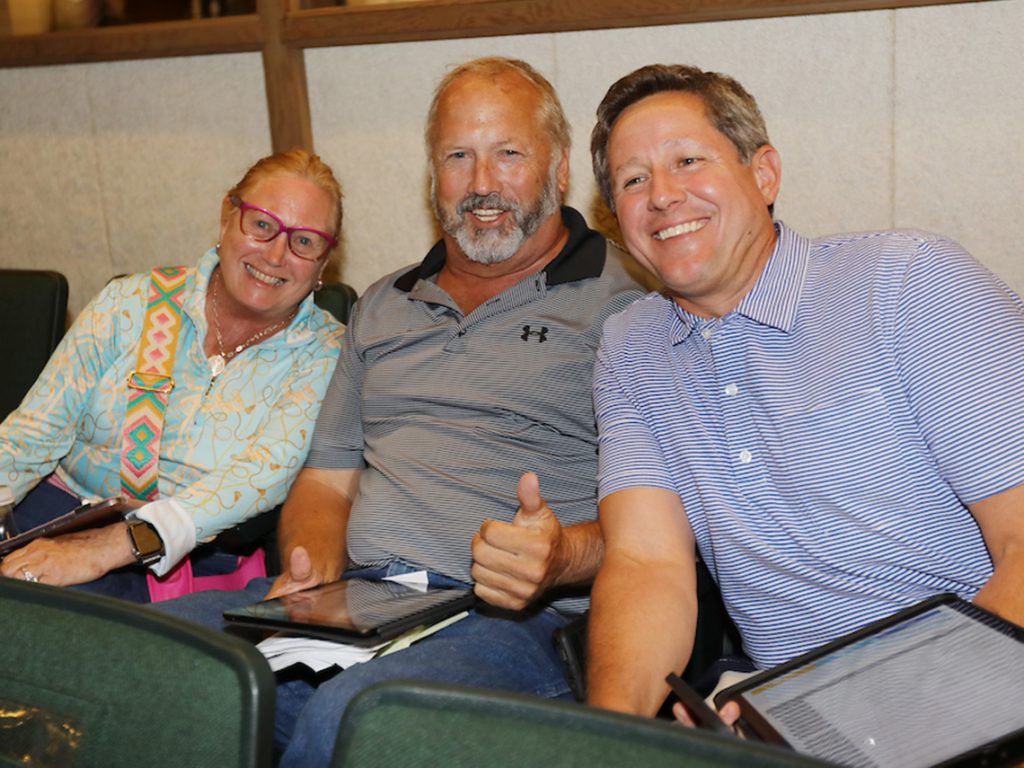
Mandy Pope, Todd Quast, and Brian Graves at the Keeneland September Yearling Sale | Keeneland photo
Obviously, other resources have been essential: the funds accrued through the Pope family business, Variety Wholesalers; the skills of Todd Quast, as general manager and farm trainer. But the dividends increasingly commensurate with Pope's investment–and with her determination to build a broodmare band both profitable and lastingly influential–could never have been achieved, without that abiding core of empathy.
“Any horse could pull you around, knock you over, walk all over top of you,” Pope remarks. “But you work out this communication. It's amazing what these horses do for us. You walk them into a starting gate, which is totally beyond their comprehension. These are flight animals, they don't want to be cooped up in those things. Same with an aqua tread, all the wild stuff that we do with them. But they have so much trust in you, that you're not going to put them in a bad situation; and we have so much trust in them, that they are just going to do what we ask. And most will do it with a happy face. Not all, but most.
“I was always more of a horse person, not a people person. They were my 'people.' You could just take off and ride and nothing else mattered at that moment, but the peacefulness and trust that you have together. Even if you're showing, or jumping, or on a fox hunt, it's always something you're doing together; it's tranquility away from everything else going on in your life and in the world.”
By the same token, there's a bittersweet undertone even to a sale as spectacular as this one. Yes, it was rewarding in every sense of the word: both financially, and in terms of market acknowledgement of an audacious business strategy. But it's always hard to say goodbye, even to a young horse—albeit nothing like as grievous as the annual cull of fringe mares, essential to the sustainability of the model.

“It can be very emotional seeing horses go, and there are times I get a little hesitant,” Pope admits. “It's hardest with mares, because we're so attached to them. That's done only with a very heavy heart. But if we do end up with a yearling coming back, we're not disheartened. We always feel we still have a legitimate possibility of a racehorse.”
Few from this farm will nowadays fail to find a buyer. And while Pope has required the same patience as every breeder lower down the pyramid, she has reached a stage where the foals are starting to make financial sense of the significant capital investment made in their dams.
A perfect example of the way the program is maturing is Lady Take Charge (War Front), purchased as a weanling at the 2015 Keeneland November Sale for $3.2 million. She never made it to the racetrack. A pity, but not a disaster. For last week her colt by Tapit [202] brought $1.3 million–and she's obviously still a young mare.
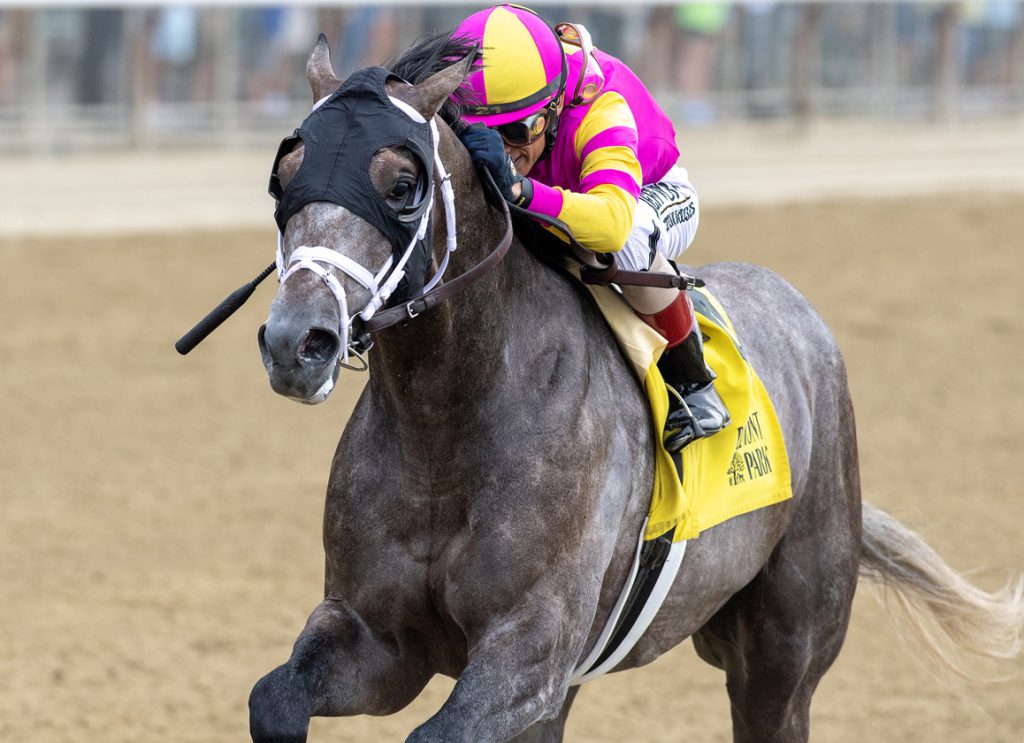
Charge It | Sarah Andrew
Her acquisition, moreover, had represented a doubling down on her illustrious dam Take Charge Lady (Dehere). Pope had already given $2.2 million for the blue hen's daughter by Indian Charlie at the 2012 Keeneland September Sale. I'll Take Charge managed only a maiden win in a light career, but now she too is quickly paying her way. Having already produced Charge It (Tapit), who was retained for the racetrack division and won the GII Suburban S. this summer, last week I'll Take Charge sold her Into Mischief colt for $1.7 million [162]. Other seven-figure dividends were meanwhile set against the expensive purchase as breeding prospects of American Gal (Concord Point), Magical World (Distorted Humor) and champion Songbird (Medaglia d'Oro).
It's not a strategy for the faint-hearted, but it is plainly coming together.
“We are in this as a business, and trying to make money,” Pope stresses. “We've been very lucky this year, but it's not just luck. A lot of thought, work, and planning went into this. The luck comes with what God created, and gave you, to start the process. There are so many variables we can't control: how they grow, veterinary issues, X-rays, throats. But if we can get to the sale with the pedigree, the conformation and the X-rays, then hopefully the buyers are going to gather.”
So far as things do fall within control, then, Pope has been determined to breed to the best to get the best. After all, a $5,000 mare takes no less to maintain than a $5 million one.
“Exactly,” Pope says. “That's been my whole point for the last several years. It costs the same to take care of the mare, costs the same to raise the foal. But statistically you have a higher probability of a big sales horse, and also of a graded stakes winner, from these more expensive mares and breedings. It costs the same to train them, too. Everything is the same, other than what you're paying for the mare and the stud fee.”
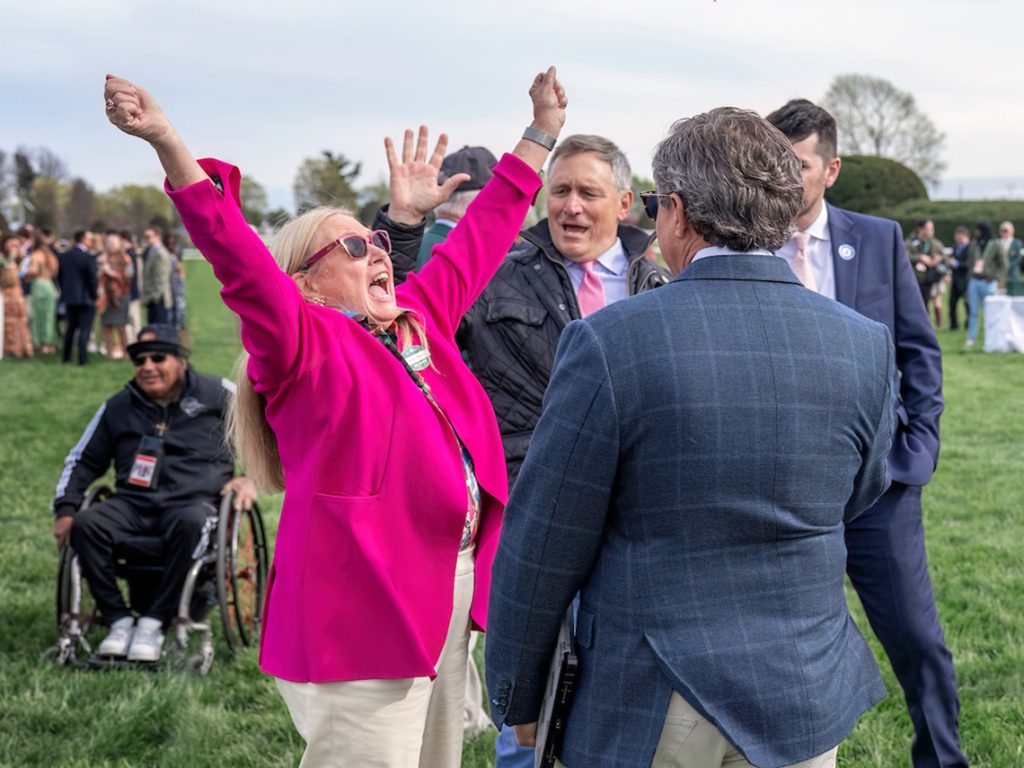
Mandy Pope Celebrates Tapit Trice's Bluegrass victory | Coady photo
So, when people ask Pope why she doesn't seek safety in numbers, buying 10 or 20 mares for the same headline cost as one or two, she sees a false economy.
“To me, the financial risk would be even greater,” she explains. “Doing it this way, you always have the next generation as back-up. If one of those hits it big, that can make everything work out.”
Havre de Grace herself was a paragon of pedigree plus performance: her third dam, remember, is Toll Booth (Buckpasser). And that quality will linger in the blood even if misfortune might cause it to lie dormant for a generation.
“Some of those more expensive mares, like Havre de Grace, only have one graded stakes winner,” she says. “But several of their other foals had talent and then got injured. That's going to happen. But the fillies can still put half her genes into it, when they're bred. And statistically, again, a lot of breeding theory has shown that even if these big racemares don't reproduce themselves in the first generation, it's going to show up in the second.”
Among the young producers now coming onstream are Doll Collection (Tapit), out of dual Breeders' Cup winner Groupie Doll (Bowman's Band), and Havre de Grace's daughter Heavenly Grace (Tapit). And Pope evidently has similar hopes for daughters of Plum Pretty (Medaglia d'Oro), acquired for $4.2 million at Keeneland the same fall that Pope broke the broodmare record for Havre de Grace.
“She's another whose daughters are now having these gorgeous babies,” Pope says. “And they'll be coming on the market in the next year or so. So even though it may not always look good right away, it's about generational planning; about continuing to multiply, and hopefully getting better and better.”
Such a bold strategy, of course, brings challenges as well as privileges to those charged with its execution. For while every foal slithering into the Whisper Hill straw is an aristocrat, each must learn how to deal with roughneck opposition on the track. Quast and farm manager Lynda Hayes duly strive for an appropriate balance.
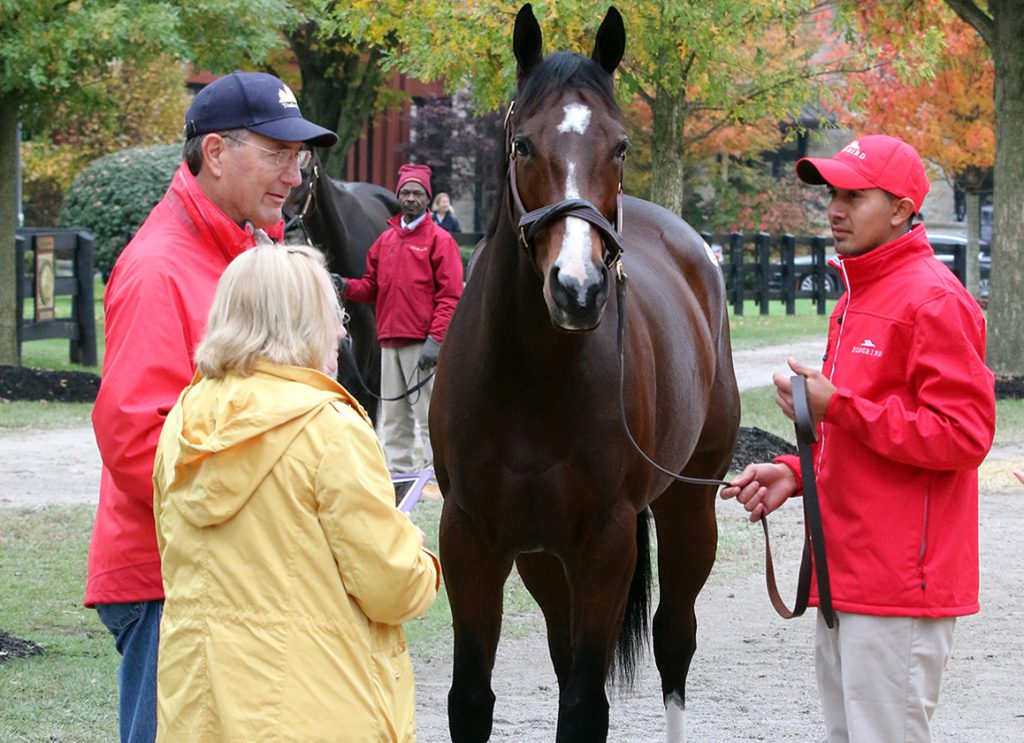
Songbird with Mandy Pope | Fasig-Tipton
“Turned out, you're going to maybe lose one, or one's going to get a bump,” says Quast. “But they've got to be a horse. They've got to develop that pecking order, just like any lower caliber horse. Mandy's really big on that. They come in, temperatures checked, food check later, and then they get to go out and be a horse. Hotboxing them, you don't get the same bone and ligament development. We have the pedigree, and we're not going to mess that up by bubble-wrapping them.”
The same logic is still more pertinent to the early training. Having educated three Kentucky Derby winners during 11 years with D. Wayne Lukas in his heyday, followed by a long stint at Gold Mark, Quast knows that the best will only emerge if treated the same as the rest.
“They don't know if they're a $10,000 claimer or next Horse of the Year,” Quast says. “You can't say, 'Oh, no, I can't do this because he's out of Songbird.' And conversely you don't push another horse just because he's not by Tapit.
“So, we have a way of doing it. My guy at the farm, Lee Guerrero, has been with me for 32 years: all the way through Wayne, all the way to this. And we're lucky enough that our average crew has been there about 15 years. We keep track of it all, and Lee tells me we're up to 4,887 horses that we broke together. That's a number! If you don't learn something through all those horses, there's something wrong.”
Pope met Quast just as she was upgrading her program, in 2012, moving a first handful of novices to his supervision at Gold Mark. She partnered with that operation in Classic-placed Mylute (Midnight Lute)–gray, of course–and in 2019 invited Quast aboard full-time.
“Gold Mark was a great job,” Quast emphasizes. “But I had three stallions, I was foaling 60 mares, I trained 160 head. And I had an 8-year-old son. Mandy and I always had a good relationship, professionally and personally, and we said, 'All right, let's do this.' She already had the farm, and we found a training center, got it up to what we felt was our caliber.
“Lynda's doing a fantastic job, too, and has people underneath her that have also been there forever. Everybody's gelled as a team, and that's what it takes. It's a lot of work, it's long hours, but we're having a lot of fun.”
Pope and Quast both stress the role of Dr. Greg BonenClark as principal vet to both farm and training center, besides assisting at the sales. And here, too, there has been evolution, with Pope's Bluegrass presence now increasingly focused on Gainesway. Pope stresses her debt to Timbertown, but explains that Wayne Sweezey was winding down somewhat just as her own program was entering overdrive. Pope speaks with enthusiasm about Brian Graves and his team, who board most of the mares and raise the stock until weaned and sent to Florida.
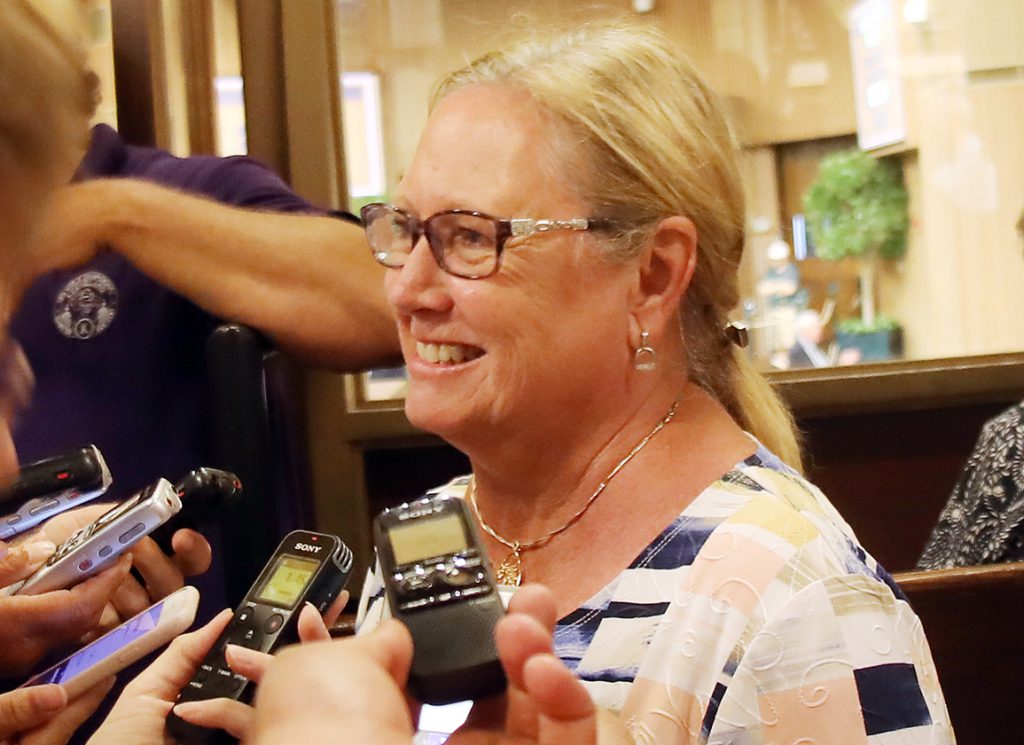
Mandy Pope | Keeneland
One way or another, it feels as though a maturing regime is picking up pace. Among the first graduates of the training center are Charge It and Tapit Trice (Tapit), who took Pope to the last two runnings of the GI Kentucky Derby. And, while nobody spending this kind of money will qualify as underdog, the scale of Pope's program actually remains fairly conservative.
Quast reckons that Whisper Hill produces about 35 foals annually. With retentions largely determined by fate–through market rejection or setbacks–and supplemented by maybe half a dozen purchases, that boils down to around 20 at the racetrack. Charge It, however, was always one of those too cherished to sell, and the team is adamant that he can seal his stud pitch with a Grade I.
Pope has been on his sire's train virtually since it left the station—and not just because of that gray coat.
“When we moved a bunch of our mares over to Gainesway, they had them divided up in two fields,” she says. “And going out there we were like, 'It's snowing! Look at all the white out there!” Because it's Tapit, Tapit, Tapit. I just always had a lot of belief in him, and he has treated us well.
“I loved his breeding and, starting off, when he stood for less money and got those kind of mares, a lot of his progeny were displaying a good turn of foot, some were sprinters. And then, as he's grown, he's gotten better and better mares that are throwing the distance, which he also has in his pedigree. So, I think you're getting stamina with a turn of foot combined. They're multifunctional. We've had some that wanted five-and-a-half on the grass.”
But Tapit's rival Into Mischief certainly served the cause well last week, accounting for three of those seven-figure sales. And he is also sire of perhaps the most precious animal on the farm: the orphaned colt raised by a foster mare after the death of Havre de Grace.
How typical of this game, that the symbol of new ambition should have been lost even as it neared fulfilment! The nadir, however, remains the breakdown in 2021 of America's Joy (American Pharoah), the $8.2 million half-sister to Into Mischief.
“Oh, it was absolutely devastating,” acknowledges Pope. “I thank God that I was not there that day, but Todd was.”
“We lost Mandy for 10 days, maybe two weeks,” Quast recalls. “I couldn't talk to her. Left her alone. Oh, it was horrific. I'll never forget. Just an easy breeze. No rhyme or reason to it. We feel every and any loss, but that was very emotional. Great reports all the way through, she'd outworked all these nice colts, and then something like that happens. Making a call like that is not the good part of my job, for sure. Mandy took it very hard and rightly so.”
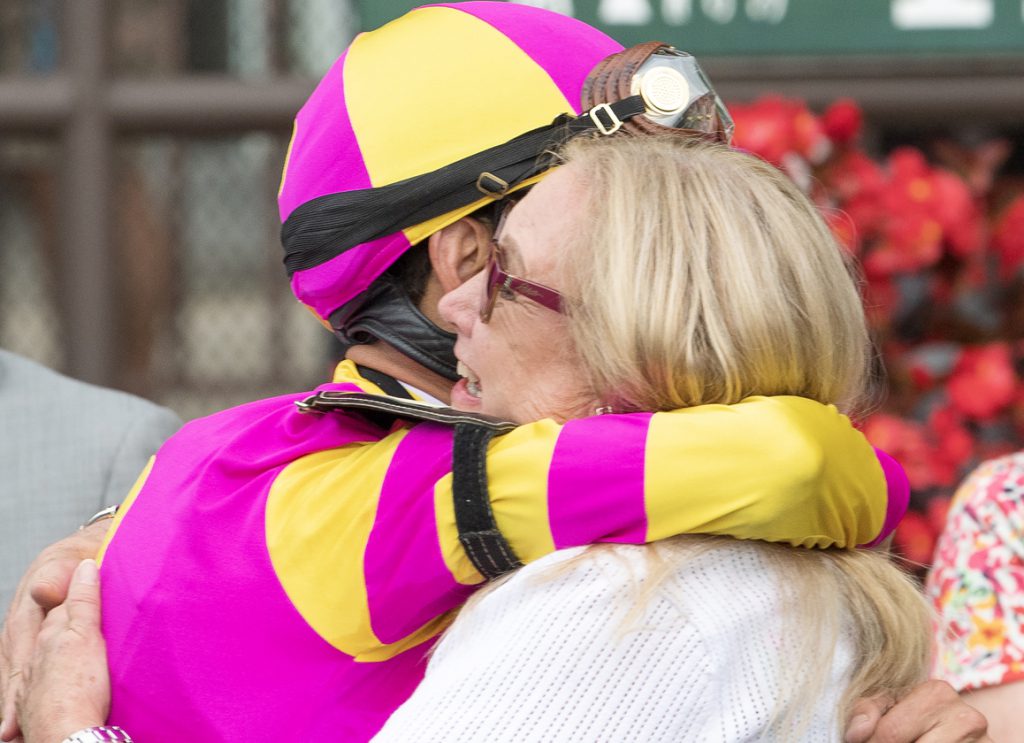
Mandy Pope and John Velazquez | Sarah Andrew
Pope is uncomfortable with the word “legacy,” in that she does not aspire to some lauded personal imprint on the breed. Like all good breeders, she sooner has a sense of trusteeship or stewardship. “It's about what gets passed down to generations that will be here long after I'm gone,” she says. “It's a long process and you just want to know that you've done everything right: both in taking care of them, and in what you're trying to achieve for your business plan.”
“It takes time to build the legacy: 10, 15, 20 years,” Quast agrees. “But Mandy's not a flash in the pan. And it's all starting to work out. It was tough getting to this level, but it's paying off now.”
As such, Keeneland felt like a real landmark: vindication for the gradual evolution of what feels a uniquely bold model for commercial viability.
“Absolutely,” Pope affirms. “Especially with the racing over the past couple of years. It's been an amazing year. I'm just a small, one-person band. I have no partners in the farm at all. It's a battle because people will put me up with some of those great names–Stonestreet, Winstar, Spendthrift–and I'm not in the same caliber at all. I mean, gosh, they'll have, I don't know, 200 mares. And partnerships everywhere. But it does feel like it's starting to pan out.
“I was in the business a long time before Havre de Grace, buying less expensive mares. At the time that was all I could afford, and that was a tough business. When I started buying those [top] mares, yes, everything changed. My mindset changed. I wanted to do the best quality job we could, buying and raising and training, and to get to the top.”
Yet it all still circles back to her girlhood, to that inexpressible frisson she discovered with a gray horse in the adjacent yard. There is still nothing Pope values more than petting horses at pasture.
“Oh, absolutely,” she says. “And when they're running, I always go up to the saddling paddock and pat them on their head and neck and say, 'May God be with you. Stay safe. And win!' In that order. But yes, it's been a wonderful year. Knock on wood, we're blessed that all our hard work is showing. You can't sit on your laurels. This year's success is going to put a lot of pressure on us, to keep it going. But we're up to the challenge. It took a very long time to get here–and hopefully we can stay for a bit longer.”

The post Keeneland Breeder Spotlight: Mandy Pope’s Whisper Hill Turning Up The Volume appeared first on TDN | Thoroughbred Daily News | Horse Racing News, Results and Video | Thoroughbred Breeding and Auctions.
Source of original post
