Jonathan Sheppard, a Hall of Fame trainer whose horses excelled on the dirt, on turf and over steeplechase fences, will retire from American horse racing, but will continue to train a small stable in Ireland, he announced Monday morning.
Sheppard, who turned 80 last month, won every race and prize worth winning in American steeplechase racing over a 56-year career. He is the National Steeplechase Association’s all-time leading trainer by wins (1,242) and purse earnings ($24,902,442). He has been the champion trainer by wins 26 times, and he has led the sport by purses in 29 years, both records.
He also had the distinction of winning a race at Saratoga Race Course in 47 straight years through 2015.
He has won 15 Eclipse Awards, behind only D. Wayne Lukas and Bob Baffert, and his 11 individual Eclipse Award winners have included two Hall of Fame members, Augustin Stables’ Cafe Prince and Flatterer, the four-time champion (1983-1986) who was bred by Sheppard and William Pape, a longtime client and partner. Sheppard was inducted into the National Museum of Racing’s Hall of Fame in Saratoga Springs, NY, in 1990.
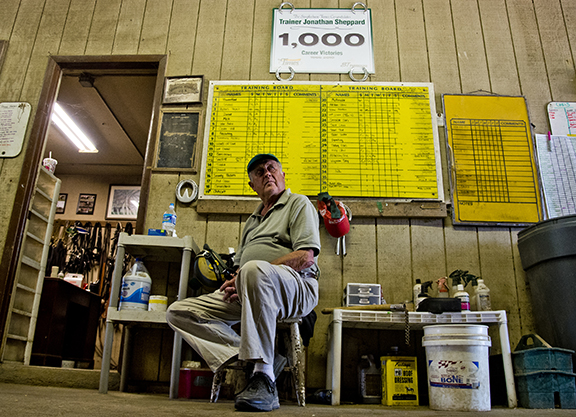
Sheppard in his Ashwell Stables Office | Eclipse Sportswire
Also among Sheppard’s Eclipse winners were Forever Together (Belong to Me), the 2008 female turf champion, and Informed Decision (Monarchos), the champion female sprinter the following year. Both were owned by George Strawbridge Jr.’s Augustin Stable. He also trained William T. Young’s Storm Cat, a Grade I winner who became America’s foremost stallion in the 1990s.
Over the years, Sheppard has provided leadership to the steeplechase sport. He served as the NSA’s president from 2004 to 2006 and received the sport’s highest honor, the F. Ambrose Clark Award, in 2013.
He also has provided leadership in other ways. Throughout his career, he has been the go-to interview for race meets looking to provide media stories that were positive, honest, and easy to understand. With the late Jack Van Berg, he has been an innovator in marshalling large training stables similar to those in his native England.
He also has participated in groundbreaking research projects with the University of Pennsylvania’s New Bolton Center, not far from his training base in West Grove, PA, approximately 35 miles west of Philadelphia. Throughout his career, he has strived successfully to bring new owners into Thoroughbred racing.
His impact on the sport has continued to today. His most recent champion, in 2019, was Hudson River Farms’ Winston C (Ire), now in training in Ireland, and he won the steeplechase trainer titles by wins and purse earnings in the recently concluded 2020 season.
“People undoubtedly will ask why I am retiring now,” Sheppard said. “There’s no one single reason, and the reasons combined to say that now was the time to step back from American racing. I always wanted to go out on top, and the past year’s championships checked that box.
“I had a flare-up of my Lyme Disease last year that kept me away from the horses and the races. It’s in remission now, but in fairness to my owners, I didn’t want to have another Lyme episode interfere with their horses’ careers. My staff at Ashwell in Pennsylvania did a marvelous job with the horses last year, but I don’t want to repeat that.
“And, I just turned 80, so it seems to be a good time to pass the reins to a younger generation here in the U.S. I’m not ready to retire completely, and that’s why I am retaining a small stable in Ireland for now.”
Jonathan E. Sheppard was born December 2, 1940, in the Hertfordshire hamlet of Ashwell, approximately 45 miles north of London. His father, Daniel, was a Jockey Club handicapper, and as a result, Sheppard was exposed to racing at an early age. For several reasons, however, a racing career in England was impossible.
Because of his father’s position, conflict-of-interest regulations prohibited him from participating under rules in England even though he was an accomplished point-to-point jockey. Beyond that, he had neither the financial resources nor the connections to train in England or France.
After completing his education at Eton, he proved conclusively to himself and everyone else that he was not cut out to be a stockbroker during a stint at a brokerage firm bearing the family name.
In the early 1960s, he turned his eyes westward to the United States. He landed in the Pennsylvania operation of W. Burling Cocks, himself a future Hall of Fame member. Sheppard absorbed a knowledge of American flat and steeplechase racing, and–after a return to England and a brief period working in France’s racing center in Chantilly–came back to the U.S.
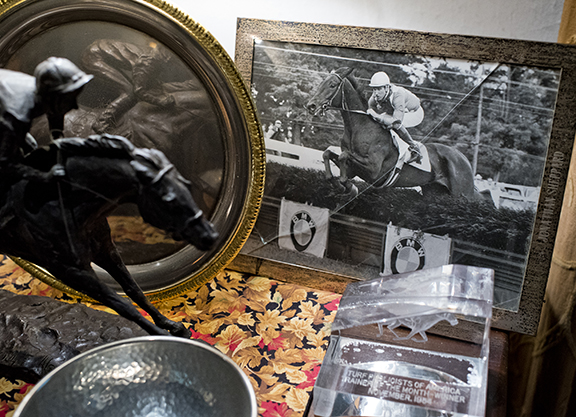
Mementos of an extraordinary career | Eclipse Sportswire
He took out his trainer’s license in 1965 and won one start on the flat that year, according to Equibase statistics. His first steeplechase winner was Redmond Stewart’s Haffaday in the 1966 John Rush Streett maiden timber race at My Lady’s Manor in Maryland. Two years later, Haffaday won the Maryland Hunt Cup for him.
Sheppard concluded 1966 with seven jumps victories and tied for seventh in the steeplechase trainer standings. The prior winter, Sheppard had met Strawbridge at an Aiken, SC, dinner, and they immediately developed a rapport. It was misfortune, rather than success, that cemented a relationship that would endure for five decades.
When one of Strawbridge’s early horses sustained a career-ending injury, Sheppard volunteered that his actions–bandages applied too tightly and improper jumping boot–—had led to the breakdown. Strawbridge said in a 1970s interview that he was impressed with Sheppard’s honesty and decided to continue their relationship. They notched their first victory together with Brandon Hill at Aqueduct in September 1966.
It was a partnership that blossomed over the following decades and took off at a turning point of American steeplechase racing. The arrival of New York off-track betting in the early 1970s led to the virtual banishment of jump racing from the metropolitan tracks. Steeplechase racing pivoted to its roots, the race meets that grew out of fox hunting and became increasingly popular as upscale community activities.
Strawbridge, a descendant of Campbell Soup Co.’s founder and a history professor, was a highly talented amateur jockey, and many of his Sheppard-trained horses were suited to the hunt meets. Augustin would become the NSA’s all-time leading owner with more than $9 million in purses and 23 annual championships from 1974 through 2005.
Sheppard won his first steeplechase title by wins in 1970 and, as racing moved away from Aqueduct and Belmont Park, his first earnings title in 1973.
The best member of the Augustin-Sheppard steeplechase team was Cafe Prince, who was bred in California by Verne Winchell and won four times over fences at three in 1973. He achieved his best form in 1977 and 1978, when he was voted Eclipse Awards as North America’s champion steeplechase horse.
Cafe Prince won the International Gold Cup at the Rolling Rock Races in Ligonier, PA, in his championship years, and he twice won the Colonial Cup in Camden, SC, in 1975 and 1977. He was elected to the Hall of Fame in 1985.
Sheppard collected his first Eclipse Award in 1973 with Athenian Idol, a $2,200 purchase who had started in Sheppard’s name in 1971. Athenian Idol missed the following season, and Sheppard offered a half-interest in him to Pape, a Long Island auto dealer who was beginning to expand his involvement in jump racing.
Athenian Idol won six times in 1973, including victories in the International Gold Cup and the Temple Gwathmey, to sew up his Eclipse Award and launch a partnership that included four more champions: Martie’s Anger in 1979, Flatterer from 1983 through 1986, Mixed Up in 2009, and Divine Fortune in 2013.
None shone brighter than Flatterer. Always frugal, Sheppard bred him with a free season to Mo Bay, a multiple stakes winner he had trained for Augustin. Sheppard and Pape also owned the mare, Horizontal, by Nade, who was a modest winner.
Flatterer was good from the start.
“He was exceptional. You know you were a part of something special while it was happening,” Sheppard told The BloodHorse‘s Esther Marr shortly after Flatterer’s death at age 35 in 2014.
At four in 1983, Flatterer sealed his first Eclipse Award by winning the steeplechase triple crown–the Grand National, Temple Gwathmey, and Colonial Cup. He would win the Colonial Cup, then a championship year-end race, three more times. He became so dominant that in 1986 he carried a record 176 pounds to victory in the National Hunt Cup in Malvern, PA.
In all, he started 52 times, won 24 of those starts, and had eight second-place finishes and five third-place finishes. Two of his best races were second-place finishes.
In 1986, Sheppard and Pape dispatched Flatterer to France for the French Champion Hurdle. The heavily watered Auteuil course was a bog, but Flatterer ran bravely to finish second, beaten five lengths. Accompanying Flatterer on that trip was assistant trainer Graham Motion, a fellow Englishman who would go on to a distinguished training career of his own.
Flatterer recovered from that grueling test to win his fourth Colonial Cup that fall. Sheppard brought him back in early spring for a shot at England’s Champion Hurdle at the 1987 Cheltenham Festival. He again finished a valiant second, beaten less than two lengths by the champion hurdler See You Then.
He came home to win the Iroquois Steeplechase in May before bowing a tendon in the Breeders’ Cup Steeplechase that fall and retiring to Pape’s Pennsylvania farm. Flatterer joined Sheppard in the Hall of Fame in 1994.
By then, it was clear that Sheppard could train any type of horse, and Kentucky businessman William Young entrusted him in 1985 with Storm Cat, a 2-year-old by the Northern Dancer stallion Storm Bird and out of the stakes-winning Secretariat mare Terlingua. The colt was foaled at Derry Meeting Farm in Pennsylvania so that Terlingua could be transported easily to Windfields Farm in Maryland to be bred to Northern Dancer.
Despite offset knees, the powerfully built Storm Cat showed he was something special by winning the Meadowlands’ GI Young America S., then one of the top juvenile stakes races, and he went off as the second favorite in the second GI Breeders’ Cup Juvenile at Aqueduct. He led by 2 1/2 lengths in the stretch, but could not resist Tasso, who won by a nose and claimed the 1985 Eclipse Award.
Storm Cat underwent surgery for knee chips over the winter, won at a moderate level at four and did not race at five. Young wanted to sell him as a stallion prospect, but Sheppard’s wife, former jockey Cathy Montgomery Sheppard, counseled Young to stand him at the owner’s Overbrook Farm in Lexington. She had frequently galloped the headstrong Storm Cat and believed he would prosper at stud.
Young changed his mind and prospered. Storm Cat became the dominant sire of his generation as well as a sire of sires, among them the prominent stallion Giant’s Causeway. Storm Cat passed along his precocity and was the leading North American sire of juveniles a record seven times.
By then, Sheppard was maintaining a schedule that would break a less committed or less competitive person. He had horses stabled at the Pennsylvania farm and horses in Camden for the winter months; he had horses at Philadelphia Park and, during its fall season, at the Meadowlands in New Jersey.
He also was an inveterate multitasker who was pulled over on occasion for reading the Daily Racing Form while driving between racetracks and the farm. His formidable intellect gathered information, processed all the data, and applied the acquired knowledge when appropriate.
No horse illustrated Sheppard’s process better than Forever Together, who was a Grade II winner at three but had a condition—a compromised ability to sweat, or anhidrosis—that limited her prospects. Sheppard remembered an old Irish remedy, Guinness Stout, and began mixing it into her feed. She began to sweat, and Sheppard moved her onto the turf, where she won three Grade 1 races and an Eclipse Award in 2008.
The following year, Sheppard accounted for two champions, Augustin’s Informed Decision as the year’s leading female sprinter and Mixed Up as the steeplechase champion. He closed out the most recent decade with two more champions, Divine Fortune and Winston C, both over fences.
Divine Fortune, in particular, provided ample evidence that, if correctly handled, a horse’s career need not end at three or four. Bred by Pape and Sheppard, Divine Fortune won his Eclipse Award at age 10, capped by a dominant victory in the Grand National (NSA G1) in New Jersey.
On the flat, Strawbridge’s homebred With Anticipation had his best seasons at age six and seven, earning more than $2.3 million over those two years.
Between the jumps and the racetrack, Sheppard has accounted for almost 21,000 starts, and he has won 3,426 races. His career earnings total $88.7 million. It has been a marvelous career, the sum total of intelligence, experience, instinct, horse knowledge and horse sense.
Charles Fenwick Jr., a retired steeplechase jockey and trainer, summarized the marvel that is Jonathan Sheppard in a 1980 interview with Sports Illustrated‘s Douglas S. Looney.
“You can’t explain brilliance,” he said.
After 56 brilliant years, Jonathan Sheppard has closed the book on his history-making American training experience.
The post Jonathan Sheppard Retires from American Racing appeared first on TDN | Thoroughbred Daily News | Horse Racing News, Results and Video | Thoroughbred Breeding and Auctions.