Hall of Fame Assistants

The relationship between trainer and assistant can often be tumultuous and fleeting, while in other instances, it can prove life-altering and enduring. And every once in a while, the spark ignites, paving the road to great glory and even the Hall of Fame.

When it was announced that trainer Todd Pletcher would be inducted into the National Museum of Racing's Hall of Fame this summer, most could not have been surprised that the 53-year-old would have been granted the honor in his very first year of eligibility. In truth, there was never really any doubt that it would happen so quickly. Having accomplished more in the last two decades than most trainers will achieve in their lifetimes, the Dallas, Texas native towers over his competition with $406 million in career earnings. In fact, he leads his nearest pursuer, fellow Hall of Famer Steve Asmussen, by a tick over $50 million even though his counterpart has started twice as many runners. Pletcher's resume is commanding: Seven Eclipse Awards as the nation's outstanding trainer; 10 Eclipse Award winning champions, and five winners of Triple Crown races. Among the plehtora of equine athletes that have helped him place seventh overall with over 5,100 career victories are Rags to Riches, Ashado, Always Dreaming, English Channel, Honey Ryder, Palace Malice, Wait a While, Fleet Indian, Shanghai Bobby, Speightstown, Super Saver, Stopchargingmaria and Uncle Mo.

While there is no guarantee for success in racing, apprenticing under some of the game's biggest names certainly couldn't have hurt. Similarly to a formidable slew of equine champions and human proteges, Pletcher hails from the formidable program of D. Wayne Lukas, who was also inducted into the great hall in his first go around in 1999. While attending the University of Arizona, Pletcher served summer stints working as a groom for Lukas at Arlington Park between his sophomore and junior years before joining another Hall of Famer, Charlie Whittingham, between his junior and senior years.

Upon his graduation, Pletcher joined Lukas's New York string in May of 1989, initially serving as foreman before being promoted to assistant in 1991. Splitting his time between New York and Florida, he managed Lukas's powerful East Coast string through 1995, and in that time, helped develop a bevy of stalwarts, including Horse of the Year Criminal Type and champions Thunder Gulch, Tabasco Cat, Open Mind, Steinlen, Serena's Song and Flanders. Lukas is responsible for 14 Classic victories, 20 Breeders' Cup wins and has trained 26 divisional titles and a trio of Horse of the Year champions. The horseman was the first trainer to reach $100 million and later the $200-million mark in career earnings. A native Antigo, Wisconsin, Lukas was the leading North American trainer in earnings 14 times. And it speaks volumes that Pletcher is one of only a handful of trainers who have been able to breath the same rarified air as his predecessor. Pletcher, who is responsible for seven Eclipse Awards and 10 earnings titles thus far, surpassed the then-leading Lukas in lifetime earnings in 2014 before going on to become the first trainer to reach the $300-million mark in 2015.

Soaring With Eagles

Whittingham would make only a brief appearance in the career of the newest Hall of Fame trainer inductee, however, the 'Bald Eagle' would have a far more meaningful influence over another future Hall of Famer. Based on the West Coast, Whittingham annexed a trio of Eclipse titles throughout his career, in addition to leading all North American trainers in earnings on seven occasions. Himself a former assistant to another Hall of Famer, Horatio Luro–best known for training Classic winner and legendary sire Northern Dancer–the Chula Vista, California native would go on to become the all-time leading trainer of stakes wins at both Hollywood Park and Santa Anita. Inducted into the Hall of Fame in 1974, he was responsible for five future Hall of Famers–Ack Ack, Cougar II, Dahlia, Flawlessly and Sunday Silence. Whittingham also guided the careers of champions Turkish Trousers, Perrault, Kennedy Road, Estrapade, Ferdinand and Miss Alleged.
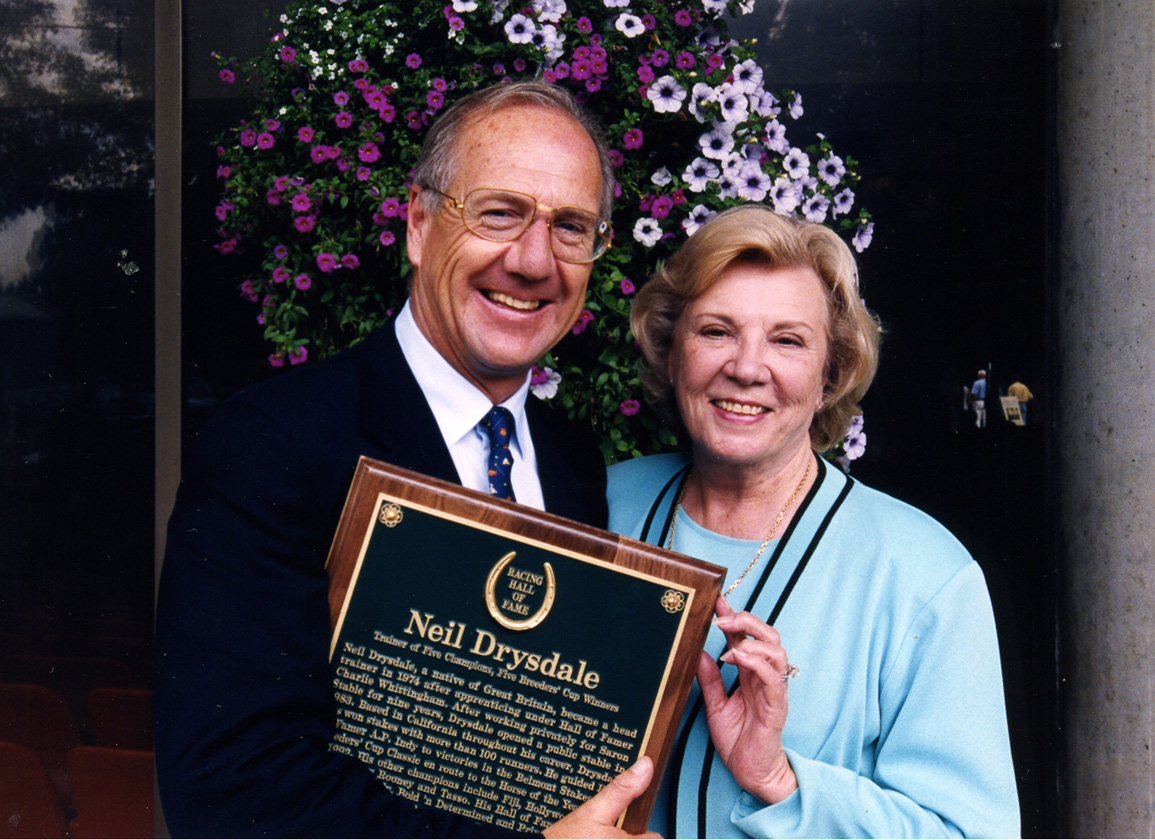
Neil Drysdale and Charlie Whittingham's wife, Peggy | National Museum of Racing and HOF

In a career that spanned 49 years, Whittingham served as a mentor to a long list of horsemen and women, and one of the most well known was English transplant, Neil Drysdale. After spending two years with John Hartigan at Tartan Farms in Ocala, Florida, Drysdale worked in Argentina and Venezuela before returning to the U.S. to serve as an assistant to Roger Laurin for two years. He subsequently joined Whittingham as an assistant for five years before going out on his own. Since launching his stable in 1975, Drysdale has trained a trio of Hall of Fame members: A.P. Indy, Princess Rooney and Bold 'n Determined. To his credit, he has won over 1,500 career victories, including the 2000 Kentucky Derby with Fusaichi Pegasus, and the Breeders' Cup on six occasions, including with champions Tasso (Juvenile) and Hollywood Wildcat (Distaff), in addition to Prized (Turf) and War Chant (Mile). Also included among his most notable runners are champion Fiji.

Jumping to Glory

Another English transplant that found success in America, Jonathan Sheppard, who received some of his early inspiration from Hall of Famer W. Burling 'Burley' Cocks (inducted in 1985), who also had a hand in the illustrious career of Hall of Famer Tom Voss (2017). Launching his stateside training career in 1965, Shepperd registered his first victory on the flat, however, he would grow into a powerful force on the American steeplechasing circuit. He led all steeplechase trainers in purses from 1973 through 1990, heading the list 29 times in total. He is also responsible for Hall of Famers Café Prince and Flatterer, in addition to champions Forever Together and Informed Decision. In 2010, he became the first trainer to win 1,000 career steeplechase races, before following up the next year by surpassing the $20-million mark in earnings. Sheppard, who was inducted in 1990, retired from racing in 2021 with 3,426 victories and earnings of $86,679,925.

Ensuring his lasting influence, the Englishman was followed into the Hall of Fame in 2009 by another steeplechase luminary, Janet E. Elliot, the only female trainer currently in the great hall. Serving as an assistant to Sheppard for 11 years, the Irish native went out on her own in 1979, and in 1991, surpassed Sheppard as the leading trainer in purses, ending the 18-year stranglehold of her mentor. Elliott's runners have earned a trio of Eclipse awards with Correggio (1996) and Flat Top (1998 and 2002). With over $8-million to her credit, she also developed 1986 Breeders' Cup Steeplechase winner Census.

Midwest Connection

Marion Van Berg dominated the Midwest, first as an owner, winning over 4,600 races, before assuming the mantle as a trainer in 1945. Leading all owners in number of victories 14 times, Van Berg was also the leading owner in money won four times. Before retiring in 1966 with 1,475 wins, the Columbus, Nebraska native saddled stakes winners Rose Bed, Knights Reward, Estacion, Rose's Gem, Spring Broker and Grand Stand. He was inducted into the Hall of Fame in 1970.
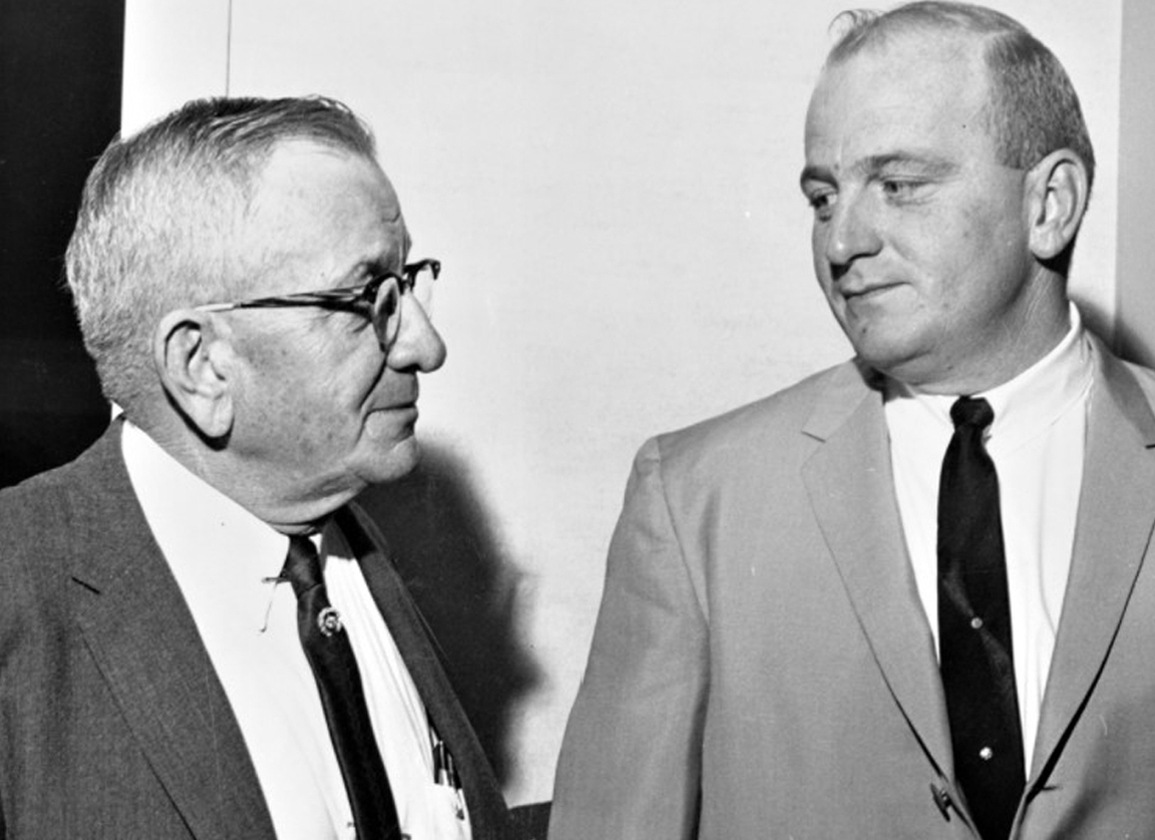
Jack and Marion Van Berg | Keeneland Library

Following his retirement from training, Van Berg's son, Jack, took over the reins, achieving even greater success than his forerunner. After sending out his first winner in 1957, the junior Van Berg was the leading trainer at Ak-Sar-Ben in Nebraska for 19 consecutive seasons, and topped all trainers by number of wins nine times between 1968 and 1986. Becoming the first trainer to win 5,000 races, Van Berg ultimately retired with 6,523 victories and purse earnings of $86 million. Joining his father in the Hall of Fame in 1985, he ranked as high as fourth in all time wins at the time of his death in 2017. Van Berg was responsible for a host of top rung winners, but was probably best known for a pair of Classic winners–Gate Dancer and Alysheba. The former won the Preakness in 1984, the year Van Berg earned the Eclipse Award training title. The latter, won the Kentucky Derby and Preakness, and came back at four to win six Grade I's, including an epic renewal of the Breeders' Cup Classic. After garnering the Eclipse Award as champion 3-year-old male in 1987, the son of Alydar was named Champion Older Male and Horse of the Year at four. He retired with a then-record $6,679,242 in earnings, surpassing the previous record of future Hall of Famer John Henry (1990).

The Van Berg stable was well established by the time a young horseman from Mobridge, South Dakota–Bill Mott–appeared on the scene. A year after joining Van Berg, Mott was promoted to assistant–alongside Frankie Brothers–and the stable enjoyed unprecedented success through the 70s, including a banner campaign in 1976 when Van Berg earned the training title at Arlington Park in addition to leading the nation with 496 wins.

After Van Berg decided to head West, Mott opted to remain in the east, launching his own public stable in 1978. Through the ensuing four decades, Mott was responsible for six champions; Theatrical, Paradise Creek, Ajina, Escena, Royal Delta and most notably, Horse of the Year Cigar, who won a tick under $10 million in earnings before his retirement. Voted the Eclipse Award trainer three times, Mott ranks sixth among all trainers with 10 Breeders' Cup victories and over $19 million in earnings. Mott set a then-record for number of wins at a single Churchill Downs meet with 54 in 1984. He was inducted into the Hall of Fame in 1998.

Creme de la Creme

In stark contrast to Lukas and Van Berg who operated two of the most expansive operations of their era, Frank Y. Whiteley Jr. commandeered a much lighter ship. However, what the Maryland native lacked in breadth, he more than made up for in brilliance and talent. Through a career that spanned five decades, he trained 35 stakes winners, although is best known for his quartet of champions. Arguably the most famous of the group is Ruffian, Champion 2-year-Old Filly of 1974, who became only the fourth horse in history to win the Filly Triple Crown at three en route to another divisional championship. Tragically, while facing 1975 Kentucky Derby winner Foolish Pleasure in a match race on July 6, 1975, the black filly suffered a catastrophic breakdown and was subsequently euthanized.

Although Whiteley never won on the First Saturday in May, he did annex the second jewel in the Triple Crown twice, the first with Tom Rolfe (1965) and later with Damascus (1967), who also added the Belmont. Damascus was inducted in 1974, while Ruffian took her place in the hallowed halls two years later. Whiteley also trained the mighty Forego, a three-time Horse of the Year and winner of eight Eclipse Awards who was inducted in 1979.

Forever etched in history through his equine stalwarts, Whiteley, who retired from training in 1984, also played a significant role in the career of his son David, himself a much-lauded trainer with a select number of runners, and with Barclay Tagg, responsible for dual Classic winning Funny Cide. He is probably best known as mentoring future Hall of Famer Claude 'Shug' McGaughey III. McGaughey took on a public stable in 1979, but it was his tenure as the principal trainer for the Phipps family that would help cement his claim to the Hall of Fame.

Listed among the champions trained by the Kentucky native are Hall of Famers Easy Goer, Personal Ensign, Heavenly Prize, Inside Information and Lure. In addition to those luminaries, McGaughey also conditioned champions Honor Code, Queena, Rhythm, Smuggler, Storm Flag Flying and Vanlandingham. Earning the Eclipse Award in 1988, McGaughey collected his first Classic victory in the 1989 Belmont with Easy Goer before capturing the Run for the Roses in 2013 with Orb. With nine Breeders' Cup victories already to his credit, the 70-year-old has collected over 2,100 in victories and earnings in excess of $155 million, ranking him 10th among top active trainers. He was inducted in 2004.

All In the Family

The 2007 inductee, John Veitch, holds the distinction of having served as an assistant to not one but two Hall of Fame trainers–his father Sylvester, who was inducted in 1977 and John Elliott Burch, who earned his own admission in 1980. Both generations of Veitch men had the opportunity to train for some of the most influential stables of their respective eras. The elder Veitch, arguably best known for training C.V. Whitney's champion juvenile filly First Flight and George Widener's What A Treat, 3-year-old champion filly of 1965, also developed Classic-winning champions Phalanx (1947) and Counterpoint (1951). A third generation horseman, the junior Veitch trained a pair of Hall of Famers–Calumet runners Davona Dale and Alydar–in addition to champions Before Dawn, Our Mims and Sunshine Forever during a career that spanned three decades. Veitch also won the second renewal of the GI Breeders' Cup Classic with Darby Dan's Proud Truth.
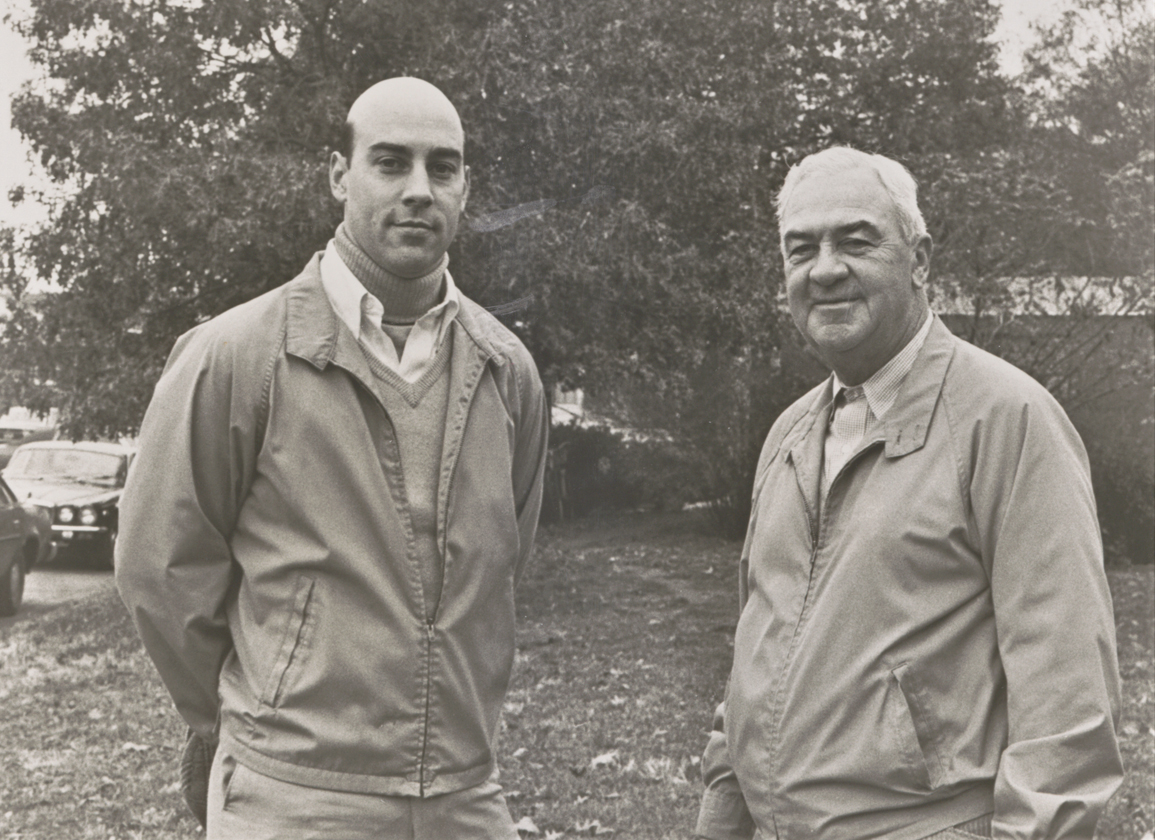
John and Sylvester Veitch | Keeneland Library

Another third generation horseman, Elliott Burch, succeeded father Preston M. Burch (1963) and grandfather William P. Burch (1955) into the Hall of Fame. The most recent inductee, Elliott Burch trained six champions and four members of the Hall of Fame–Horse of the Year Sword Dancer, Arts and Letters, Bowl of Flowers and Fort Marcy. Owner, breeder and trainer Preston Burch developed stakes winners both on the flat and over the jumps in the U.S., Canada and throughout Europe. The breeder of Hall of Famer Gallorette, he took over training duties on 1916 Kentucky Derby hero George Smith, and later defeated Derby winners Exterminator and Omar Khayyam in the 1918 Bowie H. Burch also won the 1951 Preakness with Bold. Heading the Burch trifecta is William Burch, who was among six inductees during the initial round of admissions into the Hall of Fame in 1955. Among the notable horses trained by Burch were Wade Hampton, Burch, Telie Doe, Biggonet, Inspector B., Mart Gary, Grey Friar and Decanter.

One can count on one hand the number of trainers who can boast having had a single Triple Crown winner in the barn, but the father-son duo of Benjamin A. Jones (1958 inductee) and Horace A. 'Jimmy' Jones (1959) were blessed with a formidable pair courtesy of Calumet Farm–Whirlaway (1941) and Citation (1948). The elder Jones conditioned six Derby winners, including Lawrin, Pensive, Ponder and Hill Gail, and was also the trainer of record for Citation's Derby score, however, it was widely understood that his son, Jimmy, actually campaigned the champion colt through his Horse of the Year season. Following in the footsteps of his father when assuming training duties for the powerful Calumet stable, the junior Jones was responsible for seven champions, including Armed, Coaltown, Bewitch, Two Lea and Tim Tam, all of whom are members of the Hall of Fame. The leading money earner five times, Jones was the first trainer to surpass the $1-million mark in a single season in 1947.
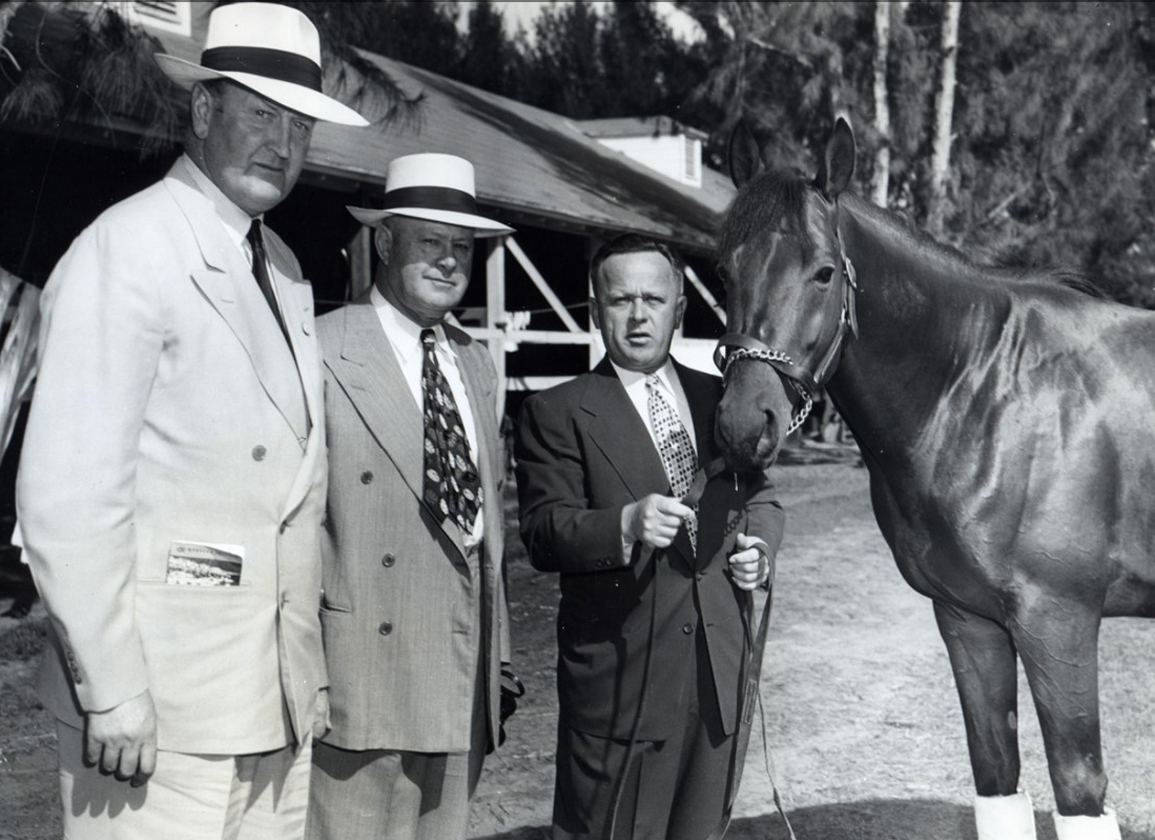
Capt. Rochefort, Ben and Jimmy Jones with Citation | National Museum and  Hall of Fame

Another name synonymous with racing excellence is the Hirsch family, represented by Maximillian (Max) J. Hirsch (inducted in 1959) and William J. 'Buddy' Hirsch (1982). Armed with a slew of powerful patrons, the elder Hirsch dominated the Classics, winning nine from 1936 through 1954, including sweeping all three with King Ranch's Assault (1946). The Texas native also conditioned Classic winners Bold Venture, Middleground, Vito and High Gun.

Supporting the old adage that 'the apple doesn't fall far from the tree,' Hirsch's daughter, Mary, became the first woman to be granted a trainer's license in the U.S., and his one-time assistant and son, Buddy, would follow him into the Hall of Fame. Earning a Bronze Star and Purple Heart while serving in the Army, Buddy continued to train for many of the names that would help define his father's training career. In addition to King Ranch, Hirsch's stable of owners included Alfred Vanderbilt, Greentree Stable, Edward Lasker and Jane Greer. Standing atop his leading runners was King Ranch's Hall of Famer Gallant Bloom, champion juvenile and 3-year-old filly. The California native also conditioned To Market, Triple Bend, Intent, Rejected, Golden Notes, Cyrano and O'Hara.

Also continuing along family lines, Texas-born George Carey Winfrey, who apprenticed under Hall of Famer Sam Hildreth, launched his own stable in 1917, and through almost five decades, won 940 races and over $2.4 million in purses while never having more than 10 horses in his stable at once. He was succeeded by his stepson, William C. 'Bill' Winfrey, who developed Alfred Vanderbilt's Hall of Famers Native Dancer and Bed o' Roses, in addition to champion Next Move. Born in Detroit, Michigan, Bill Winfrey later took over the powerful Phipps stable following the retirement of Hall of Fame trainer 'Sunny Jim' Fitzsimmons, and developed champions Castle Forbes, Queen Empress, Bold Lad and Buckpasser, who entered the Hall of Fame in 1970.

Branching Out

A handful of candidates come to mind that are likely to give rise to a new Hall of Fame branch, however, arguably none more so than Chad Brown. After working for a time with McGaughey during his college years, the native of Mechanicsville, New York joined the powerful stable of legendary Hall of Famer Bobby Frankel (inducted in 1995) in 2002. Venturing out on his own in the fall of 2007, it didn't take long for the young trainer to earn his first graded stakes win with Maram in Belmont's GIII Miss Grillo S. The 2-year-old filly went on to annex the GI Breeders' Cup Juvenile Turf Fillies at Santa Anita later that fall. Since then, the 42-year-old has earned the Eclipse training title four times, has developed 10 Eclipse champions, including Horse of the Year Bricks and Mortar. Ranked just behind Frankel in seventh with career earnings over $204 million, he has also accounted for 15 Breeders' Cup wins to date. And although yet to win the Kentucky Derby, Brown has registered a win in the Preakness, taking the race with Cloud Computing in 2017.

Like the Pletchers and D. Wayne Lukas' of the world, many of the most high-profile trainer/assistant teams to enter the great hall are typically fairly easy to single out long before their induction. However, it remains just as likely that several more names that escaped mention could have also been added to the expansive list of horsemen herein. And what might future iterations of the Hall of Fame tree look like? Arguably, not a whole lot different than it does today. Because, while the source of experience and the breadth of accomplishment may vary vastly among the horsemen and women already bestowed the great honor, the constant remains the ability to absorb the best gleaned from previous generations of masters, and to roll that into a winning formula that is successful in a contemporary world. And for 99 trainers in the Hall of Fame, it is a fait accompli.

The post Hall of Fame Assistants appeared first on TDN | Thoroughbred Daily News | Horse Racing News, Results and Video | Thoroughbred Breeding and Auctions.

Source of original post

Eight Wins Already in ’21–And It’s Only June

The Week in Review, by T.D. Thornton

We're not even at the midpoint of 2021, and one North American Thoroughbred is already taking aim at a ninth win on the season.

For perspective, the eight wins racked up so far this year by Arizona-based Six Ninety One (Congrats) are equal to the number of victories achieved by the four horses who co-led the continent during the entirety of 2020.

Such a fast start through the first 5 1/2 months puts Six Ninety One on a trajectory to blast past what has evolved as the standard for wins in a calendar year. Over the last decade, that number has ranged between eight and 12 wins annually.

You have to go back to 2011 to find the last exception. That was the explosively aberrational year Rapid Redux ran the table with a 19-for-19 record, largely by pillaging the starter-allowance ranks throughout the mid-Atlantic region.

Six Ninety One, at age nine, is also a starter-allowance stalwart, as are a good number of horses who routinely dominate the continent's most-wins category.

While it can be argued that these horses are able to pad their records by being eligible for soft conditions against thin competition while shielded from being claimed (if those starter races fill), it's still no small feat to amass eight trips to the winner's circle (with one second and a third), like Six Ninety One has done from 11 starts so far this year. In fact, it's even more of a challenge for the less physically gifted horses who populate the lower end of the claiming structure.

Six Ninety One was bred in Kentucky by Edwin and Melissa Anthony. He sold for $75,000 at KEESEP in 2013, then hammered for $59,000 at OBSOPN eight months later. Jim Thares, who bought the gelding at the Ocala auction, campaigned Six Ninety One between 2014 and 2019, earning four wins in Minnesota and Arizona before losing him via claim for $6,250 in the midst of a seven-race losing streak.

A speed-on-the-lead specialist over short distances, Six Ninety One's first-off-claim connections tried him in an 870-yard Quarter Horse dash at Arizona Downs in June 2019, which he won by 10 1/2 lengths. He then won at that same distance at Arapahoe Park, but didn't score again until 2020 when stretched back out to five furlongs against Thoroughbreds.

After a five-month break, Six Ninety One started off 2021 with five wins in eight sprints at Turf Paradise. He was claimed twice between February and April, for $3,000 and $6,250.

Current trainer Alfredo Asprino owns the gelding in partnership with Jesus Vielma, and they've kept Six Ninety One in optional-claiming and starter spots where he has not been offered for sale. He's now won three straight for those connections, and six consecutive starts since March.

Six Ninety One is entered Tuesday in the sixth race at Arizona Downs. He's favored at 3-5 on the morning line to get win number nine on the season. The gelding meets the starter eligibility by virtue of running in a $2,500 claimer last summer in Colorado.

Can Horses & Bears co-exist?

The Daily Herald of suburban Chicago ran two stories Saturday that are worth reading if you're following the Arlington International Racecourse sale by Churchill Downs Inc. (CDI), which reportedly closed its opening bid process last week. You can click through to find both articles here (then scroll down).

The first, a column by Jim O'Donnell, underscores that beyond the money involved, last Thursday's announcement that the Chicago Bears football team has submitted a bid for the 326-acre property to build a new stadium could have significant political appeal for the gaming corporation because “CDI needs to cash out of Arlington 'clean.'”

By that O'Donnell means that CDI will attempt to deflect the ill will of shutting down a nearly century-old historic landmark by delivering to the community “a global-class sports/entertainment facility and lush adjacent residential development.”

O'Donnell explained it like this: “There is already an issue of 'trustworthiness' between the more clearheaded citizens of Illinois and the Kentucky-based corporation. That directly stems from CDI's somewhat stunning decision to not add a full casino at [Arlington] two years ago after close to 20 years of lobbying for such enabling legislation.”

O'Donnell then alluded to the two Thoroughbred tracks CDI has already shuttered in the past decade (Hollywood Park and Calder Race Course), noting how regulators in other states are growing increasingly leery of CDI as a suitable steward to preserve the sport of racing.

“That question of CDI's 'trustworthiness' in Illinois could bleed over not only to its future gaming licensing in [Illinois] but also into other jurisdictions,” O'Donnell wrote.

The second Herald article, by Christopher Placek, noted that the bid for Arlington that was submitted last Tuesday by the track's former president, Roy Arnold, in partnership with a consortium of developers and investors, calls for the track's grandstand to remain in place, while a mid-size arena for a minor-league hockey team is constructed as part of a 60-acre entertainment district alongside a 300-unit housing development and 60 acres of industrial space.

But after the headline-dominating announcement by the Bears (these are the only two bids that have been publicly disclosed), Arlington Heights mayor Tom Hayes endorsed the idea of combining the two projects. He acknowledged, though, that there are challenges to building a football stadium and horse track together on the same property within his village, because some of the racing infrastructure might have to be relocated.

“In a perfect world, you'd have–and you do have–enough land to do it,” Hayes told the Herald. “The only question is would you have to at least partially tear down or reconfigure the existing grandstand … That's my only concern about trying to do both. I don't know if you could do it given the existing location.”

Hayes told the Herald that the industry-standard size for a National Football League stadium and associated parking is 160 acres. Placek wrote that Arlington's track, stables and parking come to about 125 acres. “That would leave some 40 acres on the massive site” for other purposes, he wrote–which may or may not be enough to fit in the other aspects of the desired mixed-use development.

The trustees of the Arlington Heights Village are expected to vote Monday night on zoning changes that would expressly prohibit certain uses on the property, like adult businesses, kiddie theme parks, or warehouses.

Baffert judge has 'court' experience…

The federal lawsuit that trainer Bob Baffert filed last Monday against the New York Racing Association in an effort to get his banishment there reversed on the basis that it allegedly violates his right to due process got assigned to a judge who is no stranger to handling sports-scandal cases.

Carol Bagley Amon, a Senior United States District Judge for the Eastern District of New York, is the judge who in 2008 sentenced former National Basketball Association referee Tim Donaghy to 15 months in prison for his admitted role in fixing the outcomes of pro hoops games he officiated.

Selective mastery…

Can you name the jockey who currently leads the continent with a hefty 41% winning percentage among all riders who have had at least 50 mounts this year?

Here's a hint: He's 57 years old and is a master of riding selectively and exclusively at Finger Lakes.

The answer is John R. Davila, Jr., with a 26-14-7 record from 63 rides. That 75% in-the-money strike rate also grabs your attention.

Davila, who began riding at Finger Lakes in 1982, is the track's all-time winningest jockey. He rides first call for trainer Chris Englehart, the track's all-time winningest trainer. They'll partner on three horses at Finger Lakes on Tuesday.

The post Eight Wins Already in ’21–And It’s Only June appeared first on TDN | Thoroughbred Daily News | Horse Racing News, Results and Video | Thoroughbred Breeding and Auctions.

Source of original post

For Owner Brook Smith, There’s a Method to His Madness

As the field loaded for Saturday's fourth race at Churchill Downs, Brook Smith could feel the butterflies churning in his stomach. He had just made one of the biggest bets of the meet, a $300,000 flyer. He hadn't bet to win, place or show but that three costly but unproven 2-year-olds were headed to bigger and better things. In less than a minute, he might be proven right but he also could have been proven very wrong.

“This wasn't some rich dude or someone who has some money in his pocket that was just shooting from the hip,” Smith said. “That's not at all what was going on here.”

What was? It turns out that it was a case of an owner who was not afraid to do something different and didn't care if some concluded he was naive, foolish or some combination of the two. Looking to build up his new stable, RSLP (Stands for Rocket Ship Launch Pad) Racing, Smith claimed three horses out of the pricey maiden claimer, paying $100,000 for each one. He claimed the winner, Just Call Ray (Mohaymen), the fifth-place finisher Versatile (Violence) and Braggadocio (Fr) (Caravaggio), who was 10th and last.

“I can't lie and say my adrenaline wasn't pumping,” he said. “If not, you're not alive. I thought, OK, I have signed on to this. What will be will be. At least for now, with the way the race turned out, it looks like we hit it somewhere in the middle.”

With Bill Denzik as his trainer, Smith has operated a small stable for two decades, but only recently decided to get more involved in ownership. He said RSLP will eventually become a partnership, but, for now, he is looking to build up his numbers and lay a foundation for the future. He hired Denzik to be his racing manager and brought in Jeff Hiles to train for him.

He also runs a handful of horses under his own name and won Saturday's second race at Churchill, an allowance race worth $102,000, with Lovemesomeme (Paynter), a 3-year-old plucked out of the 2019 Keeneland September sale for $8,200.

Smith said he will return to the sales later this year, but did not get everything in place for the RSLP stable in time to shop at recent 2-year-old sales. That's why he went shopping in the $100,000 maiden claiming race.

Entering Saturday, RSLP had already claimed four older horses at Churchill for a combined $180,000, but Smith was just getting started. He wanted some younger horses to complement his growing stable, so he focused in on the $100,000 maiden claimer, which was run at five furlongs.

“He wanted to get in and play ball and young horses are where it is at,” Hiles said. “We thought, let's take a shot with these 2-year-olds. You never know what you are getting.”

There was a case for claiming Just Call Ray. He had been a competitive fifth in a maiden special weight race in his debut and was dropping in class. Versatile and Braggadocio, both first-time starters, seemed a bit like a reach. Versatile is a homebred who was owned by Whitham Thoroughbreds LLC and trained by Ian Wilkes and was dismissed at 25-1. Braggodocio was bet down to 9-2 and, like Just Call Ray, was trained by Norm Casse,

“The thought with these horses that we claimed, and especially with the 2-year-olds was, why not?” Smith said. “We didn't claim three out of a $100,000 race because we thought it would be fun and cute or some kind of stunt. We were serious about this. I have worked very hard for the dollars in my pocket.”

Smith said he considered claiming several horses in the race, but went for ones that came from connections that he respected, people who were used to dealing with good horses.

“If we end up with a zero out of it, that's the risk you take,” Smith said. “Or you could get a stakes horse. If you look at that race, you had some well-bred horses from professional connections. We claimed them off people who take the business seriously and would have their horses prepared. Anything could happen, but these are ready made 2-year-olds.”

Though the results of the race were something of a mixed bag for Smith, he said was very happy with the way things turned out. He predicted that the last-place finisher, Braggadocio, will turn out to be the best of the three.

“I'm not so sure that I don't like the one who finished last the best,” he said. “What can you tell from one race? He came from a wide post and never really had a chance to get into it. He's a big strong horse and with his breeding he looks like he will be a route horse on the grass. Are you always going to pick the right ones? No. Did we pick the right ones? Time will tell.”

Smith said he will look to claim a few more horses this summer and that he will also be active at the yearling sales. If someone cards another $100,000 maiden claimer, he won't be afraid to take another shot.

“I understand that what he did was different, but there are a thousands ways to approach this industry,” Hiles said. “The best is yet to come.”

The post For Owner Brook Smith, There’s a Method to His Madness appeared first on TDN | Thoroughbred Daily News | Horse Racing News, Results and Video | Thoroughbred Breeding and Auctions.

Source of original post

Repole Keeping His ‘Wits’ About Him

How badly does New York native Mike Repole want to win the GI Belmont Stakes?

Well, if the scene in the winner's circle following the eye-catching unveiling of 'TDN Rising Star' Wit (c, 2, Practical Joke–Numero d'Oro, by Medaglia d'Oro) after a tardy start in the blockbuster card's 11:35 a.m. lidlifter was any indication, NYRA may have to start constructing a larger enclosure.

“I had six horses running on Belmont day and had 50 family and friends there,” Repole said. “Here he is at 2-5 and eighth after spotting the field seven, eight lengths. I was about to go back to my car and just go home.”

It's a good thing he stayed.

Last of eight from post two and immediately under a busy ride from Jose Ortiz in the 5 1/2-furlong affair, the 2-5 favorite began to launch on the far turn, remarkably got himself into striking distance in a three-wide third passing the quarter pole and turned on the afterburners from there in the stretch, rolling home a six-length winner. He earned a 70 Beyer Speed Figure for the effort. Wit is currently being aimed at the GIII Sanford S. on opening weekend at Saratoga July 17.

The $575,000 Keeneland September sale purchase, the most expensive of 74 yearlings to switch hands from the first crop of the highly regarded Practical Joke, is campaigned in partnership with the Viola family's St. Elias Stable and Antony Beck's Gainesway Stable. He is trained by Todd Pletcher.

Bred in Kentucky by Rosilyn Polan, the half-brother to GIII Longacres Mile H. hero Barkley (Munnings) hails from the family of graded stakes winner and multiple Grade I-placed Ivy Bell (Archarcharch). His fourth dam is French champion 2-year-old Silver Cloud.

“He's just really special,” Repole said. “To see a first-time starter do that is incredibly impressive. We knew that he was talented. He was the best horse on the farm when he was at Stonestreet, and when Todd got in 20 or 30 2-year-olds, by far he separated himself. We loved him when we bought him. If he was by Uncle Mo or Curlin, he might've gone for $1.5 million. He was that good looking. He's done everything right so far and hasn't missed a step. You just cross your fingers and pray.”

Repole continued, “I've had horses like Uncle Mo break their maiden and win by 14 1/4 lengths wire to wire, and I thought that probably was one of the most impressive maiden wins I've had. But the way this horse just broke so slow, took dirt in his face, circled the field going 5 1/2 furlongs and pulled away… I wonder, what happens if he broke? What would've he done then?”

Repole and St. Elias, of course, also teamed up to campaign 2019 GI Breeders' Cup Classic hero, champion older dirt male and promising young Spendthrift Farm stallion Vino Rosso (Curlin). The high-powered axis of Repole, St. Elias, Gainesway, John Oxley and Grandview Equine joined forces on a $1.2-million Curlin colt out of MGISW Midnight Lucky (Midnight Lute) at last year's Keeneland September sale. At that same auction, on behalf of Repole and St. Elias, West Bloodstock also signed for an $875,000 Into Mischief colt, a $500,000 Quality Road colt, a $500,000 Nyquist colt, a $475,000 Curlin colt, a $450,000 Not This Time colt, a $450,000 Into Mischief colt, et al.

“To own this horse with Vinnie and Teresa [Viola] that we've had so much success with, we're really building on top of our incredible friendship, a great partnership,” Repole said. “We also decided to partner on a couple of horses at the September sale with Alex Solis II and Antony Beck at Gainesway. This is our first horse together and we met in the winner's circle. So there you go. It's a good start. We're all very excited.”

With an impressive roster of former Repole standouts turned stallions led by top sire Uncle Mo ($175,000 stud fee; Ashford Stud); Vino Rosso ($25,000; Spendthrift Farm); Outwork ($15,000; WinStar Farm); et al., is the co-founder of Glaceau (the company was sold to Coca-Cola for $4.1 billion in 2007) just minimizing some risk by taking on partners with his runners going forward?

“Some people say that,” Repole replied. “Are you looking to share your risk? I don't know. When I used to buy all my horses at 100%, I'd spend $4 million. Now at 50%, I'm spending $6 million. So I don't know if I increased or decreased my risk. Depends how you look at it. At the end of the day, the game has evolved a lot with partnerships. I try to be very selective of who I partner with. I want to partner with people that I enjoy and people that I like. People that after we win, we could go out to dinner or come back to my house. Vinnie and Teresa are family. I think we have 30 2-year-olds together–that is the most ever. Honestly, I think we love the friendship more than the partnership.

He continued, “I wouldn't say less risk. I would actually say, more chances. How's that sound? Instead of 30 at 100%, you have 60 at 50%. I think it's more fun. I also buy a lot of horses by myself and breed my own, too. And the stallion game, that's been interesting. The first great horse I owned turned out to be a great stallion. And I know that doesn't always happen. Just because you're a great horse doesn't mean that you're going to be a great producer. Now that I've been in the game at a high level for over 10 years, it's fun to have an Uncle Mo out of Nonna Mia (each raced by Repole) turn out be a Derby horse like Outwork. It gives it a great feeling. He's been doing pretty well [at stud], we have Vino Rosso with Spendthrift and I've also invested in City of Light, West Coast and Accelerate.”

The Phipps Stable-bred Dynamic One (Union Rags), a $725,000 Keeneland September yearling purchase and narrow GII Wood Memorial S. runner-up, brought together Repole and St. Elias with the Phipps family for a trip to this year's GI Kentucky Derby. Overtook (Curlin), a $1-million KEESEP graduate campaigned by Repole, St. Elias, Michael B. Tabor, Mrs. John Magnier and Derrick Smith, failed to build off his third-place finish in the GIII Peter Pan S. and was a well-beaten seventh in the Belmont. St. Elias homebred and GI Curlin Florida Derby winner Known Agenda (Curlin) was ninth in the Derby and fourth in the Belmont, respectively.

“It's really been great to have these friends and relationships,” Repole concluded. “I think you know how special it is for me to have 50 family members come to the track with me. It's like an extra holiday. Listen, I want to win these races, but if I can run a 50-1 shot and get 50 of my family and friends together at the track, I'm willing to do it. That part is just as special as winning one of those races. As I get a little older and I realize how tough these wins are, they just get more special.”

The post Repole Keeping His ‘Wits’ About Him appeared first on TDN | Thoroughbred Daily News | Horse Racing News, Results and Video | Thoroughbred Breeding and Auctions.

Source of original post

Verified by MonsterInsights