Six Ninety One Rolls to Ninth ’21 Win

Six Ninety One (Congrats) assertively stalked outside then pounced on the pacemaker entering the far turn to win his ninth race of the year Tuesday at Arizona Downs.

The victory augmented the 9-year-old gelding's lead as the winningest horse in North America for 2021. No other Thoroughbred on the continent has won more than six so far this year.

The most noteworthy aspect of Six Ninety One's achievement is that he has racked up those nine wins in just the first six months of the season from 12 starts.

In all of 2020, four horses tied with eight victories apiece to lead the continent–but it took 12 full months of racing to win that many.

In 2019, seven horses shared the year-end honor with nine wins.

Over the last decade, the number of most annual victories has ranged between eight and 12.

Six Ninety One's June 22 score came in a  4 1/2-furlong $4,000 optional-claimer with starter-allowance conditions that protected horses from being claimed if they had started for a $2,500 tag price since 2019 (the gelding met that condition).

Under jockey Karlo Lopez, Six Ninety One broke running, but was parked three wide into the bend, which can be a disadvantage in short sprints that start on the backstretch so close to the far turn.

He took over three furlongs out, cornered several paths wide into the lane, then kicked on with gusto in the straightaway as Lopez looked over his right shoulder for competition, which was 2 1/2 lengths behind by the time the 1-5 favorite hit the wire in :51.82.

Trainer Alfredo Asprino owns the gelding in partnership with Jesus Vielma. They've had Six Ninety One for his last four wins since claiming him for $5,000 Apr. 20.

Six Ninety One was bred in Kentucky by Edwin and Melissa Anthony. He sold for $75,000 at KEESEP in 2013, then hammered for $59,000 at OBSOPN eight months later.

The gelding has now won 14 races from 39 lifetime starts while racing in Minnesota, Colorado, New Mexico and Arizona. A speed specialist in abbreviated sprints, two of Six Ninety One's victories in 2019 came against Quarter Horses in 870-yard dashes.

The post Six Ninety One Rolls to Ninth ’21 Win appeared first on TDN | Thoroughbred Daily News | Horse Racing News, Results and Video | Thoroughbred Breeding and Auctions.

Source of original post

Smith’s Unusual Claim to Benefit BLC

Owner Brook Smith, who made headlines when he claimed three horses for $100,000 each out of Saturday's fourth race at Churchill Downs, will enroll all three of those horses in Churchill's Backside Learning Center (BLC)'s Purses for a Purpose program. A percentage of each horse's winnings will be donated to the program to support BLC's mission to build community and enrich the lives of backside workers and their families. All three horses are to be trained by Jeff Hiles.

Smith has operated a small stable for more than 20 years, but is building a new operation called RSLP Racing, which is slated to eventually become a partnership. He has been a long-time supporter of BLC and was the person who initiated the concept of Purses for a Purpose in order for owners and trainers to directly support the organization.

“When launching RSLP Racing, beyond the excitement of doing things a bit differently–making a splash, thoughts immediately went to supporting those that make horse racing possible, the backside,” said Smith. “RSLP will give 4% of the purses of its runners to support the Backside Learning Center. At present there are eight RSLP horses and growing. It's time we all contribute to those who are making the industry great.”

Click here for more information on how to become involved with Purses for a Purpose.

The post Smith’s Unusual Claim to Benefit BLC appeared first on TDN | Thoroughbred Daily News | Horse Racing News, Results and Video | Thoroughbred Breeding and Auctions.

Source of original post

Ennis Widens Shop Window on Closing Day

He was hardly the first horseman who couldn't afford to be wrong, and he won't be the last. And he knows that another day, with another horse, the high-wire might not have taken the weight of the gamble. But if John Ennis duly needed a share of luck to make it across, then everything that has happened since suggests that he did so principally through his own dexterity.

The trainer remembers trembling as he signed a $7,000 docket for a Yes It's True colt at the Fasig-Tipton October Sale in 2017.

“My heart was racing,” he recalls. “The first yearling I ever bought. Combined, me and my wife probably didn't have $3,500 in our account. 'God, how am I going to pay for this?' We were still only going out then, and Erin knew nothing about the horse industry when I met her. But she's always been super supportive. And we found a way. I was able to borrow maybe $1,000 off a friend, and we had no kids then, no real responsibilities. So we just worked, just did all the extra hours we could.”

Ennis, who arrived in Kentucky a decade ago after riding as an apprentice and amateur in his native Ireland and then Britain, was at that stage still freelancing: riding trackwork, pre-training, lay-ups. But in trying to assemble a small barn in his own name, this would prove the game-changing moment.

He got the colt rolling early, starting him at the Keeneland spring meet where he showed bright speed before flattening into fifth. By starting him next in the Kentucky Juvenile Stakes, Ennis looked naïve, a dreamer. But Weiland (a name he had carried into the catalog) won a grueling stretch duel in a photo.

“So eight or nine months after we bought him, he had won a $100,000 stakes in Derby week,” Ennis says. “There were probably 60,000 people there, and I was being interviewed on NBC. It was just overnight stuff, and I ended up being able to sell the horse. So I thought to myself, 'Maybe I can make this work.' And it just snowballed from there.”

By sheer “happenstance”, as he puts it, Ennis had discovered a niche in the market that played to his instinct for a precocious horse. And each new cycle has generated extra horsepower for the next. So much so, that Ennis has three candidates to divide between the two big juvenile races on the card that closes the Churchill meet on Saturday. All three have begun their careers with the same branding: an exceptionally alert, forward style and an abundance of speed.

Mollie Kate (Tapizar) showed so much dash in her maiden over the track that Ennis is considering taking on the colts in the GIII Bashford Manor S; while Shesgotattitude (Tiznow), who beat a subsequent Royal Ascot runner-up on debut at Keeneland before struggling in the slop next time, could stay with the fillies in the Debutante S. However their trainer deploys those two, Whatstheconnection (Connect) will contest the Bashford Manor after giving his sire a first success at Indiana Grand last month.

“I actually wasn't expecting Shesgotattitude to win first time out,” Ennis says. “She was a breeze short and I thought, 'Ah, look, if she finishes in the first three I'll be happy.' But she went and won, showing a lot of heart. Mollie Kate was very impressive winning in Derby week. I think you're going to see big things from this filly, especially going two turns. Towards the end of the year, I'd hope she can maybe be looking at something like the [GI] Alcibiades. She's that good. Both fillies breezed a half in 46-and-change at the Kentucky Thoroughbred Center [Sunday], that's a really good move on a deep track, so they're sitting on 'go' for Saturday.”

For all the pace shown by Whatstheconnection on debut, this $27,000 September RNA was another who actually exceeded expectations. “I felt he was still soft, mentally and physically, that the penny hadn't dropped yet,” Ennis recalls. “And probably it still hasn't. But the second came back and won by seven next time, and this horse has improved a hell of a lot. He's a big, imposing horse, stands about 16.2hh, 16.3hh, a great mover with a great mind. He'll make them run a bit.”

The big ladder between Weiland and horses of this caliber was a $9,500 Oxbow colt Ennis found at the 2019 September Sale, deep in the second week. By this point, he had begun to find partners; but while it naturally makes sense to spread the risk, his policy is always to retain at least a leg. Apart from anything else, that manifests to potential investors his own belief and commitment; and if his judgement happens to be vindicated, then he can upgrade his restocking. Sure enough, this colt–named County Final–won on debut, finished second in the Bashford Manor, and then made $475,000 to top the Horses-of-Racing-Age catalog at the Fasig-Tipton July Sale.

“So, yes, I was able to invest a good bit more this year,” Ennis acknowledges. “And I've a real nice group. We have about 16 or 17 in the barn now, and had some good success in the spring. Hopefully we can keep going, keep buying better individuals every year.”

His work has also been noticed by breeders reluctant to send their RNAs through some Florida factory for the 2-year-old sales. In instead trying to add value on the track, Ennis is not tied down to a specific date for a specific breeze show.

“Well, I get them going the same way and the precocity shines through,” Ennis reasons. “The plan has always been: 'Opening day' [at Keeneland]. But if one of them takes a step back, I can say, 'No problem, let's wait, let's recharge.' There's nothing wrong with a [2-year-old] sale, it's great for buyers and sellers. But you have to get the horse ready to go 10 flat on that one day, and that's not easy.”

Sure enough, neither of the fillies entered for stakes on Saturday ever went through the ring. “Shesgotattitude was a small yearling, and with her nice pedigree they didn't want to end up giving her away cheaply,” Ennis explained. “They asked me to get involved and so we organized a plan, and it's worked out great for everybody. If not this Saturday, then I'm sure she'll win a stake down the road. Mollie Kate, I loved from the moment I went and looked at her last October. She's pleasing enough to look at, when you stand beside her in the barn. But I remember then sitting up on her back the first time, and just being wowed by her.”

The program offers the same flexibility to the sales recruits. So even a filly like Bohemian Frost (Frosted), a $42,000 filly who showed blistering speed to thwart another Wesley Ward flyer on the opening day at Keeneland, can be afforded time to regroup after finishing third (a place ahead of Shesgotattitude) in the slop next time.

“We turned her out,” Ennis explains. “This is an extremely fast filly, I can't speak highly enough of her. She was just a bit quiet in herself going into the last race and I probably shouldn't have run her. But she's come back now and looks amazing. I think the grass is going to move her up and she'll go for the Colleen S. at Monmouth.”

Every day of the September Sale, he spends eight straight hours at the back ring. “You might look at 60, 70 horses and not see one you like,” he says. “Then all of a sudden three or four come through one after the other: boom, boom, boom. 'Okay, now that looks like a real 2-year-old.' They have to walk well, like they're going somewhere. And a bit of presence, that's big. But it's just an instant thing. I see them, and say either 'yes' or 'no' straightaway.”

Since he's simply looking for functionality, for a horse that can add value by running fast, less commercial stallions can actually open up the profit margins. So long as the physical specimen clicks, in its build and outlook, the sire will only be a factor in determining the necessary budget. Ennis likes a Klimt, for instance: feels they typically stand over a lot of ground, and are built to run. Last September he gave $10,000 for a Klimt filly out of a Bernardini mare.

Her half-brother by Temple City was then unraced, but has meanwhile rapidly developed into one of the most exciting grass sophomores in the land as Du Jour, winner of the GII American Turf S. Given that their dam is out of a half-sister to Ghostzapper and City Zip, the Klimt filly–named Royal County–is already sensationally well bought even before running third when switched to turf in a Churchill maiden a few days ago.

“I'd seen that Bob Baffert had paid $280,000 for the Temple City [as a 2-year-old],” Ennis recalls. “And Peter O'Callaghan from Woods Edge Farm said, 'John, you need to look at this filly.' I liked her, and I was lucky: I didn't think I'd get her for $10,000. She's a big, beautiful filly so if Du Jour can win a Grade I, then she'll be a valuable broodmare down the road.”

Whatever their provenance, Ennis draws on the same assets in his young charges. First and foremost, he's looking for a quick learner. “They obviously need the physical, to go with it,” he says. “But then it's basically routine, routine, routine. Like they would be in the army. They're herd animals, so I do the same thing day in, day out, and then look to just steadily increase it. Knowing when to do that, and when not, is key to keeping them mentally fresh.”

That's a flair imported to the Bluegrass by many an Irishman, albeit Ennis himself had no background in the game and only attended the Racing School at the Curragh because he had the right build and no better inspiration on leaving school. But he was mentored by some special horsemen, notably Christy Roche, and was emboldened to try his luck here by the example of Simon Callaghan, for whom he rode in Newmarket. And his new home has certainly lived up to its billing as a land of opportunity.

“I came over here with maybe $500 to my name,” Ennis says. “I wanted to do better for myself, take myself as high as I could. And it really has been the American dream. You just have to be prepared to work hard, and keep learning. Obviously you need a bit of luck, but you also have to make your own. So I'm never afraid to invest in myself.”

He's firmly rooted here now: indeed, he and Erin now have 2-year-old twins to feed, Jack and Eleanor. But Ennis does still retain one particular yearning to venture back over the water.

“I texted Wesley [Ward] after he won with Campanelle (Ire) (Kodiac {GB}) the other day,” he says. “Wesley's a good friend; a super, humble fella. And I said that I'd love to get over there to Royal Ascot myself someday. And he said, 'Keep doing what you're doing, and you'll be over here in a couple of years.' To hear that from him was huge, and just inspires me to keep trying. Maybe not next year, but down the road sometime. The dream is there.”

The post Ennis Widens Shop Window on Closing Day appeared first on TDN | Thoroughbred Daily News | Horse Racing News, Results and Video | Thoroughbred Breeding and Auctions.

Source of original post
Champion Accelerate Stamping His First Crop of Yearlings

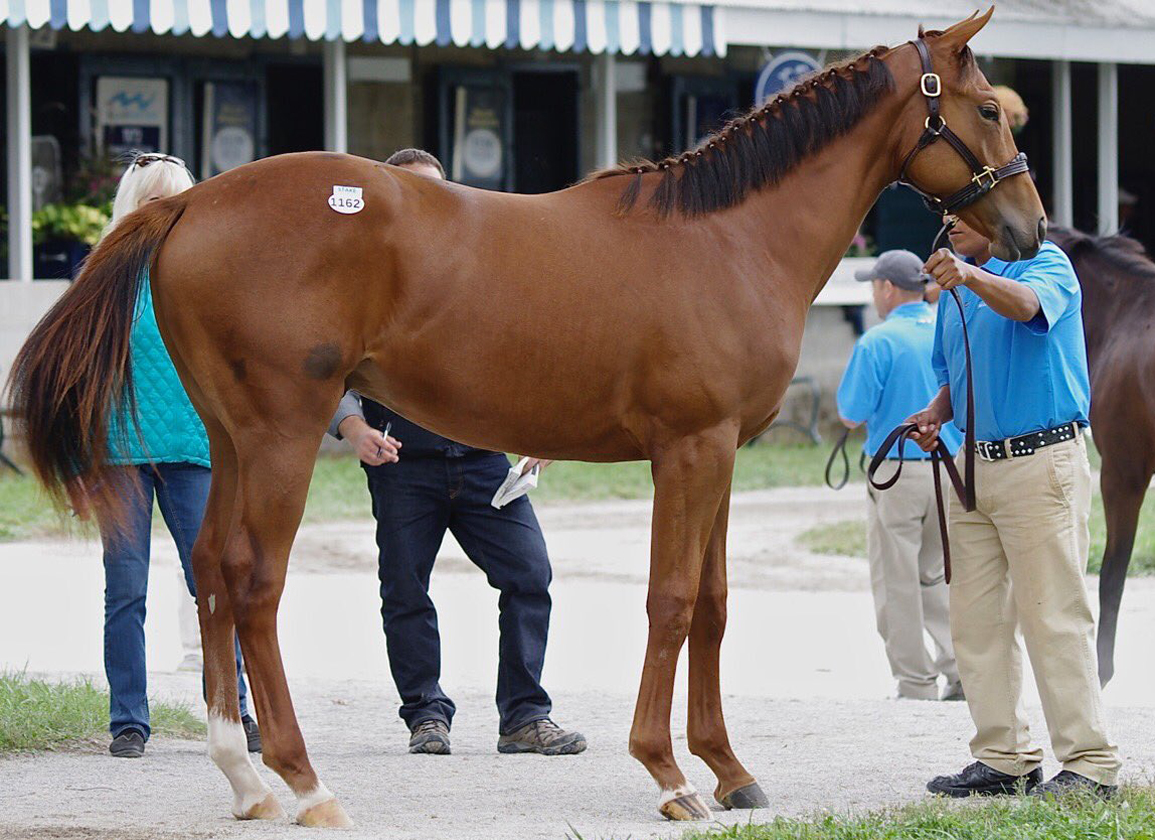
David Ingordo has undoubtedly inspected thousands of yearlings, many of whom went on to become Ingordo-purchased success stories, since he saw Accelerate (Lookin at Lucky) at the 2014 Keeneland September Sale. Nevertheless, the well-respected agent has a vivid memory of seeing Hip 1162 at the Bluewater Sales consignment, a May-foaled son of the stakes-placed Awesome Again mare Issues.

“When a horse first walks out, you get an impression–at least, that's what it is for me,” Ingordo said. “And he was an extremely well- balanced horse, plenty of substance to him. He caught my attention. He was a beautiful chestnut color and was really well prepared. When you see them, you project what they're going to turn into. What he looked like to me there is what I hoped he would grow up to be, which is this beautifully well-balanced older horse now.”

Flash forward seven years after Ingordo purchased the yearling colt for $380,000, and Accelerate is now an Eclipse-earning, Breeders' Cup Classic-winning Lane's End sire with first yearlings hitting the market this summer.

Aside from the quality physical Ingordo recognized in Accelerate as a yearling, there was one intangible trait, according to Ingordo, that made the son of Lookin at Lucky such a success on the track.

“The thing you can't see is his heart,” he explained. “We buy these horses and they're all balanced, they have the pedigrees, they're good walkers and they vet clean. You put them in training and put them in company and they move forward each week. But what you never know is when they get hooked in a race, how bad do they want it? And Accelerate, he wanted it badly every time.”

That competitive energy led the Hronis Racing colorbearer to 10 career victories, from an 8 3/4-length maiden score as a sophomore to a win two years later in the GI Breeders' Cup Classic. Between those bookend wins, the John Sadler trainee also brought home Grade I scores in the Santa Anita H., Gold Cup at Santa Anita S., Pacific Classic S. and Awesome Again S. during his championship 5-year-old season.

“The thing I remember about Accelerate's 5-year-old campaign was just how dominant he was,” Ingordo said. “When John led him over [in the Breeders' Cup Classic], there wasn't any doubt we were going to run well. But the way he did it, he drew outside and delivered with a powerful performance.”

Retiring to Lane's End with over $6.6 million in earnings, Accelerate served 167 mares in his first year at stud at a $20,000 fee. He held the same stud fee in 2020 and bred 137 mares in his second book. This year, his fee was adjusted to $17,500.

Look closely to see Accelerate's eventual purchaser inspecting the colt at the Bluewater consignment. | Lucas Marquardt

Ingordo has been busy visiting Accelerate's first crop of foals slated for the approaching yearling sales.

“When I go around looking at the offspring of a stallion, I expect to see the stallion in that foal,” he said. “So a lot of times before I go out looking at a crop of horses, I like to go see the stallion. So I'll come look at Accelerate and refresh myself about what I like about the horse. He's exceptionally well balanced, he's got a great shoulder, is very powerful behind, wide across his hips and has great bone.”

This physical description, Ingordo says, also fits the trends he's seeing in Accelerate's yearlings.

“They look like miniature versions of him. He's kind of throwing back to the Smart Strike part of his pedigree, which I think is an important element of what made Accelerate so good and I think that's going to help his offspring as they get to the track,” he said.

Ingordo also said he finds Accelerate's presence and demeanor reflected in his progeny.

“Accelerate is very regal. He's all class. I've noticed that same trait in his offspring. You can't teach that; they either have it or they don't, and they've definitely got his head and his eye, that presence,” he said.

One big boost to Accelerate's appeal to both breeders and buyers, according to Ingordo, is the support he received in his first books.

“What was great for the stallion, the syndicate and then for me as a buyer of the Accelerates this year is how solid of a book of mares people presented to the horse. We've also gotten some really good updates. I just saw a colt that's going to one of the later sales and is a half to [2021 GII San Pasqual S. winner] Express Train (Union Rags) and he is a killer. I looked at several others around town and they're all really, really nice. They remind me of him at that stage of his life.”

Accelerate, a late-blooming May foal, did not see the starting gate until his sophomore year.

“He was broke and trained at Mayberry Farm and he always did everything right, but we had to remind ourselves that he was almost a June foal,” Ingordo said. “He hit another growth spurt once he went out to California so we weren't able to really run him as a 2-year-old. Our program is not to force them. We could have gotten Accelerate there faster if we wanted to, but that didn't make any sense for the horse.”

Accelerate's belated start makes Ingordo all the more excited to see his first runners begin their career earlier than their sire was able.

“I think they're going to be Classic types,” he said. “We missed that opportunity with Accelerate just because of his age, but I see these foals and they're a little more mature than he was. I could see him getting the Classic horse that every breeder and owner wants to get to the Derby or even some of the earlier 2-year-old races.”

At last year's weanling sales, Accelerate's offspring averaged $46,159 with 22 of 30 sold. His top lot, a filly out of Grade III-placed Mystic Mama (Scat Daddy), sold for $140,000 to Buena Madera at the Keeneland November Sale. Two Accelerate colts, one out of Aspiring (Seeking the Gold) and another out of Onestaratatime (Cape Canaveral), brought $110,000 at Keeneland November.

Accelerate yearling out of West Coast Chick sells as Hip 95 at the upcoming Fasig-Tipton July Sale.

Accelerate has 11 yearlings cataloged for the upcoming Fasig-Tipton July Sale on July 13.

Hip 95, a colt out of West Coast Chick (Malibu Moon), will sell with the Lane's End consignment. The youngster is the second foal from his winning dam, who was runner-up to GISW Paulassilverlining (Ghostzapper) in the 2016 GIII Vagrancy H. and is a half-sister to GISW and sire Klimt (Quality Road).

“The cross is very good,” Ingordo noted. I like the Accelerate, Lookin at Lucky, Smart Strike line bred over Malibu Moon. The colt is a bay version of his sire. He's an excellent mover, a good athletic type, and has the head, eye and shape that we've been talking about. I wish I owned him.”

Other Accelerate yearlings heading for the Fasig-Tipton July Sale include Hip 13, a colt out of a daughter of GISW and graded producer Harmony Lodge (Hennessy), Hip 61, a filly out of a full-sister to champion Trinniberg (Teuflesberg) as well as Hip 98, a filly out of a daughter of Grade III winner Win Crafty Lady (Crafty Prospector), the dam of three graded winners, including Harmony Lodge. See Accelerate's full Fasig-Tipton July roster here.

Ingordo said he has high hopes for this first crop of yearlings as they take on the sales, but added that he believes Accelerate and his progeny will find even greater success in coming years.

“I'm going to say this is the cheapest they're ever going be is out of this first crop,” he said. “I think they're going to be horses that are bought on the high end of a reasonable price. I'm pretty excited about them. I plan on every customer of mine that has an order is going to have one, because I'm a believer. Everybody has their own horses and they can get barn blind, but we like to put our money where our mouth is on this and this is a horse that I'm going to support at the sales, my clients want to support him at the sales, and hopefully we will help him then on the racetrack.”

Click here for the first feature in our 2021 First-Crop Yearling Sire series on Gainesway's Tapwrit.


The post Champion Accelerate Stamping His First Crop of Yearlings appeared first on TDN | Thoroughbred Daily News | Horse Racing News, Results and Video | Thoroughbred Breeding and Auctions.

Source of original post
Verified by MonsterInsights
