LEXINGTON, KY-The ongoing labor crisis in the Thoroughbred industry was the focal point of discussion at the Kentucky Thoroughbred Farm Managers' Club's monthly meeting, which was held on Tuesday and brought in a large audience for a discussion on the talk.
A panel of five industry participants and educators was on hand to give their perspective on the history of the issue and how the situation has worsened over time. They also spoke on projects currently in the works that have potential to bring in skilled labor and shared their thoughts on the best methods for effectively recruiting a new generation of workers.
“We had a board meeting and discussed what would be relevant for this meeting and this is a topic that pertains to every farm right now,” KTFMC President Courtney Schneider said. “You hope that there's a light at the end of the tunnel, but it's an issue that needs to be addressed and we need to be educated about what we can do to bring in new people and keep them in the industry.”
“Our goal for the club is to refocus on issues that are important for farm managers–be it health and disease, operational issues or the bigger challenge of labor,” KTFMC Treasurer Gerry Duffy said. “It's an issue affecting every farm and everyone you talk to. Some people are in a desperate situation. Not only are you changing how you do things due to the absence of help, but it's putting an extra burden on the people you do have. It's not sustainable and we need to really get in front of the issue to try and solve it.”

Fasig-Tipton
Chris Baker was the first member of the panel to speak. The Chief Operating Officer of Three Chimneys Farm briefed the audience on the state of the issue when he first joined the industry through an entry-level position as a groom in 1986.
“It was a different time with 50,000 foals on the ground, the market was strong and input and labor costs were relatively low,” he said. “But even at that time, when labor was more abundant than it is today, I can still remember lamenting about finding the next group of people coming up to do this. The problem of identifying, recruiting and retaining a workforce isn't a new one, but it was less of an issue then.”
According to Baker, the connection with the horse–or lack thereof–is a main cause for today's limited employee pool and poor job retention.
“Finding help seemed easier [in 1986] and I think some of that was because we were less removed from an agrarian society. When you look now at the composition of the workforce, with a lot of Latinos, many of the people who have immigrated here are less removed from or are coming from an agrarian society. I think that's a big part of it–the connection with the horse. Without that, it can be hard to make sense of what you have to do and the sacrifices that need to be made in order to have a career in this industry.”
Baker emphasized that in order to recruit a strong, skilled workforce, finding the right person to fit the job is crucial.
“If you're going to come to work in the Thoroughbred industry, you probably have a different realistic financial ceiling than if you were going into medicine or finance,” he explained. “So why do you come to the horse business? It all comes back to the horse. I think if we can put the horse first in all we do, make people aware and make that focus on the horse as part of your recruiting, you're going to get the kind of people you want who are doing it for the right reasons.”
He continued, “We need to focus on a fair wage, a good work environment where people and horses are treated with respect, because that's part of making people feel like they're a part of something special, and then we need to train, develop and encourage so there is infrastructure in place for people to grow.”
Frank Taylor, Vice President of Taylor Made Farm, also shared his experiences as an employer. Taylor Made has several programs that Taylor said have been key to keeping their operation fully staffed.
This year, Taylor Made has started a pilot program called the Taylor Made School of Horsemanship. Created in partnership with Shepherd's House, a transitional residential drug addiction treatment center in Lexington, the program set a goal to bring in five trainees every 90 days. The workers spend their days on the farm and then return to the Shepherd's House every evening, where in addition to food and housing, they are also provided with counseling services.
“We have one barn set up where they are all working together and we also have a director there, someone who is good at teaching,” Taylor said. “I think it could be huge in the future. It's such a win for everybody. Obviously it's a win for society, it's a win for the horse business and a win for Taylor Made, and if we can give these people second-chance employment and help them get on their feet, I think we can do a lot of great stuff.”
While the project is still in the beginning stages, Taylor said he envisions future expansion.
“When you give these people a second chance and they are fully recovered, they become an example for everybody else,” he said. “For people dealing with addiction, one of the things that keeps them going is helping other people. So our hope is that we grow this and help a lot of people, who in turn help a lot of other people. We want to take this, get it perfected and show it to other farms. This has a lot of potential and we could envision 50 to 60 people a year graduating from this program and going out into the industry.”
Taylor said that his farm has also been a part of the H-2A Temporary Agricultural Workers program for four years.
“This program has been a godsend,” he said. “The thing about these guys is they're coming in and they're grateful and they love what they're doing. They can do two times as much work as the average person, maybe three.”
The Kentucky Equine Education Project (KEEP) Foundation and the Kentucky Chamber of Commerce Workforce Center has joined forces to launch the Equine Workforce Initiative in an effort to address the shortage of equine workers on a state level. Laurie Mays, another member of the panel, serves as the initiative's Equine Talent Pipeline Project Manager.
“We are in year three of this initiative,” she said. “We bring employers together and give them a safe space to discuss their struggles in terms of workforce development. We look at things like what skills go along with specific positions and how many people an employer might need in these positions.”
One problem her team has encountered, Mays said, is that accurate research on employment in the equine industry is difficult to pinpoint quantitatively due to the broad scope of data the state agency has to offer on employment in agriculture as a whole.
“One of the things we're doing is trying to get hard data for the needs of the industry,” Mays said. “This information and data can feed into our state's statistical agency so we can have a better idea of what our true needs are. This gives us a better way to talk to training programs when we can show them the actual number of positions we need to fill.”
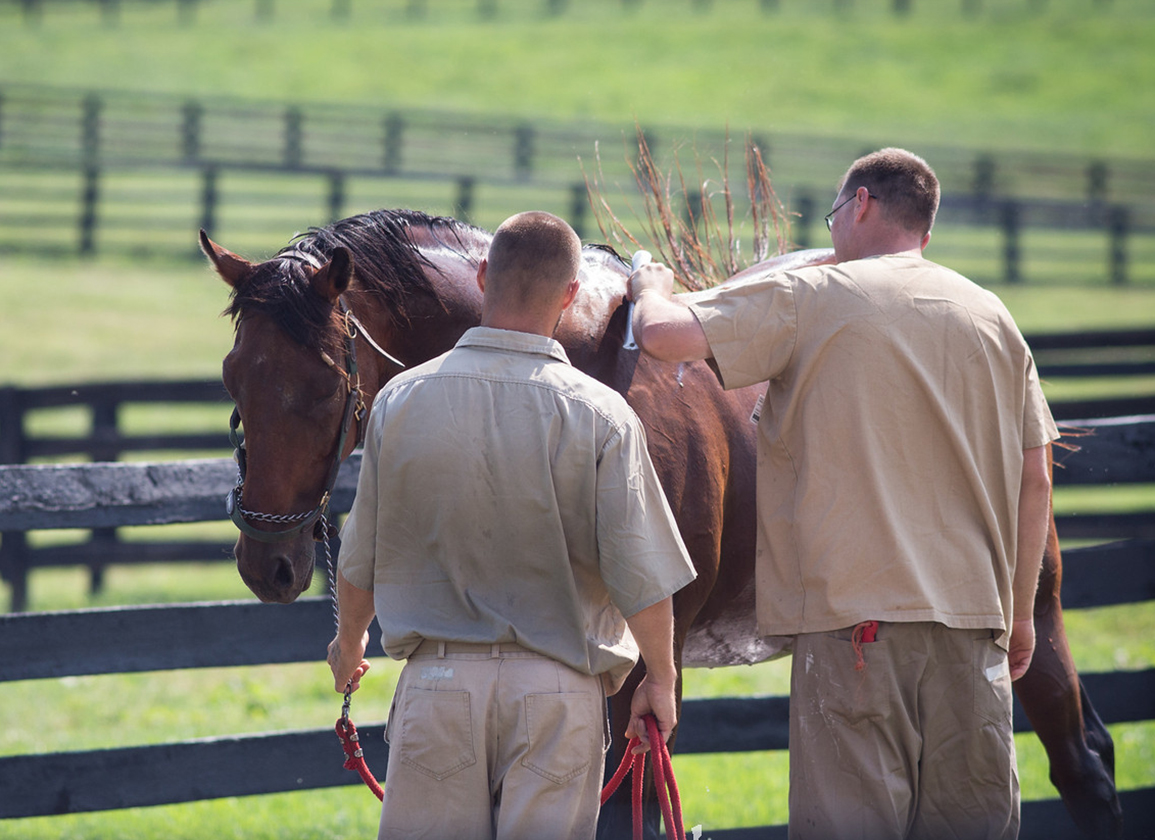
The program at Blackburn Correctional Complex currently has seven graduates working in the industry. | EquiSport Photos
The Equine Workforce Initiative is in the process of developing several other programs that could prove to be valuable resources for employers. In partnership with the Thoroughbred Retirement Foundation and the Blackburn Correctional Complex in Lexington, Mays and her team are working to create meaningful connections between inmates who have undergone training on the farm and potential employers so that graduates of the program have a job as soon as the time comes.
“As of yesterday, we've placed seven people in Lexington at farms and vet clinics and it's going very well,” May reported. “We've heard great feedback from the employers who have hired them. We're going to look at doing an educational tour for employers to meet the instructors and the gentlemen, see the facility and learn more about what they learn.”
Savannah Robin serves as the internship coordinator for the University of Kentucky's Equine Program. She joined the panel to speak on the growing population of higher-education graduates seeking a career in the equine industry.
Robin shared that seven institutions in Kentucky offer an equine program. At the University of Kentucky, 300 students are in the program at any given time and on average, 89% come from out of state.Each student is required to complete an internship in order to obtain their degree at UK, and Robin said that on average, 21% of these internships focus on horse and farm management. However, only 9% of the UK Equine Program's alumni base currently works in that same field.
“We need to figure out how to tap into that 21% and help retain them within an industry than can provide them with leadership experiences,” Robin said.
Katie LaMonica, the Charities Manager for Godolphin, closed out the panel by reminding the audience about the upcoming Thoroughbred Industry Employee Awards.
“We are heading into the sixth year of the TIEA Awards,” she said. “If we're looking for ways to reward and recognize our staff, this is a great way to do it. This year, all seven award categories have a sponsor. Our nominations are now open and we also have a new award. The Support Service Award is for your maintenance crew, gate grew, night watch team, farriers-people who don't necessarily work on the end of the shank, but they keep you going.”
The audience present at the meeting consisted of a diverse group of both well-established and up-and-coming industry participants, with UK Equine students and Kentucky Equine Management Internship (KEMI) members on hand. During the 'Q and A' session at the end of the meeting, much discussion was brought forth on the topic of work-life balance and the incoming generation's emphasis on the subject.
“Millennials and Gen Zers get beat up sometimes in terms of their work ethic, but the values of their generation won't disappoint you in what they can bring to the workforce,” Robin said. “These students need different things. They need different things than what I needed when I graduated. They're looking at work-life balance early on so that they don't burn out and can go on a long time within a career and be sustainable within that career.”
Baker and Taylor agreed that better working conditions and increased job flexibility are areas they could see evolving in the future, but said that participation in the Thoroughbred industry would always require hard work and sacrifice.
Baker said, “Do we need to adapt and provide opportunities to broaden the people that come to this business for a career? Yes. But on some level, I think the people that do the best, go the furthest and accomplish the most are those that embrace the lifestyle and the sacrifices that come with it in their personal life.”
“It is a lifestyle and it's not a job,” Taylor echoed. “If you're getting in the horse business and you want to be successful, it has to be a lifestyle. If you're going to get in this business, you better love it and be dedicated to it.”
“It's a matter of figuring out a way to make our industry available to the incoming generation who, quite rightly, doesn't want to work seven days a week,” Duffy said in conclusion. “We have competition from other industries who are paying more and making variable work times and conditions available to people, but behind that there's some great work going on here and some great initiatives. We have to keep the conversation going. We're here to get a discussion going and not necessarily present the answers, but just to get the industry talking and collaborating. As an industry, we need to come together and try to solve our issues together.”

The post KTFMC Meeting: Labor Crisis in the Thoroughbred Industry appeared first on TDN | Thoroughbred Daily News | Horse Racing News, Results and Video | Thoroughbred Breeding and Auctions.
Source of original post
