Wednesday’s Insights: $460K Munnings Colt Makes Spa Debut

1st-SAR, $100K, Msw, 2yo, 5.5mT, 1:05 p.m.

Lady Sheila Stable's MUNNY BOLT (Munnings) launches his career for trainer Steve Asmussen, who recently became the leading North American trainer in number of races won. The Pennsylvania-bred colt was secured for $460,000 at this spring's Fasig-Tipton Midlantic sale, making him the second highest priced juvenile overall–and top priced 2-year-old colt–by the stallion this year. Out of the Medaglia d'Oro mare Tweet, the dark bay breezed a half-mile in a bullet :48.10 over Saratoga's Oklahoma track Aug. 2. GMP Stables LLC's and Bellavia LLC's Java Buzz (Mshawish) kicks off his career for trainer Linda Rice. The Florida-bred–the most expensive juvenile by the sire in 2021–realized a $210,000 final bid at the OBS April sale following a :20 4/5 quarter breeze. From his sire's second crop, the colt is out of Agasaya, an unraced daughter of Animal Kingdom who is a half-sister to multiple Grade II winner Great Hot (Brz). This is also the family of Grade I winners Hennessy and Pearl City. Always dangerous with his firsters, Wesley Ward brings to the table Rockingham Ranch's Admiral Halsey (War Front). Out of the Galileo (Ire) mare Aloof, the colt will be accompanied by Irad Ortiz Jr.

The post Wednesday’s Insights: $460K Munnings Colt Makes Spa Debut appeared first on TDN | Thoroughbred Daily News | Horse Racing News, Results and Video | Thoroughbred Breeding and Auctions.

Source of original post

Purse Increases for Santa Anita’s Winter/Spring Meet

Santa Anita will increase purses for overnight and stakes races for the upcoming Winter/Spring Meet, which opens Dec. 26. More specifics will be released soon, but maiden special weight races will increase by $6,000 to $67,000; first condition allowances will be upped $6,000 to $69,000; and $25,000 claiming purses will rise by $4,000 to $40,000. The increases are in partnership with the Thoroughbred Owners of California (TOC).

“There are now many reasons to be optimistic about 2021 and beyond,” said Santa Anita's senior vice president and general manager Nate Newby. “We've been able to raise purses at the Winter/Spring Meet by 10% for two consecutive years now and that's certainly good news. We have invested heavily in change and in our racing infrastructure, which has resulted in better, safer racing, which is our top priority.”

Santa Anita's 16-day Autumn Meet opens Friday, Oct. 1.  Purses were increased for last year's Autumn Meet and will remain at the same level this year.

The post Purse Increases for Santa Anita’s Winter/Spring Meet appeared first on TDN | Thoroughbred Daily News | Horse Racing News, Results and Video | Thoroughbred Breeding and Auctions.

Source of original post

Embracing New Technology

Periodically I find myself on the other end of a call with a client seeking a nonexistent 'tool' in my bag of tricks. It can be awkward to expose one's own ignorance on a topic, not to mention uncomfortable. In these instances, I suspect most farriers don't make it a habit of turning away 'good' clients and some of them reply, “Oh sure, I do that, or use that product all of the time.” Shoeing sometimes requires a certain degree of salesmanship; I believe the Irish call it malarkey.

Given the range of innovation and abundance of out-of-the-box thinkers attempting to bring new ideas and products to market within the farrier industry, it has become essential to have Google and/or YouTube on your speed dial (if that still exists). One click of a button, 'virtually' makes you an expert. When necessary, I'm not ashamed to say, that's what I do too.

Recently, I was advised about a client horse, “Ellie,” who was returning home from an extended stay at the clinic after a severe bout with laminitis. Laminitis, also commonly known as founder, is a painful condition affecting the tissue (laminae), which bonds the hoof wall to the coffin (pedal) bone. The root cause and remedy continues to elude investigators. The mare was reportedly comfortable and stable enough for the van ride home. Additionally, I was advised that she was due, and that a product called 'FormaHoof' was successfully being used by the clinic's farrier. In truth, I was initially skeptical. After multiple phone calls with veterinarians, followed by calls to the clinic's farrier, and activating my online speed dial to view multiple application videos, I acquiesced.

FormaHoof had already been on my radar. After some further investigation, the concept seemed interesting and possibly useful in certain cases. However, when a new product or concept makes landfall at your doorstep, there also can be some level of anxiety. In an industry that is built on sayings like, “you're only as good as your last horse,” undoubtedly there is some pressure to perform.

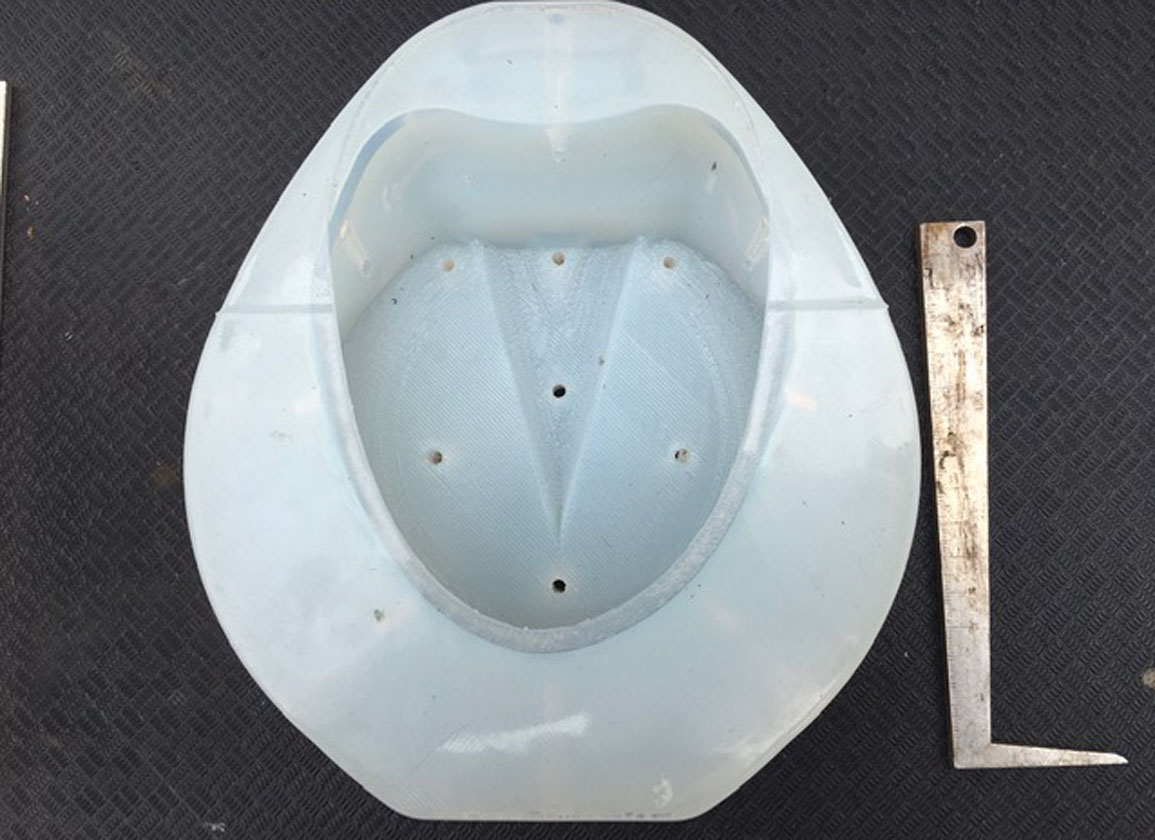
View of the sole with a FormaHoof barefoot mold | Jude R. Florio photo

FormaHoof essentially creates a glue cast, by the use of a mold and a type of fast-set glue which encapsulates the hoof. The process basically creates a cuff, with the glue covering the outer wall to a midway point, as well as the sole and frog. Additionally, there are multiple types of molds: barefoot, traction, or performance. Fortunately, Ellie's front hooves were a similar size which only required the purchase of one mold. (It should be noted: a horse with differing hoof sizes may require the purchase of an additional mold, making the undertaking costlier).

The application requires glue and tips for every application, with the one-time expense of the applicator glue gun. Also provided was a length of plastic/fabric mesh, which is cut and inserted into the mold prior to the hoof and acts as an additional structure for the glue to adhere to. Theoretically, the mold should also be a one-time purchase, however, that is dependent upon hoof size and growth which may require the future purchase of a larger or smaller-sized mold. Multiple applications seem likely for reuse, especially when care is taken ensuring the proper maintenance and storage of the mold(s), which in this instance consists of one horse, two feet, once a month.

A degree of patience is necessary for both the applier and horse, as there is a slight learning curve for correct application. Additionally, some degree of agility and maneuverability are required. The application process requires contorting oneself with steps that include elevating the hoof with the mold and injecting glue into multiple points, followed by lowering the hoof to the ground and maneuvering around the foot to additional glue injection points. Throughout the duration of this hoof/mold/glue ballet, cartridges and tips will likely need to be exchanged, including keen observation of the glue's path and attempting to predict where to move next. I definitely recommend giving oneself some extra time when first attempting this process, and I would advise the purchase of extra glue cartridges and tips until your technique is perfected. It is probable that a few spots will need touching up, but with additional attempts, it does get slightly easier. Admittedly, the ability to perfect the application on the initial go around continues to remain elusive after multiple attempts.

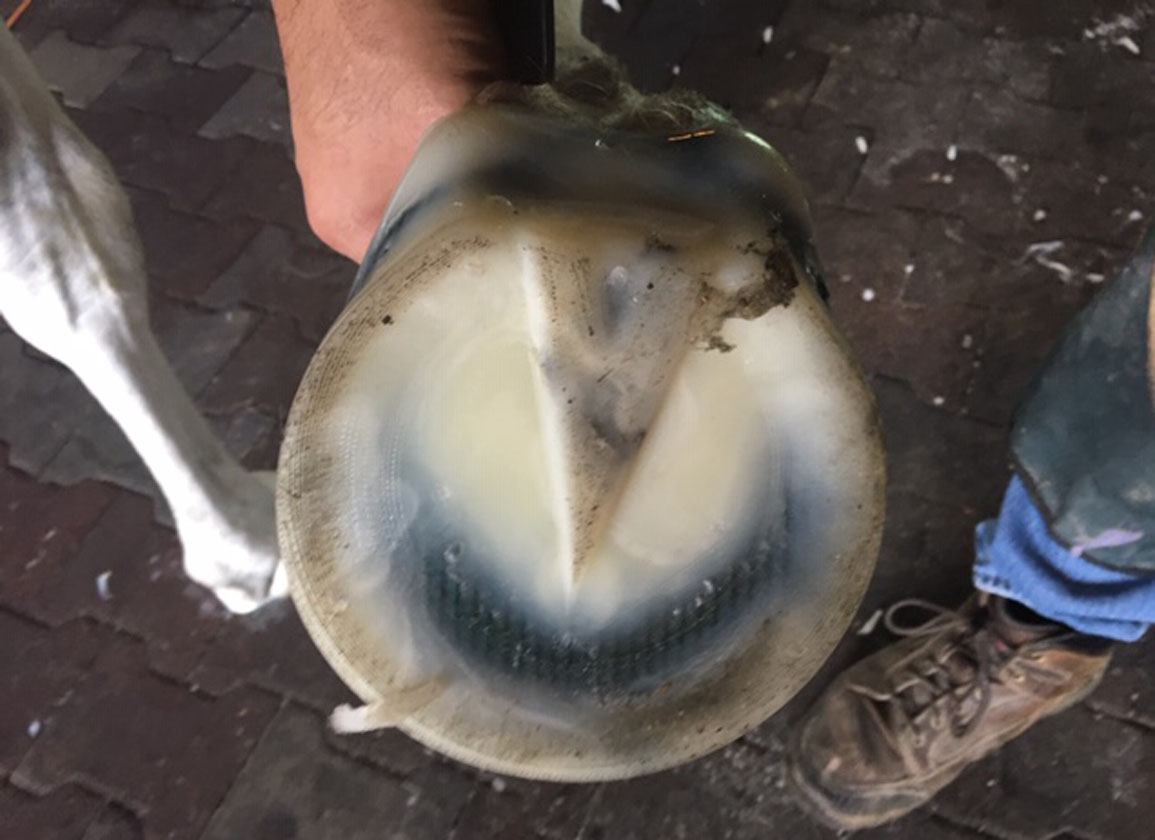
Residual product after removal | Jude R. Florio photo

A cost benefit analysis is recommended as some may consider the investment cost prohibitive.

There are multiple scenarios where FormaHoof use would be appropriate, specifically on a barefoot horse where the ability to conventionally affix a shoe is difficult and/or impossible. However, 'flat-footed' horses may not be able to take sole or increased frog pressure as a result of the hoof's encapsulation, an unfortunate reality which may not be initially apparent until after the product is applied requiring the product's immediate removal. In my conversation with the clinic's farrier, he mentioned occasionally experiencing the pressure problem and indicated it was alleviated by the placement of some impression material. Additional concerns may include a horse's transition out of the product and the experience of possible soundness issues with the removal of a 'cuff' glue-on or a hoof cast, when the hoof wall has a negative reaction to the loss of the artificial support created by those interventions. Lastly, the hoof's preparation is key to ensure reducing opportunity for bacteria promotion and/or eliminating the possibility of abscessing which would require the product's removal.

FormaHoof's barefoot mold | Jude R. Florio photo

On hand for the initial application for Ellie, Dr. Mark Ketner, DVM of Ketner and Associates, a seasoned practitioner and Monmouth Park veterinarian since 1987, admitted he was “very impressed” with the product. When discussing other scenarios that might warrant the product's use, Ketner said, “[FormaHoof] should be great in situations with significant hoof wall defects, or prolapsed soles.”

He added, “There should be minimal soft tissue effects.”

When asked specifically about the appropriateness for racing, he replied, “Not sure about racing; it would depend on the reason the horse needed the product, assuming significant rotation and sole prolapse would preclude a racehorse from being sound.”

As with all stories, the hope is that they will end happily. Unfortunately, far too many stories of laminitis most often don't. Fortunately for Ellie, this story does. Recently while turned out in the paddock, she decided to take a number of trot steps and then proceeded to successfully exit the paddock with a jump over the four-foot gate! I think it's pretty clear she is feeling good and at the end of the day that's what every farrier strives for.

The post Embracing New Technology appeared first on TDN | Thoroughbred Daily News | Horse Racing News, Results and Video | Thoroughbred Breeding and Auctions.

Source of original post

Asmussen’s Next Target: Juan Suarez

The Week in Review by Bill Finley

Steve Asmussen moved past Dale Baird Saturday to become North America's all-time leading trainer in wins with 9,446. But for such a goal-oriented individual, it's no time to rest. To be number one in the world, Asmussen still has to catch Peruvian trainer Juan Suarez. And it won't be easy.

Suarez, as of Saturday, had 9,886 wins–or 440 more than Asmussen. On the same day that Asmussen won one race from 13 starters spread across four racetracks, Suarez had three wins on the Saturday card at Peru's only racetrack, the Hipodromo de Monterrico, which is in Lima.

Over the last five years, Suarez, 71, is averaging 315 wins a year, while Asmussen is averaging 390. That means he will likely chip away at Suarez's lead but could spend years trying to catch him. The main advantage Asmussen has is his age. He is 16 years younger than Suarez and will surely outlast him.

Suarez was born in Santiago, Chile and moved to Peru in 1963 at the age of 13. The family moved because Suarez's father, Juan Suarez, Sr., was hired as the trainer for Haras Barlovento, then among the leading stables in the country. The elder Suarez won the most prestigious race in Peru, the G1 Derby Nacional, eight times. Suarez worked as an assistant to his father before going out on his own in 1980 and won 116 races that year.

Much like Asmussen, he built up a huge stable that delivered year after year. From 2001 on, he has not had fewer than 200 winners in a year. He had a personal best 368 in 2013. He currently trains 210 horses and has had as many as 300 at times.

Asmussen enjoys advantages Suarez will never have. Not only does he have more horses than Suarez, but he has the ability to race at four or five tracks at a time. Suarez is restricted to running at Hipodromo de Monterrico.

Through an interpreter, Suarez said that his numbers are down because the stable is still dealing with COVID-19 issues. Though in his seventies, he shows no signs of slowing down and he is not contemplating retirement.

“I live for this activity and I do not have any plans for retirement,” he said. “I am still active in the field here in Peru and many horse owners still look to me because of my experience and our friendship.”

It seems that Asmussen and Suarez share many of the same attributes and both believe the key to success is hard work, putting together a good team and paying attention to every last detail.

“The most important thing is having a dedicated work team,” Suarez said. “You must also have support from your family because the job takes up so much of your time.”

“I was reading about Steve Asmussen and his having such a great memory,” said Suarez's nephew, Lexington-based bloodstock agent Dante Zanelli, Jr. “My uncle is just like that. He has a photographic memory. He has had as many as 300 horses at a time and he knows everything about every horse. He knows his horses and he remembers everything about them. That has a lot to do with his success. He is also an extremely good trainer and has great people working for him. It's very similar to what Steve Asmussen has.”

While Suarez wants to win, he is not consumed with winning.

“I don't focus too much on the wins,” he said. “I pay more attention to the work. I want everything to be OK, and then to see the result of the hard work done by my team and I.”

Suarez has had just one starter in the U.S. For the 2012 GII Breeders' Cup Marathon at Santa Anita, he brought over the Peruvian-bred mare Almudena (Per) (Silver Planet {Arg}). A Group 1 winner in her native country, she finished 10th with Jose Valdivia, Jr. aboard. Valdivia is Suarez's nephew. He is also related to retired jockey Fernando Toro, who is his brother-in-law.

“That was a great experience,” Suarez said. “We did not have much luck in that race but the experience and being able to celebrate the experience was amazing. I love how in the USA they make the experience even greater with the Breeders' Cup organization and all the attention to detail.”

He has also exported horses to the U.S., including a stakes winner at Hialeah. He trained Tomcito (Street Cry {Ire}) before sending him to Zanelli, then a trainer, for the 2008 GI Florida Derby, where he was third.

Zanelli said that his uncle has considered opening up a small stable at Del Mar.

“We have talked about that and the logistics involved and how to make it work,” Zanelli said “He's been talking to his owners about this and has been trying to get permission from the Jockey Club of Peru to open a stable at Del Mar. He'll explore that again for next year. He has a couple of pretty good horses that could win there. He'd like to have a stable with six to nine horses.”

With 12 horses entered Saturday at the Hipodromo de Monterrico, Suarez didn't have time to watch Asmussen move past Dale Baird, but he is well aware of Asmussen's accomplishments and he is an admirer.

“I know that Mr. Steve Asmussen is one of the top-tier horse trainers in the USA,” he said. “I also know that he has a lot of horses and a great work team and family. That shows why he is so successful. His breaking the record in the USA shows the great work ethic that he has. I know the sacrifices you must make to train horses, for the trainer, the family and the team that works with him. It is particularly difficult in such a competitive horse racing country as it is in the USA. I wish the best to Mr. Asmussen and congratulate him for the enormous achievement he has accomplished.”

Panza Left His Mark on Saratoga and NYRA

The paid attendance Saturday at Saratoga for the card topped by the GI Whitney S. was 38,525 and the all-sources handle was $36,820,234. Yes, Saratoga sells itself, but those numbers may not have been possible without NYRA Senior Vice President of Racing Operations Martin Panza. Panza announced his resignation last week. He will work through the end of the Belmont fall meet.

Panza “got it.” He loves racing and is always happy to roll his sleeves up and get to work to make it better. Two of his primary innovations were on display Saturday and contributed to the card's success. He put together the successful turf series for 3-year-old males and fillies that includes the $1-million GI Saratoga Derby Invitational run Saturday. He's also an advocate of creating “Super Saturdays” at the NYRA tracks. Saturday's card didn't include just the Whitney, it had five stakes races and three Grade I's. He turned the card for the GI Belmont S. into a day that goes well beyond the Belmont itself. Next to the two Breeders' Cup Days, it is the best card on the year.

His successor will have big shoes to fill.

The post Asmussen’s Next Target: Juan Suarez appeared first on TDN | Thoroughbred Daily News | Horse Racing News, Results and Video | Thoroughbred Breeding and Auctions.

Source of original post
Verified by MonsterInsights