With Strength in Numbers, Repole and Viola Hope to Hit It Out of the Park

Passionate about the sport and determined to win at the highest level, partners Vinnie Viola and Mike Repole have come up with a formula they hope will mean lasting success. It's not just about quality, but quantity. Attack the game with an army of well-bred horses, most of them colts, send them to Hall of Fame trainer Todd Pletcher and sit back and wait for good things to happen.

In what amounts to a historic buying spree, Repole and Viola's St. Elias Stable bought 43 yearlings at Keeneland September, paying a combined $16.045 million. That's after they spent $1.375 million on two yearlings at Fasig-Tipton October and one at Fasig-Tipton Saratoga for $350,000.

Represented by bloodstock agent Jacob West, the Repole-Viola partnership bought 40 colts at Keeneland and three fillies, paying anywhere from $40,000 for a colt by Always Dreaming to $1.05 million for a City of Light colt. They went after a number of sires, including four by Curlin and three by City of Light. The average price they paid was $373,000.

“There really is a good formula,” Repole said. “We know what we are doing. We have incredible lists. We have incredible advisors, an incredible team. We expect to do the same next year, the year after. We do it because we really enjoy this game.”

It's all about putting yourself in a position to win at the highest levels of the sport, something both have achieved. They teamed up to win the 2019 GI Breeders' Cup Classic with Vino Rosso (Curlin), a horse they bought at the 2016 Keeneland September sale for $410,000. Viola owned 2021 GI Florida Derby winner Known Agenda (Curlin) and was a co-owner of 2017 GI Kentucky Derby winner Always Dreaming (Bodemeister), while Repole campaigned, among others, GI Breeders' Cup Juvenile winner Uncle Mo (Indian Charlie) and GI Travers S. winner Stay Thirsty (Bernardini).

At the end of the day, it's not necessarily about the bottom line, but a thirst to win in a sport neither can get out of their systems.

“We've developed a passion,” said Viola, who owns the NHL's Florida Panthers. “It's less market driven. It makes sense on a sportsman's level. Every sports person wants to compete at the highest level at whatever activity or sport they participate in.”

Viola is from Brooklyn and Repole is from Queens. Both used Pletcher as their primary trainer and have similar goals and philosophies when it comes to the sport. It made their teaming up natural. As a partnership, their first big splash at the sales came at the 2020 Keeneland September Sale, where they bought 23 horses for a total of $9.295 million.

They are not just spending a lot of money, they are trying to spend a lot of money wisely. It starts with a team of advisors that includes West, Pletcher, Ed Rosen, Jim Martin, Rory Babich and Monique Delk. Each one has their strengths. Their information is passed on to Viola and Repole, who continue the hunt to find the next Vino Rosso.

“This is not an easy task” Viola said. “This is part art, part science, part team discipline. Mike and I are constantly communicating about those three challenges. It is very, very easy when you have a partner like Mike. He is an ultra-talented individual. We work really well together.”

“In business, it's 80% plan and 20% luck” Repole said. “In horse racing, it's 20% plan and 80% luck. Not too many people have that 20% plan. They are all over the place. Vinnie and I are hyper focused right now.”

Buying mainly colts is part of that plan. For Viola, it comes down to trying to win another Kentucky Derby.

“We are primarily buyers of colts,” Viola said. “The sole purpose is to win what we think is the Super Bowl of horse racing , the Kentucky Derby. You will see us buying 90% plus colts.”

Repole wants to win his first Derby, but he also wants to develop stallions, another reason why the two buy very few fillies.

“It's driven by having colts and driven by having stallions,” he said. “The one thing that Vinnie and I figured out pretty quickly is that the ability to make money in this game is with stallions. I still own a big percentage of Uncle Mo. His stud fee is $175,000 and he's bred every year to 200 mares. Anyone can do the math.”

Repole said he's reluctant to go over $1 million for any horse and prefers to stay in the range of $300,000 to $600,000.

“It's a numbers game” he said. “What Vinnie and I are trying to get is quality and quantity. That's what we are looking for. If somebody wants to go up to $2.7 million, God bless and good luck. Vinnie and I will never buy the sales topper because there's always going to be one horse that goes for $4 million and everyone says, 'Wow, look at that horse.' A couple of years later tell me what that horse did.”

The relationship has grown over the years. In 2016, the year they bought Vino Rosso at Keeneland, Repole and Viola went in on only two horses together. Repole said the success they had with Vino Rosso cemented the partnership, which has come to be more than just a business relationship. It has become a close friendship.

“Vinnie and I have gone from partners to great friends to family over the last 12 years,” Repole said. “There's no doubt I'd rather own 50% of a great horses with Vinnie than own 100% of as great horse by myself. It feels more special that way.”

Buying yearlings is never easy and there are no guarantees, but there is something to be said about having such a deep group of horses. So they hope to make some memories in the years ahead, starting next year when the 2021 yearling class hits the track and continuing in the 2023 Kentucky Derby. From the 2021 yearling buys, they'll have 46 chances to find a star. The odds are in their favor.

The post With Strength in Numbers, Repole and Viola Hope to Hit It Out of the Park appeared first on TDN | Thoroughbred Daily News | Horse Racing News, Results and Video | Thoroughbred Breeding and Auctions.
Source of original post

New SoCal MRI Study Aims to Bring Clarity to its Diagnostic Role

Seeking a full stop to the spate of high-profile fatalities in the race that stops Australia, Racing Victoria this year tightened the veterinary screws. The practical rollout of these efforts can hardly be described as an unadulterated success, however.

One of these new measures was a precautionary CT scan of all runners in the days leading up to the G1 Melbourne Cup–a target that hit the skids when Racing Victoria's new $1.27-million CT unit suffered a malfunction with the Cup field only half scanned, leaving the rest to be X-rayed (with a machine that was also temporarily incapacitated).

But other, less-mechanical incidents highlight some of the more nuanced problems that come with using sophisticated–and still yet relatively new–imaging technologies to diagnose lameness in equine athletes.

Despite the results of a mandatory CT scan that gave French import Gold Trip (Fr) (Outstrip {GB}) the all-clear to train up toward the G1 Cox Plate, Racing Victoria's veterinary team scratched him on the eve of the race–a diagnosis that jarred with the horse's connections, who declared him sound.

In a further twist, Gold Trip was given the all-clear to run in Sydney in the Rosehill Gold Cup just a week later–only to be scratched once more due to the prevailing firm going.

In short, as more and more regulatory veterinarians turn to imaging modalities like MRI, PET, and CT to help diagnose lameness, they're left to wrestle with slippery conundrums.

What clear connection exists between the image before them and an increased chance of injury in the horse, for example? And without an extensive historic medical record at their fingertips, how can they be sure that any possible abnormality that appears on the image is significant?

A new standing MRI-focused study set to launch in Southern California seeks to provide some much-needed answers.

“Lameness is a precursor to fetlock failure, and maybe we find bone changes that help us identify lameness. But we should never get to the point where the fetlock fails–we want to do better than that. And that's the goal of the study,” said Florida-based John Peloso, the lead researcher on the study.

“We need to figure out when they're helping us,” Peloso added, of imaging modalities like the standing MRI. “We need to learn more.”

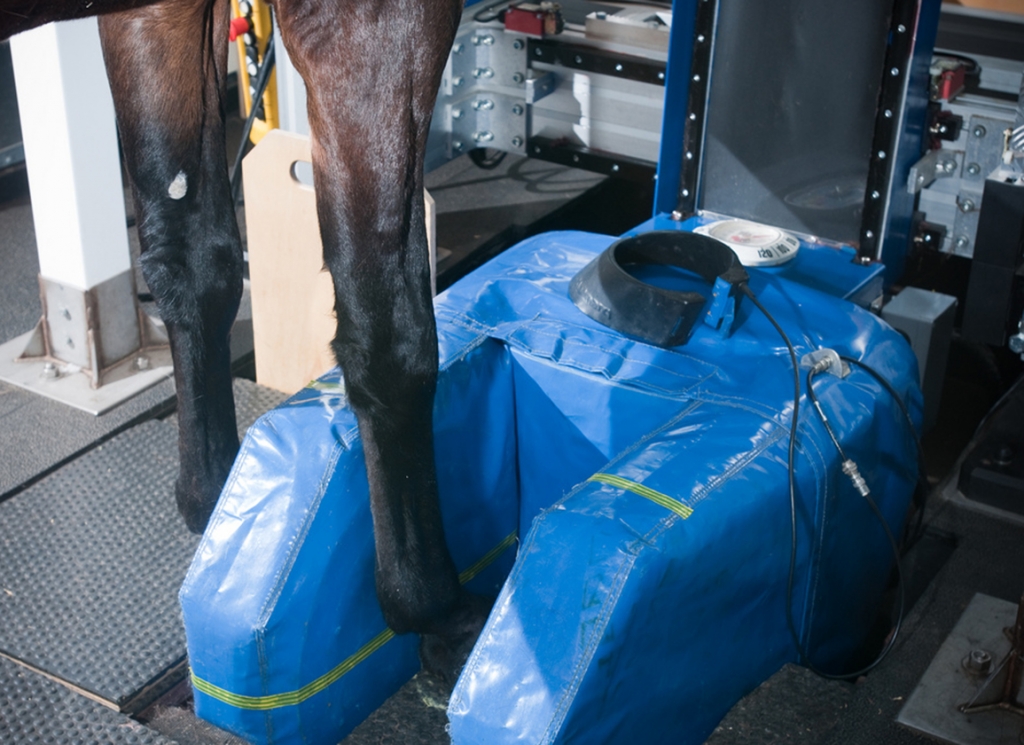
Standing MRI | UC Davis photo

Participants in the study–which is funded by the Dolly Green Research Foundation and the Southern California Equine Foundation–will be split into two.

There will be 23 case horses whose lameness has been narrowed to the fetlock region, and 23 control horses who exhibit no visible sign of lameness.

The 23 case horses will be selected by Dr. Tim Grande, the California Horse Racing Board (CHRB)'s chief official veterinarian, from a variety of scenarios where regulatory veterinarians commonly have to intercede in a horse's training or racing program.

These include a morning or race-day scratch, a voided claim, and lameness in the test barn or following a scheduled work or race.

The control horses–those with no visible lameness–will be selected as a comparative match in terms of things like sex, age, and class.

If a case horse is picked from a race, then the winner–if sound–will make an obvious control match. If a case horse is selected after a workout, then a suitable match will be selected using PPs.

And what exactly will the researchers be looking for? The answer encompasses four specific areas of concern within the fetlock joint, the primary site of musculoskeletal injury in racehorses.

Researchers will be looking for density within the proximal sesamoid bones and distal cannon bone, bone marrow edema–or swelling–in the cannon bone, and palmer osteochondral disease, a type of bone bruising commonly referred to as just “POD.”

To elaborate on these points, Peloso pointed to a couple of relatively recent papers he had co-authored connecting important diagnostic dots.

Two issues associated with fetlock failure are high density–noticeable bone development that predisposes a horse to a greater risk of fracture–in the sesamoid bone and palmer osteochondral disease, while condylar fractures are linked to bone marrow edema and high density in the distal cannon bone.

“It's because of those two papers that we've dialed in on those bone changes,” said Peloso. “Maybe the study will teach us something new, and so, there'll be something that gets added to it.”

The standing MRI unit has been part of the Southern California backstretch furniture since the start of last year. Since then, the unit has been used to scan hundreds of fetlocks.

Nevertheless, as a relatively newfangled diagnostic tool, the MRI is still looked upon with a touch of skepticism by some corners of the backstretch community, including attending veterinarians, admitted Peloso.

As such, this study is seen as an opportunity to increase the volume of MRI equine traffic. “It needs to be a real relationship so we can do best by the horse and best by the owner,” Peloso explained, before looking at the broader implications from this and other such studies.

“It'll be interesting to see to what degree some of these imaging modalities–PET, CT if it makes it, MRI–what role they play to help the regulatory veterinarian identify who's safe and who's not safe.”

The post New SoCal MRI Study Aims to Bring Clarity to its Diagnostic Role appeared first on TDN | Thoroughbred Daily News | Horse Racing News, Results and Video | Thoroughbred Breeding and Auctions.
Source of original post

Knicks Go Set to Join Growing Taylor Made Roster

Following his emphatic triumph in the 2021 GI Breeders' Classic, champion Knicks Go (Paynter -Kosmo's Buddy, by Outflanker) enjoyed a brief interlude from training as he spent about a week at Taylor Made Farm, where he will soon begin his stud career, before he returned to the Brad Cox barn at Churchill Downs.

The colorbearer for the Korea Racing Authority cemented his status as the top older dirt male in the country with his gate-to-wire Classic victory. Now, the favorite for Horse of the Year honors is preparing for one last dance to defend his title in the GI Pegasus World Cup Invitational S. before he takes up stud duty in 2022.

Meanwhile, the team at Taylor Made is counting the days until they can welcome the famed grey back to their stallion facility.

“We are fired up about Knicks Go,” Duncan Taylor said. “He's the epitome of a racehorse. When you have a horse that wins the GI Breeders' Futurity at two, comes back and wins the GI Breeders' Cup Dirt Mile and then the next year wins the GI Breeders' Cup Classic, it doesn't get any better than that.”

Knicks Go was able to get an early taste of his future career during his short stay at Taylor Made as a steady stream of breeders dropped in to visit the new stallion.

“I think his conformation is definitely a plus,” Taylor said. “He reminds me a lot of Blushing Groom and Awesome Again. They're not overly big horses, but they're very well-balanced and have plenty of hip. I think those types of stallions cross well with a lot of different mares. He's very correct and he's one of those horses that have that look in their eye.”

The Taylor family is familiar with their new addition's sireline through their involvement with now-pensioned stallion Tiznow, whose female family is also responsible for Grade I-producing sires Paynter, Oxbow and Awesome Patriot.

Knicks Go takes in the scenery upon his arrival at Churchill Downs on Nov. 17 | Coady

“If you look at this year's Breeders' Cup, you have [Filly and Mare Sprint contestant] Bella Sofia, who is by Awesome Patriot, [Classic contestant] Hot Rod Charlie by Oxbow and Knicks Go by Paynter,” Taylor explained. “So this sireline can get you a runner. We had Tiznow and everybody thought, 'A son of Cee's Tizzy. Why do you want him?' But he turned out to be a great stallion for us.”

Bred in Maryland by Angie Moore and daughter Sabrina Moore, Knicks Go is out of the stakes-winning mare Kosmo's Buddy (Outflanker). A debut winner at two, the colt went on to win the GI Claiborne Breeders' Futurity and was runner-up in the GI Breeders' Cup Juvenile.

“Sometimes when horses race until they're five, you sort of forget about their 2-year-old career,” Taylor joked. “But the fact that he won a Grade One at two, that says everything. Everybody's looking for that.”

At three, Knicks Go failed to make it to the winner's circle and was transferred to the Brad Cox barn for his 4-year-old season. He ran undefeated in three starts that year by over 20 lengths combined, with his season culminating in a record-breaking performance in the GI Breeders' Cup Dirt Mile.

This year, Knicks Go was five for seven against graded company, accumulating Grade I wins in the Pegasus World Cup Invitational S., Whitney S. and the Breeders' Cup Classic, where he defeated a pair of leading sophomores in GI Kentucky Derby winner Medina Spirit (Protonico) and GI Belmont S. winner Essential Quality (Tapit).

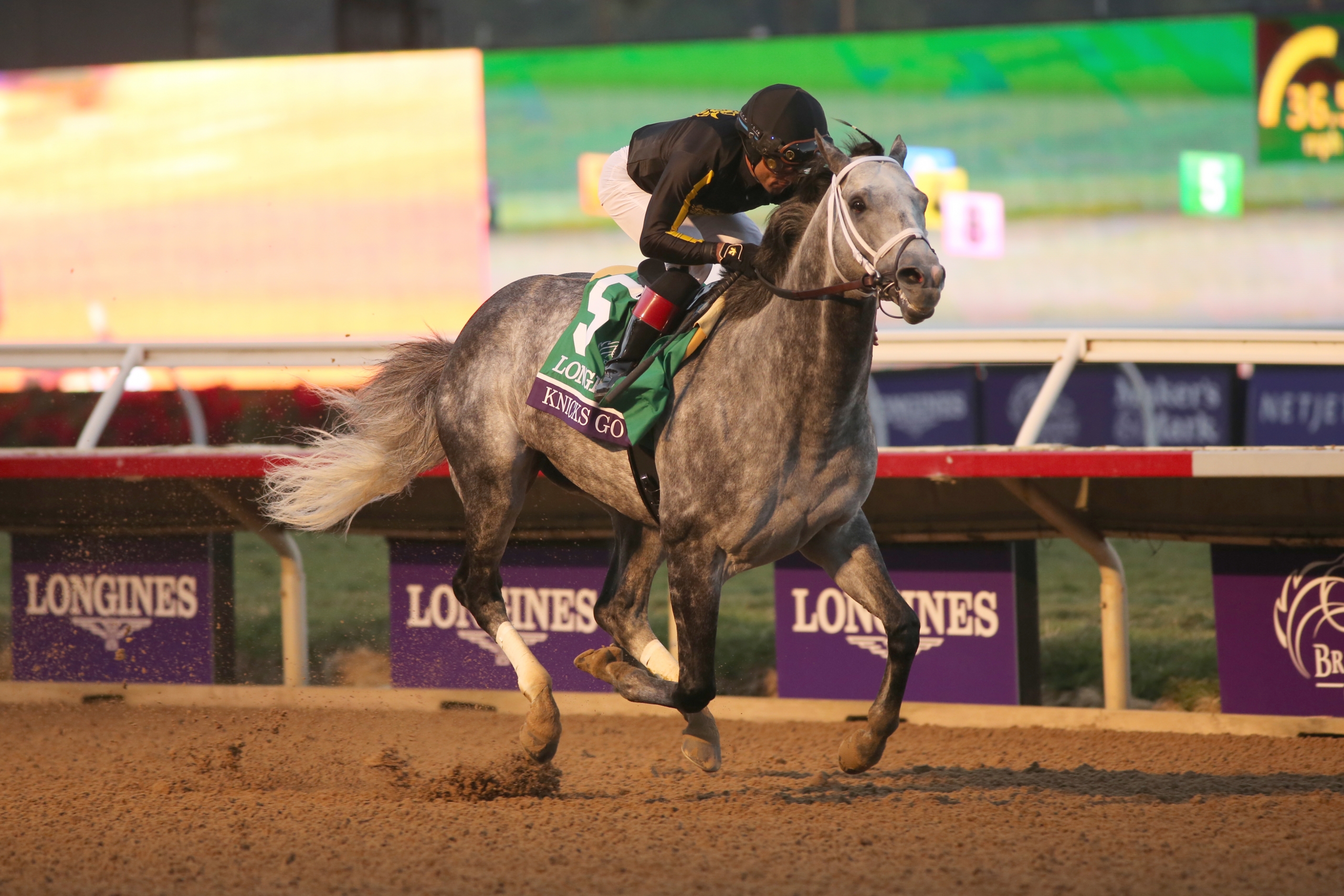
Knicks Go earns a 112 Beyer Speed Figure in the 2021 Breeders' Cup Classic | Horsephotos

“Knicks Go's best quality as a racehorse is speed,” Taylor said. “I remember Mr. [John] Gaines used to say that we're trying to breed the horse that has the most speed, that is the best looking and that can carry the speed the farthest. That's the kind of horse everybody is looking for. Not only can Knicks Go run fast, but he can carry the speed. Setting the track record in the Dirt Mile, that was quite an accomplishment that shows he has the speed. Then to go under two minutes for a mile and a quarter [in the Classic], that takes a special horse. Those two achievements set him apart from other racehorses.”

Taylor said that their team first started speaking with the Korea Racing Authority regarding their superstar's stud career as the colt was training up for the Whitney S. this summer.

“We knew they weren't wanting to sell part of the horse and they knew we do good marketing and work hard,” he explained. “When we started doing our research, we found that he was a perfect fit for us so we went for it.”

Knicks Go will begin his stud career with a $30,000 stud fee. He joins the growing Taylor Made roster alongside MGSW Tacitus, a regally-bred son of Tapit who will stand for $10,000.

“For us, it's hard to go out and buy a horse like this,” Taylor said. “We have to have some breaks in getting our stallions. You haven't ever seen us standing 20 or 25 stallions because we don't have the financial power to do that. But we do have the hustle and we do a good job with our stallions. We're aggressive and we're always trying new things.”

At a farm once home to the likes of heralded Unbridled's Song, as well as Saint Ballado and Forestry, Taylor Made's stallion program has welcomed several promising new additions in recent years.

“When you run a stallion operation, horses help each other,” Taylor noted. “Now we have Not This Time, who has shown that we have a proven stallion on the rise, and then with Instagrand, Instilled Regard, Mshawish and Midnight Storm, we have new blood at Taylor Made. So we have faith and we think Knicks Go is going to be a good one.”

The post Knicks Go Set to Join Growing Taylor Made Roster appeared first on TDN | Thoroughbred Daily News | Horse Racing News, Results and Video | Thoroughbred Breeding and Auctions.

Source of original post

RTIP Global Symposium to be Streamed Live

The 47th annual University of Arizona's Race Track Industry Program (RTIP) Global Symposium on Racing, to be held in Tucson Dec. 6-8, will be streamed live online for the first time. Roberts Communications Network (RCN) will make the live streaming package, which will include archived sessions of each panel, available for $195 on Racetrack Television Network (RTN), with all proceeds from the sales going back to the RTIP.

“We are thrilled to stream the symposium to a global audience for the first time,” said RTIP Chair Robert Hartman. “While there will be a huge turnout of industry attendees, we also understand that travel may not be possible for some, and felt it was important to make these panel sessions available to everyone. We are very appreciative of RCN's help in this endeavor and especially their generosity in donating all of the proceeds back to the program.”

The agenda for this year's symposium includes panels on and/or reports from the Horseracing Integrity and Safety Act (HISA), industry leaders sharing their three-year plan, ways to increase field size, seizing the fixed odds and sports betting opportunities, growing sponsorship revenue, and more.

For more information on the symposium, including a full agenda, visit ua-rtip.org/symposium.


The post RTIP Global Symposium to be Streamed Live appeared first on TDN | Thoroughbred Daily News | Horse Racing News, Results and Video | Thoroughbred Breeding and Auctions.

Source of original post

Verified by MonsterInsights