Notable US-Bred Runners in Japan: Dec. 11 & 12, 2021

In this continuing series, we take a look ahead at US-bred and/or conceived runners entered for the upcoming weekend at the tracks on the Japan Racing Association circuit, with a focus on pedigree and/or performance in the sales ring. Here are the horses of interest for this weekend running at Chukyo, Nakayama and Hanshin Racecourses. With the season winding down, this year's 2-year-old crop get their crack at Group 1 glory beginning with this weekend's Hanshin Juvenile Fillies. The boys get their chance in next Sunday's Asahi Hai Futurity:

Saturday, December 11, 2021
5th-CKO, ¥13,400,000 ($118k), Newcomers, 2yo, 1400m
MOZU BONHEUR (f, 2, Street Sense–Endless Chatter, by First Samurai) cost Capital Systems Co. $200K at last year's Keeneland September sale and is out of a stakes-winning and Grade I-placed half-sister to SW & G1SP Whitcliffsofdover (War Front) and to Berate (Blame), a good-looking maiden winner at Turfway Park Dec. 3. The filly's third dam is the excellent GISW Preach (Mr. Prospector), the dam of the influential Pulpit (A.P. Indy). The Curlin half-brother to Mozu Bonheur fetched $325K from Repole/St Elias at KEESEP this fall. B-Alpha Delta Stables LLC (KY)

Sunday, December, 12, 2021
6th-HSN, ¥13,830,000 ($122k), Allowance, 2yo, 1200m
CLOS DE MESNIL (f, 2, Practical Joke–Valiant Emilia {Per}, by Pegasus Wind) topped this year's OBS March sale on trainer Hideyuki Mori's $750K bid and she began to chip away at that investment with a hard-fought debut success over this course and trip Nov. 7 (see below, SC 7). She most recently set the pace in the Nov. 27 Cattleya S. at Tokyo, but dropped away in the final stages and cuts back to her winning distance for this. Clos de Mesnil hails from the female family of GII Tampa Bay Derby upsetter Helium (Ironicus). B-Teneri Farm (KY)


7th-NKY, ¥13,830,000 ($122k), Allowance, 2yo, 1800m
FIFTY CHEVY (c, 2, Tapit–Stopchargingmaria, by Tale of the Cat), an $825K KEESEP purchase, won his maiden at second asking over 1800 meters (video, SC 11) and was an allowance third going that same distance next time out before finishing fifth at 10 furlongs when last seen Sept. 25. He tries the dirt for the first time here and is a candidate to handle it, as his dam counted the 2015 GI Breeders' Cup Distaff among her three top-level scores. Stopchargingmaria was acquired by Mandy Pope's Whisper Hill Farm for $4.4 million with this colt in utero at Fasig-Tipton November in 2018. B-Three Chimneys Farm LLC & Whisper Hill Farm LLC (KY)


12th-HSN, ¥28,600,000 ($252k), Allowance, 3yo/up, 1400m
LEMON POP (c, 3, Lemon Drop Kid–Unreachable, by Giant's Causeway) was a good-looking winner of his career debut going 6 1/2 furlongs at Tokyo last November and went missing off a strong victory in the Cattleya S. at headquarters three weeks later (video, SC 1). A $70K purchase out of the 2019 KEESEP sale, the chestnut is out of an unplaced daughter of MGSW Harpia (Danzig), a full-sister to the legendary and prolific Danehill and to the talented Eagle Eyed. B-Mr & Mrs Oliver S Tait (KY)


The post Notable US-Bred Runners in Japan: Dec. 11 & 12, 2021 appeared first on TDN | Thoroughbred Daily News | Horse Racing News, Results and Video | Thoroughbred Breeding and Auctions.

Source of original post

The California Series: Art Sherman

   In this TDN series, we curry lessons and wise counsel from veteran Californian figures who, like gold nuggets panned from the Tuolomne River in the High Sierras, have unearthed career riches on arguably the toughest circuit in the States.

   The series started with John Shirreffs and continues here with Art Sherman, son of a barber who would go on to train, for a period, the richest horse in history. Last month, Sherman announced his retirement. His last runner is expected this weekend.

The golf cart plunges out of the soupy early-morning fog swallowing Los Alamitos Racecourse like the focus of a slow-motion action sequence, Wagner's Ride of the Valkyries playing in the writer's ears, before rolling to a stop outside a barn with a plaque memorializing the GI Preakness S. of 2014.

Riding side-saddle on this mechanical rickshaw, Art Sherman springs from it like an elastic band–his 84 years be damned–marches over to a horse, all suds and statue–still on the wash rack, telling the groom and the hotwalker how well their soapy pupil had just schooled in the gates.

Commentary complete, Sherman finally heads for his office.

“That's it, I'm done for the morning,” he says. This, despite the clock hands reading 7:00, and the heavy foot traffic on the equine expressway leading to and from the track telling a far less finished story among the surrounding barns.

There are two reasons for the abbreviated workday–one is familiarity, a habit contracted from his former mentor, trainer Paul Guidotti.

“I'm always the first one on the racetrack. I just like to get my horses in and out and let them relax,” Sherman would later explain. “I don't like to wait for the horses to train and get tacked up and standing there and waiting.”

The other is practicality. With only a handful of horses in his care, the morning's a quick study.

Partly for this reason, Sherman has announced his retirement from training–though he won't disappear completely, looking to maintain an advisory role to his two trainer sons, Alan and Steve, and the occasional dabble in the world of bloodstock.

What the training ranks lose, however, is an important connecting thread between the sometimes sparse returns of California's current industry–short fields, disappearing farms, shrinking foal crops–with the profligacy of the industry's post-war extravagances.

None epitomize this more than owner-breeder Rex Ellsworth, who kept and raised hundreds of horses between farms in Ontario and Chino, inland from Los Angeles, and Sherman's first employer in racing.

“He grabbed my ass a couple of times and put me back in the saddle. I mean, I was airborne,” says Sherman, from his office chair, a hand shot airborne like a rocket as he describes Ellsworth's hands-on approach to breaking his young-stock, the old cowboy accompanying the crew on his pony-terrorizing them, too.

“He'd slap them under the belly. Boom!” he adds, another arm pretzel in the shape of Buckaroo.

For a period in the 1950s and the 1960s, Ellsworth and his trainer, Meshach Tenney, reigned supreme in the West–kings of an empire forged from California's golden sandy loam. But theirs was hardly a show-room operation.

Instead of sturdy white-picket fences, think barbed-wire. Instead of gourmet treats, think dry pellets manufactured on the ranch.

“I can't ever remember being with Rex and having any vitamins,” he says. “But all the horses looked good.”

Tenney shared that same spartan mentality. “He worked his ass off all day long. I used to hold the horses for him and he'd be shoeing them all afternoon, six or seven at a time.”

As for the horses, “They hardly were ever done up. I just used to feed them, no bandages.”

The Ellsworth school of rough-and-ready brooked no favor. “He broke every horse like he didn't care how they were bred,” says Sherman. Egalitarian, certainly. Uncompromising, too.

“You loved to ride their horses because when you rode them in the afternoon, they were broke,” he says. “They had to behave themselves, you know what I mean? This was a no-nonsense type of thing. There was no babying and feeding them sugar and all that.”

Spare the rod and spoil the child–back then, a backbone of a generational approach to raising horse and human alike.

In his own training career, however, Sherman has cultivated the opposite reputation.
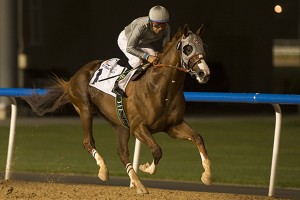
California Chrome | Edward Whitaker

Few who followed California Chrome's exploits could have failed to notice the rather doting paternal attention–akin to the proud father of the cocky jock–with which Sherman ushered the colt around the globe.

It's this careful approach that Sherman has used to produce a list of top performers nurtured over more seasons, and campaigned with much more of a competitive appetite, than is now standard.

“It's that confidence you build up between a horse and yourself, that you know you're doing the right thing and having a good rider ride them,” he says, in explanation. “That's very important, knowing your horse. I don't know how to even explain it.”

He doesn't need to explain it–it's right there in the numbers and the records. You have to go all the way back to 1991 to find the most recent winner of the GI Kentucky Derby, Strike the Gold, who raced more times than California Chrome. (The gelding Funny Cide, who won the 2003 Derby, isn't really a fair comparison).

Lykatill Hil, another of Sherman's multiple graded-stakes winning Faberge eggs, started his career two months before Bill Clinton won his first presidential election, and retired 19 wins from 61 starts later, only a few months short of that millennium's end.

Integral to Sherman's success, he says, was his own broad-brush grounding after he turned up on Ellsworth's doorstep without any practical experience with horses, and plunged straight into the breeding operation.

“He taught me everything and it wasn't the money,” he says, of his time with Ellsworth.

At the time, Khaled, sire of Swaps, was kingpin of the Ellsworth empire.

“I used to exercise him and keep him fit around the big pen. It was pretty interesting for a kid that never had been around horses,” says Sherman, bemoaning the lack of comparable opportunities for today's new racetrack inductees. “There are so many kids that have never been there around the breeding season, watching mares foal. Those things. They come to the racetrack now and want to be a jockey in a year's time, you know? But I think that schooling, the background of being at the ranch and working there for a year, really improved my mind about how a horse should be.”

His 22 years as a jockey proved something of a training manual pick-and-mix. “I think that helped a whole lot, getting the basics and watching different people train horses, you know what I mean? What works. Some of it doesn't work for a lot of people. I saw good horsemen-horsemen good with legs-but who could never condition a horse that great.”

But when asked who–or what–has been most influential in shaping his approach to training, Sherman steers straight towards Guidotti, who maintained a small stable in Northern California.

“You know, when I first started training I just decided I would just mostly be like Paul taking care of horses,” he says. “They always looked good. He was a good caretaker, good feed, top notch feed, you know what I mean? He gave vitamins which I do.”

Like Sherman now, Guidotti wasn't one for the morning bullets. “I'm not really for the fast workouts. I like distance. I like endurance. I like them to finish the last eighth of a mile and kick it in.”

Art and Alan Sherman and team accept Horse of the Year for California Chrome | Horsephotos

Moral lessons were also on offer. “He's the only guy I ever seen fire an owner over me. They wanted to take me off a horse that I won a little stake on and then the horse got beat. He told them, 'If you change riders, just take him to another trainer.'”

Unlike Sherman, the horse found lodgings anew.

Home in Sherman's early years with a license consisted of the barn tack room, his wardrobe a bunch of cast-offs from a jockey who quit the saddle to become a Mormon missionary.

“I had a hotplate and a little small fridge. I liked staying in the tack rooms. It was fun. I had the old locker where I had my clothes.”

Some 40 years later, he retires the trainer of 2,261 winners and the fourth-highest earning horse in history.

Gone are the penitential digs.

“I just sold my place here. I had a condo here in Cypress,” he says, of his home near Los Alamitos. “I've got another place in Rancho Bernardo in San Diego.”

But acquired along the way has been one valuable lesson. “Patience is a lot of it, you know what I mean?” he says.

“You just can't, like I said, train every horse the same way. Some horses have got little quirks about them. You just got to realize what capabilities that your horse has. Conditions help you win races. Don't run them over their head. Don't put them in spots where they got to run their eyeballs out and get beat, you know what I mean? Don't over race them to a point where you take the heart out of them.”

In part two next week, Sherman talks Swaps and California Chrome, and gives his thoughts on the evolving shape of the California industry.

The post The California Series: Art Sherman appeared first on TDN | Thoroughbred Daily News | Horse Racing News, Results and Video | Thoroughbred Breeding and Auctions.

Source of original post

Smaller, But Still Super: David Donk

The concept of the super trainer is by no means a new phenomenon in horse racing, but the huge stables run by super trainers have undoubtedly changed the landscape of the sport in many ways, from the backside to the racing entries. Are super trainers bad for the sport? Are there any benefits for an owner in using a “smaller” trainer? We asked these questions and more to a few trainers who may not be considered super trainers in terms of their stall numbers, but they have made the most of the horses they're given to build competitive racing stable over their careers.

David Donk's stable has been a fixture in New York for over 30 years. His most notable runners include MGISW Awad (Caveat), plus graded stakes winners Hessonite (Freud), Ordway (Salt Lake), King Kreesa (King Cugat) and Pennine Ridge (Cure the Blues). The easygoing and approachable horseman enjoys spending time developing young horses and takes pride in being one of first ones at the racetrack each morning. Donk is approaching 800 career wins and is represented this year by Shesastonecoldfox S. winner Shesawildjoker (Practical Joke).


KP: How did you first get involved in horse racing?

DD: I grew up in a small town in upstate New York near Finger Lakes Racetrack called Clifton Springs. My dad owned and bred some horses and we were neighbors with the trainer that he used. I got hooked at a very young age and realized, probably when I first got into high school, that it was something that I wanted to pursue.

After I graduated high school, I did train on my own at Finger Lakes  for five years, mainly with my dad's horses, and then I got a break in the spring in 1985. Phil Gleaves left to go out on his own so I got hired as an assistant to Woody Stephens.

I worked for Woody for five and a half years until his health wasn't doing as well and then I went out on my own in 1991. I started out with seven horses. I had a couple for Henryk de Kwiakowski, Jim Ryan [Ryehill Farm] and John and Theresa Behrendt. I was able to stay in New York and gradually have a bit of success, enough to where I was able to stay in New York to make a living. I've been here for 36 years.

KP: How many horses are normally in your stable?

DD: The number has been a little bigger for the last few years. I'm at about 50 over the summer. I try not to have any more than that. In the winter, I try to get to the low 30's. I have a lot of people who are on visas and have to go back, so I try to reduce the size of the stable to make it a little more comfortable and easier on us all in December and January before we gear back up again.

KP: Who have been your biggest mentors throughout your career?

DD: First would be my dad, who is still with us, and then the biggest break of my career was getting a job for Woody Stephens. I like to say that I went to one of the best universities in the country when I worked for him.

KP: What horse was the most influential to your career?

DD: My most influential horse is obviously Awad (Caveat). He made $3.2 million in his career, had over 70 starts and won a few Grade I races. We got to travel all over the country and we went to Japan twice. That's the horse that put me on the map and where I'm at financially. There's no question that he was the horse who is most influential for me.

KP: What do you believe makes your stable unique?

DD: This is a business, so when you are a trainer, you are the president and CEO of your own company. One of the classes I took in high school was bookkeeping. I always knew that if I was going to have a business, I needed to be able to do the financial side of it.         Horse racing today is different from when I was a kid or even from one or two generations ago. There's a lot more to it. You are the president and CEO of your own company and there's a lot of federal, state, immigration and law regulations. Even if you don't do the bookkeeping yourself, you need to understand it. You're the one that's liable and you're the head of the company.

It's not just about training horses. There's also the customer service side of it with clients. I'm a little bit unique in that I like the paperwork and the business side of it. I do most of my own bookkeeping. My dad taught me this as a kid and now I preach it to my kids-it's not a bad thing to be your own boss. The biggest difference is that you work 80 hours a week instead 40 hours a week, but at the end of the day, it's your own.

I've been here a long time, but I've had a number of clients who I've had for 25 years with John and Theresa Behrendt, Charles Marquis, Bill Punk and Bob Spiegel. I've been fortunate that I've had a lot of loyalty and at the same time, they're very successful in their own professions and they've taught me a lot.

Shesawildjoker (Practical Joke) breaks her maiden on debut this summer before running in the money in three stakes, including a win in the Shesastonecoldfox S. | Coglianese

KP: What do you believe are the benefits, for owners, in using a “smaller” trainer?

DD: They're going to run more often. I come from a different era and the game has changed a lot. I sometimes say that owners, to a degree, are brainwashed. Horses can run more than once every two months. Sometimes economics don't come into play for them.

I understand the financial side of it for an owner. In New York, we run for a lot of money. I always say that I don't win enough. Sometimes I don't run my horses quite where they belong because I cater to what a client wants to do. I call it customer service. Maybe it's too far to an extent, but if you're running second or third in New York all day long, it pays a lot of bills for the client and keeps money in circulation. We're not always looking at it by numbers or in percentages. That's where technology has changed things a little bit. Everybody is worried about their numbers.

I enjoy 2-year-olds and trying to educate them to shed a little light onto what their quality might be. Sometimes you might run them a little over their head to find that out and appease someone.

Of course, we live in a democracy so I wouldn't take anything away from the big stables. But at the same time I think those owners should be willing to diversify their stable a bit more and give younger trainers who are up-and-coming an opportunity. There are a lot of really good people out there. We have some in New York now, even some female trainers who I hope are successful because we need 20 or 30 more of them.

KP: Do you think super trainers are bad for the sport?

DD: It's fair to say that it's not good for the sport when we're trying to sell races. Handle is based off of field size. We see it in New York that in the better allowance races, the field sizes are not as big as you would like them to be. That goes back to horses not running quite as often. There are rules in place where a trainer can only run two horses in a race and in New York if a race overfills, a trainer can only run one. So I think the biggest downfall is that it affects field size.

KP: What do you enjoy most about your job?

DD: I have two kids so I do a lot of coaching and I always tell them that in life, if you find something you like to do, you'll be happy. If you find something you love to do, you have a chance to be really successful.

I love what I do. I love the early mornings. I think the greatest part of the day is the first set at 5:30 when it's really quiet and has that serene feeling to it. I'm getting a little older so I try to get away a little bit or a couple of days a week during the winter, but at the same time when I'm away for a few days, I miss it. I'm at an age now where I see people who I went to school with who are retiring. But boy, I don't know if I could ever retire. I love the quality of help that I have and the quality of clients that I have. I love the challenge of training two-year-olds and then continuing to learn and do a better job. I love the human aspect to it as much as the equine aspect.

With Ramon Dominguez aboard, Hessonite wins the Ticonderoga S. for Donk in 2012 | Horsephotos

KP: What is the most frustrating aspect of your job?

DD: The most frustrating part of this industry is getting people to come to the table to make compromise. It takes too long to make changes in our industry. I believe that a lot of common sense heads could come together and make decisions. It's frustrating that as an industry, we seem to be behind the times, even in the U.S. compared to the standards internationally.

KP: Do you have any thoughts on the Horseracing Integrity and Safety Act (HISA)?

DD: Not at the moment, but there was a great comment the other day from [NYTHA President] Joe Appelbaum, who sent out an email to our membership. He said that at the moment, the bill is written by lawyers for lawyers to understand. So right now with the way the bill is written, no one understands it. So it remains to be a bill that obviously needs a lot of input.

So it's far from being done in a way that is understandable and has a common sense approach, but it is needed in our industry. I think we can always do a better job and we need the rules to be the same in every jurisdiction. Again, we're behind the times and I think it's a good thing, but there's a lot more work to be done and hopefully now that the bill is out, a lot more good people will get involved with it.

KP: If you didn't have a career in horse racing, what would you do?

DD: I don't know. I always say that if it wasn't for racing, I'd probably be driving a truck for UPS. I knew what I wanted to do when I was a freshman in high school. I think as I've gotten older, I could have gone into management, but at the same time and more importantly, I love being my own boss.


To nominate a trainer for this ongoing series, email katiepetrunyak@thetdn.com. General criteria: Multiple graded stakes-winning trainer, fewer than 300 starts this year, has trained for over 20 years and accumulated no more than approximately $50 million in career earnings. 

The post Smaller, But Still Super: David Donk appeared first on TDN | Thoroughbred Daily News | Horse Racing News, Results and Video | Thoroughbred Breeding and Auctions.

Source of original post

Homebred Code of Honor Arrives at Lane’s End Farm

   Code of Honor (Noble Mission {GB} – Reunited, by Dixie Union) arrived at Lane's End Farm, where he will stand the 2022 season, early in the morning hours of Tuesday, Dec. 7. The multiple Grade I winner was bred and raced by W.S. Farish and earned nearly $3 million over his four-year career.

“It's a really fun day for all of us at Lane's End,” Bill Farish said after watching the homebred take in his new surroundings at the Lane's End stud barn. “Code of Honor coming home is something we've been waiting on for a long time, so it's very exciting to get him here and we're really looking forward to starting his breeding career.”

Bought back by Lane's End at the 2017 Keeneland September Sale, Code of Honor was soon sent to trainer Shug McGaughey. The chestnut broke his maiden on debut as a juvenile at Saratoga and ran second in the GI Champagne S. after stumbling at the start.

As a sophomore, the colt won the GII Fountain of Youth S. before finishing third in the GI Florida Derby and second in the GI Kentucky Derby. He then rolled off consecutive victories in the GIII Dwyer S., GI Runhappy Travers S. and GI Jockey Club Gold Cup S.

The Travers win, Farish said, marked an unforgettable day for the Farish family.

“It was a real high point for us,” he explained. “It's hard to put into words. It's something that Dad has been trying to do for a long time and we have been second twice, so it was a big, big day for us. It's really what it is all about for us. It's very rewarding to go to the sales and pick out a Grade I winner, but to breed one is a whole other thing.”

As an older horse, Code of Honor captured graded victories in the GIII Westchester S. at four and the GIII Philip H. Iselin S. at five. He also hit the board in the GI Runhappy Metropolitan H., GII Kelso H., GI Clark S. and GII Hagyard Fayette S.

The six-time graded stakes winner is from the first crop of Noble Mission and is out of the W.S Farish-bred and owned Reunited, winner of the 2005 GIII Thoroughbred Club of America S. Farish said he is confident that the versatility in Code of Honor's pedigree will be reflected in the individuals he will soon produce.

“I wouldn't be surprised at all if he was able to get both dirt and turf horses with his pedigree,” he noted. “He has a lot of speed on the bottom side and he has stamina on the top. He's a really well-made horse with a tremendously-efficient stride and he's a real throwback-type horse.”

Code of Honor will stand for a fee of $10,000 in 2022.

“We're going to be supporting him very heavily,” Farish said. “We're going to put everything we can into getting him a really good first crop and we've priced him to where we think he's unbelievably attractive for a horse with his credentials. We just can't wait to get going.

The post Homebred Code of Honor Arrives at Lane’s End Farm appeared first on TDN | Thoroughbred Daily News | Horse Racing News, Results and Video | Thoroughbred Breeding and Auctions.

Source of original post

Verified by MonsterInsights