Diego Herrera: A Prepared Young Man is Worth Two

Cauthen, Ouzts, Bourque, Parker, Migliore, Delahoussaye and Baze all have one thing in common–perhaps several, if we are splitting hairs.

They all started from the ground up: mucking stalls, grooming, walking hots. All too often nowadays, young upstarts are appearing and eschewing the shank for the helmet, goggles and jock's license, which is why it's so refreshing to spend some time with apprentice Diego Herrera who, at just 17, is wise beyond his years.

Herrera is currently eighth in the jockey standings at the Santa Anita meet with six winners.

“Just come to Los Al, I will be there all day,” he said. All day? What the hell is he doing there “all day”? Santa Anita is closed Tuesdays to workers so most jockeys take the day off.

Intrigued, I hopped in my car and headed down the 605 to Cypress, California. I arrived about 10:30 a.m., only to be greeted by the gate crew on their way out after finishing up the morning's trials, or “training races.” One horse was left on the track with a jockey riding legs-length and smiling as he walked off the track toward me. It was Herrera.

Once off his mount and at the barn, one thing stood out: there were no fewer than four wheelchairs in various states of disrepair, one of them housing a grinning Oscar Andrade, Sr. and his dog, Fendi. “He's hard on them,” said his wife, Elena, with a giggle.

Andrade was a very successful Quarter Horse jockey who once mimicked Frankie Dettori by winning seven races on a single card at Los Alamitos, a record that still stands today. His son, Oscar, Jr., was just 10 days old when Andrade was paralyzed in a spill in 2001.

It was evident that the Andrade barn was more than just horses. Herrera explained the father-son dynamic between himself and Andrade, who, funnily enough, is no relation at all.

“He's like a father to me, but also has been very hard on me. He has always told me, give 110% and never look back. That's what he did and he has no regrets.”

Herrera went on to talk about learning how to gallop on the farm, how Andrade would make him gallop the babies bareback or take away his stirrups.

Herrera remembers asking, “Why? I'm going to be riding with stirrups!” To which Andrade simply replied, “You never know.”

This invaluable lesson was evident Jan. 14 in the eighth race at Santa Anita, when he was riding a longshot at a mile on the grass. Herrera's stirrup became unbuckled, he lost an iron, kicked out the other one and went on to finish second aboard the Philip Oviedo-trained Explain This Audit (Vancouver {Aus}).

“That really, really opened my eyes,” said Herrera. “I thought after, 'Okay! That's why he did that.'”

Herrera was born in Inglewood, a stone's throw from Hollywood Park. His father owned some Quarter Horses and Herrera as a young boy would spend many days at Los Alamitos. When Herrera wasn't with his father, he would spend time “training” his pony, Sparky, a tiny bundle of fur, through the riverbeds of Los Angeles County.

According to Herrera, Sparky won match races from Long Beach to as far away as Idaho, carrying his flyweight 40-pound, 8-year-old rider, Herrera. It was here the racing bug took off.
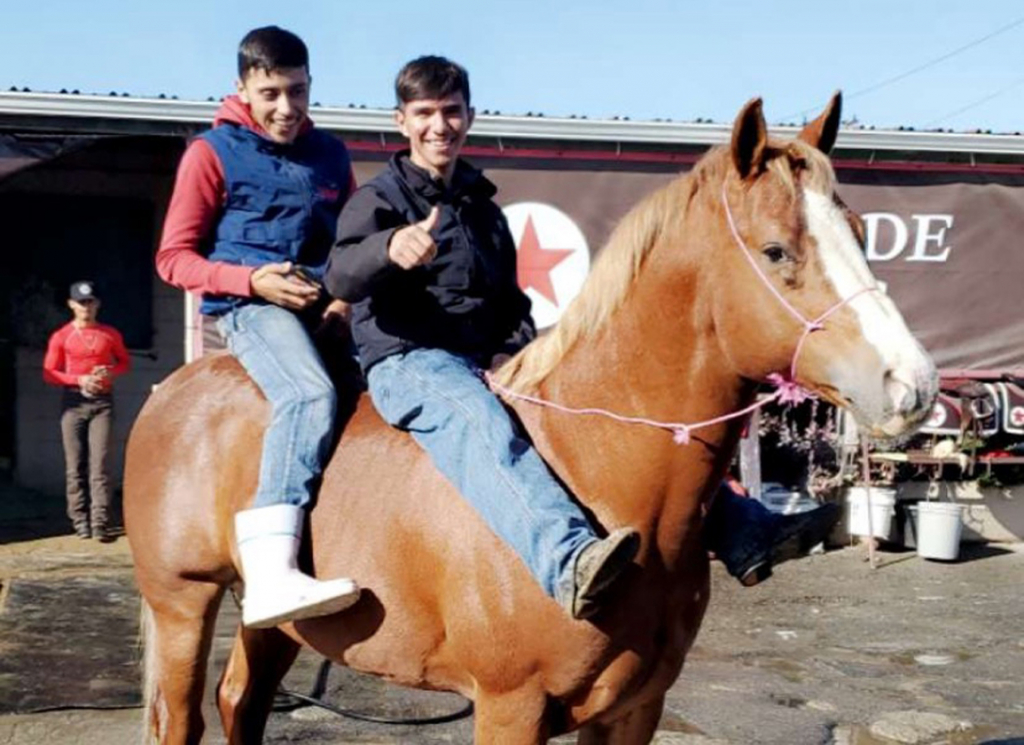
Herrera with Oscar Andrade, Jr. | Courtesy of Diego Herrera

Back at Los Alamitos, he made fast friends with Andrade, Jr. The two of them would watch the races on the roof together, race each other on hay bales and even sneak into the jock's room to practice on the Equicizer. In between the fun and games, the two boys would be put to work by Andrade's mother and Quarter Horse trainer Elena, mucking stalls, raking the shedrow, anything that would earn them a leg up.

It was in the Andrade barn that Herrera felt he finally fit in.

“You know, as a kid I didn't really have a lot of friends,” said Herrera. “I talk to everybody but I didn't consider anybody else a real friend. But when I met Oscar, he showed me what that horseman feel is. You don't make relationships with people; you make them with horses.”

As Herrera and Andrade, Jr. grew up, they only had one thing on their mind and that was to go fast. But to go fast meant they would have to put the work in, as Elena Andrade explained: “Our barn, the deal is you have to learn the fundamentals. The foundation. The inside of a horse from the ground up, not just get on a horse and go fast.”

Herrera never intended to be a Thoroughbred jockey, thinking more along the lines of Quarter Horse pilots G. R. Carter and Cody Jensen. But it was at the behest of trainer Angela Aquino–sister of Elena–for Herrera to give Thoroughbreds a go. He was light, could do the weight, so why not?

It didn't take long for Herrera to start winning the regular nighttime 1,000-yard races and 4 1/2-furlong races for Thoroughbreds.

When he rode his first double, Scott Craigmyle–director of racing operations at Los Al–got on the phone, and just like that, he was off to Santa Anita, first under the tutelage of Vince DeGregory, who has handled the books of such luminaries as Shoemaker, Cordero and Pincay, and now under Derek Lawson, who previously managed Flavien Prat. As for his Quarter Horse business, that is handled by April Ward, who books all his mounts.

So, where did his Puritan work ethic come from?

Herrera said he grew up watching his father toil with his landscaping business day and night. “He wants to strive to be a better person in this world.” His father never went to school but always told his son, “A prepared young man is worth two.”
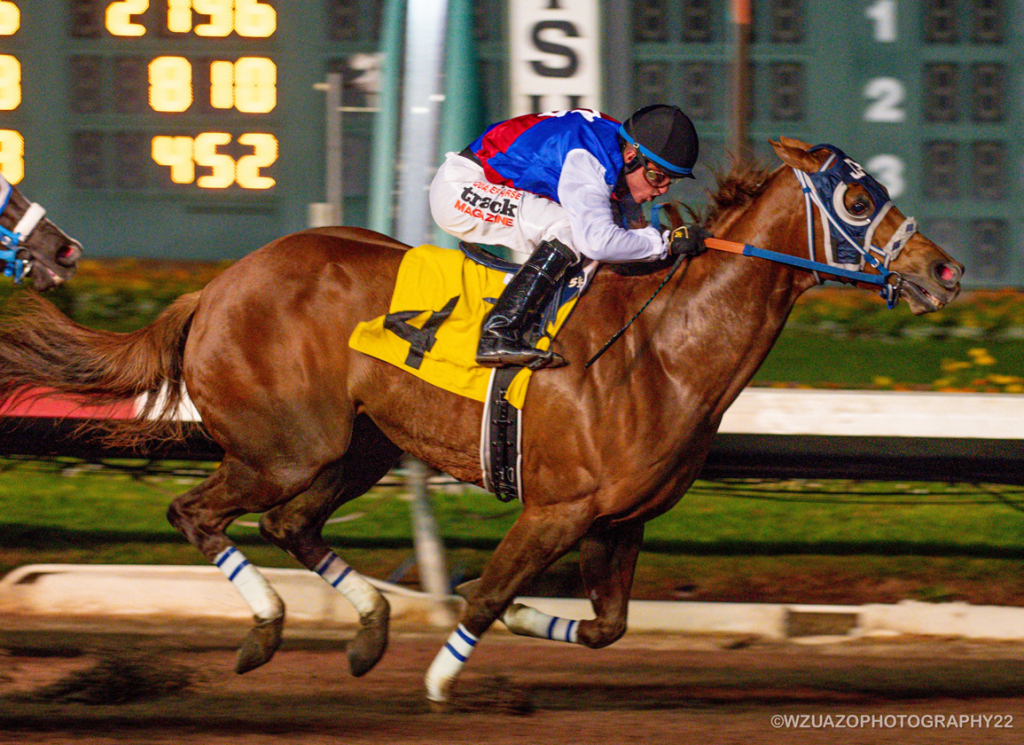
Herrera's GI Quarter Horse win on Kiss Thru Fire | William Zuazo

A pick-up mount on the favorite in a Grade I Quarter Horse event was not something the teenager was expecting the night of Jan. 2. Herrera recalled having 13 mounts already that day, five of them at Santa Anita. He was getting ready to go home when he got a call in the jock's room to pick up a mount.

“It was crazy,” said an animated Herrera. “I didn't know she was the favorite, and when I looked up, I saw she was and I was like, 'Okay, no pressure.'”

The horse in question was Kiss Thru Fire, the defending champ in the GI Charger Bar H., contested at 400 yards. Herrera called it a surreal moment as he hit the line half a length to the good.

Herrera picked up his first turf win going two turns on the Santa Anita sod the very next day.

So, what's next for the teen from Inglewood?

“I'm just going to keep working hard and learning every day,” he said, and then added, “A nomination for an Eclipse Award would be nice.”

Herrera's bug is over in April, but that won't stop this lad dreaming his dreams, now longer than 440 yards.

The post Diego Herrera: A Prepared Young Man is Worth Two appeared first on TDN | Thoroughbred Daily News | Horse Racing News, Results and Video | Thoroughbred Breeding and Auctions.

Source of original post

2022 Mating Plans: Smokin C LLC (Steven Chumney)

STORM RAVEN (m, 6, Bodemeister–Crystal Current, by A.P. Indy), to be bred to Justify

Several days into the 2020 Keeneland November sale, I found Storm Raven. She was just what I was looking for, a 2-year-old winner from a deep dirt race family and in foal to my most sought-after covering sire, Vino Rosso.

Fast forward to not quite a year later and I found myself at the Fasig Tipton Night of the Stars November Sale. Her beautiful scopey Vino Rosso Colt sold for $150,000, becoming my top sale, was the highest-priced Ohio-bred weanling in 2021. My hobby now turned profitable and the dream of being able to breed a mare to Justify was looking like a possibility. Coolmore had looked at the Vino Rosso colt and liked the Justify/Storm Raven mating and after analyzing a few other options, the contract was signed to breed to Justify in 2022. Dreams really do come true.

CANDY LANE (m, 6, Twirling Candy–Tangueray Miss, by Cowboy Cal), to be bred to Practical Joke

I walked the Keeneland Sales grounds with my best friend Jon Wise in 2021, looking for another standout mare that would fit my program. After a couple of good sales earlier in the year, our budget had grown. Candy Lane was that standout to us. A young multiple stakes placed  Twirling Candy mare from a family of solid dirt winners and in foal to Justify, I doubted the chances, but decided to make sure we were there when she sold. She ended up selling for the exact amount that I had written down for her. In all of my excitement, I hadn't really considered that although our Ohio OTBO board had passed a rule allowing me to make the Justify foal an Ohio-bred, it still had not been approved by the Ohio legislature.

My only commercial and financially responsible option with her would be to become a Kentucky breeder, leave Candy Lane there to foal and breed her back to Kentucky stallion. It was a bittersweet decision. Candy Lane's pedigree lines up particularly well with Into Mischief line, and we spent the rest of the November Sale looking at foals of sons of Into Mischief and decided that Practical Joke was the best choice for Candy Lane based on the attributes he was passing on to his foals.

I am so excited for these 2022 matings and hope to see them result in great foals for these two young mares.

Let us know who you're breeding your mares to in 2022, and why. We will print a selection of your responses in TDN over the coming weeks. Please send details to: garyking@thetdn.com.

The post 2022 Mating Plans: Smokin C LLC (Steven Chumney) appeared first on TDN | Thoroughbred Daily News | Horse Racing News, Results and Video | Thoroughbred Breeding and Auctions.

Source of original post

Like Baseball, Racing Will Have to Come to Grips with Unsettling Era

While horse racing was consumed last week by headlines related to the federal doping conspiracy trial and Bob Baffert's exclusion hearings at the behest of the New York Racing Association (NYRA), the sport of baseball, too, was embroiled in its own ongoing performance-enhancing drug (PED) saga.

Last Tuesday, retired slugger David Ortiz was voted into the Baseball Hall of Fame in his first year of eligibility, while Barry Bonds (the all-time and single-season home run record-holder) and Roger Clemens (one of the most dominant pitchers in major league history) both were denied entry by a lack of votes in their 10th and final years on the ballot.

Baseball's controversy had been simmering for years against the backdrop of the “steroid era” that ran roughly from the late 1980s to around 2010, during which a number of prominent players with outsized statistical output were either strongly suspected of or tested positive for PED usage.

While Ortiz reportedly tested dirty in 2003, it was later suggested by league officials that his one-time bad test (for a substance that has never been publicly disclosed) was the result of a false positive. Given his otherwise clean record and Hall-worthy stats, Ortiz sailed through the voting in his first try. But Bonds and Clemens–both of whom had never tested positive for, nor were ever disciplined for PED usage–again didn't make the cut despite overwhelmingly dominant on-paper credentials.

Baseball's Hall of Fame is unique compared to other sports in that it has a clause stating that those voted worthy of the honor “shall be chosen on the basis of playing ability, sportsmanship, character, their contribution to the teams on which they played, and to baseball in general.”

The “character” part of that requirement is why Bonds and Clemens failed to secure the necessary 75% of the voting bloc. Just like the presumed prolific juicers Mark McGuire and Sammy Sosa, who had also put up incredibly aberrational numbers in the 1990s, they were all denied entry because of the rampant perception they had cheated and sullied their sport.

An obvious (and admittedly flippant) racing-related take on this is that perhaps baseball should be more like our sport–we induct Hall-of-Famers (at least the human ones) while they are still active in the game.

It is only after honoring trainers and jockeys for lifetime accomplishments that regulators and racing associations occasionally have to make uncomfortable decisions about whether those honorees will be allowed to participate in the day-to-day doings of Thoroughbred racing.

But the election of Ortiz could be signaling another subtle shift in baseball's Hall voting. As the years and decades pass, there is a greater likelihood that future voters will decide that players from the PED era were not specifically guilty of doping because they were caught up in a time when the entire game was perceived to be pharmaceutically tainted. Blaming circumstances always gets easier with the passage of time.

Yet as John Feinstein of the Washington Post put it last week, “A Hall of Fame–in any sport–is supposed to be about what is good in that game. It goes beyond numbers. If you insist that Bonds and Clemens should be included because of their performance, fine. Then the Hall should create a 'Steroids Wing' and recognize those with stunning statistics who we know used steroids, even if they never tested positive.”

Racing, too, is going to have to make similar decisions in the long run.

In fact, you can already see some of the nearer-term ramifications of NYRA's attempted banishment of Baffert and the edict issued by Churchill Downs, Inc. (CDI), that prohibits Baffert's trainees from running in the next two GI Kentucky Derbies coming more clearly into focus.

In the case of NYRA, it's a Pandora's Box type of vicious cycle. Now that Baffert has been established as a baseline for exclusion, who's next? We already know that trainer Marcus Vitali is scheduled for a similar “go away” hearing in March. And NYRA announced just last week trainer Wayne Potts could be on deck.

It doesn't take more than a quick scroll through social media or a chat with backstretch folks to come up with a growing list of alleged wrongdoers who all fit the mold of, “They're trying to rule off Baffert, but what about so-and-so?”

So where does it end? Can we expect that NYRA will be charging and then holding exhaustive, week-long hearings related to detrimental conduct on a continual basis from here on out? The costs could be staggering, both in terms of actual legal expenses for NYRA, plus the public relations price of never-ending negative headlines becoming entrenched atop the news cycle.

Then again, another school of thought holds that this type of trainer-by-trainer house-cleaning is long overdue and is exactly what NYRA needs to do as a protective measure.

As for CDI's banning of Baffert from the Derby, it's also fair to ask how this decision will affect the image of America's most iconic horse race over the long haul.

Right now Baffert trains two undefeated Derby contenders, the presumed divisional champion and 'TDN Rising Star' (Corniche), plus Saturday's winner of the GIII Southwest S., Newgrange (Violence). Per usual, the seven-time-Derby-winning trainer could have another colt or two primed to peak before the first Saturday in May rolls around.

A few weeks ago I wrote about how CDI's ban could backfire by turning Baffert's exclusion into the unwanted focal point of the 2022 Derby. Now let's widen the lens further: How do you think history will portray the “most exciting two minutes in sports” when the ink is dry on what might someday be called the “Dirty Derby” era that started in 2019?

We already have a decent idea of what the first section of that rough draft will look like. It starts with Maximum Security, a one-time $16,000 maiden-claimer, soaring improbably above his peers to win the 2019 Derby, only to get disqualified for a debatable in-race interference call that roiled the sport for months.

A year later, in 2020, we learned that Maximum Security's trainer, Jason Servis, was arrested in a nationwide equine drug sweep, and that the feds allegedly have him on wiretap repeatedly discussing the doping regimen of Max during the time frame that included the colt crossing the wire first in that 2019 Derby.

Then 2021 brought us another unlikely Derby victor in Medina Spirit, a colt who was so unheralded in the sales ring that he once hammered for the too-low-to-be-true price of $1,000. Yet Baffert had him honed to such a high degree that he wired the field in the first leg of the Triple Crown.

This time, the feel-good aura of rags-to-riches glory barely lasted a week until it was revealed that Medina Spirit had tested positive for an overage of betamethasone, an infraction that has still not been adjudicated by state regulators in Kentucky (although it has sparked several high-profile federal lawsuits, CDI's no-Bob stance, and NYRA's attempts to rule off Baffert).

So if the story of the 2022 and 2023 Derbies ends up being the exclusion of Baffert's trainees, what do you suppose might happen if CDI ever decides it has to take action against other allegedly toxic trainers of top colts?

If it turns out that Baffert isn't the only conditioner told he's not welcome under the Twin Spires, the sport could soon be facing a difficult reckoning involving years in which a sizable swath of otherwise-eligible equine stars aren't allowed to participate in the Derby.

There might not be enough asterisks to go around if handicapping every year's foal crop becomes an exercise of exclusion related to which human handlers are deemed not worthy of the Derby.

Similar to baseball's steroids era, Thoroughbred racing is eventually going to have to come to grips with how the present will appear in the future.

Will the current time frame be viewed as an over-reactive witch hunt? Or will it eventually be defined as the era when the industry started cleaning up its act for the betterment of the sport?

Truth tends not to favor one extreme or the other, so the unknown answer to that question most likely lies somewhere in the hazy middle.

The post Like Baseball, Racing Will Have to Come to Grips with Unsettling Era appeared first on TDN | Thoroughbred Daily News | Horse Racing News, Results and Video | Thoroughbred Breeding and Auctions.

Source of original post

First Foal for Mr. Money

Five-time graded stakes winner Mr. Money (Goldencents–Plenty O'Toole, by Tiznow) was represented by his first foal when Road to Riches (Quality Road) produced a filly Jan. 20. The foal is the first out of the unraced mare.

“We're excited to see Mr. Money's first foals,” said Brent Fernung of Journeyman Stud, which stands the 6-year-old stallion. “Mr. Money is a handsome horse and I fully expect that he'll pass that along to his foals. With his talent and pedigree, we're anticipating great things from Mr. Money's progeny.”

Campaigned by Allied Racing Stable and Spendthrift Farm and trained by Bret Calhoun, Mr. Money won the 2019 GIII Matt Winn S., GIII Pat Day Mile, GIII West Virginia Derby and GIII Indiana Derby and was second in that year's GI Pennsylvania Derby. He added the GIII Ack Ack S. to his resume in 2020.

Mr. Money will stand for $4,000 in 2022.

The post First Foal for Mr. Money appeared first on TDN | Thoroughbred Daily News | Horse Racing News, Results and Video | Thoroughbred Breeding and Auctions.

Source of original post

Verified by MonsterInsights