HISA Appoints Guilfoil to Oversee State Commission Relations

Marc Guilfoil, Executive Director of the Kentucky Horseracing Commission, has joined the Horseracing Integrity and Safety Authority (HISA) as Director of State Racing Commission Relations.

In the role, Guilfoil will direct outreach to and collaboration with state racing commissions on the implementation of HISA's Racetrack Safety and Anti-Doping and Medication Control Programs.

Tom DiPasquale, a HISA consultant, has been performing in the role on an interim basis and will continue to do so until July 15 to facilitate a smooth transition.

“Marc is a respected leader in the racing industry with years of state racing commission experience, and I trust that his expertise, relationships and professionalism will serve HISA well as we continue to work closely with state racing commissions to implement the new federal law,” said HISA CEO Lisa Lazarus. “I also want to thank Tom DiPasquale for his incredible work over the last several months as HISA has prepared to go into full effect this summer; he has been an invaluable contributor to HISA's implementation plan.”

“I want to thank the Governor and the State of Kentucky for the opportunity to serve the state as Executive Director. It's been both an honor and a privilege. I am looking forward to helping HISA achieve national uniform safety and integrity standards,” said Guilfoil.

Guilfoil began his work at the Kentucky Horse Racing Commission in 1988 and was promoted to executive director in 2016. He had previously served as the commission's director of racing and as deputy executive director of the commission.

The post HISA Appoints Guilfoil to Oversee State Commission Relations appeared first on TDN | Thoroughbred Daily News | Horse Racing News, Results and Video | Thoroughbred Breeding and Auctions.

Source of original post

Don’t Get Ticked: Know the Risks Ticks Pose and How to Protect Your Horse

Over the past decade, researchers and laypeople alike have noticed an increase in the prevalence of ticks throughout the Midwest. Some blame this “uptick” in ticks on global warming, while others attribute their proliferation on the increasing populations of wildlife in some areas.

This increased population of ticks can put horses and other farm animals, as well as those taking care of them, at risk for tick-borne diseases, which means it is not only important to know how to manage and/or prevent them, but also how to get them tested for infectious diseases.

Ticks gravitate to wooded and/or grassy areas, which means the average horse farm is a prime habitat for these parasites. They crawl to the tops of blades of grass, and with their front legs outstretched, then attach to their hosts as they walk by or are grazing. While some may bite immediately, many will make their way to a warm and somewhat protected area of their host where the skin may be thinner, which on horses is often the forelock, mane, tail or inside of their flank, though they can also be found on other parts of a horse's body.

Once a tick attaches to its host, it will fill with their blood, at which time they can also transmit bacteria, diseases and/or blood parasites, before dropping off to molt, and in the case of female ticks, to lay eggs.

Tick-Borne Diseases

In addition to their bites causing skin irritation, ticks can carry and subsequently infect their equine host with a bevy of serious diseases. According to the American Association of Equine Practitioners (AAEP), the most common tick-borne diseases that pose a threat to equines in North American are Equine Piroplasmosis, Lyme Disease, Equine Granulocytic Anaplasmosis (Ehrlichiosis) and Tick Paralysis.

Equine Piroplasmosis (EP) – This blood-borne protozoal infection causes fever, reduced appetite, anemia, exercise intolerance, weight loss, labored breathing, and colic and the mortality rate can reach 50 percent. Blood tests are used to diagnose EP and horses that test positive must either be placed under quarantine and enroll in a USDA-APHIS-approved treatment program until all diagnostic tests are negative or be euthanized.

Lyme Disease – Most commonly transmitted by the deer tick (Ixodes scapularis), Lyme Disease is a bacterial infection that can cause swollen and/or painful joints, uveitis, stiffness/lameness, low-grade fever and chronic weight loss, among other symptoms. Drugs such as doxycycline or oxytetracycline have been successful in treating infected horses. A rarer form of Lyme Disease is neuroborreliosis, which occurs when the bacteria affects the horse's central nervous system and can be fatal.

Equine Granulocytic Anaplasmosis (Ehrlichiosis) – This seasonal bacterial tick-borne disease can cause fever, depression, mild limb edema and ataxia. While younger horses (>1 year) may present with a fever only, adult horses will likely present with multiple symptoms and geriatric horses may be affected more significantly. Oxytetracycline is an extremely effective treatment, and horses with severe ataxia and edema may also benefit from a short-term course of corticosteroids and an anti-inflammatory.

Tick Paralysis – Though rare in horses (the first North American cases were reported in 2019), Tick Paralysis will present as weakness, labored breathing, reduced coordination/stumbling and lack of appetite and quickly evolve into recumbency. Affected horses may also incur secondary symptoms, including pressure sores, corneal ulcers, pneumonia and sepsis. In the initial U. S. cases, it was found that horses regained neurological normalcy within 48 hours of the removal of the ticks. The tick bite sites were also treated with topical permethrin.

Preventing Tick-Borne Diseases

Ticks infected with any of the diseases mentioned do not typically transfer their pathogens immediately. Rather, they typically attach themselves and feed for up to 24 hours before disease transfer occurs. As such, checking horses daily for ticks and removing them as soon as possible is imperative in preventing tick-borne diseases from infecting a horse.

Since many ticks are quite small, it is often easier to feel for ticks then to see them, so be sure to run your hands over your horse thoroughly, especially their mane, forelock, tail and inner flanks.

The AAEP advises that should you find a tick/ticks on a horse, put on gloves (latex or nitrile) and grasp the tick with your fingers or tweezers as close to the head as possible and slowly and firmly pull it straight up from the site of the bite. Put the tick in a jar filled with rubbing alcohol to kill it, along with any disease it may be carrying. Then, wash the bite site and your hands with a mild antibacterial soap.

When removing ticks from horses or other animals (or yourself), do not:

– Do not crush or twist the tick while it is attached to the horse (this will cause it to regurgitate blood back into the animal, increasing the chance of infection or disease transmission).

– Do not apply baby oil, petroleum, nail polish, etc. in an effort to smother the tick (such efforts are not effective and can cause skin irritation to the horse at the bite site).

– Do not attempt to detach the tick with a lit match (this method is ineffective and can cause serious risk and injury to the horse).

Removing brush and keeping pastures mowed is an easy and effective way to deter ticks.

Not all fly repellants deter ticks, but topical insect sprays, powders and wipes containing coumaphos, pyrethrins, synthetic pyrethroids and seta-cypermethrin are an effective way to protect horses from tick bites. Name brands such as Co-Ral, Deep Woods Off and Frontline spray have proven efficacy against ticks.

Orally administered ivermectin or moxidectin dewormers are effective against ticks, however a tick must take a blood meal from the host horse in order for it to be effective. Amitraz, while effective in treating dogs for tick infestations, is toxic to horses and should not be administered.

Pyrethrin, Permethrin, Cypermethrin and commercial grade pyrethroids can be applied to pastures to kill ticks in the environment, but label directions should be followed closely and careful consideration should be made for pastures containing foals three months or less in age.

Tick Surveillance Study

The University of Kentucky College of Agriculture, Food and Environment's Entomology Department is currently conducting a tick surveillance study to identify what areas have higher concentrations of ticks carrying infectious diseases.

Dr. Reddy Palli, Entomology Department chair and a state entomologist, says he and his team began surveying ticks throughout Kentucky roughly two years ago. In that time, they have been able to gather significant data for their study.

“We are conducting surveillance, speciation and pathogen screening of ticks collected in Kentucky in order to inform the public about the presence of ticks and the pathogens they carry,” said Palli. “In general, there seems to be an increase in tick-borne diseases. Many factors could contribute to this, such as climate change, increases in tourism and deforestation.”

If you find a tick and want to submit it to the study for pathogen testing, you can fill out the submission form and send in the specimen (instructions for how to prepare the specimen can be found here). The study team will alert those who send in ticks if any pathogens are detected in the ticks they submit.

Depending on your county and state of residence, your local extension office may offer the option for you to submit ticks for testing via mail (in a sealed plastic container with an alcohol-soaked cotton ball) and will contact you if the tick(s) test positive for any pathogens.

“For those outside of Kentucky, land grant universities have extension entomologists that may be able to help [with similar resources],” added Beth Wilson, a Kentucky Horticulture Agent.

The post Don’t Get Ticked: Know the Risks Ticks Pose and How to Protect Your Horse appeared first on TDN | Thoroughbred Daily News | Horse Racing News, Results and Video | Thoroughbred Breeding and Auctions.

Source of original post
Taking Stock: It’s High Time for This Stallion

The Classic season is over. A surface reading shows that Arrogate (Unbridled's Song), Keen Ice (Curlin), and Gun Runner (Candy Ride {Arg}) got the GI Kentucky Oaks, GI Kentucky Derby, and GI Preakness S. winners, respectively, from their first crops, and proven star sire Uncle Mo (Indian Charlie), who had a Derby winner from his first crop in 2016, sired the GI Belmont S. winner. Sometimes, however, what's between the lines is as important as what's on the page, and Taylor Made's Not This Time (Giant's Causeway), whose second-crop sons Epicenter and Simplification were major players in the run-up to the Classics and in the Derby and Preakness themselves, occupied that white space this season.

Epicenter, who won two Grade II Derby preps at Fair Grounds–the Risen Star S. and the Twinspires.com Louisiana Derby–was sent off as the Derby favorite and finished an admirable second. He returned in the Preakness as the race favorite and again finished second, this time with trouble and a ride that gave him way too much to do.

Simplification won the GII Fasig-Tipton Fountain of Youth S. at Gulfstream and was third in the GI Curlin Florida Derby. He was also in the Derby, finishing fourth, a neck ahead of subsequent Belmont S. winner Mo Donegal.

These two, both from Candy Ride mares, were joined by two other Not This Time 3-year-olds vying for spots in the Classics. In Due Time was second to Simplification in the Fountain of Youth, over Howling Time in ninth, who bounced back to finish second by a scant nose to Cyberknife (Gun Runner), the GI Arkansas Derby winner, in the GIII Matt Winn S. at Churchill a day after the Belmont S.

All told, Not This Time, with his oldest foals just four, is represented by 18 black-type winners, including two Grade I winners–the filly Just One Time won the GI Madison S. at Keeneland a month before the Derby, and Princess Noor was a top-level winner at two in 2020. Seven of the 18 are graded stakes winners.

This is an impressive haul for the half-brother to Lane's End's Liam's Map, more so because they were all conceived on a $15,000 stud fee. It's only the last two seasons that his stud fee has risen, to $40,000 (2021), $45,000 (the early part of this year), and $75,000 (later part of this year). The mares bred to him at higher fees will no doubt include some significantly better producers and racetrack performers than those covered his first four years, and they will include some mares Taylor Made has specifically handpicked for him by pedigree analysis. All of this is certain to elevate the stallion's stakes production in the coming years.

The broodmare sires of his seven graded winners are respectable enough, with dams by Candy Ride (two), Tapit, Speightstown, Smart Strike, Cape Town, and Wilko. However, the modest last sales prices of these mares tell the real story: stakes-placed Simply Confection (Candy Ride) sold for $80,000, in foal to Not This Time; Silent Candy (Candy Ride), a Grade III-placed stakes winner, made $130,000, in foal to Scat Daddy; non-winner Delightful Melody (Tapit) was a $65,000 RNA, in foal to Flameaway; Ida Clark (Speightstown), a winner of $25,580, sold for $60,000, in foal to Outwork; unraced Smart Jilly (Smart Strike) was a $70,000 2-year-old; unraced Running Creek (Cape Town) sold for $35,000, in foal to Latent Heat; and Grade III winner Sheza Smoke Show (Wilko) sold for $185,000, in foal to Not This Time.
The first graded winner for each of these mares was by Not This Time. In some cases, they were bred to high-class stallions before producing their graded winners.

Silent Candy, the dam of Epicenter, had an unraced colt by More Than Ready and a winner of $34,404 by Scat Daddy; Running Creek, the dam of Grade III winner Easy Time, had a Twirling Candy winner of $57,410 and a Pioneerof the Nile winner of $48,896; and Sheza Smoke Show, the dam of Princess Noor, had a Malibu Moon winner of $28,056, and an unraced Liam's Map.

Not This Time only raced at two, and he made just four starts, winning twice. However, he won the GIII Iroquois S. at Churchill by 8 3/4 lengths and next out was a neck second to Classic Empire in the GI Sentient Jet Breeders' Cup Juvenile at Santa Anita, 7 1/2 lengths ahead of third-place finisher Practical Joke. Classic Empire would go on to win the Arkansas Derby and Practical Joke the GI H. Allen Jerkens S. at Saratoga, so his form was obviously of the highest order and there's no telling what he might have accomplished had injury not ended his career. His half-brother Liam's Map was a multiple Grade I winner.

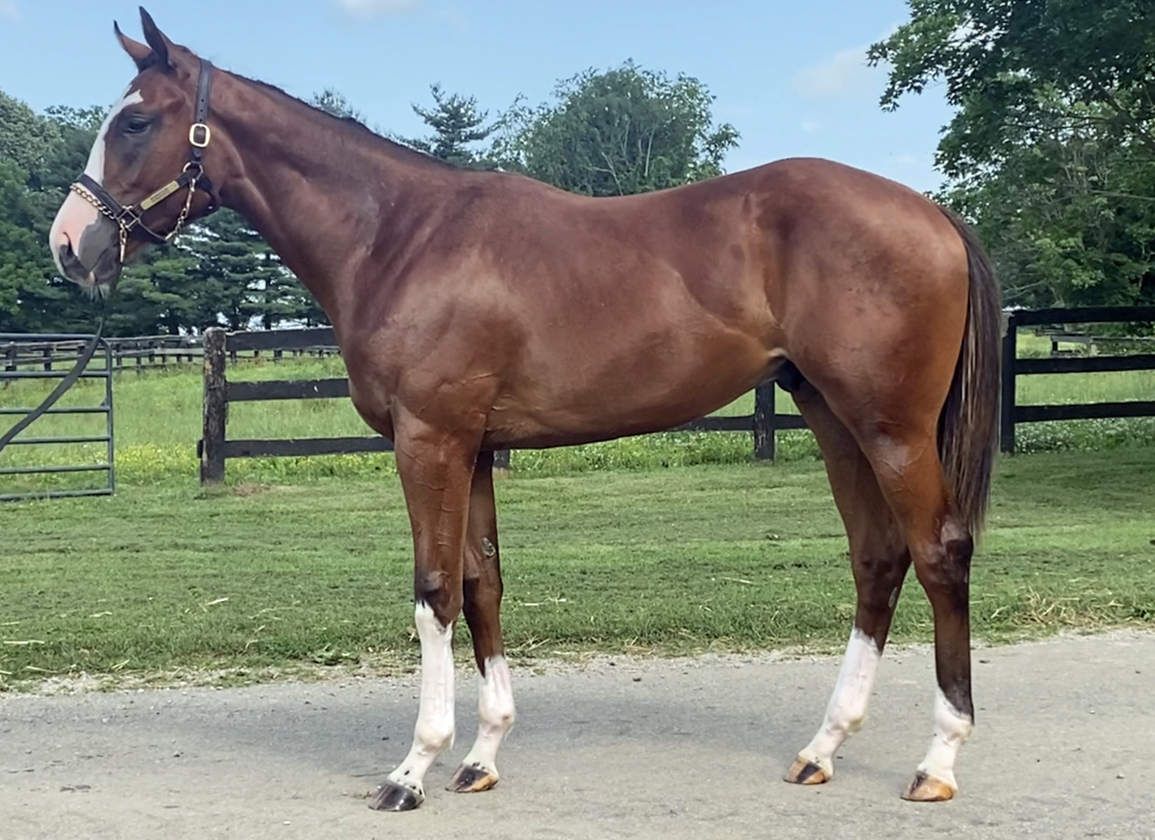
Not This Time entered stud at three and is an outstanding physical specimen, big and tall, and he made an impression with breeders right away by getting good-looking foals. Buyers responded in the sales ring, paying an average price of $76,833 for the 18 weanlings from his first crop that sold in 2018, with seven making $100,000 or more. From then on, he's been something of a sales sensation across the board vis a vis stud fee. Princess Noor, for example, made $1.35 million as a 2-year-old at OBS April in 2020.
In his case, looks translated to performance.

Black-type percentages

That Not This Time has already sired 18 black-type winners is impressive as it is on face value alone, but it's even more so as a percentage of named foals. These days, with popular stallions routinely covering more than 100 mares each year, a good stallion can be expected to get 5% black-type winners to foals, and for young horses with fewer crops racing, the percentages are even lower.

War Front leads all established Kentucky stallions with a ratio of 11.23%, followed by Tapit at 9.86%, Speightstown 9.77%, Into Mischief 8.56%, Medaglia d'Oro 8.36%, Curlin 8.29%, and Ghostzapper 7.89%.

Not This Time is next on the list behind Ghostzapper at 7.47%, ahead of Munnings at 7.15%, Quality Road 7.13%, Uncle Mo 6.95%, Constitution 6.80%, More Than Ready 6.73%, and Street Sense 6.67%.

You get the picture. Not This Time is right up there in the production of black-type winners with the best in the country, and he's the youngest of this group.

Among his own cohort, he's the leading third-crop sire, ahead of Laoban at 5.71%, Upstart at 4.07%, Hit It a Bomb 3.95%, Nyquist 3.18%, and Runhappy 3.04%.

Not This Time's first crop came to the races in the COVID year of 2020 when racing, as life, was disrupted, but there were clues then–at least by August, when I wrote here “Not This Time Leads Freshman Sires“–that he was going to be more than a flash in the pan. He was getting quality maiden special winners then and performing far above his stud-fee level, and that impression has turned into reality.

A stallion that can move up his mares to graded and listed levels–not to mention Classics contenders–at a $15,000 fee is one that can better withstand the drops in book quality from years two to four, and we're seeing this year that his second crop headed by Epicenter and the others noted is highly effective.

He is the real deal.

Sid Fernando is president and CEO of Werk Thoroughbred Consultants, Inc., originator of the Werk Nick Rating and eNicks.

The post Taking Stock: It’s High Time for This Stallion appeared first on TDN | Thoroughbred Daily News | Horse Racing News, Results and Video | Thoroughbred Breeding and Auctions.

Source of original post

First-Crop Yearling Previews: Catalina Cruiser

The 2022 class of first-crop yearling sires features a diverse batch of Kentucky-based young stallions, including a pair of Breeders' Cup champions, two sons of reigning top sire Into Mischief, five graded stakes winners at two and five Grade I winners on turf. Throughout the course of the yearling sales season, we will feature a series of freshman sires as their first crop points toward the sales ring.

David Ingordo has followed Catalina Cruiser (Union Rags–Sea Gull, by Mineshaft) throughout his career, but the Lane's End bloodstock agent said that this year, the multiple graded stakes-winning stallion has never looked better.

Catalina Cruiser has always been a big, well-grown horse,” Ingordo said. “I've seen him from when he was a yearling at Lane's End through his time at Mayberry Farm and with John Sadler and to coming back here to our stallion barn. When he retired, he just filled out even more. He's one of the most magnificent individuals you're going to find that's big and strong and has the body to go with his race record and substance.”

With a debut stud fee of $20,000, Catalina Cruiser bred 148 mares in his first year at Lane's End. After the stallion's first foals arrived, Ingordo said it has never been a challenge to guess their sire. The group includes plenty of good-sized, flashy chestnuts.

Catalina Cruiser is stamping his offspring to look like himself,” he said. “They're flashy, they're big and they're strong. They have this precocious look to them. I'm a balance fanatic and the Catalina Cruisers that I have observed have great balance. He has a tremendous hindquarter, hip and great width behind and all his offspring do as well.”

In his second and third year at stud, Catalina Cruiser stood for a fee of $15,000. One of the greatest compliments a young sire can receive, according to Ingordo, is to have a mare return to him after their first mating. Such has been the case with this stallion, he said.

Bred by W.S. Farish, Catalina Cruiser was a $370,000 Keeneland September yearling. His debut win at three for Hronis Racing was followed by three straight wins as a 4-year-old, including the GII San Diego H. and GII Pat O'Brien S. Returning at five, the Sadler pupil shipped to Belmont to take the GII True North S. at six and a half furlongs in stakes-record time before going back home to California to claim repeat titles in the San Diego H. and Pat O'Brien.

Ingordo said he is often asked why Catalina Cruiser did not debut until October of his sophomore year.

“When he left Mayberry Farm, we knew he had a ton of talent, but that his mind was way ahead of his body,” he recalled. “He was this big, gangly horse and he wanted to do it, but his body wasn't ready for it yet. We gave him all the time to be the best horse he could be. When he came together as a 3-year-old, he never really looked back.”

Despite the five-time graded stakes winner's late start, Ingordo said he does not believe the same will be said of Catalina Cruiser's offspring.

“I look for them to be precocious,” he explained. “I see these 'Cruiser' babies as a little bit better versions of their sire because I think they're maybe a little bit less growthy than he was. I can see them running at two and I can see him having a 2-year-old champion.”

Catalina Cruiser colt out of She's Trouble sells as Hip 39 at the Fasig-Tipton July Sale

“I don't think they'll be limited to sprinting,” he added. “I think they'll be able to go two turns and ultimately be a Classic horse, like Catalina Cruiser's sire Union Rags and his broodmare sire Mineshaft.”

Catalina Cruiser sent 47 first-crop weanlings and short yearlings through the auction ring. Headlined by a $200,000 colt at the Keeneland November Sale, 37 sold to average $66,027 and rank their sire among the top five first-year sires in North American by weanling average.

The son of Union Rags has six yearlings entered in the upcoming Fasig-Tipton July Sale on July 12, including Hip 39, a colt out the stakes-placed Into Mischief mare She's Trouble from Scott Mallory's consignment.

“This has always been a mature colt,” Mallory said of the yearling. “He's really nice for the first foal out of the mare and he's got a lot of attributes that I like from Union Rags and Catalina Cruiser. We're hoping for the best and believe that the Catalina Cruisers are really nice foals. They have a lot of leg to them, a lot of scope and of course a lot of flash. They all seem to have a really good mind.”

Ingordo did not hesitate to say that he would be looking to get his hands on a Catalina Cruiser yearling or two for his own clients this summer.

“I don't have any pride of ownership in this stuff,” he said. “If I don't like a horse, I don't like them. I look at every horse and ask, 'Would I buy it?' and I want to buy some Catalina Cruisers because they're the kind of horses that we buy to win races and win the big races.”

The post First-Crop Yearling Previews: Catalina Cruiser appeared first on TDN | Thoroughbred Daily News | Horse Racing News, Results and Video | Thoroughbred Breeding and Auctions.

Source of original post

Verified by MonsterInsights