Equine Ethics: A Case for Teaching the Language of Horses

Editor's note: This column is the first in our new series about the strides horse racing is making to advance the ethical treatment of racehorses.

On many levels, those in horse racing and breeding are working to ensure the sport is humane and ethical. New studies and standards about track surfaces, stress, medications, diagnostics and more, shed light on how to ensure the safety and comfort of racehorses. Enforcement of anti-doping regulations has reached a new level with better use of surveillance, hotlines and other anti-crime tactics. And in the U.S, there is a major attempt at regulation uniformity and centralization of enforcement efforts.

Good horsemen will tell you it's important to have a horse in a positive mindset no matter what you ask of him or her. The use of force, fear and intimidation to make a horse comply are not only seen as inhumane and unethical by today's moral standards, but are ineffectual.

But one big question remains: how do we ensure that horses are treated humanely and ethically by the people who handle them every day at the barn and on the track?

A good groom can be the companion that a horse needs in its unnatural lifestyle on the track. But a frustrated, fearful or untrained groom or hotwalker can be a daily living nightmare for a horse.
In more than one way, the starting gate is where the 'rubber meets the road' as far as the relationship between humans and horses on the racetrack. To successfully enter the race, a horse must safely enter the starting gate, stand quietly (sometimes for several minutes) and then break from the gate efficiently. This process is often done on television in close-up where millions of people can see it go well or go badly.

In the not-too-distant past, horses were often dragged, pushed, punished or tricked into going into gate, after spectators witnessed an unfortunate battle of wills between the assistant starters and the fearful, reluctant horse. When a horse is in the wrong mindset, the gate is a dangerous place for the horse as well as the rider and the assistant starter. If the horse does get through the process of being forced into the gate, it will likely break and race on an adrenaline rush, the least optimal way to perform in the race.

We asked retired New York Racing Association (NYRA) Head Starter Robert (Bob) Duncan, renowned for his success at transforming starting gate protocol, to talk about his experience in running the gate-schooling and starting-gate program at NYRA and how he came to be a proponent of natural horsemanship at the gate and throughout all elements of the training, racing and breeding process.

TDN: You are credited with revolutionizing the starting gate process. What about your experience on the gate caused you to go on that quest?

RD: During my early years as an assistant starter, we had been following traditional methods of gate work that often called for more insistent ways to get horses into the gate with the intention to mimic the pace of the race day experience. When coaxing failed, we would, at times, resort to using force, fear or mental intimidation. This caused the horses to become fractious, and at times explosive. So, we found various ways to restrain and contain them. We were treating the symptoms but not the disease. Frustration led to anger and escalation as we had no understanding of the instincts or needs of the horse.

I liken it to being a five-year-old entering school for the first time only to find out that everyone there spoke a different language than you. The school is spooky and the classroom is loud and crowded with threatening-looking people who speak gibberish. When you don't respond to their instruction, they get frustrated and speak louder and louder at you. Now they are surrounding you with angry expressions on their face. Now they start pushing you then slapping you while you struggle to figure out what they want. You feel like your life is being threatened and you want to escape.

TDN: What changes did you first implement in your experiment?

RD: While still a foreman, I was given the freedom to take a fresh look at our gate procedures with an eye toward finding more horse friendly ways of preparing horses at the gate.
Traditions die hard, especially in the insular world of horse racing. For instance, when I started on the gate, the wisdom of the day was that horses had to be wound “tight as a watch” to give their best efforts at leaving the gate. Horses were drilled from the gate with bells ringing, doors slamming and a slap on the rump if there was a moment's hesitation. Truth is, horses are taught to react to the movement of the front doors. All the other commotion is background noise. If the horse needs to react to the bell, he missed the break because the bell rings a split second after the doors open.
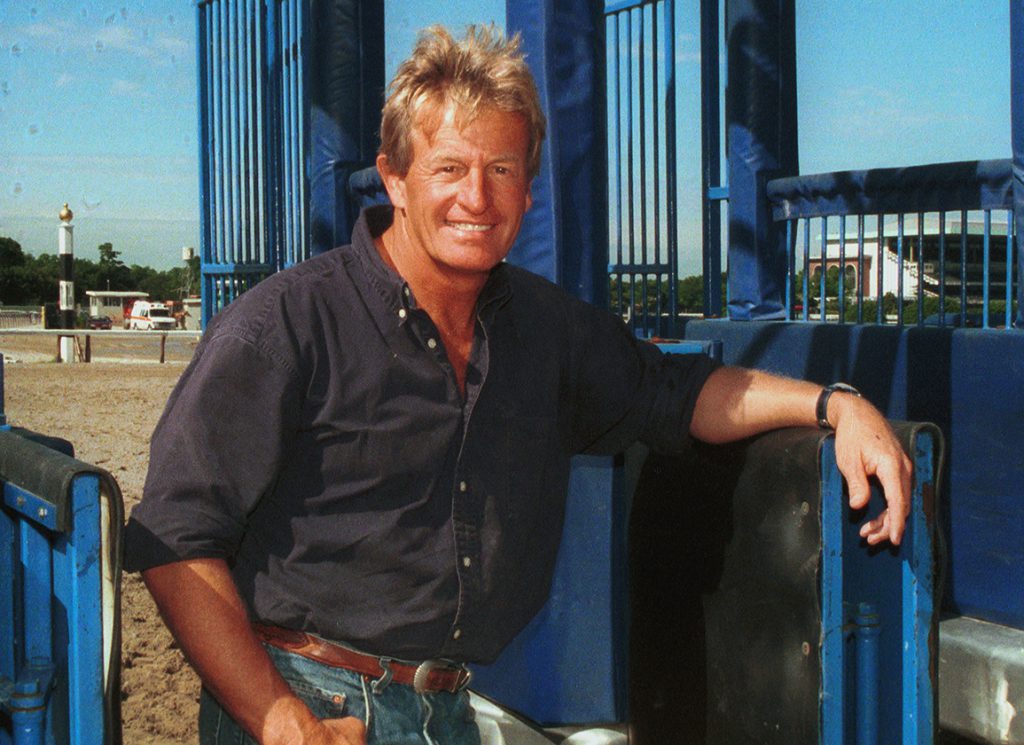
Duncan in his early days at NYRA | Coglianese photo

The changes started with us slowing the schooling process down and allowing the horses the time and environment to learn the gate process in an unthreatening way. We also broke from the old “one size fits all” regimentation and concentrated on each horse as an individual needing particular care.

We started to see improvements. The atmosphere at the gate was calmer, more conducive to learning. But we were still stumbling along like a blind pig searching for an acorn.

Also, in the early stages much thought was given to making the gate more habitable. More padding was added to the stall space at the horses' hips to stabilize them as they reset their feet at the start. The extra padding reduced stumbling. It also prevented knee injuries that were so common among gate crews. (When a horse broke awkwardly, it often drove its hip into the assistant's calf, torqueing the knee.) The Japanese Racing Association had an interesting schooling gate at its Mijo training facility. Stalls were graded from a large walk-through stall down to an actual racing stall, allowing their horses to acclimate to the constriction of the small racing gates. All our schooling gates now have a similar adaptation.

Later, as I learned the natural body language of horses and how to establish oneself as a leader worthy of a horse's trust, we changed our approach and steps to gate schooling. We no longer needed buggy whips, forceful loading from behind or even, except in the rarest of cases, blindfolds.

TDN: Were those initial changes acknowledged and well received?

RD: Word of our changes started to get around and we found trainers to be less resistant when asked to school a problem horse. Joanie Lawrence, a friend of mine who worked at The Jockey Club offices in NYC, called one morning, to ask if she could come out to Belmont to write an article about what we were doing.

Joanie's one page article was read by Stu Kirshenbaum, a television short films producer for Winner Communications. He brought a crew out to do a short piece on our “new” methods and the ball started rolling. To this day, I credit Joanie for opening up a life-changing world to me that I didn't know existed.

Later in that same summer of the short film, the legendary horseman Monty Roberts sought me out at the races in Saratoga. At the time, his book, “The Man Who Listens To Horses”, was on a long run at number one on the New York Times best seller list. Monty was in Saratoga for a book signing but he had seen the piece we did and he was impressed. He complimented the crew and proceeded to invite me out to his Flag is Up Farm in Solvang, Ca. A couple of weeks later, in early September, I received a letter from the University of Arizona, asking me to participate in the Symposium on Racing. Tom Durkin moderated and Monty Roberts was also on the panel. Directly after the Tucson panel, I went to his ranch to be a part of his work with a horse that was having 'severe gate issues.'

TDN: What were some of your “aha” moments as you developed this knowledge and plan?

RD: The first of many aha moments occurred the next spring after the Tucson conference. Monty called to invite me to a demonstration he was doing in Topsfield, Massachusetts. My 15-year-old son David was with me. Monty had us placed in the arena in the front row of a small group of people that surrounded a round pen. The arena behind us held a couple thousand people. Monty explained that the horse he invited was a 14-year-old mare who had never loaded into a horse trailer without being staggeringly tranquilized.
A step-up trailer was backed into the opening of the pen. It was easy to see that the mare was on edge in these unfamiliar surroundings with a fairly vocal crowd. Monty held a coiled line that was snapped to the mare's halter. While he spoke, he asked the mare to step backward and then forward, using only as much pressure on the lead line as needed to get a response. The second she responded, he released the pressure. With each ask, he became lighter, eventually just barely leaning towards her and she quickened in her response until it seemed they were connected with an invisible thread.

He paused for a moment and asked someone in the immediate area to note how long it took to load the mare. With that Monty turned, dropping lengths of the lead to the floor, and walked briskly toward the trailer. Even before the slack went out of the rope the mare hustled up behind Monty following him directly into the step-up trailer, turning inside and hanging her head over Monty's shoulder. It was a show stopper.

He finished his demo by asking the crowd not to applaud just yet. He then unsnapped his lead and walked back to the far side of the arena. He said when I tip my hat you can applaud. He did so and at the burst of applause the mare hopped out of the trailer and ran over to Monty hanging her head over his shoulder again. It was all about the mare accepting Monty as a leader and finding safe haven with him. With his technique of creating a connection with her, she found a leader she could understand and trust. He was speaking her language.

This was exactly what I had been searching for. This was an unspoken language that all horses understood. David and I drove back to Belmont late that night. We went straight to the starting gate and napped until the first two horses showed up to school.

We snapped a lead on each one and mimicked the moves that Monty used. It worked so well that both horses almost jogged into the starting gate. We were on our way.

In Wednesday's TDN: Part II of Ethics: A Case for Teaching the Language of Horses

Diana Pikulski is a partner at Yepsen & Pikulski Public Affairs, and a former criminal defense attorney who served as the first Executive Director of the Thoroughbred Retirement Foundation. She is married to Bob Duncan. 


Watch Alayna Cullen's 2017 interview with Duncan below:

The post Equine Ethics: A Case for Teaching the Language of Horses appeared first on TDN | Thoroughbred Daily News | Horse Racing News, Results and Video | Thoroughbred Breeding and Auctions.

Source of original post

Why Have Standardbreds Gotten Faster and Thoroughbreds Have Not?

It's been almost 55 years since Dr. Fager set a world record for the mile distance when winning the 1968 Washington Park Handicap at Arlington Park in 1:32 1/5, a record that has yet to be broken. In 1973, Secretariat won the GI Kentucky Derby, covering the 1 1/4 miles in 1:59 2/5, a record that still stands 49 years later. There are other examples, all leading to the same conclusion–the Thoroughbred racehorse is not getting any faster.

Some believe that horses have gotten as fast as they can get, have reached their physical limits and that there's no room for improvement. That was the conclusion reached by Stanford University biologist Dr. Mark Denny, whose 2008 study looked at the evolution of racehorses, greyhounds and human runners.

“While all such extrapolations must be used cautiously, these data suggest that there are limits to the ability of either natural or artificial selection to produce ever faster dogs, horses and humans,” Denny wrote.

But Denny failed to take into account that the Standardbred is doing exactly what he concluded could no longer be done. When Dr. Fager set his record, the fastest time ever by a Standardbred in a one-mile race was the 1:55 clocking turned in by pacer Bret Hanover in 1966. (Trotters are a few seconds slower than pacers).

Today, a 1:55 time would barely get it done in a mid-level race at a mid-level track as there doesn't seem to be any slowing down of this breed. Earlier this month, the record for the fastest mile ever by a Standardbred was set again as Bulldog Hanover won the William Haughton Memorial at the Meadowlands in 1:45 4/5. Since 1968, Dr. Fager's one-mile record has not been surpassed. (In 2003, Najran essentially equaled Dr. Fager's record, going a mile in 1:32.24 while winning the GIII Westchester H.). During that same time frame, starting in 1968, the record mile for a Standardbred has come down by 9 1/5 seconds.

“By far, our horses are just better horses than they were before,” said prominent harness trainer Mark Ford.

Harness racing breeders, owners and trainers say that the Standardbred is still evolving. Bill Solomon owns the Pennsylvania Farm Pin Oak Lane, which breeds both Thoroughbreds and Standardbreds. He says that the trotter or pacer of 2022 looks nothing like their predecessors from 50 or 60 years ago.

“Thoroughbreds have been bred for speed and for racing for a long time, for centuries,” Solomon said. “Don't forget the Standardbred was still used for transportation and commerce into the 1900s. So they evolved a lot later. We're breeding a totally different kind of horse. We used to breed a horse that had more of a Coldblood appearance and now we breed a horse that looks more like a Thoroughbred. Go back and look at a picture of [1951 Little Brown Jug winner] Tar Heel and compare that with sons of Meadow Skipper on to Speedy Crown and today to Somebeachsomewhere and that will answer your question. You will see a horse in Tar Heel that looked like a draft horse and when you get to Speedy Crown you'll start to see horses that look like fashionable Thoroughbreds.”

“I remember when I first got involved, our horses were the proverbial jugheads,” said Murray Brown, the retired general manager and vice president of Standardbred Horse Sales Company. “They were big, they were coarse, they were built more for endurance than they were for speed. It wasn't unusual back then for a horse to go three prep miles before the race. They were bigger and perhaps tougher, but they weren't this fast. They're now being bred predominantly for speed. Look at  conformation pictures of the horses by Tar Heel. You got big, coarse, kind of plain horses. Today's horse is so much more streamlined.”

Another factor has been the advances the industry has made when it comes to equipment, primarily the sulky. They have become lighter and more aerodynamic.

“You hear all the time that the bikes are built so much more for speed now,” Brown said. “There's almost no friction and there's more loft and they just go faster because of that.”

The drivers are another part of the equation. Bret Hanover was driven by his trainer, Frank Ervin, typical of the time when the concept of the “catch driver” had yet to take hold. The trainers who drove their own horses might have weighed 200 pounds and weren't particularly skilled as drivers. Today, the vast majority of the horses are driven by individuals who do nothing but drive. The best invariably weigh in the neighborhood of 140 pounds.

“The main factor is probably the evolution of the breed, but there are other extraneous things like the dominance of the catch driver,” Brown said.

It's not that Thoroughbreds have always been this fast. Based on times for the Kentucky Derby, the Thoroughbred breed did evolve and get faster in the early 1900s. Between 1896, the first year the race was run at a 1 1/4 miles, and 1910, the average Derby time was 2:09.8. Over the next 14 years, from 1910 through 1923, the average winning time fell to 2:06.1. By 1962, the record for the Derby had fallen to 2:00.4, the time turned in by Decidedly. Every Derby since 2002 has been run in a slower time. Northern Dancer's time of 2:00 in 1964 has been eclipsed just twice, by Secretariat and by Monarchos in 2001. If there is a way to produce faster species, no one has figured that out.

The Standardbred will never be as fast as the Thoroughbred, but how close can they get? The consensus is that the Standardbred will eventually hit its peak as a breed but that may still be years away.

“When will we see a mile in 1:44?” Ford said. “I don't think we'll have to wait 10 years. The way things are going, it might be 10 weeks.”

The post Why Have Standardbreds Gotten Faster and Thoroughbreds Have Not? appeared first on TDN | Thoroughbred Daily News | Horse Racing News, Results and Video | Thoroughbred Breeding and Auctions.

Source of original post

The Week in Review: Nest Belongs in the Travers

For Nest (Curlin), the easy route to the Breeders' Cup includes a stop in the GI Alabama Aug 20. It's a prestigious race, has a $600,000 purse and Nest would be an odds-on favorite against many of the same horses she thrashed Saturday in the GI Coaching Club American Oaks. But what fun is that?

Owners Mike Repole, Michael House and Eclipse Thoroughbred Partners and trainer Todd Pletcher have already shown that they will think outside the box. They ran their filly in the GI Belmont S., where she finished second despite stumbling and getting bumped at the start. It was a huge effort and proved that she can handle herself if thrown into the mix with the sport's best 3-year-old males.

Yet, there had to be a sense of disappointment that she ran so well but lost. Now, there is a chance to make amends, one that could put Nest into the conversation when it comes to the Horse-of-the-Year picture. There's a race out there where she could make history and it's not the Alabama. Nest should go in the GI Travers S.

It's a race the connections will consider.

“We're leaning towards [the Alabama],” Pletcher said Sunday. “I had a brief conversation [with her owners] though and we did not completely rule out the Travers. She showed she can hold her own against [males] and we know the mile and a quarter suits her. So, we'll keep it in the back of our mind. I'd say all things being equal, we'll probably see her in the Alabama.”

The Travers is the right call. For one, she can win it. She got a 104 Beyer for winning the CCA Oaks, two points better than the number Cyberknife (Gun Runner) received for winning the GI Haskell S. on the same day. Among those eyeing the Travers, only her stablemate, Charge It (Tapit), who got a 111 Beyer when winning he GIII Dwyer S., is notably faster. Nest is in the same range as all the other top colts.

And, yes, the Travers will be a very tough race, but it got a lot easier Saturday when Jack Christopher (Munnings) finished a tiring third in the Haskell, all but cementing his status as a horse that wants no part of 1 1/4 miles. The race has also lost Mo Donegal (Uncle Mo), who beat Nest in the Belmont but has since been sidelined.

This has become a sport where there are few chance-takers and the sportsmen have given way to the businessmen. But there remain some out there who get it, that it doesn't always have to be about the money and that you can't put a price on challenging yourself and doing something special. Get Nest to the Travers winner's circle and you have done something that will stamp her as one of the greatest fillies of her generation. In modern times, no filly has won the Travers. Seven fillies have won the race but none since Lady Rotha in 1915. That's 107 years.

It will take a special filly to erase 107 years of history and owners and a trainer who understand the historical significance of pulling off such a feat. In Nest, Repole, Eclipse, House and Pletcher we may just have that combination. For them, winning the Alabama would fall under the category of “just another race.” The Travers would be so much more.

A Missed Opportunity

Fixed odds wagering may some day become a big part of how people bet on the sport, but the slow progress the concept is making is frustrating. It remains available only on Monmouth Park races and only to on-track customers at Monmouth.

Just imagine, though, for a minute, what might have happened last week had fixed odds bets have been available and had they been available to sports betting customers through their on-line wagering accounts.

The Wednesday following the MLB All-Star game is the single slowest day of the year for sports betting. When it comes to the four major sports, nothing is available. It's normally the only day of the year when that is the case.

There's a huge void and maybe some day racing can fill it and fill it in a way that can expose the sport to hundreds of thousands of sports bettors craving action on a Wednesday. But that can't happen until much more progress is made, starting with the advent of fixed odds and getting the product available on sports betting websites. This is something everyone needs to get behind.

Juan Vazquez and Fake News

The New York Gaming Commission came out last week with a press release crowing about how Juan Vazquez has beeen banned from running horses in the state through Jan. 26, 2025. That's sort of like announcing that today is Sunday.

The New York regulators did nothing other than honor the reciprocity agreement that exists among all horse racing states and has been around forever. Vazquez was suspended by the Pennsylvania Racing Commission, so New York, and everyone else, had no choice but to honor the suspension. There was absolutely no need to tell everyone that New York was honoring the suspension and by doing so it looks like the New York commission was looking to take credit for something it had absolutely nothing to do with.

Because the Pennsylvania suspension did not take effect until a few days after it was announced, Vazquez was able to run six horses in Saratoga after it was announced that he had received the lengthy suspension after the Pennsylvania regulators alleged that a horse he shipped from Belmont to Parx arrived in such bad shape with a severe case of laminitis that it had to be put down. The Pennsylvania stewards said his actions were “grossly negligent, cruel and abusive,” yet there he was running in Saratoga. That's a terrible optic.

If the New York Gaming Commission really wanted to do something about Vazquez, it should have taken steps to keep him from running in Saratoga.

On Jack Christopher

So, Jack Christopher is not a two-turn, mile-and-an-eighth horse. At least he sure didn't look line one in the Haskell. But that doesn't mean he still can't have a sensational ending to his 3-year-old campaign. He's still a very fast horse. Trainer Chad Brown can now look to races like the GI Allen Jerkens Memorial and, maybe, the GI Breeders' Cup Sprint, where we could see what could be a scintillating  showdown between Jack Christopher and Jackie's Warrior (Maclean's Music).

“We tried!,” began a tweet Saturday from Liz Crow, who purchased the colt for his owners. “Jack Christopher doesn't want nine furlongs. Cut him back to one turn and we will enjoy the ride from there.”

The post The Week in Review: Nest Belongs in the Travers appeared first on TDN | Thoroughbred Daily News | Horse Racing News, Results and Video | Thoroughbred Breeding and Auctions.

Source of original post

July 24 Insights: The March of the Pricey 2YOs Continues at Saratoga

1st-SAR, $105k, Msw, 2yo, 6f, 1:05p.m. ET
The WinStar and Siena Farm partnership sends out FAITHFUL AND TRUE (Good Magic), a $450,000 OBSMAR grad out of a half to Champion older mare Escena (Strawberry Road {Aus}), for his unveiling from the Rodolphe Brisset barn. Along with Bat Flip (Good Magic), a $350,000 FTSAUG yearling who is out of a half to MGISP Money Multiplier (Lookin at Lucky) and the dam of MGSP Threes Over Deuces (Flat Out), they make up two parts of the triplet debuting in the race for their freshman sire. Bourbon Bash (City of Light) debuts here for D. Wayne Lukas, who sends the colt–out of a half to GISW Volatile (Violence)–to post for BC Stables. Upgrade (Flatter) rounds this field as the most expensive of the bunch, a $550,000 KEESEP purchase by Repole and St Elias Stables last year. His young GSP dam has produced GI Frizette S. placed A Mo Reay (Uncle Mo). TJCIS PPs

6th-SAR, $105k, Msw, 2yo, f, 6f, 3:55 p.m. ET
RARIFY (Justify) is a daughter of Bella Jolie–making her a half to champion sprinter-turned-sire Runhappy (Super Saver)–and a $750,000 KEESEP purchase by the powerhouse connections of Westerberg, Mrs. John Magnier, Jonathan Poulin, Derrick Smith, and Michael Tabor, looms a long a shadow over this field. Wesley Ward will send her to post in this juvenile dash. Randomized (Nyquist) looks to validate her $420,000 KEESEP price tag for her Preakness-winning connections of Klaravich and Chad Brown. She's out of a half to MGISP millionaire Smooth Air (Smooth Jazz) and the dam of course record-setting MGISW Got Stormy (Get Stormy). Take Charge Briana (Curlin), hailing from the family of broodmare of the Year Take Charge Lady (Dehere) via second dam Charming (Seeking the Gold), goes out from the D. Wayne Lukas barn. TJCIS PP

7th-SAR, $105k, Msw, 2yo, f, 1 1/16mT, 4:29p.m. ET
IDEA GENERATION (IRE) (Dubawi {Ire}) looks set to continue what could be a big day for the Chad Brown barn. Klaravich Stables went to 340,000gns–about US$485,808–at TATOCT last year for her. Out of a half to G1SW Zoffany (Ire) (Dansili {GB}); G1SP Rostropovich (Ire) (Frankel {GB}); and GSW Wilshire Boulevard (Ire) (Holy Roman Emperor {Ire}), the firster picks up the services of Irad Ortiz Jr. Stay Lost (Bernardini) is part of the Joseph O'Brien contingent brought over by the young trainer for the Saratoga meeting. Her dam was runner-up in New Zealand's G1 One Thousand Guineas. TJCIS PPs

4th-DMR, $80k, Msw, 2yo, 5f, 6:33p.m. ET
John Shirreffs sends the Stonestreet-bred, C R K Stable-owned SKINNER (Curlin) to the blocks for his career showing here. The colt is out of a dam who is no stranger to California, former 'TDN Rising Star' and GIII Rancho Bernardo H. heroine Winding Way (Malibu Moon), and has a set of winning half-siblings. They dropped a cool $510,000 at OBSAPR to secure him a few months ago. TJCIS PPs

5th-ELP, $60k, Msw, 2yo, 1mT, 1:22p.m. ET
LAVER (Bernardini), a son of GISW Centre Court (Smart Strike) and a half to GSW Navratilova (Medaglia d'Oro), debuts here for owner/breeder G Watts Humphrey Jr. This is also the family of Japanese multi-millionaire Eagle Cafe (Gulch) through his half-sister, the second dam GISP Let (A.P. Indy). TJCIS PPs

1st-MTH, $55k, Msw, 3yo/up, f/m, 1 1/16mT, 12:15p.m. ET
E Five Racing sends out YARBOROUGH (Medaglia d'Oro), whose two most recent works were a bullet 1:00.80 five furlongs July 6  and a 1:01.60 (2/8) five panel move July 13, both over the Monmouth main track. The $260,000 KEESEP alumnus hails from the family of G1SW Diamondsandrubies (Ire) (Fastnet Rock {Aus}) via G1SW & MG1SP second dam Quarter Moon (Ire) (Sadler's Wells). TJCIS PPs

6th-MTH, $55k, Msw, 3yo/up, 1 1/16mT, 2:35p.m. ET
Breaking from the rail, MANASSAS (Frankel {GB}) brings Group and Grade I quality pedigree on both sides. His sire needs little introduction, but his dam Avenge (War Front) was a good racehorse in her own right, twice winning the GI Rodeo Drive S. and finishing third in both the GI Breeders' Cup Filly and Mare Turf and the Gamely S. at Saratoga. His dam's half-sister Lira (Giant's Causeway) was graded stakes-placed, and was herself the dam of a stakes winner. This is the family of GISP Grasshopper (Dixie Union) and of the globetrotting MG1SW Mashaallah (Nijinsky II). TJCIS PPs

The post July 24 Insights: The March of the Pricey 2YOs Continues at Saratoga appeared first on TDN | Thoroughbred Daily News | Horse Racing News, Results and Video | Thoroughbred Breeding and Auctions.

Source of original post

Verified by MonsterInsights