Op/Ed: That Burton Sipp is Still Racing is Indefensible

Take the time to read colleague Dan Ross's extensive and detailed story on the sordid career of trainer Burton Sipp and you might conclude that, in horse racing, enough is never enough. The story is about a lot more than the many controversies that have shadowed Sipp throughout his career, it is about how racing somehow always let Sipp back in, to give him a third chance, a fourth, fifth chance. It is about the sport's inability to police itself and its failure to permanently ban someone who has no business training horses.

Yet, on Monday night, Sipp, who has sent out 117 starters so far this year, will have two runners in at Mountaineer Park. This is the person that, in a 1993 story I penned for the New York Daily News, was called the “most deplorable person I have encountered on the backstretch of a racetrack,” by former Pennsylvania Racing Commission commissioner Hart Stotter. That he is still actively training is a beyond embarrassing. Worse yet, it plays right into the hands of racing's many critics who argue that the sport doesn't do nearly enough to keep the horses safe or to rid itself of its worst elements. When it comes to Sipp, how do we defend against that? We can't.

The latest firestorm surrounding Sipp involves allegations that he knowingly funnels his horses into the slaughter pipeline. That could have led to his permanent banishment from Mountaineer, which, in 2010, notified horsemen they will lose stalls and may be excluded from the track if any horses racing at Mountaineer end up at the Sugarcreek auction in Ohio, which is frequented by killer buyers who send horses on to slaughter. Proving such allegations can be tricky, but there's no evidence to suggest that Mountaineer racing officials have so much as launched an investigation. Perhaps they just decided to look the other way.

Ross reached out to James Colvin, the director of racing at Mountaineer, about the recent scrutiny on Sipp and got a non-answer answer. “I have no information for you to discuss on Burton Sipp, the WV Racing Commission has licensed Mr. Sipp and has also investigated him and to my knowledge have found no wrongdoing as to date,” Colvin wrote in an email.

Ross had more questions for Colvin, but he did not respond to subsequent emails.

With the allegations that Sipp sent horses to the auctions frequented with killer buyers gaining more and more traction, Churchill Downs Inc. took action, announcing on Tuesday that it was banning Sipp from its tracks. Sipp has started 25 horses this year at Presque Isle Downs, which is owned by Churchill. The company is to be commended for taking action against the trainer, but it's fair to ask them what took them so long. It's also fair to ask how they could have banned Bob Baffert for two years for nothing worse than medication overages while, until this week, taking no action against Sipp.

Sipp has been training since 1968. He carved out a niche for himself, winning a lot of races on the leaky roof circuit. He won a career best 272 races in 1981, but he would soon become embroiled in a controversy that should have meant the end of his career. In 1984, Sipp was indicted by a grand jury in New Jersey on charges of inflating insurance claims on nine horses who died in his care over a four-year period. Sipp eventually pled guilty to the lesser charges of witness tampering and was fined $7,500 and sentenced to five-years probation. When interviewed in 1993, Gregg Shivers, the assistant Burlington County prosecutor at the time, said that his office could have easily proven the earlier charges, but that the plea bargain was driven in part by the anticipated cost of the trial, expected to be one of the most expensive in Burlington County history.

Insurance fraud is a serious offense and so is witness tampering. Sipp had also been charged around the same time with forging a scratch card on another trainer's horse. Collectively, the industry acted and Sipp did not start any horses between December of 1984 and September of 1993.

“From my experience as Director of Enforcement for the Pennsylvania Racing Commission, I am aware of a number of actions and activities (Sipp) was involved in, all of which are a matter of public record,” Roger Marciano told me in 1993. “I thought and fully expected that he would never race again or be involved in any way with pari-mutuel racing.”

But Sipp never gave up on the idea of making a comeback and in 1993 found a racing commission willing to give him a license. With a license in hand from the Pennsylvania Racing Commission, he was back, entering horses at the track then known as Philadelphia Park. Ken Kirchner, the executive secretary of the Pennsylvania Racing Commission said that Sipp “deserved a second chance.”

After making 136 starts in 1994, Sipp disappeared, and it's not clear why. He did not return to racing until 2004. It appears that he spent some of that time operating Animal Kingdom, a 32-acre zoo and pet store in Burlington, N.J. According to a Philadelphia Inquirer article, Sipp was under investigation by the United States Department of Agriculture (USDA) for alleged animal welfare violations at the zoo. According to the Inquirer, citations stemmed all the way back to 2002, when five emaciated giraffes reportedly died at the zoo.

Having returned to training, Sipp settled in at Suffolk Downs. When asked by a Boston Globe reporter in 2005 why Sipp had been licensed Suffolk Downs steward Bill Keene said: ”There's nothing in the rule book that keeps him from getting a license because he has a past.” That Keene believed that a person's past transgressions should have no bearing on them getting a license says a lot of about the sport's attitude toward rule-breakers. Of course a person's past matters.

Sipp has been operating ever since resurfacing at Suffolk Downs. But it appears that there are some racetracks that have refused to accept his entries as all of his 2021 and 2022 starts have come at Mountaineer, Presque Isle and Thistledown. In at least one state, he has been permanently banned. Since the mid 1990s, Sipp has been barred from applying for a racing license in New Jersey.

On the surface, Sipp is a nobody. He is 78, competes only at low-level tracks and has won just eight races this year. His stable has earned just $112,861. When he makes headlines it is only for the wrong reasons. Perhaps the tracks that have allowed him to run thought no one would pay attention. But that hasn't been the case. There are plenty of good people who care and plenty of good people who want to see Burton Sipp permanently banned from every racetrack in the country. That that hasn't happened yet is simply inexcusable.

The post Op/Ed: That Burton Sipp is Still Racing is Indefensible appeared first on TDN | Thoroughbred Daily News | Horse Racing News, Results and Video | Thoroughbred Breeding and Auctions.
Source of original post

Background Check: Alabama

In this continuing series, we examine the past winners of significant filly/mare races by the lasting influence they've had on the breed. Up today is the GI Alabama S., one of the oldest stakes races in the country.

Dating to 1872, eight years after the first Travers S. was run and 12 years after the first Queen's Plate (the oldest stakes race in North America), the Alabama is the last leg in New York's Triple Tiara following the GI Acorn S. and the GI Coaching Club American Oaks. The major-league 3-year-old filly contest was run at different distances early, but has remained a constant at 1 1/4 miles since 1917. It's a safe bet anyone with a good sophomore filly would love few things more than adding the Alabama to their win column. As with most races this old, a few years were skipped owing to various circumstances, but history has recorded 141 individual winners of the Alabama. How have they fared as broodmares?

Several Alabama winners through the years also won the GI Test S., GI CCA Oaks, GI Diana S., or GIII Schuylerville S.; please see those previous profiles for notes on broodmare phenomenons Sky Beauty, November Snow, Tempted, Busanda, Vagrancy, and Cleopatra. Following are the some of the other most important Alabama winners by what impact they have had on the breed through their sons and daughters.

Pretty Discreet (1992, Private Account–Pretty Persuasive, by Believe It): Her three stakes winners were all colts–GISWs Discreet Cat and Discreetly Mine, as well as MSW & MGISP Pretty Wild–and her three daughters to stay in this country are all stakes producers. She is also the granddam of GISW Awesome Maria, who sold for $4 million at the 2013 Keeneland November sale, and June 9 Astoria S. winner Devious Dame, the first black-type winner for freshman sire Girvin.

Heavenly Prize (1991, Seeking the Gold–Oh What a Dance, by Nijinsky II): One would expect a mare descended from Blitey and Lady Pitt to do great things and Heavenly Prize held up her end of the bargain. Her sons included MGISW Good Reward and GSW Pure Prize, while her descendants thus far include GISWs Persistently, Queen Goddess, and Instilled Regard, plus GSW & MGISP Stays in Vegas.

Versailles Treaty (1988, Danzig–Ten Cents a Dance, by Buckpasser): GI Breeders' Cup Juvenile Turf winner George Vancouver is out of this mare, as is GII Remsen S. winner and GI Met Mile runner-up Saarland. Her daughters and granddaughters have produced GISW Mongolian Groom, MGSW Dragon Bay, and several other stakes performers.

Maplejinsky (1985, Nijinsky II–Gold Beauty, by Mr. Prospector): Her daughter, Sky Beauty, won the Alabama and the CCA Oaks in 1993, was named champion older mare in 1994, and captured a total of nine Grade I races before producing MGSW Hurricane Cat and a daughter who would later be granddam of GISW Violence. Maplejinsky didn't stop there. Other daughters and granddaughters have produced MGISWs Guarana, Point of Entry, Pine Island, and Tale of Ekati, as well as GI Breeders' Cup Distaff winner Pleasant Home and a slew of other high-quality stakes winners. Her great-granddaughter Magical World sold for $5.2 million at last year's Fasig-Tipton November sale, while Magical World's daughter Guarana brought $4.4 million at the same sale.

MG1SW State of Rest traces to 1979 Alabama winner It's in the Air | Sarah Andrew

It's in the Air (1976, Mr. Prospector–A Wind Is Rising, by Francis S.): This mare, often remembered as her sire's first of many champions, has had some very significant activity among her female descendants in the last year. Her MGISW granddaughter, Music Note, produced the 2021 G1 Dubai World Cup winner Mystic Guide, while another unraced granddaughter is the dam of 2021 GI Saratoga Derby Invitational S. winner State of Rest (Ire), who is also a G1 winner in England, France, and Australia. Other GI/G1 winners produced by her daughters include Musical Chimes and Storming Home (GB).

Lauries Dancer (1968, Northern Dancer–Its Ann, by Royal Gem II {Aus}): Although she didn't produce a stakes winner, this Canadian Horse of Year's daughters and granddaughters have produced MGISWs Will's Way and Tizway, as well as GISW Willa On the Move, and GISP and excellent Maryland sire Citidancer.

Fanfreluche (1967, Northern Dancer–Ciboulette, by Chop Chop): This Canadian Horse of the Year, even more famous for her abduction than for her race record, was also a remarkable producer with long-reaching influence on multiple continents. Honored as Canadian Broodmare of the Year in 1978, her own foals included two-time Canadian Horse of the Year and U.S. GISW L'Enjoleur, additional Canadian champions La Voyageuse and Medaille d'Or, GSW D'Accord, and MSW Grand Luxe. Her female-line descendants have thus far included French highweight and multiple G1SW Holy Roman Emperor (Ire), as well as European G1SWs Majestic Roi and Erupt (Ire); U.S. GISWs Aube Indienne (Fr) and Combatant; Australian G1SWs Russian Revolution (Aus), Flying Spur (Aus), Encosta de Lago (Aus), and Duais (Aus); and New Zealand G1SW Sherwood Forest (Aus).

Natashka (1963, Dedicate–Natasha, by Nasrullah {GB}): Named Broodmare of the Year in 1981, Natashka sports a long list of black-type winners tracing to her, including leading U.S. sire Elusive Quality and a number of champions.

High Bid (1956, To Market–Stepping Stone, by Princequillo {GB}): This Wheatley/Phipps mare is on this list for one very sound reason. Her first foal was Bold Bidder, not only a champion on the racetrack, but sire and broodmare sire of several luminaries. His two Kentucky Derby winners in a six-year span included one considered among the Top 10 runners of the 1900s: Horse of the Year Spectacular Bid.

Coolmore stallion Wootton Bassett is a descendant of 1931 Alabama winner Risque | Coolmore Stud

Parlo (1951, Heliopolis {GB}–Fairy Palace, by Pilate): Her daughters included 1969 Broodmare of the Year All Beautiful, who produced Horse of the Year Arts and Letters and is great-granddam of dual champion and five-time GISW Silverbulletday.

Salaminia (1937, Man o' War–Alcibiades, by Supremus): A number of stakes winners trace to this daughter of Man o' War, none more notable than English Horse of the Year and excellent sire Sir Ivor. He lives on particularly through his daughters, although his sire son, Sir Tristram (Ire), redefined the breed in Australia and New Zealand.

Risque (1928, Stimulus–Risky, by Diadumenos {GB}): 1980 Broodmare of the Year Key Bridge traces to her, as does U.S. Horse of the Year Fort Marcy and Canadian Horses of the Year Izvestia and With Approval. Champion Key to the Mint, MGISW Touch Gold, and excellent European sire Wootton Bassett (GB) are just a few on the long list of other high-class descendants of Risque.

Escutcheon (1927, Sir Gallahad III {Fr}–Affection {Fr}, by Isidor {GB}): In addition to producing Kentucky Oaks winner Mars Shield, this mare is the ancestress of Broodmares of the Year Levee and Delta, champions Shuvee, Slew o' Gold, Bayou, Smart Deb, Talking Picture, Sacahuista, Playful Act (Ire)–and many more.

Malachite (1913, Rock Sand {GB}–Miss Hanover, by Hanover): A number of stakes performers trace to this mare, most importantly 1943 Horse of the Year and Triple Crown winner Count Fleet. He was ranked among the leading sires and broodmare sires in the country for many years.

Sallie McClelland (1888, Hindoo–Red and Blue, by Alarm): This wonderful producer of yesteryear is the dam of 1904 Kentucky Oaks winner Audience and ancestress of Horses of the Year Whisk Broom II and Crusader, as well as dual champion Top Flight.

The post Background Check: Alabama appeared first on TDN | Thoroughbred Daily News | Horse Racing News, Results and Video | Thoroughbred Breeding and Auctions.

Source of original post

This Side Up: Baaeed News is Good News

I guess the whole point is that ours is a world apart, a sanctuary from the cares of the “real” one. But it still feels unnerving, to see a new cycle of the sales calendar open with such blithe indifference to a wider consensus that the global economy is scrabbling along the top of a precipice.

Both Saratoga and Deauville benefit from a heady atmosphere that might easily induce a perilous incaution when a yearling stands there shimmering on a sale rostrum. But it was ever thus, and the market at both Fasig-Tipton and Arqana exhibited remarkable buoyancy when measured against historic standards.

We know that bloodstock tends to lag somewhat behind other indices of recession, and conceivably this will prove to be some final, decadent flourish before the bulls start to draw in their horns. But it may also turn out, as when bloodstock showed such startling resilience during the pandemic, that the outlook simply looks different to the affluent elite on whom our industry so candidly depends. Inflation may be a bolting mustang; there may be wars and rumors of wars; political discourse may be ever more acrimoniously polarized. None of it seems to matter to these guys.

To be fair, in certain states American investors can increasingly entertain the possibility that their racetrack programs can aspire to something vaguely resembling viability–even if some benighted horsemen appear masochistically determined to erode that equation with their stubborn litigations. But the parallel strength of the market over the water suggests that a lot of people must also be animated by less tangible dividends.

(To listen to this column as a podcast, click the arrow below.)


That being so, we must always remember how destructive to our sport is the contamination of bad publicity. No shortage of that, of course, in an average week–and this one has been no different. Equally, however, we must acknowledge our debt to those priceless horses and horsemen that do succeed in capturing the public imagination; to those that intrigue outsiders, and inspire them to enter and contribute to our community, whether as fans and handicappers or as buyers of seven-figure yearlings. And it's also been a week, either side of the ocean, that has magnified those positives.

First and foremost, we have had a fresh reminder of the captivating grandeur within the compass of the Thoroughbred. Raised in distance for the first time, Baaeed (GB) (Sea The Stars {Ire}) also raised his game anew to reach a pantheon lately shared, on European turf, perhaps only by his sire and Frankel (GB) (Galileo {Ire}).

Someone as tediously insistent as me, on the importance of a transatlantic cross-pollination, is hardly going to neglect the opportunity to highlight the way Baaeed's pedigree combines gene pools that have since become disastrously bisected. No fewer than 11 of the 16 contributors to this grass titan's fourth generation were bred in North America. Mr. Prospector is sire not only of Baaeed's fourth dam; but also of his damsire, Kingmambo; and of Miswaki, whose daughter Urban Sea gave us Sea The Stars. And look who's here, as sire of the third dam: the great enigma himself, Arazi!

Galileo, half-brother of Sea the Stars, sire of leading stallion Frankel (GB) | Emma Berry

Sea The Stars, specifically, combines two transatlantic cocktails. Start with his sire Cape Cross (Ire). He's by Green Desert, himself a son of Danzig out of a daughter of Sir Ivor and Courtly Dee; and out of Park Appeal (Ire), whose genes (by Ahonoora (GB) out of a Balidar (GB) mare) are no less evocative of a completely different world. As for Urban Sea, the epoch-making dam of Sea The Stars (and Galileo, of course), she similarly blends a classic American brand (Miswaki was by Mr. Prospector out of a Buckpasser mare) with a mare whose parents both channelled doughty German blood.

Much the same kind of thing happens along Baaeed's bottom line. That Mr. Prospector fourth dam we just mentioned, for instance, is actually out of the British matriarch Height Of Fashion (GB), who was by Bustino (GB) and saturated with other indigenous influences. So, really, can anyone look at Baaeed's pedigree and still understand why most breeders, either side of the Atlantic, no longer want to mix turf and dirt lines?

So much for Baaeed's past. As far as his future is concerned, we must naturally yield to the judgement of those who have brought him this far with such skill. But it must be said that the horse stands in danger of leaving us with the same wistfulness as did Frankel, who similarly spent most of his career beating up proven inferiors at a mile before stepping up in trip only in his penultimate start–and in the same York race that Baaeed won this week. The plan has long been to remain in step with Frankel by also bowing out over 10 furlongs at Ascot, but the door is apparently still ajar to going to the Arc instead.

In declining to run either at Longchamp or at the Breeders' Cup, Frankel was left exposed to the charge that he never went looking for trouble. Suspecting him to be one of the best of all time, everyone was comparing him to specters past–yet he never measured himself against plenty of good ones then alive and well, and available for racetrack competition.

The fact is that Baaeed finished the new trip at York ravenously, and is a full-brother to a Group 1 winner at 12f (and Group winner at 14f). So let's hope that the desire to preserve his immaculate record does not discourage connections of another great horse from exploring the full range of his brilliance.

If a sporting gamble happened to misfire, it wouldn't take a cent off his value. In terms of his legacy, he has nothing to lose and much to gain. And, as we've been saying, there's a wider consideration–one might almost say, a wider obligation–to make this game as engrossing as we can; to showcase charisma, and retrieve the news agenda from the bad guys.

Happily, that is just what is happening at Saratoga this summer, with D. Wayne Lukas back on center stage Saturday with his latest Classic winner squaring up for her decider with Nest (Curlin). Last week we highlighted the way Lukas appears to be reversing the ageing process, as a rejuvenated force in the sales ring as well as on the racetrack. He promptly produced another exciting juvenile in Bourbon Bash (City Of Light), who won his second start by eight lengths and looks eligible to extend his trainer's record of eight wins in the GI Hopeful S.

This is the first foal out of a stakes-winning Violence mare named Buy Sell Hold. Sell or hold is an adequate conundrum for most people right now, trying to read the alarming runes in less singular markets. How long our own marketplace can remain insulated by such unquantifiable factors as horses like Baaeed, and horsemen like Lukas, remains to be seen. But history tells us that we will find out soon enough.

The post This Side Up: Baaeed News is Good News appeared first on TDN | Thoroughbred Daily News | Horse Racing News, Results and Video | Thoroughbred Breeding and Auctions.

Source of original post

Rosario Set For Record-Breaking Saratoga Meet

SARATOGA SPRINGS, NY – It's not your imagination that jockey Joel Rosario is having a big summer at Saratoga.

Rosario, 37, is very much in the hunt for the overall title, a competition led by Irad Ortiz, Jr. Through Thursday's program, Ortiz had 37 wins, eight more than Rosario. However, in graded stakes races, Rosario is far and away the leader with 10 victories from 19 starts, a remarkable 53% win rate. Ortiz is next with five.

With the 10, Rosario is in position to smash the current record of 11 graded stakes wins in a Saratoga season. According to Equibase stats, Hall of Famers Javier Castellano and John Velazquez share the record of 11. Castellano won 11 of 31 graded stakes starts in 2015 and Velazquez, who is nearing 1,000 wins at the track, finished first in 11 of 23 graded stakes in 2005. At 10, Rosario is on level with Castellano (2016) and Jerry Bailey (2001).

“It's unbelievable what we've done early,” Rosario said. “Thanks to all the people who gave us the opportunity. My agent, Ron Anderson, has done a really great job for me. We appreciate the opportunities from the owners and the trainers.”

Rosario is no stranger to success. The native of the Dominican Republic has finished in the top 10 in North American jockey earnings for 13 years, has a resume filled with graded stakes wins, including 13 in the Breeders' Cup. Last year, he had a career year, riding horses that earned $32,956,215 and secured his first Eclipse Award as champion jockey.

In 2020, Rosario was the leading graded stakes winner at Saratoga with seven. Last summer, he finished in a tie with Luis Saez for the top spot at six. This year, he had seven graded wins in the first 13 days of the 40-day season.

“We always are looking for a good meet,” Rosario said, “But, we've been doing really well this year.”

During the first four days of the meet, Rosario won the July 15 GIII Forbidden Apple S. with City Man (Mucho Macho Man) for trainer Christophe Clement; the GI Diana S. on In Italian (GB) (Dubawi {Ire}) for Chad Brown July 16; and the GIII Quick Call S. on Big Invasion (Declaration of War) for Clement July 17. He completed the month with three wins for Steve Asmussen: the GII Shuvee S. on Clairiere (Curlin) July 24, the GI Alfred G. Vanderbilt S. on Jackie's Warrior (Maclean's Music) and the GII Jim Dandy S. on Epicenter (Not This Time).

In August, he won the GII National Museum of Racing and Hall of Fame S. on Ready to Purrform (Kitten's Joy) for Brad Cox Aug. 5 and the next day won the GI Test S. on Chi Town Lady Verrazano) for Wesley Ward and the GII Glens Falls on War Like Goddess (English Channel) for Bill Mott.

Six trainers. Dirt. Turf. Sprints. Routes.

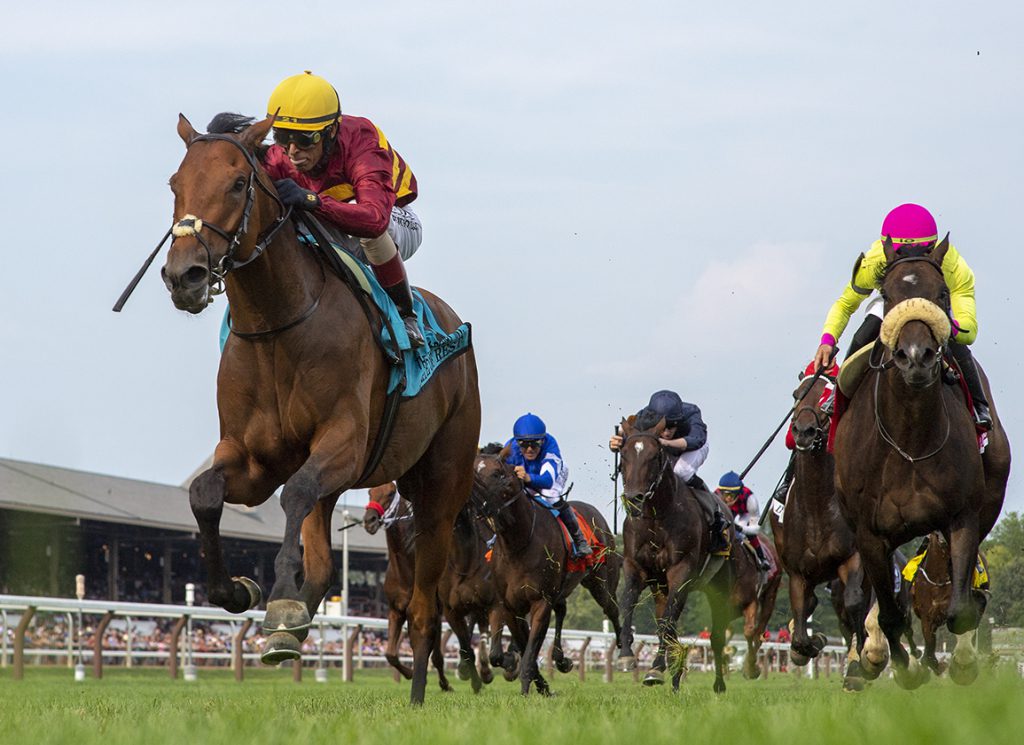
Starting on Saturday with the GI Alabama and the GII Lake Placid, there are 17 graded stakes left in the Saratoga season. Rosario has the mount on Haughty (Empire Maker) for Brown in the Lake Placid and will ride Gerrymander (Into Mischief) for Brown in the Alabama. He is likely to be up on contenders in most of the remaining graded stakes, including the Asmussen triumvirate of Epicenter in the GI Runhappy Travers S., Jackie's Warrior in the GI Forego S. and Clairiere in the GI Personal Ensign.

In 2015, six of Castellano's 11 wins were in Grade I races. Velazquez had five Grade I winners in 2005. So far, Rosario has three.

The post Rosario Set For Record-Breaking Saratoga Meet appeared first on TDN | Thoroughbred Daily News | Horse Racing News, Results and Video | Thoroughbred Breeding and Auctions.

Source of original post

Verified by MonsterInsights