Battalion Runner Flashes His Hand as a Sire via Rudder’s Men

It might feel a touch trite to repeat it, but the timeworn observation is such for a reason: the stallion market is one packed to the brim with tough customers and salty competition. And it turns out, both literally and metaphorically as evidenced by the recently released Report of Mares Bred. Breeders gravitate to quality and are more frequently turning to tried-and-true sources to find it, or are becoming more demanding of first-year sires before taking the chance.

In an economy where connections are forced to steadily tighten their belts, it's not an unreasonable nor unforeseen response to current trends to ask for more before opening a wallet. Many owners/syndicates with stallions outside of Kentucky usually find themselves among their stallion's chief supporters until the first crop runners make their first impressions.

An example of this would be the case of Ocala Stud's Battalion Runner (Unbridled's Song) and his son, Rudder's Men. Unveiled last Saturday, Oct. 22 at the Belmont The Big A meet for breeder–and sire owner–St. Elias Stable, the dark bay was hard to miss as he sailed through a brisk :22.53 opening quarter while under wraps, and sprinting home to an easy 4 1/4-length score. With the effort, he became Battalion Runner's third winner after Lady Runner and Lightnin Runner. The latter carried her sire's banner into the winner's enclosure Sept. 17 in Charles Town's Rachel's Turn S., his first black-type horse. Not a bad feat for any sire to have his first winner also turn out his first stakes victory, no matter the track.

Battalion Runner's first crop tally? A grand total of nine foals.

“We foaled, raised, and trained Rudder's Men,” said Ocala Stud's general manager David O'Farrell. “He's a runner. When we shipped him up to Todd Pletcher, we all felt that [Rudder's Men] would have to be the one to help carry the load and really give Battalion Runner a chance to come on the scene. We thought he would be better suited running in Florida as a state-bred by a Florida sire, but Todd realized when he got him up there that the horse could run in open company in New York and that's what he did.”

A part of a still-growing legacy from Tamboz (Tapit), Battalion Runner claims a host of accomplished siblings. One of which being a more recent, and easily recognizable name, in GI Preakness-placed Creative Minister (Creative Cause); starting his career at Gulfstream Park before finding himself on the national stage in just his fourth career start.

And it's not just his immediate family, either. Battalion Runner's dam is a full-sister to Tapizar, whose determination en route to victory in the GI Breeders' Cup Dirt Mile–by some genetic magic–was passed on to his offspring. None were more famous than the fabulous Monomoy Girl, who accumulated quite a career crowned by victories in the GI Longines Kentucky Oaks and dual GI Longines Breeders' Cup Distaffs. Tapizar tragically passed away in a stall accident a few weeks before he was scheduled to travel to Japan to begin his 2021 season at Yushun Stallion Station.

However, misfortune has a counter-balance as successes in the pedigree hail notably in the form of Olympio (Naskra), Fun House (Prized), and Cuvee (Carson City), who make appearances deep in Battalion Runner's female line; genetics which still enjoy a long-arching impact on the breed today.

Battalion Runner earns 'TDN Rising Star'-dom in 2016 | Lauren King

On the back of a workman's female family–even before the most recent additions–and as a son of the great Unbridled's Song, the stallion's eye-catching conformation helped him command a princely sum as a Keeneland September yearling in his day; bringing $700,000 from Crupi's New Castle. Racing for the partnership of Teresa Viola Racing Stables and St. Elias Stable, the striking grey overcame such an eventful second career start (winning by over eight lengths after playing bridesmaid on debut) that the effort attracted even the TDN to his side, awarding him the title of 'Rising Star'.

Battalion Runner would duel his way to a second, gutsy victory in his 3-year-old bow in 2017 before traveling north to the Big A for a start in the GII Wood Memorial. The defeated favorite that day by Irish War Cry (Curlin), and finishing ahead of names like Cloud Computing (Maclean's Music) and Mo Town (Uncle Mo), he'd run third three months later in the GIII Dwyer after his connections opted to bypass the GI Kentucky Derby. The winner that day was Practical Joke (Into Mischief).

Unknowingly, the GIII Smarty Jones S. at Parx, where he steadied to fifth, would end up being a career finale; the connections valiant, but ultimately unsuccessful, in their efforts to bring him back from injury.

Then came a curious initial phone call to O'Farrell.

“[St. Elias Stables'] Vinny [Viola] reached out to me at a time when breeding season was just about under way and said that they'd had Battalion Runner at Crupi's New Castle Farm. They were trying to bring him back, and he just wasn't able to do it.”

He admits that the timing was less than ideal: the stallion register had already been printed, many breeders had already committed their mares, they'd be behind the eight-ball on getting him advertised, and that was only the start.

“I told Vinny that I just didn't feel that we could do the job he'd expect. He was an awfully nice horse but as a non-stakes winner getting a late start, it would be very tough to get mares to the horse. With all the expenses of registering, advertising, and so on, I told him I didn't think [Battalion Runner] would generate enough to pay his way.”

O'Farrell says Viola understood the concerns and the uphill battle his stallion prospect was facing. Such was racing luck; it could be kind but it could also be cruel, and it seemed like Battalion Runner had just missed the favorable side. But like all good sportsmen in the industry, Viola refused to ignore his gut feeling and sometime later, the second call came in to O'Farrell with a counteroffer.

“He said 'You're going to think I'm crazy, but we still have this horse. I know it makes absolutely zero business sense, but would you stand the horse if I breed a few mares to him? I'll pay the registration fees; I just want to have a little fun with it. I believe in him, I just have a feeling.'…And I was all for it.”

Battalion Runner arrived to his new Florida home and the owner was good to his word, but in a way O'Farrell admitted he wasn't entirely expecting. There would be fillies, yes, but 12 claimed straight from the track as opposed to experienced broodmares. The second challenge to overcome would be the impending end to the season, and getting all covered by a stallion who had never jumped a mare before. It was a tall order, but remarkably, one Battalion Runner rose to. Of his first initial group, 11 caught and nine foals hit the ground; all late, but they were here.

“It was a very unconventional way to start, and market a stallion, but they're having fun with it. And they're being rewarded.”

For everything to navigate through, it might well end up an understatement. The sire currently sits at a 33% win and 11% stakes rate coupled with the fact that, of their eight combined starts, the offspring have won half of them. The chance to become the sire of a multiple stakes winner will come Saturday, Oct. 29 when Lightnin Runner goes to post in the Eleanor Casey Memorial S. at Charles Town. In many aspects, the grey stallion has thrown his hat into a familiar ring; one where Florida breeders carefully and patiently prove their 'eye' for horses is as good as any in the big markets.
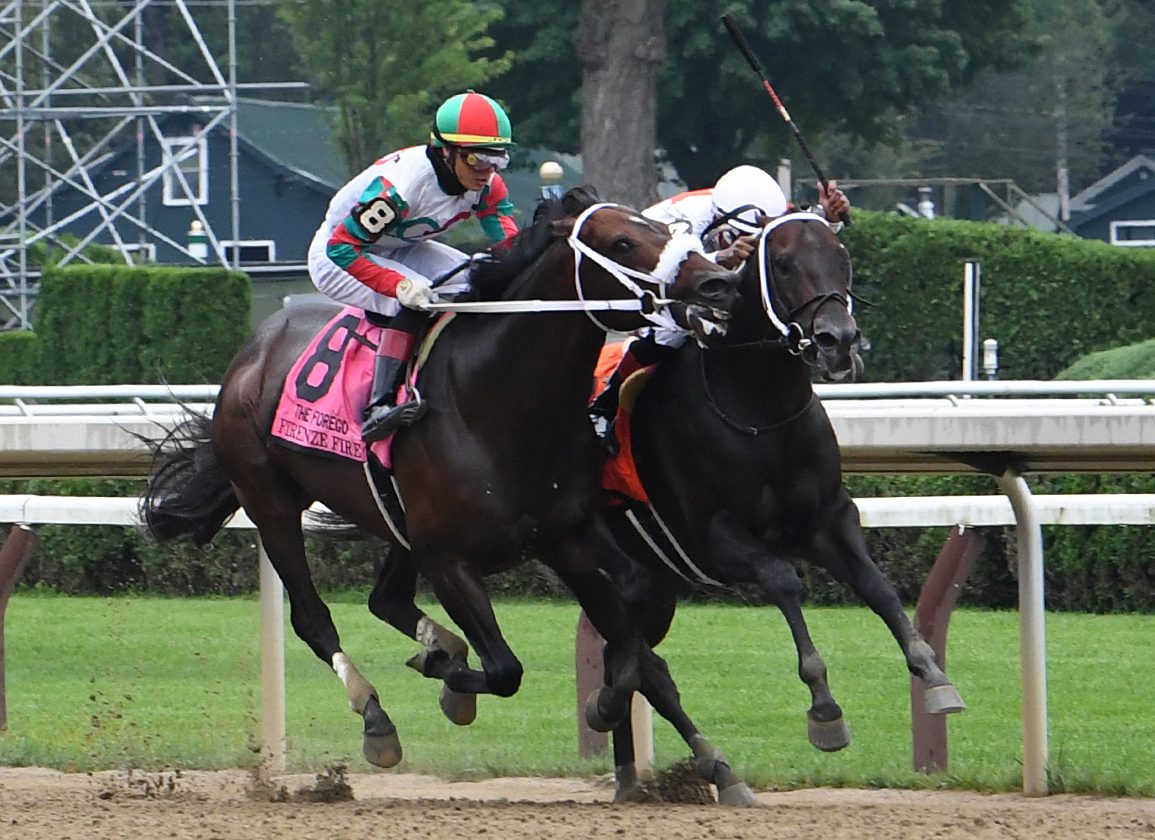
Firenze Fire Savages Yaupon in GI Forego | Susie Raisher

As for Rudder's Men, it appears the cliché 'the sky is the limit' runs true. Much like his sire, the colt hails from an active female family. His young dam Unblemished (Speightstown) is a half-sister to the second-busiest stallion in North America; Spendthrift's Yaupon (Uncle Mo). That sibling-turned-sire won the infamous rendition of the GI Forego at Saratoga where rival Firenze Fire (Poseidon's Warrior) chose violence and took to savaging him over gracefully accepting defeat.

A $140,000 Keeneland September graduate–purchased by Crupi's New Castle–the mare is also a half to GII Del Mar Derby and GII Twilight Derby-placed Sawyer's Hill (Spring At Last), who enjoyed a fruitful career as a multiple winner in California. As one of the 12 claims by St. Elias Stable in 2019, she was picked up for $40,000 in a maiden claimer over the Belmont turf, a race in which she finished eighth after breaking through the gate and dumping her rider. For all the chaotic circumstances leading to his arrival, Unblemished's first foal is already showing a lot of promise and so to is the gut feeling Viola would not ignore.

“It's really a passion project of Vinny's. He raced and campaigned Battalion Runner…the horse is absolutely gorgeous. He's putting a lot of bone on his babies, and I wouldn't be surprised when he has more than one runner. If he gets the chances, he's one who could really make it,” said O'Farrell. “From what we've seen, the St. Elias weanling crop this year is exceptional. He's passing on his good looks, and if they run like anything close to what Rudder's Men is capable of, they're going to be in business for a long time.”

The post Battalion Runner Flashes His Hand as a Sire via Rudder’s Men appeared first on TDN | Thoroughbred Daily News | Horse Racing News, Results and Video | Thoroughbred Breeding and Auctions.

Source of original post

Dolce Zel Can Give Brown First Valley View

Hard though it may be to believe, a 3-year-old filly trained by Chad Brown has never won the GIII Rubicon Valley View S. at Keeneland, but Dolce Zel (Fr) (Zelzal {Fr}) appears to be equipped to be the one to get the conditioner on the board Friday afternoon.

Winner of the GIII Florida Oaks in her U.S. debut in March, the bay was runner-up to future GISW Spendarella (Karakontie {Jpn}) in this track's course-and-distance GII Appalachian S. Apr. 9 and got a bit of a freshening following a third in Churchill's GIII Edgewood S. May 6. Back to winning ways in the GII Lake George S. at Saratoga July 22, Dolce Zel and five others were undressed by front-running stablemate Haughty (Empire Maker) in the GII Lake Placid S. Aug. 20 and settled for second. Irad Ortiz, Jr., the only rider she's known in this country, is back in the irons.

California Angel (California Chrome) caused a 17-1 upset in the GII Jessamine S. at this venue 54 weeks ago and is winless in six subsequent tries, though she has not run poorly. Runner-up in the Mar. 12 LaCombe Memorial S. at the Fair Grounds, the chestnut returned from a six-month vacation to be third in the Sept. 5 Dueling Grounds Oaks, whose runner-up Skims (GB) (Frankel {GB}) returned to win the GII Sands Point S. at Aqueduct. She backs up on 13 days' rest, having been beaten just two lengths into fourth behind Dolce Zel's stablemate Gina Romantica (Into Mischief) in the GI QE II Cup.

Bubble Rock (More Than Ready) was among the best turf sprinters of her generation last season, with a victory in the GIII Matron S. The Shortleaf homebred proved she could handle a route of ground when taking out the one-mile Cincinnati Trophy over the Turfway all-weather in March and she was surely in need of the run when a weakening sixth in the 6 1/2-furlong Music City S. at Kentucky Downs Sept. 13.

The post Dolce Zel Can Give Brown First Valley View appeared first on TDN | Thoroughbred Daily News | Horse Racing News, Results and Video | Thoroughbred Breeding and Auctions.

Source of original post

Lisa Lazarus Talks HISA Budget

Early last week, a bill landed on the doorsteps of the nation's state racing commissions containing their portion of the money needed to fund the Horseracing Integrity and Safety Act (HISA) remit for next year.

The total $72,509,662 amount is broken down four main ways:

  • $58,108,758 to run the anti-doping and medication control (ADMC) program overseen by the newly minted Horseracing Integrity and Welfare Unit (HIWU);
  • $3,654,830 towards HISA's racetrack safety program, which initially went into effect on July 1 this year;
  • $5,466,709 to continue building the technology needed to support HISA's programs;
  • And $5,279,365 for administrative and organizational costs, with $1.8 million of that budgeted for litigation expenses.

That $72.5 million figure doesn't necessarily have to be the final total. The Horseracing Integrity and Safety Authority–the non-profit umbrella established by HISA to broadly oversee the national program–has offered state racing commissions approximately $23 million in monetary credits against the assessment.

“These credits are available to [state racing commissions] who choose to provide sample collection personnel and investigative services (including stewards involved in investigations) in compliance with the new Anti-Doping and Medication Control (ADMC) Program rules,” a HISA press release stated.

To dig down into the particulars, the TDN spoke earlier this week with HISA CEO, Lisa Lazarus.

The Primer

The financial assessments recently sent to individual state rate commissions form a “worst-case scenario” budget “if nobody works with us and we can't hold onto any of that money,” explained Lazarus.

In other words, that $72.5-million figure is the sum total to the industry if no states reach an agreement with HISA and HIWU to continue performing many common anti-doping and medication control program tasks like sample collection and certain investigative duties.

All state commissions could, of course, deicide to fund their portion in full. But for those jurisdictions that reach an agreement with HISA and HIWU, they will likely want to offset some of those costs through the $23 million in credits on offer.

Credits are based, said Lazarus, on how much it would cost the Authority to fill a designated position, rather than what it currently costs the commission for the same role.

And because such a calculation isn't necessarily a 1:1 trade-off–and because many commission personnel often perform more than one task–Lazarus said that she believes the credit system largely plays to a commission's financial advantage.

“Let's say Kentucky's spending $1 million dollars a year on sample collectors,” said Lazarus, using a hypothetical number. “If we had to go in there and hire all new collectors from scratch, we'd actually have to pay $1.5 million. A lot of those state collectors might [also] do other things for the state.”

More broadly, HISA will assume other financial burdens come Jan. 1, including investigation costs, laboratory fees and shipping costs, as well as legal expenses associated with prosecuting ADMC program violations.

But this leads to a potential conundrum for some commissions whose budgets were finalized many months ago in the state legislature when HISA's 2023 budget was unknown, and who, in some circumstances, might have already accounted financially for these costs, including for personnel.

In response, Lazarus pointed in a follow-up statement to the available HISA budget relief, and added, “It's been clear for months that HISA's ADMC program would be going into effect by January 1, 2023. Our goal is that some processes and staffing that have been in place in the past can be re-purposed in collaboration with HIWU so we're all being as efficient and strategic about the transition as possible.”

Ultimately, per Lazarus's calculations, the additional cost of the federal program to the entire industry is roughly $20 to $25 million more than what is currently spent nationally, and she calls those extra monies the cost of “automating and professionalizing a national program.”

Said Lazarus, “That's a relatively small amount, in my view, to invest in safety and integrity to protect a sport that has so much potential.”

Opting Out

Fourteen different jurisdictions are scheduled to host racing on Jan. 1, when the new anti-doping and medication control program goes into effect. And these respective states have until Nov. 17 to decide whether or not to enter into an agreement with HISA and HIWU.

The others will be required to make that agreement decision later down the line, proportionate to the date of their first scheduled 2023 race meet. So far, said Lazarus, no individual states have entered into a voluntary agreement.

On the flip side, only Ohio has so far officially opted out, said Lazarus.

For those commissions that shun a voluntary agreement, HISA's monetary assessment falls onto the shoulders of the respective tracks–a figure which, among all the tracks in the state, is no larger than what had been assessed each respective commission. All sample collections in that state will also become HIWU's responsibility.

The amount charged each track is based on a per-start calculation that factors in numbers of starts and the total purses paid out.

As such, the per-start calculation can vary quite wildly between different tracks, with Los Alamitos charged a per start fee of around $85 and Kentucky Downs looking at a fee of over $1,000 per start. Churchill Downs would face the largest overall assessment if the state commission opts-out of an agreement–nearly $3.9 million.

Furthermore, “if the state opts out, they lose the opportunity for the monetary credit,” said Lazarus. But she added that there are possible avenues for individual tracks or racing associations to unilaterally enter into agreements with HISA to access some of the $23 million in credits.

A track, for example, could form a not-for-profit organization–similar in effect to the New York Racing Association–and hire their own team to conduct tasks like sample collection.

“We're open to any agreement,” said Lazarus, mirroring HISA's approach for the race-track safety portion of the program. “We've had to be really creative because every state is different, and we have to be sensitive to that.”

Which leads to perhaps the most urgent question: Will HISA have enough adequately trained personnel to fill the required positions among those states that opt-out before Jan. 1?

“We've been working very hard on recruiting and getting the workforces in place so that we don't miss a beat on Jan. 1,” said Lazarus.

She is unsure, however, which of the 14 jurisdictions scheduled to race on Jan. 1 will opt-in or out beforehand, stressing how the financial assessments have only very recently been issued.

That said, “I think I can predict with a fair amount of certainty–maybe give or take one or two states–on who's going to enter into an agreement and who's not,” said Lazarus, pointing out how 18 of the 23 individual states entered into an agreement of sorts with HISA for the racetrack safety portion of the program.

Not all agreements were identical, however, and it's believed that only about a handful of states shouldered their racetrack safety costs in full.

Other Budget Components

HISA has priced the entire cost of sample collection, laboratory analysis, enforcement, and other program costs at around $58 million.

Lazarus pinned the laboratory costs alone at around $18.7 million. This is in comparison to estimated national laboratory costs of between $13.2 and $13.8 million from a few years ago.

HIWU can tap all laboratories currently accredited by the Racing Medication and Testing Consortium (RMTC) for adoption into the ADMC program. Laboratory contracts have yet to be inked though, said Lazarus. “I think they're pretty far along,” she added, about those negotiations.

“What I'll tell you is that the strategy and the focus is on smart intelligence-based and investigation-based testing,” she said, adding that, “I actually think you'll see an increase in out-of-competition testing almost everywhere, because that's going to be an important component of the new testing plan.”

Lazarus demurred, however, when asked if this scenario could also lead to a potential reduction in post-race testing among those states with currently the most rigorous post-race testing programs.

A key part of HISA's intelligence-based investigatory approach appears to be the use of technology and centralized databases. For this, HISA has budgeted around $5.4 million for next year.

The racetrack safety database is, of course, already up and running, though Lazarus said that it's constantly being tweaked and improved. She also said that the database for the ADMC program will be “ready to go” on Jan. 1.

At least initially, the ADMC database will compile information like the responsible person in the event of a violation, their charges, case status and the eventual rulings.

HISA has also budgeted $1.8 million next year for the costs associated with fighting the four suits seeking to derail the law. In the event HISA succeeds in court, could it seek cost recovery from the plaintiffs?

“I'm going to leave that one for lawyers,” Lazarus responded. “I do know they have looked into it and we're evaluating our options there.”

Other Stakeholder Questions

The TDN spoke with several stakeholders around the country to canvas other questions and concerns about the budget and the impending roll-out of the ADMC program. The key questions are posted below along with Lazarus's response.


Q: Even if a jurisdiction enters into an agreement with HISA for next year, could some current state commission positions be culled, made redundant through efficiencies made in the national program?

“Obviously, many responsibilities will no longer be on the shoulders of the racing commissions, but don't forget they still have other breeds like Standardbreds and Quarter Horses,” she said.

“How all of that works out, it's hard for me to say at this stage, but I think you're probably right philosophically that we'll continue to see efficiencies in this space as we work towards a national uniform professionalized system, but one that's also as cost-efficient as we can make it.”

Q: What can you tell stakeholders in those states with the highest HISA assessments who feel as though they're essentially subsidizing the high volume racing, low purse states?

“The HISA board approved a cost-assessment methodology that equally weighed starts and strength of purse. If you didn't have that methodology, you'd have states like Pennsylvania paying more than Kentucky. The statute requires us to be equitable, and it felt to the board that was the place you would land on equity,” said Lazarus.

“They may have potentially an outsized role to play in their view now, but they also have a tremendous amount to gain because when a horse dies or tests positive in a state that maybe doesn't have the same integrity and safety [protocols] in place as some of the bigger, stronger states, that hurts horse racing everywhere,” Lazarus added.

“At the end of the day, if HISA works as it should, it should form a protective ring around the industry and give it a stronger foundation with which to build.”

Q: HISA statute precludes state commissions from billing a track or association for the same services that fall under HISA's purview. What will HISA do to do to prevent this from happening?

“There was some discussion about this around the racetrack safety program and where it came up, we just stepped in and said, 'it's not allowed from a legal standpoint,'” said Lazarus.

“All of these commissions, they work for state governments. These are ethical people who are professionals. So, if you put it to them that it's not allowed, they acknowledge it pretty quickly. I don't see that as being a real concern.”

Q: Do you expect any states to drop-away due to costs?

“Ultimately, there's no avoiding the cost. I mean, I'm not sure if you heard me say that we'll work with all of the states and racetracks to find a way of dealing with them that's affordable for them, that works for them,” said Lazarus.

“We will do our best to reach some kind of agreement that is manageable. But at the end of the day, if they just don't want to pay, then the only real option for them is the Texas option, which is deciding not to send out your pari-mutuel signal.”

The post Lisa Lazarus Talks HISA Budget appeared first on TDN | Thoroughbred Daily News | Horse Racing News, Results and Video | Thoroughbred Breeding and Auctions.

Source of original post

Classy Lotus Land Resumes In Japan

In this continuing series, we take a look ahead at US-bred and/or conceived runners entered for the upcoming weekend at the tracks on the Japan Racing Association circuit, with a focus on pedigree and/or performance in the sales ring. The weekend's racing is highlighted by a high-class renewal of the G1 Tenno Sho (Autumn) at Toyko, and with plenty of U.S.-bred activity, here are the horses of interest for Saturday running at Tokyo and Hanshin Racecourses. Sunday's runners of note will appear in Saturday's TDN:

Saturday, October 29, 2022
1st-TOK, ¥9,900,000 ($68k), Maiden, 2yo, 1600m
MODERNIZE QUEEN (f, 2, Distorted Humor–Never Grow Old, by Scat Daddy), a $180,000 Keeneland September yearling purchase, is the first foal to the races for her dam, sold for $100,000 in foal to California Chrome at Keeneland November in 2018. Never Grow Old is a winning daughter of Chilean Group 1 winner Noches de Rosa (Chi) (Stagecraft {GB}), who defeated fan favorite Megahertz (GB) (Pivotal {GB}) in the 2004 GI Gamely Breeders' Cup H. when trained by Richard Mandella for Gerald Ford's Diamond A Racing Corp. Breeders' Cup-winning jockey Yuga Kawada takes the ride on the chestnut, whose lone start resulted in distant fourth-place effort over nine furlongs at Niigata Aug. 7. B-Grantley Acres (KY)

11th-HSN, Swan S.-G2, ¥113m ($772k), 3yo/up, 1400mT
LOTUS LAND (m, 5, Point of Entry–Little Miss Muffet, by Freud) kicks off her autumn preparation in this spot which connections could use as a springboard to loftier targets at home and/or abroad. Victorious in six of her 15 lifetime appearances, the bay was a winner in Group 3 company last season over a mile and has proven her versatility this season with success in the G3 Kyoto Himba S. (video, SC 7) in February at this intermediate trip ahead of a fast-closing second in the G1 Takamatsunomiya Kinen (1200m) (video, SC 9). She was last seen finishing 10th, but not beaten far, in the G1 Yasuda Kinen back over a mile in June and holds entries for the G1 Longines Hong Kong Mile and G1 Longines Hong Kong Sprint in December. A start in next month's G1 Mile Championship could also be on the cards. B-Dr Aaron Sones & Dr Naoya Yoshida (KY)


The post Classy Lotus Land Resumes In Japan appeared first on TDN | Thoroughbred Daily News | Horse Racing News, Results and Video | Thoroughbred Breeding and Auctions.

Source of original post

Verified by MonsterInsights