Earning Their Stripes: Tom Morley

Last year, we conducted a popular Q and A series called 'Smaller But Still Super,' where we featured veteran trainers who have built a competitive racing stable with relatively small numbers (click here to view the archive). This year, we will highlight trainers who have already cut their teeth as novice trainers, but now have a few years of experience under their belt and are looking to make a name for themselves as they grow their stable. We'll talk about the challenges that come with hanging out your single, advice for trainers setting out on their own, how the incoming class of young trainers differs from previous generations and more.

Tom Morley won his first race at Aqueduct in the spring of 2013 and has been a fixture on the New York circuit since.

Hailing from Yorkshire, the conditioner was born into a racing family. Not only was his father an owner and breeder, but his uncle David Morley was a Group I-winning trainer and his other uncle Christopher Spence was a senior steward at the Jockey Club in England. Among his cousins still involved in the sport, Henry Daly is a multiple Grade-I winning jump trainer.

Growing up, Morley spent his summer with David in Newmarket. Before graduating from Newcastle, he spent time as an assistant to Ed Dunlop at Gainsborough Stable and at the Lloyd Webber family's Watership Down Stud.

After graduating from the Godolphin Flying Start program, he worked as assistant to Jeremy Noseda for over four years. It was a busy time to be involved with Noseda's stable, with 14 Group I winners going through the barn while Morley was there including European champion sprinter Fleeting Spirit (Invincible Spirit {Ire}) and Breeders' Cup champion Wilko (Awesome Again).

From there, Morley made the move to the States to work for Eddie Kenneally, where he eventually helped open and develop Kenneally's New York operation.

As his stable celebrates its 10th anniversary this year, Morley has surpassed $13.5 million in career earnings. Graduates of his operation include Grade I victors Haveyougoneaway (Congrats) and Carrick (Giant's Causeway). Morley and his wife, NYRA racing analyst and Team Morley assistant/exercise rider Maggie Wolfendale Morley, have two daughters.
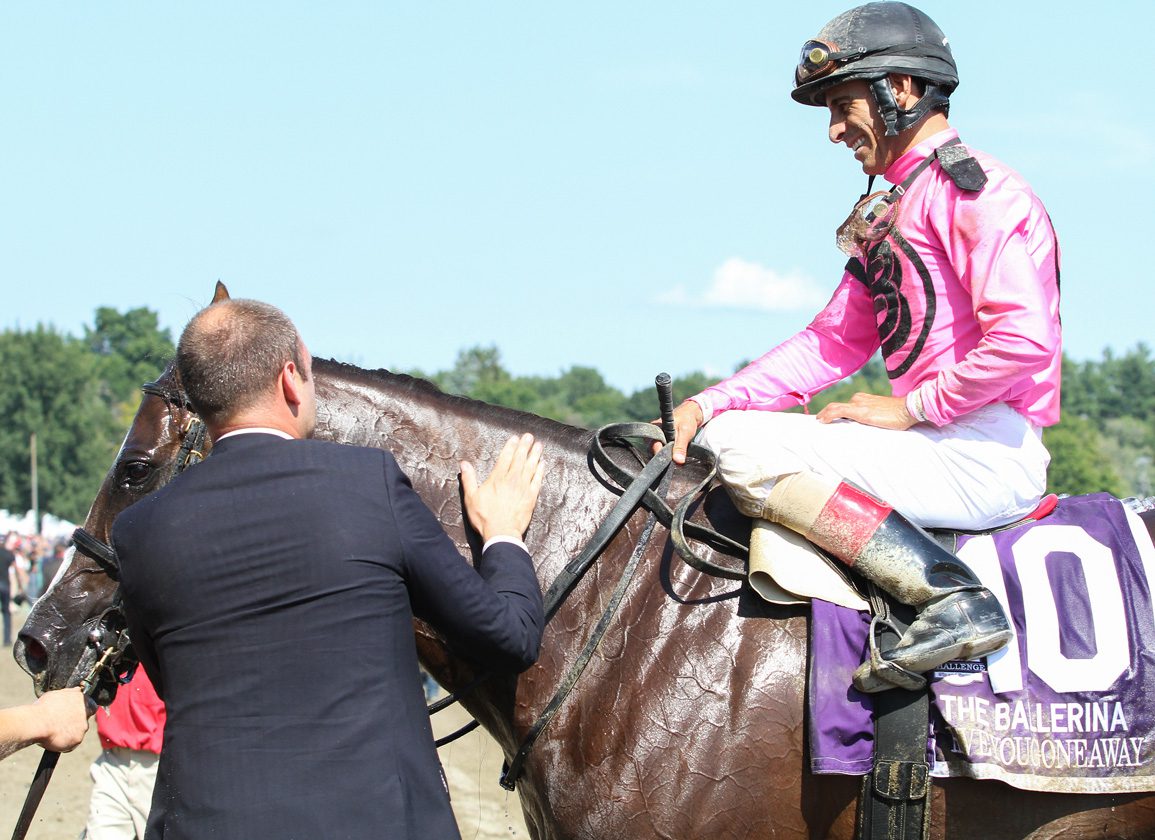
Morley celebrated his first career Grade I win with Haveyougoneaway in the 2016 GI Ballerina S. | Brittlan Wall

When you came to America, was the plan always to stay in the States and eventually train here?

Steve Hillen and Jeremy Noseda both suggested I come to America to get experience. A lot of trainers in the UK like John Gosden and Jeremy himself spent time here before going home.

That was the original game plan, but when I got here I felt like the American industry gave me the opportunity not only to travel, but also I felt like young people were given more of an opportunity to get going here. It's quite hard to get going in the UK. You have to have a lot of capital behind you. You need to be able to rent property and then you need to be able to fill the stalls immediately. Whereas here, you can literally start with one horse, a saddle and a bridle.

So after 18 months of being here, I pretty much made my mind up that I was going to stay. Now I have a business, a house, a wife and two children, so I'm not going anywhere.

Q: How has your stable evolved since it first opened?

We started with the one horse, Treblemaker (Read The Footnotes). Anthony Grey was very kind to send us a homebred of his. He won his second start on the 13th of April in 2013. I groomed and hotwalked the horse, and my girlfriend at the time who is now my wife rode him every morning.

It's grown from there over the years. Now in the middle of the summer we get up to about 50 horses. We'd love more and we're always looking for better-quality horses. That's part of growing into the training ranks. It's tough to attract the top-quality horses. I've always said that as a trainer starting out, the model should be to survive the first 10 years, grow the second 10 years and hopefully by the time you're getting into the third part of it, you're getting some top-quality horses.

When I started training in New York in 2013, seven people took their license out that year. I'm the only one that is still in business. That shows how tough it is as a young trainer to survive on a circuit like New York.

What is the biggest thing you have learned since going out on your own?

I think the biggest thing I've learned–and I'm still learning it–is to be patient with these horses. In this industry in America, we ask an awful lot of our young horses. I see a lot of talented horses not fulfill their potential because of an over-eagerness to get them to the races at a young age. I think if you can train for people who are willing to give them the time to mature, the horses will reward you in the long run. There is nothing better than having a really good 2-year-old, but just because a horse shows that he has an above-average level of ability, it doesn't mean that the right thing to do is try to win a maiden at Saratoga with him.

What do you think makes your stable and your training style unique?

It's very individual. Every horse does something different than what they did the day before.

We've certainly shown over the last few years that we can win races on both surfaces at every level. We've done very well getting older horses from other outfits and improving their careers. There are many facets to training horses and I think we're always trying to improve in every department as much as possible.
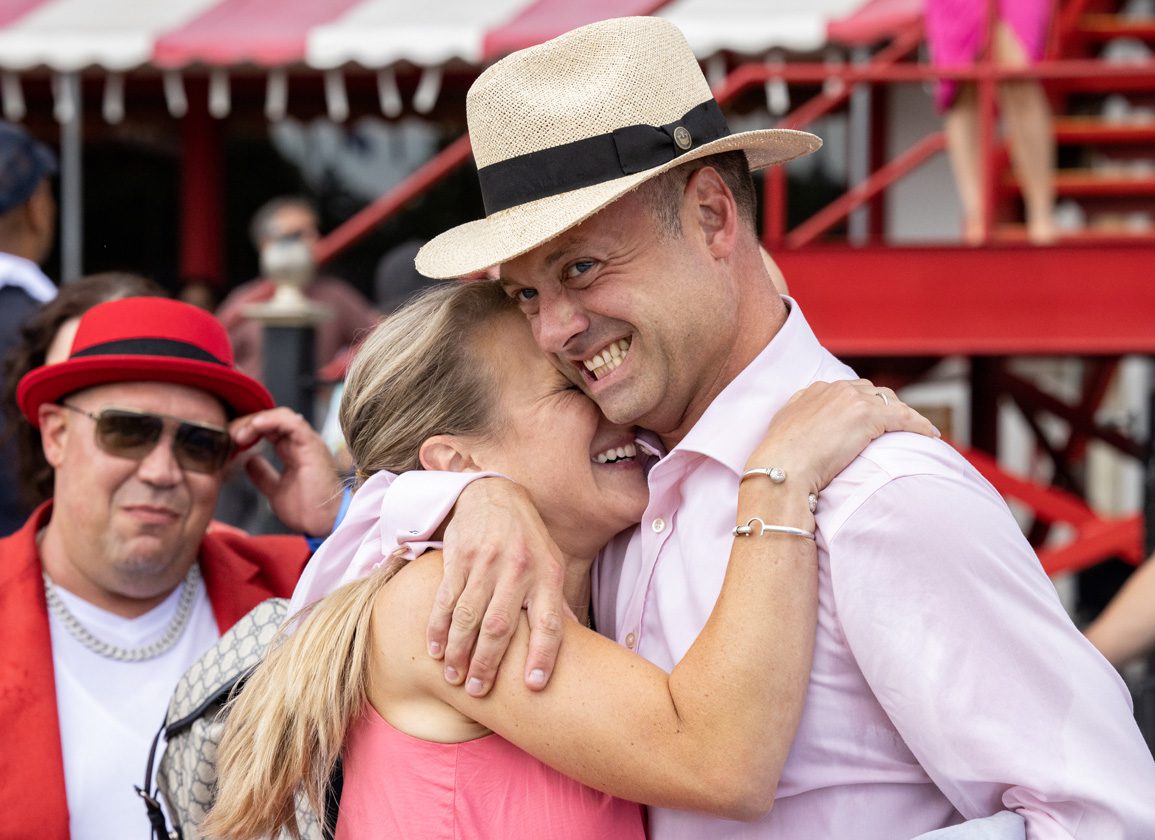
Tom and Maggie celebrate Dynadrive's win in the 2022 Fasig-Tipton Lure S. | Coglianese

Q: Do you think a trainer's success is defined more by their ability or by the quality of horses that they receive?

Without a doubt, it's about the quality of horses that they're receiving. There are plenty of very talented, capable horsemen out there. It's something that the American industry is really struggling with at the moment with super trainers. I take nothing away from these guys. It's not their fault that they train a vast number of horses. The reason they do is because they win the big races and they get the results. But I genuinely believe that there are plenty of trainers out there that could do just as good of a job with the number and quality of stock that those other trainers get. The industry needs to do more things, like this kind of series, to promote younger trainers.

If you aren't at the racetrack, what can you be found doing?

I have two daughters, Grace and Willow, who take up plenty of time. With Maggie doing her work for NYRA and Fox Sports, we're also both full-time parents as well. Between the children, our dogs and the retired racehorses, that seems to take up most of our free time but when we have the opportunity, we're a traveling family. The girls have plenty of stamps in their passports already.

With your hectic trainer's schedule and Maggie busy as one of the faces of America's Day at the Races, what is the juggling act like for you between your family and your stable?

It can be tough, especially in Saratoga when Maggie works enormously long hours. It can be tough on the girls as well because I have to be at the barn in the morning and the races in the afternoon. They go to Faith's House, which is an amazing Belmont Child Care Association school and playgroup. There's nothing I enjoy more than when I'm finished at the barn in the morning, to go pick them up and take them racing. They love going racing in Saratoga. I think it's mainly due to the popcorn and lemonade.

We try not to push horses on the girls at all because it would be very easy for them to be totally swamped with a father who trains and a mother who is incredibly active in the media. They do have a little pony called Snickers who they enjoy going to see, but it's nothing that we actively push upon them.

Obviously I'm enormously proud of my wife. She has become one of the very best around the world at what she does and she deserves all the applause that she gets because her results speak for themselves.

What is your favorite racetrack? I'm guessing Saratoga, but maybe not?

It's York, actually. I was born and raised in Yorkshire and the May and August meeting at York are two extremely special meetings for me. I really look forward to maybe one day having a horse run at York. It would be a homecoming for me.

I have a number of favorite tracks around the world. During the Flying Start program, I thought that Randwick was just the most spectacular place to go racing in Australia. There were always huge crowds of young, enthusiastic people.

I'm a huge jumps racing fan too. Maggie and I try to go to Cheltenham during the March festival whenever we can. There's no better racing atmosphere in my opinion anywhere on earth.

I do love going to Saratoga, but it's hard to call it my favorite because it is when we are under the most pressure. I don't think I can really enjoy it for what it is because it is such an important part of our year.

Who is your favorite horse that you've trained?

You never forget your first winner. I'll never forget the feeling of standing on the outside rail at Aqueduct as a field of maiden claiming $25,000 New York-breds were coming down the lane and Treblemaker cleared from the rest. He was in my barn for a while and then went on to Finger Lakes, but eventually came back to us as a pony for a while. He will always be special for us.

The first really good horse that I was lucky enough to train was Haveyougoneaway (Congrats). She seemed to really thrive in our program. She was my first stakes winner, my first graded stakes winner, my first Grade I winner and my first Breeders' Cup horse. At our house I have a photograph of her taken by Barbara Livingston from the day after the Ballerina. She was an extremely talented, very sweet filly. She will always hold a very special place in my heart.

Do you have any up-and-coming horses in your barn that we should know about?

I'm really looking forward to our group of 2-year-olds this year. We have an Arrogate colt that we bought at the Keeneland Sale for a lot of money coming to us. Steven Roco has bought an Upstart filly and an Into Mischief that are both training very well in Florida.

With the turf season coming up soon, it's going to be exciting to get some horses back like Dynadrive (Temple City), who won the Lure S. in Saratoga last year. His half-brother Tell Your Daddy (Scat Daddy), who won the GII Bernard Baruch H. in Saratoga the year before for us, is back breezing now in Florida. It's going to be fun having the brothers back here for turf season. I'm kind of dreading the idea that they might have to run against each other at some point. It would make an unbelievably cool story, but I'd like to try and keep them separate.

Click here for more from our 'Earning Their Stripes' series.

The post Earning Their Stripes: Tom Morley appeared first on TDN | Thoroughbred Daily News | Horse Racing News, Results and Video | Thoroughbred Breeding and Auctions.

Source of original post

The Week in Review: Forte’s Dominance was Expected, but Practical Move Truly Impressed

'TDN Rising Star' Forte (Violence)'s dominant sophomore debut in Saturday's GII Fountain of Youth S. at Gulfstream is understandably going to generate glowing headlines because of his kingpin status as the comebacking divisional champion. But that sharp win shouldn't overshadow the thoroughly convincing GII San Felipe S. score by Practical Move (Practical Joke) t Santa Anita, which on its own terms was emphatic enough to merit a significant reshuffling of the deck of GI Kentucky Derby contenders.

The Fountain of Youth S. has evolved into somewhat of a “trap” race for high-profile 3-year-olds, with 12 of the last 16 favorites going down to defeat prior to this year's running. In fact, 10 years ago, one of those odds-on losers was Forte's sire, the then-undefeated Violence. He lost the 2013 edition by a half-length to eventual Kentucky Derby winner Orb, but Violence sustained a right front sesamoid fracture that necessitated his retirement after only four races.

Forte, of course, had no idea he was up against a historical trend that featured a familial plot twist when the starter sprung the latch Saturday. He had a clean break and tracked the action fifth into the first turn, racing while into the bit and eager to close gaps on the heels of the frontrunners through opening quarter-mile splits of :24.05 and :23.60.

Irad Ortiz, Jr., was able to dial back Forte's enthusiasm a touch while settling into a rhythmic stride down the back straight, and true to the tactics this colt displayed at age two, Forte asserted his presence while giving the impression he was sizing up the leaders and had them well within his striking sights.

Entering the far bend, Ortiz mulled his options for about a sixteenth of a mile, which is a tactical luxury a jockey enjoys only when he knows he has a willing partner who can take off like a rocket with just a subtle flick of the wrists.

As the 15-1 pacemaker Cyclone Mischief (Into Mischief) got softened up by first and second runs from two stalkers through a third-quarter split of :24.19, Forte inhaled the three of them at the head of the lane with an all-in move that left him only three-sixteenths of a mile to fully unwind over Gulfsttream's short-stretch configuration.

Forte responded to Ortiz's rousing, but the jockey quickly sensed his mount didn't need much in the way of aggressive encouragement. Under his own power, Forte leveled off with a brief but discernible burst of late-race acceleration that put him 4 1/2 lengths clear of the leaders at the wire. The final-quarter split was :24.90 and the last sixteenth was :6.38 for a 1:43.12 finish and a 98 Beyer Speed Figure.

That Beyer represents a two-point regression from the 100 Forte earned when winning last November's GI Breeders' Cup Juvenile for trainer Todd Pletcher and owners Repole Stable and St. Elias Stable.

But Forte was geared down in the late stages of the Fountain of Youth when it was obvious that a winning outcome had been assured, and his more-in-the-tank performance was visually strong enough that it doesn't make sense to quibble over numbers in this instance.

Meanwhile, on the Left Coast…

Practical Move had already done a little avenging on behalf of his sire, Practical Joke, by winning the GII Los Alamitos Futurity back in December. That's because, despite being a top contender on the 2017 Derby trail, Practical Joke never won a two-turn race (although he did rack up a trio of Grade I victories up to one mile around one turn).

Yet bettors weren't too keen Saturday that his son, Practical Move, could win again over 1 1/16 miles in the San Felipe, letting this Tim Yakteen trainee go off as the 4-1 fourth choice coming off a three-month layoff. But a heady ride by Ramon Vazquez drove home the fact that this colt is swiftly rising through the ranks as a dangerous Derby commodity.

Breaking from post two, Practical Move brushed the gate, then absorbed some minor bumping from the horse down to his inside. Unfazed, he took up the chase while fourth through the first turn, hugging the rail. He remained unruffled with a rank rival to his outside, then willingly accepted a rating hold by Vazquez as the field cornered onto the backstretch.

Once the field hit the back straightaway, the riders avoided the rail like it was strung with barbed wire. Of the nine, Practical Move was closest to the inside, in the three path. The pace was honest, with quarter-mile splits of :23.14 and :23.98 for the first half mile. Vazquez edged his mount up incrementally–a nice display of grace under pressure–and Practical Move was jointly second 3 1/2 furlongs out.

But then the inside passage tightened up, and Vazquez had to take hold of Practical Move for a few crucial strides. The leader, Hejazi (Bernardini), still looked strong at that point, and two other horses were launching bids in the clear on the outside.

In an instant, Practical Move got relegated back to fourth. It was the type of positioning misfortune that costs races, and when you're trying to make the cut in a crucial Derby qualifying stakes, it can cost you an entire campaign.

Yet Vazquez never panicked, nor did Practical Move shy from his tight inside spot. Hejazi was soon spent, and he showed it by drifting out to the four path at the head of the lane after a robust third-quarter split in :23.96.

Practical Move deftly cut the corner when that seam opened, and he was as good as gone, kicking home under light encouragement to win with purpose by 2 1/2 lengths.

The final-quarter split was :24.59 and his final sixteenth was clocked in :6.34.

Owned in partnership by Leslie Amestoy, Jean Pierre Amestoy, Jr., and Roger Beasley, Practical Move earned a 100 on the Beyer scale, upping his Los Al Futurity number by 12 points.

There have now been 15 points-earning Derby qualifying stakes at 1 1/16 miles on dirt in 2022-23, and Practical Move owns the two fastest final clockings: 1:41.65 in the Los Al Futurity and 1:42.10 in the San Felipe.

Also Noteworthy…

Now that favorites have won the Fountain of Youth S. the past three years, the companion filly stakes on the same afternoon, the GII Davona Dale S., has become the 'bombs away” race on the first Saturday in March. The $95.40 win by Dorth Vader (Girvin) in this season's renewal was preceded by upset winners who paid $107.60 and $105.00 in 2021 and 2019…Interesting that Davona Dale herself only raced twice at Gulfstream. But the champion 3-year-old filly of 1979 did start her eight-race sophomore win streak there in the Bonnie Miss S., a run that included five Grade I victories before she lost at 1-5 odds in the GI Alabama S. at Saratoga. In a training move filed under the “you'll never see this again” category, Davona Dale then gallantly wheeled right back against colts in the GI Travers S. one week later, only to finish fourth.

The 2022 GI Kentucky Oaks winner, Secret Oath (Arrogate) will have a new jockey for her 4-year-old debut in Oaklawn's GII Azeri S. Saturday. Luis Saez, who has been aboard Secret Oath in her last six starts, is committed to pilot 'TDN Rising Star' Tapit Trice (Tapit) in the GIII Tampa Bay Derby, so trainer D. Wayne Lukas has named Tyler Gaffalione to ride. “Luis has got a [Kentucky] Derby prospect that he's really high on and didn't want to give it up. He really agonized over that decision, but he's afraid that he might lose [the call on Tapit Trice]. He's going to try to talk me into putting him back on. If Tyler rides a big race, he'll have a little trouble getting back on,” Lukas said

Here's wishing Hawthorne Race Course good luck with trying out a nationwide-low 12% takeout on win, place and show bets at the six-month meet that started Sunday. During the first three months of the season, Hawthorne will be racing on Sundays and Thursdays with a 2:30 p.m. Central first post.

“By shifting Saturday racing to Thursday in the spring, we will face less competition on the national scene while being able to make Hawthorne a more visible track to the wagering public,” said the track's racing director, Jim Miller.

Yes, it's the first week of March, and we already have two North American horses with perfect 5-for-5 records on the new season. Dulcimer Dame (Mineshaft), a 6-year-old Charles Town-based mare who races at the starter-allowance level, roared home by 5 1/2 lengths as the 1-5 fave in Saturday's eighth race at the West Virginia oval. She races for owner Richard Burnsworth and trainer Anthony Farrior. Earlier on Mar. 4, the Arizona-stabled Metarose (Metaboss) necked out a 3-2 favored win in a Turf Paradise starter-allowance. The 5-year-old mare is campaigned by owner Miguel Gallegos and trainer Miguel Hernandez.

The post The Week in Review: Forte’s Dominance was Expected, but Practical Move Truly Impressed appeared first on TDN | Thoroughbred Daily News | Horse Racing News, Results and Video | Thoroughbred Breeding and Auctions.

Source of original post

The Bargain Buy or the Seven-Figure Stunner: Take Your Pick in San Felipe

Confidence Game (Candy Ride {Arg}) gave another vote of confidence to the bargain shoppers when the $25,000 yearling made a splash on the Derby trail last weekend in the GII Rebel S. The week before, Angel of Empire (Classic Empire)–a $70,000 Keeneland September buy–proved best in the GII Risen Star S.

This weekend there is potential for another big win by the underdog in the GII San Felipe S., but there is also the likely possibility that the owner of one of those sensational seven-figure purchases will be rewarded.

The San Felipe's sizeable field of 11 includes two homebreds, three contestants purchased for less than $50,000, four bought for six figures–including $500,000 yearling and morning line favorite National Treasure (Quality Road) and $700,000 yearling Fort Bragg (Tapit)–and then that remarkable, pricey son of Bernardini known as Hejazi.

Bred by Chester and Mary Broman, Hejazi was bought by Zedan Racing for $3.55 million at the 2022 Fasig-Tipton Midlantic Sale, setting the mark for the highest-priced Thoroughbred sold at public auction in the state of Maryland and the highest-priced offspring of the late Bernardini at public auction.

Recalling the purchase, agent Gary Young said that the record-breaking colt was exactly what Amr Zedan was looking to add to his stable.

“Mr. Zedan has made it perfectly clear that his goal is to have good 3-year-old colts for the Classics,” Young explained. “This horse fit the bill. By Bernardini and out of a Medaglia d'Oro mare, he was really well-balanced and his conformation was correct. His work was terrific and Baffert loved the horse physically. Did we think he was going to go for that much? Not really. Baffert, my friend Charlie Boden and I stood in the back and Mr. Zedan was on the phone with us. One thing led to another and it got to $3.55 million. I don't think anyone in the group had foreseen it going that high, but when you get two players in the game these days, anything can happen.”

On the other end of the spectrum, Chase the Chaos (Astern {Aus})) is the bargain buy of the San Felipe field. The gelding was bought after receiving considerably less in-person scrutiny than his competitor Hejazi when he was purchased for just $10,000.

Chase the Chaos gets his first stakes win in the El Camino Real Derby | Vassar Photography

Buyer and co-owner Bill Dory purchases a few weanlings for under $10,000 every year to raise and break at his farm and then race at his local track, Century Mile.

“I didn't even go to the sale,” said Dory, recalling the 2020 Keeneland November Sale. “I went through the book numerous times and I picked out horses that I thought would fit in that $10,000 price range for Alberta. I really liked the Medaglia d'Oro-Uncle Mo cross on him. I got the vet report from the repository. He had some OCDs, but they were very minor and the vet thought he would grow out of them. When he didn't achieve his RNA, I asked the consignor how much they wanted for him and at $10,000, it was a done deal.”

From there, Chase the Chaos developed at Dory's farm in Canada and spent his early days under saddle there along with Dory's other November purchases.

“I bought five weanling colts that year and I had them all in one pasture that wasn't far off the road,” Dory recalled. “They would get to playing and people would stop and watch. They would show off for them. It was so cool to watch. Now all of them are winners and two are stakes winners.”

Dory recalled how he thought Chase the Chaos was one of the most promising colts of the bunch, so he called a 2-year-old consignor in Ocala. He named a price he said he thought was fair, but the consignor said that with the colt's inactive pedigree, Dory probably wouldn't get any takers. So Dory brought in partner Adam Ference and decided to race the colt himself.

Chase the Chaos already has free entry to the GI Preakness S. after his win in the El Camino Real Derby and now looks to add a third race to his win streak on Saturday.

Young has plenty of experience purchasing both types of horses–the seven-figure jaw-droppers and the value plays–and has been successful with each in recent years while working with Zedan Racing. Hejazi was bought the same month that Medina Spirit (Protonico), a $35,000 juvenile, won the GI Kentucky Derby. Last year their $1.7 million 2-year-old buy Taiba (Gun Runner) was a top Derby prospect and this year, along with Hejazi, Zedan's Derby hopefuls include the TDN's Derby Top 12 kingpin Arabian Knight (Uncle Mo), a $2.3 million 2-year-old.

“All of this run recently is fueled by Mr. Zedan's passion for the game,” said Young. “Baffert has the final say, which he should, and the team also includes Dr. Pug Hart. It's a team effort and it's very satisfying to see them make it into the Grade I races. It really doesn't matter if they cost $3.55 million or $35,000. Obviously there is more pressure with Hejazi and the seven-figure horses. We all realize that some of them will turn out and some will not, but we've been really lucky over the past few years.”

No matter what the final sales price will be, Young said he focuses on finding athletes at the 2-year-old sales.

“Horses have body language and you want to see them go back to the barn [after a breeze] looking like they're thinking, 'That was fun. I want to do it again.' Sometimes you like a horse and when you look at their pedigree page, you realize that it's not exactly a blue blood, but if they check the boxes for you, you go for it.”

So on Saturday, will the underdog streak continue or will the seven-figure prodigy run to his price tag? Maybe the answer lies somewhere in between. However the race shakes out, it makes for exciting viewing.

“[Bargain buys] give people an idea that you don't have to be a multi-millionaire to compete for the top running of the game,” Young said. “Yet Hejazi is a positive for the big money spenders. Let's face it, for the people that want to think 'Oh, they're just spending money,' if you look up the seven-figure horses through the years, the strike rate of those horses is very, very ordinary. That's not lost on us. We realize that.”

Switched from Baffert's barn to Tim Yakteen for Saturday's race, Hejazi enters the San Felipe coming off his maiden win, where he earned a 99 Beyer Speed Figure, but will now have to prove his ability going two turns. Young said that the colt's last work, where he went 5 furlongs in :59.20 on Feb. 19, speaks to his potential.

“It doesn't take a rocket scientist to watch his last workout and know that he worked terrific,” Young explained. “We're hopeful for a very big effort this weekend, but there are some very tough horses in the race. There are more horses I can see betting on than those that I can't.”

The weather at Santa Anita over the past month that has disrupted training, Young said, will be an added question mark for all of the race's entrants.

Chase the Chaos, who will be saddled by Ed Moger Jr., will be trying dirt for the first time since his debut last August at Canterbury.

“It was a muddy track and he got a huge lesson,” Dory recalled. “He was behind horses and then went between horses to run second. I was so proud of the way he ran in that race. He likes the synthetic, so now we're going to find out how much he likes the dirt.”

Dory is under no illusion about their competition on Saturday, but he said he plans to enjoy the ride knowing that Chase the Chaos has taken him and his partner much further than their initial goal of the winner's circle at their hometown track in Alberta.

“We talked about it, Adam and I, and said, 'You know, do you realize we're going up against a $3.55 million horse?' It's crazy. I think it makes people realize that sometimes you do get lucky and you can get the right horse for a decent price. Hopefully it brings more people into the game. My high is still as high as possible. I'm going to enjoy this for as long as I can. I think he's going to run very well against these horses and I'm hoping he goes off at 65-1 again.”

The post The Bargain Buy or the Seven-Figure Stunner: Take Your Pick in San Felipe appeared first on TDN | Thoroughbred Daily News | Horse Racing News, Results and Video | Thoroughbred Breeding and Auctions.

Source of original post

This Side Up: Lessons From A Polish Donkey

I must admit that this whole business of getting wiser as you get older is giving me a little trouble. Somehow I only seem able to nail one half of the deal–albeit, so far as that goes, I'm definitely making rapid, daily progress.

The only small increment of wisdom I can detect, meanwhile, is perhaps a rather unexpected one. Because while conforming to a dismal stereotype in becoming ever less flexible with age, in most of my habits and beliefs, I did at least sense some improvement in my levels of tolerance when considering the racing this Saturday.

In the past, I would have worn a coast-to-coast scowl. Looking east, we have a champion juvenile deliberately reserving until March the first of what will presumably be only two public appearances before the Derby. Looking west, we find the race that began its glorious history with the eye-watering status of “the Hundred Grander” offering 1/40th of a purse contested in Riyadh last week.

But you know what, I'm learning to live with all that. The world changes, and even on the Pacific shore the water can get pretty cold round your waist if you just stand there trying to turn back the tide. After all, while a couple of horses that would historically have been tailor-made for the Big 'Cap instead went to the desert, the race has still drawn a deep and competitive field. And if modern trainers want to renounce the old school in preparing their Derby horses, then that's their prerogative. The beauty of this game is that whoever's right, or wrong, we have a proving ground where we can settle all differences without rancor. With racehorses, the only rule is that there are no rules.

(To listen to this column as a podcast, click the arrow below)


Except one. Which is that whatever we ask any animal to do, we must always retain a clear conscience. With that in mind, then, allow me to recommend a way to refresh our sense of what is really meant, when diametrically opposed positions on HISA both claim to represent the best interests of the horse.

This week I was fortunate to catch Jerzy Skolimowski's movie EO, which has deservedly won an Oscar nomination for best foreign film. If you haven't yet seen it, you should. Unusually, the central character does not have a single line. He is, in fact, a Polish donkey. Actually, as with Seabiscuit–a Big 'Cap winner, don't forget!–the role is shared by half a dozen animals. But the true diversity sampled through his odyssey is found in ourselves: in our power over animals, and the ways we exercise it.

The film charts the full spectrum, from devotion to brutality. (Though, be warned, the most lurid moment of butchery actually occurs among human beings). Throughout, aside from occasional braying, the donkey naturally remains mute and inscrutable. And while Skolimowski brilliantly stretches the medium to offer him feasible perspectives, ultimately even the most lingering close-up of the donkey's eye cannot penetrate the mysteries lurking in that dark pool. Even so, he achieves an irresistible accretion of dignity simply in the stoical absorption of serial crises in his journey through life.

Interestingly, for our community, he spends an early chapter of his career in a stable housing expensive, lovingly groomed sport horses (whose beauty, by the way, is captured in haunting fashion). Few of us would hesitate to use the adjective “noble” in contrasting our Thoroughbreds with a stumpy, stubborn donkey. But this film transcends such castes, disclosing a fragile sublimity in all life, and demands scrupulous attention to the margin dividing use and abuse of animals. EO won't necessarily make you vegetarian, but it should definitely make you prepared to pay extra to know that your sirloin has a biography that squares with your conscience.

Most people working in our industry can be proudly credited with the same loving engagement that EO encounters, through human charity, in a donkey sanctuary and a veterinary hospital. But while HISA has caused virulent polarization in the interpretation of “welfare,” you would very soon know what truly animates a person if you were to sit down together and watch this film. In fact, maybe we should say that nobody gets a license unless tears are perceptibly welling as the credits roll.

And that's where I draw the line; that's where I retain all possible intolerance. You want to dope your horse so that it doesn't hurt? That is NOT humane. That just means you want to drive him past his red lights.

But make no mistake, that kind of specious logic also shows why our collective responsibility actually starts with the breeders. When we mate horses, our priority should be to produce foals that will be comfortable with the tasks awaiting them.

And that, in turn, is why we cannot permit physical vulnerabilities to be masked on the racetrack. Obviously such regulation has a more immediate purpose, simply in protecting horses from imminent peril. But unless and until we get the pharmacists out of the shedrow, the market will keep rewarding the production of horses that lack such notoriously “uncommercial” attributes as durability (and its ancillary, stamina).

A guy with a needle at the racetrack may be at one extreme, but complicities extend even to that point where good-hearted people who wouldn't harm a fly, never mind a donkey, are right now choosing a mate for their beautiful Thoroughbred mares.

It's chicken-and-egg. People will breed sturdy, robust horses if other people will pay for them. And people will do that if regulation makes such horses essential. Who knows, maybe they will turn out to be exactly the kind of horses that Kentucky has for a generation or so been wilfully discarding to Japan. (And we saw once again, in the desert last weekend, how that is working out).

Producing and preparing a Thoroughbred naturally competent for its vocation is a humane duty–and one that we all share, stubborn as a mule. Because if our industry can't get wise, it can forget any ideas it may have about becoming much older.

The post This Side Up: Lessons From A Polish Donkey appeared first on TDN | Thoroughbred Daily News | Horse Racing News, Results and Video | Thoroughbred Breeding and Auctions.

Source of original post

Verified by MonsterInsights