“Best of Both Worlds”: Mott at Home at Saratoga

SARATOGA SPRINGS, N.Y. – When three veteran turf writers approached him at his Saratoga barn last week, Hall of Fame trainer Bill Mott impishly decided to reverse roles. Before the journalists were able to offer more than a hello, Mott started asking pretty much the same questions he knew were coming his way.

For several seconds, the interviewee was the light-hearted interviewer.

Mott knows the drill. He has been training horses since he was a teenager in Mobridge, South Dakota, was inducted into the National Museum of Racing's Hall of Fame at the age of 45–the youngest flat trainer in history–in 1998 and in the 25 years since has further burnished his reputation as one of the Thoroughbred racing's all-time greats. Equibase stats show him ranked fourth in career purse earnings with $330,933,373 and eighth in victories with 5,323. The great Cigar delivered 19 of those wins–16 in a row–and $9,999,815 in earnings to those totals in the mid-1990s.

With a crew of accomplished stakes runners, Mott will once again be a major player during the 155th summer of racing in Saratoga that starts Thursday. While Cody's Wish (Curlin), who is being considered for the GI Whitney S. on Aug. 5, may have the highest profile at the moment, he is not the only star in Mott's barn located next to the Oklahoma training track. Also in residence along the shedrow are champion sprinter Elite Power (Curlin) and multiple graded stakes winners Casa Creed (Jimmy Creed), Frank's Rockette (Into Mischief), War Like Goddess (English Channel), Art Collector (Bernardini), and Caramel Swirl (Union Rags). Graded stakes winners Poppy Flower (Lea) and Wakanaka (Ire) (Power {GB}) are still at Belmont Park. Art Collector is the only one not being pointed to a Saratoga start.

After stepping back into his familiar role of talking about his horses and upcoming races, Mott acknowledged that he was upbeat and ready for the upcoming season.

“I am, all the time. I don't panic as much as I used to. I don't get the anxiety that I used to have,” he said. “I'm excited and I'm looking forward to it. There was a point when I thought I had to be leading trainer here. It's like, 'Oh, I was leading trainer last year. I've got to do it again.' I don't feel that. I just hope each individual horse does well.”

Mott saddled his first horse at Saratoga in 1984, has been at the meet every year since 1987 and won or shared the training title nine times between 1992 and 2007. These days he often finishes third behind the dominant duo of Todd Pletcher and Chad Brown.

“Naturally, I don't have quite as many as some of them,” Mott said. “I have a large stable. I have the same large stable, like I used to have, but some of these guys have got huge stables.”

Last year, he was fifth in wins with 16 from 114 starters. Brown snagged the title with 42 wins from 197 starts and Pletcher was next with 38 wins from 159 starters. With Olympiad (Speightstown)'s victory in the $1-million GI Jockey Club Gold Cup, Mott finished third in purse earnings with his personal best of $3,262,117.
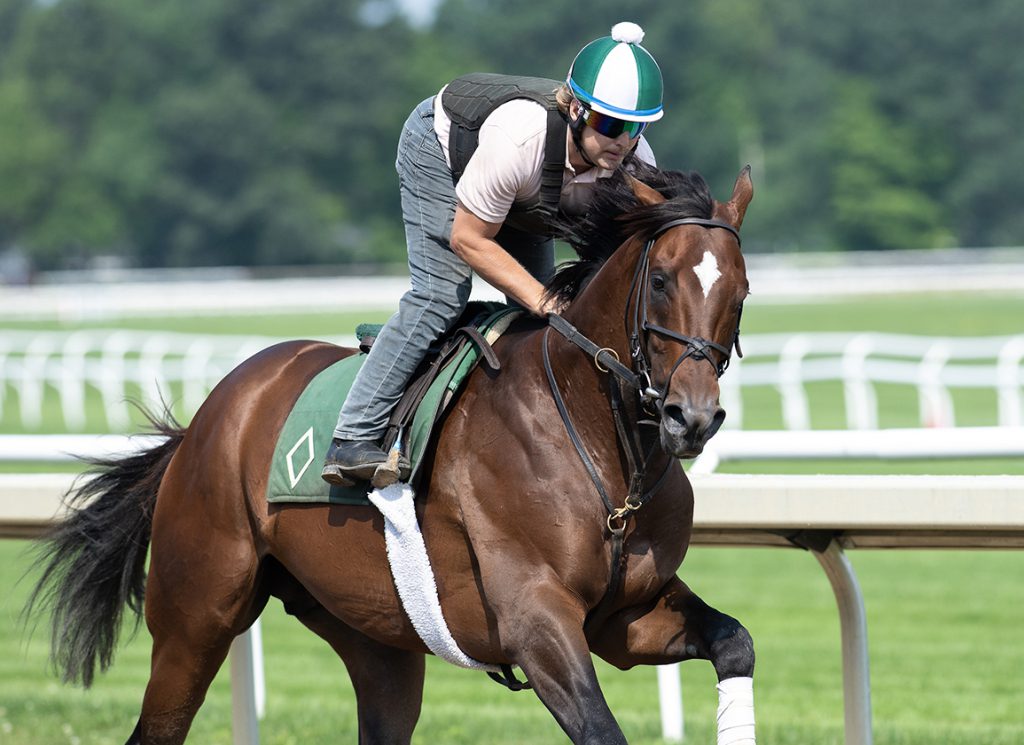
With Eddie Davis up, Cody's Wish gallops Wednesday morning | Sarah Andrew

Godolphin homebred Cody's Wish could give Mott his first victory in the $1-million Whitney. The 4-year-old colt has won six in a row and nine of 10 starts since breaking his maiden in October 2021. In his most recent start, Cody's Wish won the GI Hill 'n' Dale Metropolitan Mile H. at Belmont Park. He has proved effective at two turns, winning the GI Breeders' Cup Dirt Mile in November. Mott said the challenge will be the distance, to see if he can stretch out a bit more and continue his dominant run at 1 1/8 miles.

“He has not won at nine furlongs,” Mott said. “We know what he can do at a mile. Now older and more experienced, seasoned, maybe the mile and an eighth is more within his reach.”

Mott is leaning toward the Whitney because he doesn't have any other options on the Saratoga schedule. He is not interested in running Cody's Wish in the six-furlong GI Alfred G. Vanderbilt on July 29–his 70th birthday–as it is Elite Power's preferred distance. The more suitable seven-furlong GI Forego S., which Cody's Wish won last year, is on Aug. 26

“That's a long way, a long time to wait,” Mott said. “You kind of get forced into thinking about other things. If they had a flat mile race here that was a million dollars, we'd be looking at that but they don't have it. The Whitney is one of the two more prestigious races they run up here and he is a possible to run in it.”

Mott has won 464 races in 2,646 starts and earned $41,065,994 in purses at Saratoga. According to Equibase, he has 91 stakes victories at the Spa. Since he notched his first graded stakes win at Saratoga in 1990 with Chief Honcho in the GII Jim Dandy, his horses have prevailed in 29 different graded stakes with a total of 65 winners. Twenty-five have been in GI races.

Despite all that success in Saratoga, Mott has yet to win either the Whitney or the GI Travers S. He is 0-for-11 in the Whitney with three seconds. In the Travers, he has two seconds in 10 starts.

War Like Goddess trains Wednesday at the Spa | Sarah Andrew

Through the years he has won the GII National Museum of Racing and Hall of Fame S. and the GII Glens Falls S. seven times each, the GI Fourstardave H. and the GII Bernard Baruch H. five times each and the GI Diana S. and the Jim Dandy four times. Since being hired as Bert and Diana Firestone's trainer in 1987, he has had at least one graded stakes win in 34 of 36 seasons at Saratoga.

Casa Creed will be Mott's first stakes runner of the meet in Saturday's GIII Kelso S., formerly run as the Forbidden Apple. He picked up his third Saratoga win last year in the Fourstardave. Mott said that Poppy Flower and Wakanaka could run in the GIII Caress S. on July 22. Frank's Rockette is preparing for the GII Honorable Miss H. on July 26. War Like Goddess is headed to the Glens Falls on Aug. 3, a race she has won the last two summers. Caramel Swirl may make her next start in the GI Ballerina on Aug. 26.

In the early 1980s, Mott was based at Churchill Downs and had emerged as a top, young trainer. He recalls that it took some courage to make his first venture to Saratoga in 1984.

“Absolutely,” he said. “It was to see the people that were here and who you're running against and everything. Yeah, it was a big deal to me. It was a big deal.”

That summer he picked up three seconds in seven starts. The next year, he brought four horses and each of them ended up second. He skipped 1986 and in 1987 made his first trip to the winner's circle.

For many years, Mott has been based in Saratoga from April to November when the training track is open. His main barn was once used by Hall of Famer MacKenzie Miller.

“This is actually home, and I wouldn't want to do it any other way,” he said. “At this moment. I think I've got the best of both worlds right now. I have no complaints.”

The post “Best of Both Worlds”: Mott at Home at Saratoga appeared first on TDN | Thoroughbred Daily News | Horse Racing News, Results and Video | Thoroughbred Breeding and Auctions.

Source of original post

From The TDN Archives

A little more than four years ago, horse racing returned to the Commonwealth of Virginia and Colonial Downs for the first time since 2014. Under the leadership of then track Vice President Jill Byrne–one of Virginia's own–the track staged racing three days a week for about a month and since then, the meet has expanded both in terms of length and in terms of popularity among the betting public.

In August 2019, Ben Massam drew on his Virginian roots–Ben was a championship-caliber track and field athlete at the College of William and Mary in Williamsburg–to write a piece that was part history lesson, part trip down memory lane and 100% from the heart, as that was Ben's forte. The following is the last of a voluminous number of contributions made by Ben to the TDN. Even deep into a battle with cancer, he found the courage and energy to treat our readers to one final helping of his talents. Ben sadly passed away on Breeders' Cup weekend in 2019, taken far too soon at just 31 years of age.

On the occasion of the opening of the 2023 season at Colonial, we thought we would honor Ben's memory by reprinting his story from Aug. 7, 2019, one more time. We hope you enjoy it as much as we all do.

COLONIAL DOWNS REVIVAL ADDS LATEST HOOFPRINT TO STORIED VIRGINIA LEGACY by Ben Massam

For many, the impending return of structured racing to Virginia at Colonial Downs in New Kent evokes stirring memories of a horse culture firmly embedded in the Commonwealth's history. On a personal level, I cannot help but harken back to my days as a track and field athlete at the College of William and Mary in the heart of Colonial Williamsburg, when I would routinely pair 18-mile training days with evening trips to a musty OTB down the road in Hampton to bet Penn National and Charles Town. I'd often drag my teammates with me in hopes of sparking their interest in a game I developed a passion for early in life.

Little did I know at the time, but back in Williamsburg, the origins of Virginia's horse racing tradition were right beneath our feet. Quarterpath Road, a heavily wooded trail situated on the southeast edge of town–and the nexus of one of our most popular running routes–was the location of some of the first organized horse racing during the colonial era. The events would command the attention of the entire town, often taking place over the span of a week and sometimes lasting up to four miles in duration (although the “Quarterpath” name is a nod to the short sprints that were also conducted on the grounds). Match races were common, and the purse money was put forth by race participants.

A 1989 article in the Hampton Roads Daily Press notes, “Nothing remains of the local track where George Washington and others watched the races, except the name 'Quarterpath Road' on the east end of Williamsburg. There, on a narrow road lined by modest houses, Tidewater planters raced horses.”

A circular mile-long track was eventually developed in the vicinity and by the mid-1730s, race meets were being held every Saturday from spring through fall. As the colonial era drew to a close, even visitors who were well-acquainted with the English turf were impressed by the quality of the Thoroughbreds competing in Williamsburg's races.

“Very capital horses are started here, such as would make no despicable figure at Newmarket,” observed J.F.D. Smyth in his travelogue A Tour in the United States of America. “Nor is their speed, bottom or blood inferior to their appearance; the gentlemen of Virginia sparing no pains, trouble or expense in importing the best stock, and improving the excellence of the breed by proper and judicious crossing.”

Racing, in fact, became so popular in Williamsburg that students at William and Mary had to be issued a warning about training racehorses. While the College's founder and first president James Blair was a known supporter of racing, the faculty was eventually compelled to clamp down on students as race meets were continually held in their backyards.

“No scholar belonging to any school in the College, of what age, rank, or quality, [what]soever, [should] keep any race horse at the College, in the town–or any where in the neighborhood,” the William and Mary administration cautioned. “[They should] not in any way [be] concerned in making races, or in backing or abetting those made by others; and all race horses kept in the neighborhood of the College, and belonging to any of the scholars, [should] be immediately dispatched and sent off and never again brought back.”

When considering the history of the Thoroughbred in Virginia, many minds gravitate to the legendary career of Virginia-foaled Secretariat and his iconic owner Penny Chenery. Or perhaps one conjures images of the quaint and enduring steeplechase tradition in the northern reaches of the Commonwealth. These are the bonds that tether Virginia's horse culture from the colonial era to the present day.

The latest incarnation of racing in Virginia comes thanks to the initiative of a new ownership group at Colonial Downs in Rosie's Gaming, with a generous purse structure, low takeout, evening post times and the lure of a lush, wide turf course adding to the appeal. Vice President Jill Byrne–a native Virginian who grew up riding racehorses in Montpelier–noted the significance of the track ending a six-year hiatus of flat racing in Virginia.

“Being part of this comes with a great sense of pride in the state that I call home,” said Byrne. “Thoroughbred racing in the United States started in Virginia when they came to the shores here, and it's had a very long history. Racing was dormant for six years in a place where it has such an esteemed history and background–for it to come back is not only a big win for Virginia's Thoroughbred industry, but the Thoroughbred industry in general…It's going to revive what used to be a very robust breeding industry.”

With the prospect of an expanded schedule in coming years, Colonial Downs appears here to stay, writing the latest chapter in a storied history.

“We'll definitely expand for next year, somewhere between 20 and 30 days,” said Byrne, who added that the return of racing has a far-reaching impact on the local economy.

Whether it is the spirit of hot-blooded colonial steeds bounding down the streets of Williamsburg or a full field of turfers competing on the aptly named Secretariat Turf Course in New Kent, the legacy of racing in Virginia is alive and well. So I return to those long, taxing days of training on Quarterpath Road–footprints replacing hoofprints–but nevertheless indicative of a lasting connection between humans and horses in Old Dominion.

The post From The TDN Archives appeared first on TDN | Thoroughbred Daily News | Horse Racing News, Results and Video | Thoroughbred Breeding and Auctions.

Source of original post

Andy Serling Joins The TDN Writers’ Room

With Saratoga opening, NYRA TV Analyst and Handicapper Andy Serling will be ultra busy over the next seven plus weeks, spending countless hours on every card as he tries to pick winners and give his viewers valuable betting advice. But he's not complaining. It's hard to imagine anyone who loves Saratoga more. To talk about the meet, Serling joined the team on this week's TDN Writers' Room podcast presented by Keeneland. Serling, who has been attending the meet on a regular basis since 1975, was the Green Group Guest of the Week.

When asked if Saratoga will surpass last year's record when $878 million was bet on the meet, Serling said it all depends on the weather. Only 17 races were taken off the turf last year.

“You don't want to sit around and say we're going to do as well or better than we did last year because weather is going to play a major role in that,” Serling said. “But I don't see anything happening that's going to severely negatively affect us. There are weather situations where it rains a decent amount and it's especially a problem if it happens on Saturdays. But other than that, there's a great interest in Saratoga. It remains a place that people just love to go to. So there's no reason not to be optimistic or hopeful that things will go well. But you don't want to get caught up in that because we're geniuses when the weather's good and we're idiots when the weather's bad. Saratoga is a magical place and it seems to continue to do well regardless of what the environment is.”

One race he will be keeping his eye on is the one for the riding title. Irad Ortiz, Jr. was an easy winner last year, but it was his brother, Jose, who won the title at the Belmont spring meet.

“I think it's a very friendly rivalry between Jose and Irad,” he said. “Irad has won four of the last eight and Jose has won three of them. To suggest it's not likely to come down to these two guys is unlikely. Now, this is the first full summer that Jose has been with agent Steve Rushing. He was with Jimmy Riccio before. I wouldn't count Luis Saez out because he's been riding at Churchill and if some of these Churchill trainers do well that he's riding for I think he will have a chance to win it for the second time. Flavien Prat, Joel Rosario are guys who have a chance. I just don't know that they'll get the same kind of mounts to be able to win a jockey title. They might win a lot of stakes. They might win bigger races, but it's tough to go past the two Ortiz brothers.”

As for the trainers, it appears this will be another year where the race comes down to Chad Brown and Todd Pletcher.

“It's going to probably come down to those two guys, Todd and Chad, and it'll probably hinge really on how many good two year olds they have, how many maiden races they win,” Serling said. “Pletcher is capable and we've seen in the past his winning a boatload of maiden races. If he doesn't, he's not going to compete for the title. But the other thing is that one thing that Todd is exceptionally good at is being prepared for off the turf. Todd is usually in there with somebody and it's something that he usually has an advantage on. Chad's strength is often turf racing. So if we get a lot of rain, they come off the turf, it's going to cost Chad.”

Elsewhere on the podcast, which is also sponsored by the Pennsylvania Horse Breeders Association, Kentucky Thoroughbred Owners and Breeders, NYRABets.com, WinStar Farm, XBTV.com and West Point Thoroughbreds, the team of Bill Finley, Randy Moss and Zoe Cadman talked about what was a rocky week for the Horseracing Integrity and Safety Authority (HISA) and whether or not the way it and the Horseracing Integrity and Welfare Unit (HIWU) has been dealing with those who had positive tests for banned substances is a case of “guilty until proven innocent.” There was a review of last week's big races, including the win by Reincarnate (Good Magic) in the Los Alamitos Derby. The team also focused on the story of jockey 61-year-old Cindy Murphy. Murphy won the July 8 GIII Iowa Oaks aboard Crypto Mo (Mohaymen), which was both her 2,000th career victory and her first-ever win in a graded stakes race.

Click here for the audio-only version.

The post Andy Serling Joins The TDN Writers’ Room appeared first on TDN | Thoroughbred Daily News | Horse Racing News, Results and Video | Thoroughbred Breeding and Auctions.

Source of original post

Q&A: HISA’s Anti-Doping and Medication Control Program

The Horseracing Integrity and Safety Act's (HISA) drug control program has encountered some choppy waters since its launch on May 22, encapsulated by events surrounding the law's rules on intra-articular joint injections.

At the end of last month, HISA CEO Lisa Lazarus explained that the Authority–the non-profit umbrella broadly overseeing implementation of the federal law–had temporarily suspended full enforcement of its rules surrounding intra-articular joint injections prior to workouts.

Under HISA's rules as written, trainers are prohibited from giving their horse intra-articular joint injections within 14 days prior to the post-time of a race, and within seven days prior to any timed and reported workout. A violation of these rules could result in a 60-day suspension for the trainer.

According to an announcement dated June 26, the prohibition of such injections within seven days prior to a workout shall be enforced only by making the horse ineligible to race for a period of 30 days. This temporary measure will last until July 15, 2023. HISA had also issued a bulletin to stakeholders on June 23 stating the new policy.

The decision was made, explained Lazarus, because of general confusion surrounding the rules among horsemen. Between 15 and 20 trainers had breached the rule surrounding intra-articular joint injections prior to a workout.

Lazarus said that the names of the suspended horses would be publicly issued. But when pressed by the TDN, the Horseracing Integrity and Welfare Unit–which implements HISA's anti-doping and medication control (ADMC) program–initially responded that the names of these horses would not be made public.

On Friday, HIWU reversed course and issued the names of the horses in question. The list shows that nine of the horses in question had competed during the period of their 30-day ineligibility to race. Three had won. The 30-day ineligibility to race was made for the welfare of the horse, Lazarus had initially explained.

Because of various questions raised over this episode, as well as other issues raised by readers over the past few weeks, the TDN has decided to maintain a Q&A surrounding the rollout of HISA's anti-doping and medication control program. The answers to the questions come from representatives from either HISA or HIWU.

Over the next few days and weeks, this Q&A will be updated as more questions are fielded, and as the TDN receives answers from HISA and HIWU.


TDN: How much does a split sample cost?

The cost of a split sample to test for a Banned Substance is $2,000. The cost of a split sample to test for a Controlled Medication is $1,200.


TDN: Why does it cost substantially more than had typically been the case for a split sample?

Fees were negotiated with the laboratories to ensure expedited reporting timelines and uniformity in testing standards.


TDN: In instances of a provisional hearing after a positive finding for a banned substance (and before the full hearing before an arbitral body of 1-3 persons): Who specifically arbitrates that hearing? And where is that hearing held?

The Provisional Hearings are arbitrated by a member of the Arbitral Body, which is selected by JAMS. The hearing may be held by phone/video conference call.


TDN: How much does the provisional hearing cost?

The cost depends upon the time required by the arbitrator. The Covered Person does not pay any of the costs up front and has the option to request that HISA/HIWU cover the full cost rather than splitting them with the Covered Person.


TDN: What is the timing of that hearing? Does HIWU always wait for the split sample to be returned before holding that hearing, for example?

Timing depends on how quickly an arbitrator can be cleared of conflicts and schedules with all parties can be coordinated. HIWU does not wait for the B sample (split sample) to come back before holding the hearing.


TDN: What happens when a trainer is provisionally suspended? Can that trainer's horses be transferred to the trainer's  assistant? Or are horses required to be transferred to a person unconnected with the stable? Does the numeral size of a barn have any bearing on this decision?

When a trainer is Provisionally Suspended, they may not participate in any activity involving Covered Horses as well as any activity taking place at a racetrack or training facility. This means that the Covered Person cannot be involved in any direct care or conditioning of their Covered Horses.

However, the Covered Person can make arrangements for other individuals to oversee the care, wellbeing, and training of their Covered Horses. Trainers subject to Provisional Suspensions are not required to formally transfer their Covered Horses to another trainer via the HISA portal unless they want the horses to be eligible to participate in Timed and Reported Workouts and/or Covered Horseraces.

Regardless of the transfer status in the HISA portal, a Provisionally Suspended Covered Person may not oversee the daily care of their horses.

During a Provisional Suspension, horses cannot be transferred to the trainer's assistant(s). Transfer requirements are applicable regardless of the stable's size.


TDN: In regards claimed horses that have a subsequent post-race positive: Who pays for the split sample? The owner of the horse before it was claimed? Or the new owner who claimed the horse?

The owner of the horse before it was claimed.


TDN: If the horse in question runs back and wins before the test results come back, would that win result in an automatic DQ?

No, assuming all samples collected in connection with that race are negative.


TDN: If the horse in question runs back and wins before the test results come back, and fails a post-race test for the same substance, would the previous trainer or the new trainer be held liable?

This would depend on the specific circumstances of the case (e.g., dates of races, substance(s) detected).


TDN: HISA CEO Lisa Lazarus initially explained that the 15-20 horses that had been administered an intra-articular joint injection too close to a workout (and which were made ineligible to race for 30 days) would be made public by HIWU. When TDN asked HIWU about this public disclosure, the organization initially stated that these horses would not be made public. HIWU has since changed its mind. What was the reason for the initial confusion? And why did HIWU change course?

Since no violation was being enforced against the trainers of these horses, HIWU was not and is not required to disclose the names of the horses affected. Notices of potential violations are not considered proven or adjudicated violations.

However, HIWU ultimately disclosed the names and will continue to do so in the name of transparency and at the request of HISA.


TDN: How did HIWU/HISA land upon this 30-day ineligibility to race when the stand down period for intra-articular joint injections before a race is 14-days?

The rules (4320) state that Covered Horses who breezed less than seven days or raced less than 14 days after an IA joint injection become ineligible to race or breeze for one month following the date of the injection(s).

TDN: How was it that horses on the list who were supposedly ineligible to race actually ran? Who at HISA or HIWU was responsible for this lapse? Will responsible parties face any consequences?

Furthermore, of these 15-20 horses that violated the intra-articular workout rule (and made ineligible to race for 30 days) will you take any actions regarding those horses who subsequently ran during the period of their suspension?

HIWU had not anticipated the large volume of violations related to this rule and given the newness of the ADMC program HIWU processed and notified the cases as quickly as they could. The horsemen continued to train and race their horses prior to receiving any notification, therefore they will not receive any penalties.

HISA is reviewing the rule and procedures and will make an announcement prior to July 15 on the status of the rule and related procedures subsequent to July 15. Additionally, there were numerous other potential ADMC violations that needed to be investigated and/or processed, creating a much larger than expected workload. HISA and HIWU's top priority is the safety and welfare of each horse and measures have been taken to address these operational concerns.

The post Q&A: HISA’s Anti-Doping and Medication Control Program appeared first on TDN | Thoroughbred Daily News | Horse Racing News, Results and Video | Thoroughbred Breeding and Auctions.

Source of original post

Verified by MonsterInsights