Jerkens Trying To Adjust To Saudi Arabian Racing

Jimmy Jerkens arrived in Saudi Arabia to embark on a new and very different chapter in his training career two months ago and what he's learned so far is that the learning curve is steeper than he had imagined. From the language to the culture to the racing itself, everything is different. He believes he will find his way, but has come to understand that it may take some time.

Jerkens sent out his first starter on July 15 and finished second with a horse named Honky Tonk Man (Tamayuz). He's had three runners since and the best showing among them was an eleventh-place finish.

“To be honest with you, I'm not crazy about how things started out over here,” Jerkens said.

After going out on his own in 1997 after serving as an assistant to his father, Hall of Famer Allen Jerkens, Jerkens soon developed a reputation as one of the best trainers on the NYRA circuit. He won 846 races, had a winning rate of 20 percent and sent out 78 graded stakes winners. But, somehow, over the years, Jerkens fell out of favor and his career went into a nosedive. He won just four races in 2022 and had just two winners this year through May. He knew he had to do something and when Prince Faisal bin Khalid Al Saud offered to hire him and give him 50 horses to train in Saudi Arabia, Jerkens was in no position to say no.

“I love New York racing,” he said. “I just wasn't making any headway. I had a  good two, three years where I was not able to make it. I had some very good years in the past, but you have to keep it up to make a living. I had two, three bad years and it just killed me. It got to where I didn't want to get into a deeper hole. I figured I had to do something. So I chose this.”

He arrived in Saudi Arabia on May 22 and set up shop at King Khalid Racecourse, which is in the town of Ta'if. The Saudi racing circuit heads there every summer before returning to King Abdulaziz Racetrack in Riyadh for an October to March run.

There are so many horses in Ta'if that, in order to accommodate all the stables, the track opens for training at two in the morning. Jerkens said he usually gets there at 2:30. Training ends at 8, but the track reopens for training at 2 in the afternoon and stays open until 6.

But it's not the long hours that have given Jerkens problems. He said the track is unlike anything he's ever encountered in the U.S., so deep that in the seven-furlong race in which Honky Tonk Man finished second the winning time was 1:29.25. He's still trying to figure out the best way to prepare a horse to run over a track that is that tiring.

“The track is ultra, ultra slow,” he said. “It's unlike anything I've ever seen. It's really slow and cuppy and having it that way seems to be a tradition. Most horses need a start or two over it to do their best. The three I've run since the first one acted like they really needed the race bad. These horses don't gallop out 50 yards past the finish line. The jocks are getting the tack off of them in five seconds. The groom better be right there. It's so tiring horses don't have anything left for a gallop out. Who I am I to complain? I'm Johnny Come Lately. You try to get your horse ready for a race but at same time you don't want to go overboard. You don't want to work your horse 100 times just to have them ready to run one time. You try to save your horses for Riyadh. It's a fine line and it takes some figuring.”

He's also finding it difficult to deal with what he says is a lack of information.

“The biggest adjustment is the lack of information on the horses,” he said. “You are so used to looking at pp's and seeing everything right in front of you. There's no published workouts. They have charts but they're not detailed where you can tell where they were earlier in the race. People who work for me, they know who the speed in a race is just by memorizing the horses. Even on my own horses, I can't get good information on them. You'd like to see their past races, their past performances, like we have back home. It's just not like that. It's very frustrating. I want to know who I am running against. I want to know how they've been working. I want to know everything about them. You just don't have that. That's hard to get used to.”

While he's still trying to learn more about the competition, he's already discovered that the quality of the horses in Saudi Arabia is better than he had expected.

“This racing is a lot better than it used to be,” he said. “My owner used to have all the best horses. Now a lot of people have caught up. You wouldn't believe some of the pedigrees they have. There's a lot of Into Mischiefs. In one race we ran against a horse who is by War Front out of Lady Eli. You see a lot of American influence in the pedigrees. It's a lot tougher, a lot more competitive than it used to be.”

Jerkens had hoped that he would be joined in Saudi Arabia by his wife, Shirley, who works for the New York State Department of Education. But those plans have been put on hold because it doesn't appear that there are many employment opportunities for her in Saudi Arabia. The quiet nights at home are starting to get to him.

“I live in a nice little compound,” he said. “A South African trainer lives next door to me and we're pretty friendly. Outside of that, there's not much socializing. The compound is nowhere near as full as use to be. And there's no alcohol. You would like to have a nice glass of wine with your dinner every once in a while, but that's not happening. Outside of the horses, it's pretty lonely. I try to keep myself entertained with TV, the DVD player and by keeping up on the races back home. That's about it. Riyadh should be better. It's a lot more Americanized than it is here. It should be more interesting there. Everyone I work with has been supportive, but there's only so much they can do. It's taken a while to get used to the quietness.”

He signed a two-year contract. What will he do when it's over?

“Maybe things will go great and I'll renegotiate after two years,” he said. “I don't know. I have no idea.”

They race three days a week, on Thursdays, Fridays and Saturdays, at Ta'if and Jerkens said he will have some more runners in the days ahead. A winner or two would no doubt pick up his spirits. He's a good trainer. He should win races. For now, though, it's a work in progress.

The post Jerkens Trying To Adjust To Saudi Arabian Racing appeared first on TDN | Thoroughbred Daily News | Horse Racing News, Results and Video | Thoroughbred Breeding and Auctions.

Source of original post

Summer Breezes: July 26, 2023

Some of the most highly anticipated races during the summer racing season are the 'baby' races during the boutique meetings at both Saratoga and Del Mar and at Ellis Park, which attract its fair share of high-priced offspring from a variety of top national outfits.

Summer Breezes highlights debuting 2-year-olds at those meetings that have been sourced at the breeze-up sales earlier in the year, with links to their under-tack previews. To follow are the horses entered for Wednesday at Saratoga:

Wednesday, July 26, 2023
Saratoga 3, $88k, 2yo, f, (S), 5 1/2fT, 2:19 p.m. ET
Horse (Sire), Sale, Price ($), Breeze
Beautiful Thief (Dialed In), FTMMAY, 65,000, see below
C-Wavertree Stables (C Dunne), agt; B-Bona Venture/G Weaver
Dorth's Sol Dancer (Solomini)-AE, OBSAPR, 40,000, click
C-Omar Ramirez Bloodstock, agent; B-SJB Stable Trust
Mel's Angel (Leofric), OBSMAR, 32,000, click
C-Really and Truly Thoroughbreds; B-4K Services LLC


The post Summer Breezes: July 26, 2023 appeared first on TDN | Thoroughbred Daily News | Horse Racing News, Results and Video | Thoroughbred Breeding and Auctions.

Source of original post

Open Letter To The Stronach Group: Where Are The Answers?

Over a week has passed since The Stronach Group (TSG) announced with a short statement light on detail the closure of Golden Gate Fields at the end of the year–a momentous decision that figures to upend a way of life for so many in California.

Since then, the company has remained publicly mum on the reasons behind the closure, and its vision for the future.

Every day since the announcement, the TDN has submitted a series of questions, to which TSG has responded only once. “For now, the [Sunday] statement is going to be our comment around the story. We look forward to being in touch in the future about our plans,” wrote Stefan Friedman, a TSG spokesperson, last Monday.

The silence is troubling for the thousands of breeders, trainers, owners, grooms, hotwalkers and phalanx of individuals attempting to make a living from horse racing in the state.

With the clock racing towards the end of the year–when many will pack up bag and box, van and car, to start life anew on Christmas Eve–they face stark decisions about their professional futures and personal lives.

Do they try to make a go of it in Southern California, or do they ply their trade in another state? What's best for their families? What kind of investments should they be making at this year's sales? How do they shape their breeding plans for next year? And what kind of industry will exist to justify such investments?

These are tough questions to grapple with at the best of times–much harder still beneath a veil of uncertainty and not a little fear. The edifice of any successful racing operation is built upon foundation stones laid years, decades sometimes, in advance.

With this in mind, the TDN is publishing the questions submitted each day to TSG, and again asking when can stakeholders expect the answers they need to make those long-term business decisions that ensure this industry's future.

1 – It appears that TSG didn't give all the relevant stakeholders much (if any) of a prior warning before making the announcement. If that is indeed the case, why did TSG decide to make the announcement in this abrupt fashion?

2 – How many horses does TSG expect to be relocated to Santa Anita from GGF? And has TSG spoken with the connections of those horses about possibly making the move?

3 – Many of the horses at Golden Gate don't seem an obvious fit for the Santa Anita/SoCal circuit. Is TSG concerned that fewer horses than expected will make the move? Is TSG prepared to offer cheaper claiming races at SA (cheaper than $10,000) to accommodate the lower-level horses currently stabled at GGF?

4 – What was the reason for closing GGF? Are they economic reasons? If not, are the reasons to do with the recently proposed Berkeley City Council ordinance? Or are they a combination of factors?

5 – Did the economics from Computer Assisted Wagering (CAW) play any part in the decision to close GGF?

6 – Furthermore, TDN understands that the GGF purse account was in deficit to the tune of around $1.9 million. Did this play a part in the decision to close GGF? If so, is Santa Anita's purse account in the red or black?

7 – Is it true the state is stepping in to turn GGF into a park?

8 – What are TSG's thoughts about CARF's proposal to make Cal Expo a year-round hub of racing in the north?

9 – What specific long-term plans does TSG have for Santa Anita? Will TSG be making any substantial financial investments into the property, to show stakeholders that the company is sincere about the long-term viability of the facility?

10 – On top of that, will TSG be making any investments in the Santa Anita backstretch–in particular, to vastly improve living conditions for the backstretch workers living there?

11 – Does TSG intend to purchase the Arizona Downs facility?

12 – Will TSG extend GGF's closure date to accommodate the needs of California industry stakeholders in making the necessary adjustments to their businesses?

The post Open Letter To The Stronach Group: Where Are The Answers? appeared first on TDN | Thoroughbred Daily News | Horse Racing News, Results and Video | Thoroughbred Breeding and Auctions.

Source of original post

Mel Giddings Enjoys First Saratoga Summer With Her Own Stable

Melanie Giddings had originally planned on a no-stress summer when she decided to move her fledgling stable from its home base at Palm Meadows up to New York for the Saratoga meet.

“I had said, 'Why don't we just go up to Saratoga and enjoy ourselves?'” Giddings recalled with her signature easy smile. “No pressure, no nothing. Just take the horses there and see what we can do.”

Those expectations went out the window pretty quickly when a filly named Maple Leaf Mel (Cross Traffic) landed in her barn. The undefeated sophomore won her first race with Giddings listed as trainer when she put in a dominant gate-to-wire performance in the GIII Victory Ride S. on July 8 and now, Giddings and her stable star are preparing for what will be the biggest race of both their careers in the Aug. 5 GI Test S.

Last spring, former Super Bowl-winning head coach Bill Parcells purchased Maple Leaf Mel for his August Dawn Farm at the Fasig-Tipton Midlantic Sale. He decided to name the daughter of Cross Traffic after Canadian-born Giddings, who was then the assistant to his regular trainer Jeremiah Englehart.

Giddings has been with Maple Leaf Mel since the grey filly first came to the racetrack, so when Giddings went out on her own at the beginning of this year, her namesake soon followed. It was a decision by Parcells and Englehart that Giddings does not take lightly.

“It would have been weird for me to not have her in my barn, but to have her in my name is pretty incredible,” she explained. “It's  a big responsibility to try to live up to a filly who is undefeated and keep it that way. I'm so grateful for Coach to give me the chance and for Jeremiah to be so supportive of my training career and let me have this filly in my name.”

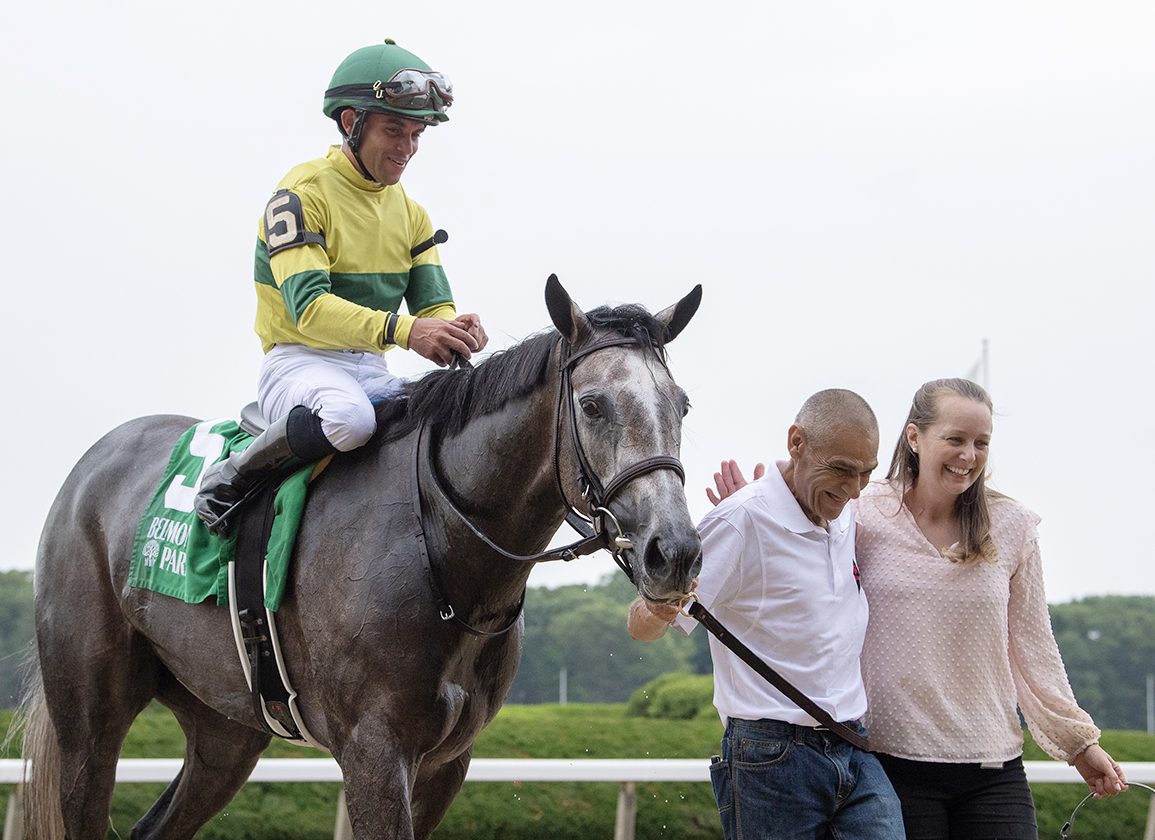
Mel Giddings and Jeremiah Englehart celebrate Maple Leaf Mel's first graded stakes win in the GIII Miss Preakness S. | Horsephotos

The pressure was on in the Victory Ride when Giddings was first listed as Maple Leaf Mel's trainer, especially when the entries included the likes of MGSW Red Carpet Ready (Oscar Performance) and Grade II-placed Interpolate (Into Mischief). Giddings called an old friend and mentor for a confidence boost before the race.

“I spoke with Jeremiah when the past performances came out and I said, 'Well I drew the toughest field to have her in my name for the first time.' He told me not to worry and he was right. She doesn't care who it is and horses don't read the form. She went out there like every other time and put on a show.”

Now five-for-five with four stakes wins to her credit, Maple Leaf Mel is emerging as one of the top fillies of her division, but her trainer said that the speedy grey is like a kid on the playground when she steps into the starting gate.

“I think for her, being a good racehorse is just the fact that she loves her job,” said Giddings. “She knows what day it is when it's time to run and she's a different horse. She can't wait to run. I don't even know if she really knows what she's doing. She just goes out there and she thinks it's a good time.”

Maple Leaf Mel put in her most recent work in preparation for the Test on July 21, going four furlongs in :49.22.

“She's feeling frisky,” reported Giddings. “I'll try to keep her that way and keep her as fresh as I can going in. This will obviously be the biggest race of her life.”

Giddings has been around her fair share of talented racehorses in her 26 years in the industry. Over the years she has worked for the likes of Al Stall Jr., Mark Casse, Kevin Attard, Steve Asmussen and Roger Attfield. The thought of hanging out her own shingle never really crossed her mind until a life-threatening illness put things in a new perspective.

In 2020, Giddings was diagnosed with Stage 4B endocervical and ovarian cancer. After surgery to remove two grapefruit-sized tumors, several rounds of chemotherapy, and a long recovery, Giddings returned to the racetrack.

Maple Leaf Mel goes five-for-five in the GIII Victory Ride S. | Sarah Andrew

“I thought I would see how I could make it through the first year, whether I could even make it still doing what I love doing,” recalled Giddings. “The first year was really tough. I mean, that first year if you had said that I was going to train, I'd have told you that you're nuts because I was struggling a lot.”

But by last year, Giddings was back to overseeing around 40 horses in the Englehart barn and soon after, she discovered the dream she never really knew she had.

“I had never thought of training,” said Giddings. “I just always loved the racetrack. I've been here for 26 years and I just love getting horses ready and I take pride in them doing well and succeeding. When I got sick, I wasn't sure if I would ever be able to have another job in my life, let alone make it. So when I did I thought, 'Why not do it for myself?' No stress, no goals. Just do it and see what happens.”

Giddings said she sometimes can't believe how much time has passed since those long, excruciating months when she was so far removed from life on her beloved racetrack.

“Sometimes I look at my hair and I go, 'Oh, it's been that long,'” she said, grabbing her ponytail of now shoulder-length hair.

So just over three years after she first received the cancer diagnosis, Giddings is soaking in every moment with a filly named in her honor and a stable of promising 2-year-olds that she hopes will further her stable's early success.

Giddings has eight horses in her barn on the Oklahoma this summer, which she runs with the help of her 15-year-old pup Reese. Maple Leaf Mel is her only older horse, but Giddings has always enjoyed working with the babies and she is excited about the progress of each of her pupils.

On Wednesday, another auspicious grey namesake called Mel's Angel (Leofric) will make her debut at Saratoga. Picked out by Giddings for $32,000 at the OBS March Sale for owner James Kelly, the filly will face fellow New York-breds sprinting on the turf.

“Mel's Angel is really straightforward,” said Giddings. “She's a total sweetheart in the barn, but she's got a lot of feistiness on the track.”

With several new clients, Giddings hopes to be busy claiming and taking on the sales in the coming months. She understands the struggles that come with starting out on your own and she is grateful to the owners who have shown their support from the start.

“It's tough to break out on your own if you don't have people to back you,” she said. “If you're not winning, you're not making money so [support] is huge. We're super grateful to owners like Bill Parcells, who gave Maple Leaf Mel some time off when we asked him to and now she's rewarding him. I'm just glad it worked out because we all told him that it would and now here she is. I hope she can have a big year for him.”

Of course, not every horse in her stable will be another Maple Leaf Mel, but Giddings loves all her horses just the same.

“You get attached to the horses,” she said. “They all have their own personality. I mean, even if they're a five claimer of if they're a stakes winner, I love them all.”

The post Mel Giddings Enjoys First Saratoga Summer With Her Own Stable appeared first on TDN | Thoroughbred Daily News | Horse Racing News, Results and Video | Thoroughbred Breeding and Auctions.

Source of original post

Verified by MonsterInsights