Not Enough Jockeys For ‘Quality Racing Product’ Causes Del Mar Cancellation

On Wednesday, when Del Mar Thoroughbred Club (DMTC) announced the cancellation of this weekend’s three days of racing in the aftermath of 15 asymptomatic jockeys there testing positive for COVID-19, the chief reason listed in the track’s press release was “to help ensure the safety of all workers at Del Mar and our surrounding community.”

But in a Thursday teleconference organized by the Thoroughbred Owners of California (TOC) that featured Del Mar executives explaining their decision not to race, the focal point centered not so much on preventing the spread of the disease, but on whether or not there would have been enough qualified replacements to take the mounts vacated by the quarantined jockeys.

“We felt it was the prudent thing to do,” said Josh Rubinstein, the president of Del Mar Thoroughbred Club, at the outset of the call. “We just wouldn’t have enough riders to put on a quality racing product that you as owners are used to in California and that our customers are used to wagering on.”

A few minutes later, when the teleconference was opened up to questions from the 141 participants listening in, the very first query was from owner Billy Koch, who asked Rubinstein to clarify whether the primary reason for the cancellation “wasn’t that we couldn’t find other jockeys, it was that we were more concerned with how it would actually look.”

Rubinstein’s reply was “That’s partially accurate. We debated several scenarios [like] bringing in northern California riders. That was challenging, as they had been named on horses up north.”

Rubinstein also explained that after the 15 positive tests, the Del Mar pool of regular riders was down to about 12. And when track management announced on July 15 that a new health protocol will prohibit jockeys from entering the backstretch to exercise horses, three of those “not big-name riders” opted to keep working as per-diem exercise riders in the mornings rather than accept mounts as in the afternoons.

“So that took the number down from 12 to about nine, so it would have been very challenging to try to put together a card with jockeys of the quality that you owners need and what our players need to wager on.”

Several subsequent teleconference participants wanted to know why other racing jurisdictions haven’t had jockeys testing positive en masse for the coronavirus and why Del Mar only began testing riders after the outbreak was detected.

“We’re very confident of the protocols that we have in place,” Rubinstein said, alluding to “some challenges” that occurred before riders got to Del Mar.

Greg Avioli, the president and chief executive officer the Thoroughbred Owners of California, interjected with a more pointed response.

“Let me be more direct,” Avioli said. “What Josh is not saying is a number of these jockeys showed up at Del Mar having almost certainly picked up this virus when they were at Los Alamitos. So it didn’t really matter what the Del Mar protocols were at that point [because] asymptomatic jockeys showed up with the virus. I think this should be a one-time issue.”

Avioli was referencing a cluster of five jockeys who all rode at Los Alamitos Race Course on July 4 then subsequently tested positive for the virus. Those riders have been publicly acknowledged as Luis Saez, Martin Garcia, Victor Espinoza, Flavien Prat and Eduard Rojas Fernandez. Of the 15 jockey positives from the July 14 testing at Del Mar, 14 of them have been contact-traced to Los Alamitos.

“The good news is they are all currently asymptomatic,” Rubinstein said of the 15 positive-test jockeys, whom Del Mar is not naming out of respect to privacy rights.

“And based on our conversations with the county and with [the San Diego health care provider] Scripps Health, as long as they remain asymptomatic, and we’ve had contact with all 14 of the [Los Al] jockeys, they will be able to quarantine for 10 days and they will be able to ride when we resume racing next Friday, July 24.”

The starting gate crew and pony riders who accompany Thoroughbreds to the gate are scheduled to undergo COVID-19 testing on Friday, Rubinstein added. Exercise riders are not currently scheduled for testing.

When pressed by another call participant about why Del Mar did not plan for testing jockeys prior to the meet, Rubinstein explained it this way:

“We received guidance from both the county and Scripps Health. And their guidance to us [was] that there are challenges with asymptomatic testing. And their recommendation to us was to allocate resources to other things we’re doing with facial coverings, sanitizing, reconfiguring the jockeys’ room. But obviously, if somebody [shows] symptoms, you get them tested right away. That thinking changed [when] five jockeys tested positive from Los Alamitos. Then we immediately tested the riders on Tuesday.”

When a member of the media inquired as to whether the valets, who work in close quarters with the jockeys, were also tested and if any of those results came back positive, Avioli, who was moderating the teleconference, was quick to say that “this isn’t really a media call.” But he said he would “make an exception” if the DMTC executives wanted to answer the question.

A woman who did not identify herself prior to speaking then answered that all of jockeys’ room personnel were tested on Tuesday along with the riders. But she did not answer the part of the query that dealt with the results of those tests, and Avioli quickly called for the next question.

In addition to the list of new health protocols Del Mar announced on July 15 (read them here), Rubinstein said that out-of-state jockeys will not be allowed to enter the Del Mar riding colony this meet. And if they leave Del Mar to ride elsewhere, they won’t be allowed back.

With one notable exception.

“It starts when the colony is back together next week,” Rubinstein said. “So the question that you may be asking is ‘[What about] Mike Smith?'”

Smith, the in-demand Hall-of-Fame jockey, is booked to ride five graded stakes mounts Saturday at Monmouth Park, including heavily favored Authentic (Into Mischief) in the GI Haskell S. for trainer Bob Baffert.

“We had actually had conversations with Mike,” Rubinstein explained. “Mike is riding Saturday in New Jersey. If we were to [have had races] this weekend, we had Mike scheduled for a quick test at Scripps on Sunday. He would be isolated until we got the results of that test. If it was clean, then he [would have been] able to ride on Sunday. So we’re doing the same thing with Mike [but] we’re just moving it a week forward. So when Mike gets back from New Jersey we will set up a test for him at Scripps. Hopefully, it’s negative, and he will be a part of the colony.”

Other jockeys won’t have that privilege.

“They can leave, they just can’t come back–[like in the song by the Eagles] Hotel California,” Rubinstein said.

“In reverse,” quipped someone on the call more familiar with the haunting lyrics that warn, “You can check out any time you like, but you can never leave.”

Because of the July 17-19 cancellations, Rubinstein said Del Mar has a request pending with the California Horse Racing Board to allow the track to add a race date on Monday, July 27. In addition, Del Mar will seek to card additional races on some Fridays and Sundays.

“We don’t think it will be an issue to get approval, but we want to let folks know…that we intend to do our best to make up for the races that were lost from this weekend,” Rubinstein said.

The post Not Enough Jockeys For ‘Quality Racing Product’ Causes Del Mar Cancellation appeared first on TDN | Thoroughbred Daily News | Horse Racing News, Results and Video | Thoroughbred Breeding and Auctions.

Source of original post

Tradition Remains on Unusual Saratoga Opening Day

SARATOGA SPRINGS, N.Y.–Just like always, the bell in the winner’s circle was rung 17 minutes before every race at the Spa Thursday afternoon.

Of course. Exactly 17 minutes.

Even on the most unusual of opening days at Saratoga Race Course, tradition was served. It is Saratoga after all. Phil Linguiti did the honors, yanking the strap that moved the clapper to produce the sound. Linguiti, a former jockey and longtime white cap in the clubhouse, is a familiar figure at Saratoga. Since this 152nd season is racing in Saratoga Springs is being conducted without spectators due to the Covid-19 pandemic, Linguiti wasn’t needed in the empty box seats and became the masked bell man for the day.

The bell is a relic to a bygone era at a track that knows bygone well. Legend has it that the bell was used as a signal to trainers to bring their horses from the barns on the backstretch to be saddled under the trees behind the clubhouse. Trainers no longer have to rely on the bell for guidance, but the bell remains. Though the winner’s circle is no longer just simply a circle of chalk on the dirt racing surface near the finish line and huge video screens in the infield provide the tote information, fortunately some things don’t change at Saratoga.

Linguiti and the bell were a link to the past on a day that a link was welcome. Under overcast skies with a consistent light breeze there was very little connection to even the most low-key racing day at Saratoga in the past 40 or 50 years, certainly not the always-festive opener of the season. With only a small collection of horsemen and essential staff permitted on the grounds, it was eerily quiet aside from the in-house feed of public address announcer John Imbriale. Aside from the time that the horses were on the track, it was easy to forget that the season was officially in session.

While we are accustomed to seeing thousands of empty seats at Aqueduct and Belmont Park and at other major tracks, the sight of a completely empty Saratoga was, at the very least, odd. It’s not accurate to call it shocking because we have known for weeks that it had to be spectator-free to be open at all, but it was different. Still, historic Saratoga is open, giving owners and horsemen the opportunity to stay in business and compete. Even though there were no fans in the seats at the track and no action at the windows, the New York Racing Association has a wildly popular simulcast brand that will produce millions of dollars in betting handle during the 40-day meet. It did $19.1 million Thursday.

After Drawing Away Stable’s Grit and Glory (Malibu Moon) won the first race, veteran Linda Rice, still the only woman to capture a Saratoga training title, provided some perspective: “It’s very strange, but winning is still the same. Whether it’s Belmont or Saratoga, it’s exciting to win a race. The horsemen, like myself and my peers, are so happy to be back racing. We just need to support the industry. But we really miss the fans. It’s just not the same without them, and I sure hope when we come here next year that they are here with us.”

Grit and Glory was ridden by 23-year-old apprentice jockey Luis Cardenas, who for a while had a perfect record at Saratoga Race Course. Winning his Spa debut was akin to hitting a home run in his first at bat in the majors and the smiling Cardenas relished the moment: “This is a dream come true,” he said. “It another check off on the bucket list.”

Cardenas is a native of Peru and has lived in the U.S. for a about a decade. He worked as an exercise rider for a number of years and launched his career as a jockey in December. He said he was injured last summer and spent his recovery time watching races from Saratoga.

“It’s exciting. It’s my first year here and to win the first race at Saratoga it means a lot to me,” he said. “This is my first time at Saratoga. Even driving here, my heart was pumping really fast.”

Ohio-based trainer Tim Hamm picked up his first Saratoga stakes victory in the GIII Schuylerville S. when Dayoutoftheoffice (Into Mischief) cruised to a six-length victory and paid $41.60.

“It’s great. Couldn’t be better,” Hamm said. “I wish there were 100,000 people here to enjoy it with, but it’s awesome.”

Hamm said the absence of fans in the stands did not diminish the victory for him.

“We’re so grateful as horsemen, and I’m sure everyone in the industry is, just to be here and able to race,” he said. “It doesn’t take anything out of it for me. There would probably be a bigger party downtown tonight if it was full of people, but other than that it’s great.”

Jockey Junior Alvarado picked up the mount on Dayoutoftheoffice and made the most of the opportunity. He said the empty stands made him appreciate Saratoga even more.

“When you come to Saratoga there are two things you are looking for,” Alvarado said. “One of the main things is to get horses like this, 2-year-olds, nice horses to keep going and win the big races. The second thing is the fans. There is nothing like the fans here in Saratoga. Even when you don’t win a race, you come back and people congratulate you still. They give you high fives. They keep your spirit up. That one of the things we are missing and hopefully we won’t take it for granted anymore.”

Three-time Eclipse Award-winning trainer Chad Brown is a native of Mechanicville, about 17 miles south of Saratoga, and spent many days in his youth with his family at the track. In 2008, he hit one out of the park, winning with the very first horse he saddled at his home track. Now one of the premier horsemen in the world, he has secured three of the last four Spa training titles. After Country Grammer (Tonalist) gave him a victory in the GIII Peter Pan S., Brown talked about this summer at Saratoga.

“It’s really nice to win this race but definitely a bittersweet day when this beautiful place is empty where I grew up,” he said. “We’ll try to get through the meet and hold out hope that maybe it will open more during the meet, but there’s no guarantees about that. We’ll do the best we can and we’re grateful they’re running here. Hopefully, this is the only year we have to do this.”

The post Tradition Remains on Unusual Saratoga Opening Day appeared first on TDN | Thoroughbred Daily News | Horse Racing News, Results and Video | Thoroughbred Breeding and Auctions.

Source of original post

Notable US-Breds in Japan: July 18 & 19, 2020

In this continuing series, we take a look ahead at US-bred and/or conceived runners entered for the upcoming weekend at the tracks on the Japan Racing Association circuit, with a focus on pedigree and/or performance in the sales ring. Here are the horses of interest for this weekend running at Hanshin and Fukushima Racecourses:

Saturday, July 18, 2020
5th-HSN, ¥13,400,000 ($125k), Newcomers, 2yo, 1400mT
KITTEN’S WALTZ (f, 2, Air Force Blue–Dance With Kitten, by Kitten’s Joy) is set to be the first Japanese starter for her sire and is the first foal out of a winning full-sister to dual GI Woodford Reserve Turf Classic hero Divisidero, who broke his maiden in his first career start going two turns over the Gulfstream turf course. Campaigning in the Carrot Farm colors, the dark bay is kin to a Shadai-bred yearling filly by Carpe Diem and a foal half-brother by Collected. Divisidero and Collected both stand at Airdrie Stud. B-Shadai Farm (KY)

12th-FKS, ¥14,360,000 ($134k), Allowance, 3yo/up, 1150m
BEST MAGIC (c, 4, Speightstown-Glinda the Good, by Hard Spun), a half-brother to champion and Hill ‘n’ Dale stallion Good Magic (Curlin), was a good second on his career debut and returns to the JRA circuit off a trio of dominating victories by a combined 18 lengths against easier at Nagoya on the NAR circuit. His dual stakes-winning and Grade II-placed dam is a half-sister to GSW Take the Ribbon (Chester House), the SW/GSP duo of Flash Forward (Curlin) and Flash Mash (Smarty Jones) and MSW Bright Magic (Prized). A $200K Keeneland September yearling, Best Magic blossomed into a $700K OBS April breezer. B-Stonestreet Thoroughbred Holdings LLC (KY)

Sunday, July 19, 2020
8th-HSN, ¥14,360,000 ($133k), Allowance, 3yo/up, 2200mT
AMERICAN SEED (c, 3, Tapit–Sweet Talker, by Stormin Fever) drops back into allowance company off a 12th-place effort behind the undefeated Contrail (Jpn) (Deep Impact {Jpn}) in the G1 Japanese 2000 Guineas Apr. 19. The $825K KEESEP yearling had finished in the top three in each of his prior four starts, including a third in the Listed Wakaba S. over this course and distance Mar. 21 (see below, gate 7). American Seed is a full-brother to SW & GSP Sweet Tapper and a half to MGSP Perregaux (Distorted Humor). Grade I winner Sweet Talker is a half-sister to three-time graded winner Silver Medallion (Badge of Silver). B-Courtlandt Farm (KY)


The post Notable US-Breds in Japan: July 18 & 19, 2020 appeared first on TDN | Thoroughbred Daily News | Horse Racing News, Results and Video | Thoroughbred Breeding and Auctions.

Source of original post

Taking Stock: Coolmore’s Plundering of British Classics

John Magnier’s Irish-based Coolmore is dominating Britain. That’s not hyperbole, either.

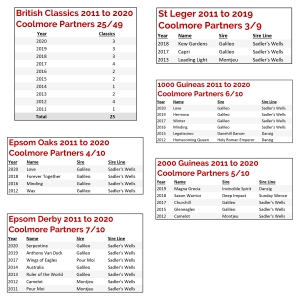
How’s this for an illustration? The Irish entity, which generally campaigns its runners under the various partnership colors of Susan Magnier, Michael Tabor, and Derrick Smith, has won an astonishing 25 of the past 49 British Classics over the last decade (see the accompanying charts of the five races), with the G1 St. Leger at Doncaster yet to be contested. And it’s possible that the partners could win that race, perhaps with Love (Ire) (Galileo {Ire}), who followed up her win in the G1 1000 Guineas at a mile with an exhilarating nine-length show of stamina in the mile-and-a-half G1 Epsom Oaks.

“[Trainer] Aidan [O’Brien] is thinking of the Yorkshire Oaks for Love and then the Arc at the moment,” a Coolmore spokesperson told me Wednesday, but those plans aside, she must still be considered an outside possibility to contest the final British Classic in September over an extended mile and three-quarters. She obviously handles a mile and a half easily and projects to stay farther, unlike Coolmore’s 2016 Guineas/Oaks winner Minding (Ire) (Galileo), who was cut back in distance after her Oaks. In 1985, Oh So Sharp (Ire) (Kris {GB}) was the last to sweep the “Filly Triple Crown,” and Coolmore has an appreciation for historical accomplishment: in 2012, it attempted the Triple Crown with G1 2000 Guineas and G1 Epsom Derby winner Camelot (GB) (Montjeu {Ire}) but fell just three-quarters of a length short. Nijinsky (Northern Dancer) was the last colt to win the three races in 1970, and he was trained at Ballydoyle in Ireland by Vincent O’Brien, Susan Magnier’s father and John Magnier’s father-in-law. Aidan O’Brien now runs the historic yard for Magnier.

Coolmore has a global presence–the partners’ Maximum Security (New Year’s Day), the U.S. champion 3-year-old colt of 2019 who is co-owned with Gary and Mary West, had been scheduled to return to the races Saturday at Del Mar before the track cancelled its meet until July 24–but Coolmore’s successes in the five British Classics over the last 10 years is unprecedented and is the primary focus here, because any attempt to broaden that scope in this space could lead to vertigo.

There’s a direct correlation between Coolmore’s British Classics haul and its late flagship sire Sadler’s Wells (Northern Dancer), whose two prepotent sons Galileo and Montjeu propelled it into a new stratosphere as their first crops hit the track in the aughts. The former, bred by D. Tsui and John Magnier’s Orpendale, was the first Epsom Derby winner for Coolmore, Sadler’s Wells, and the then-new Ballydoyle trainer Aidan O’Brien in 2001; the latter, bred by Sir J. Goldsmith and trained by John Hammond, was a G1 Prix du Jockey-Club (French Derby) winner in 1999.

Galileo and Montjeu transitioned from Derby winners to sires of Derby winners, and this is probably one reason why Coolmore chases the Classics, particularly the Epsom Derby, with multiple entries and calculated precision. The Derby is, after all, the race from which Galileo graduated to become one of the greatest sires of the sport. He is currently the all-time leading sire of Group 1 winners with 86 and counting to date, and Coolmore no doubt would like to find his successor from the same race, and why not? Galileo, now 22, has five Epsom Derby winners, more than any other stallion, and Montjeu, who died prematurely at age 16 in 2012, is in co-second place with four, and he was on a pace to have more than Galileo before his death. Together Galileo (16) and Montjeu (5, including one through his son Pour Moi {Ire}) account for 21 of Coolmore’s 25 British Classics over the last decade, and several of their Derby-winning sons are young sires at Coolmore.

Galileo was raced by Sue Magnier and Tabor while Montjeu raced for Tabor alone, but since then the Coolmore partnership horses have raced mostly in the names of all three partners, and it’s this group that has made a habit of plundering the British Classics with Aidan O’Brien at the helm from Ballydoyle, where Vincent O’Brien had done the same with horses for Robert Sangster, John Magnier, and others in an earlier era. Since 2012, Ballydoyle has sent out at least one British Classic winner every year, and except for the Andre Fabre-trained 2011 Epsom Derby winner Pour Moi and the 2015 1000 Guineas winner Legatissimo (Ire) (Danehill Dancer {Ire}), trained by the Magniers’ son-in-law David Wachman, the rest were or are based at Ballydoyle.

Seven Derbys

The Epsom Derby is the most prestigious and sought-after Classic in Europe, as the Gl Kentucky Derby is here, and to win the mile-and-a-half “Blue Riband of the Turf” once is accomplishment enough. Several owners have won the Classic multiple times since Diomed won the first in 1780, a few as many as five times, including five wins each for the current Aga Khan and his grandfather, but wrap your head around this stunning achievement: the Coolmore partnership has won seven of the last 10 renewals, including this year’s race with Serpentine (Ire) (Galileo)–a pacemaker at that, flying unfamiliar gray silks instead of the ubiquitous navy blue or plain pink of Magnier, the orange and blue of Tabor, or the purple and white of Smith. That’s a statement of depth and an embarrassment of riches.

Moreover, as individuals, no one owner has won the race as many times as Susan Magnier and Michael Tabor, who have owned nine winners. Aside from Galileo and Serpentine, they include Anthony Van Dyck (Ire), Wings of Eagles (Fr), Australia (GB), Ruler of the World (Ire), Camelot (GB), and Pour Moi (Ire), plus High Chaparral (Ire) (Sadler’s Wells), who won the Derby the year after Galileo did.

Over the last 10 years, the three partners have also won five 2000 Guineas with Magna Grecia (Ire), Saxon Warrior (Jpn), Churchill (Ire), Gleneagles (Ire), and Camelot; six 1000 Guineas with Love, Hermosa (Ire), Winter (Ire), Minding, Legatissimo, and Homecoming Queen (Ire); four Oaks with Love, Forever Together (Ire), Minding, and Was (Ire); and three St. Legers in the past nine years with Kew Gardens (Ire), Capri (Ire), and Leading Light (Ire).

In total, 22 individual horses accounted for these 25 Classics, with Love, Minding, and Camelot the dual winners. As noted earlier and is evident in the charts, most of these Classic winners trace their male lines to Sadler’s Wells through either Galileo or Montjeu, with only three tracing to Danzig and one to Sunday Silence–and three of these have Galileo (2) or Montjeu as their broodmare sires.

Clearly, Coolmore hit three extraordinary gushers with Sadler’s Wells, Galileo, and Montjeu, which it milked to advantage over other big-name European-based outfits, particularly the Maktoums, who’d ignored Coolmore sires for a while, but the 22 Classic winners are also a testament to the organization’s ability to buy, breed, and source top-level talent, something that John Magnier honed a long time ago when he was part of the buying team for Sangster with Vincent O’Brien.

Of the 22, seven were purchased at auction and 15 were either homebreds or bred by various Coolmore partnerships or associates. Coolmore oraganizational captain Paul Shanahan’s Lynch Bages, for example, is breeder or co-breeder of Pour Moi, Capri, and Leading Light.

Other European Classics

I venture here gingerly because I don’t want to drop the mic on you, but Coolmore has also raced six of the past 10 G1 Irish Derby winners, including this year’s winner, Santiago (Ire) (Authorized {Ire}), who also was bred by Shanahan and is part of a 2020 Derby double for him as the co-breeder of G1 South Australian Derby winner Russian Camelot (Ire) (Camelot). Both colts are by Montjeu stallions from Danzig-line mares, a version of the Sadler’s Wells/Danzig cross that Galileo has particularly exploited with Danehill and of which Juddmonte’s Frankel (GB) (Galileo) is its greatest expression.

Over the past decade, the Coolmore partners have also had two G1 Irish Oaks winners, Seventh Heaven (Ire) (Galileo) and Bracelet (Ire) (Montjeu); five winners of the G1 Irish 2000 Guineas – Churchill, Gleneagles, Magician (Ire) (Galileo), Power (GB) (Oasis Dream {GB}), and Roderic O’ Connor (Ire) (Galileo); and five winners of the G1 Irish 1000 Guineas, including this year’s winner, Peaceful (Ire) (Galileo), plus Hermosa, Winter, Marvellous (Ire) (Galileo), and Misty for Me (Ire) (Galileo).

And in France? The Gurkha (Ire) (Galileo) won the G1 Poule d’Essai des Poulains (French 2000 Guineas) in 2016, and this year Fancy Blue (Ire) (Deep Impact {Jpn}) accounted for the G1 Prix de Diane (French Oaks), giving Coolmore a total of six European Classics so far in 2020 with five individual horses: Fancy Blue, Peaceful, Santiago, Serpentine, and Love. Another could be added to this list from the Irish Oaks Saturday.

If you’re still standing, may I suggest a seat?

Sid Fernando is president and CEO of Werk Thoroughbred Consultants, Inc., originator of the Werk Nick Rating and eNicks.

The post Taking Stock: Coolmore’s Plundering of British Classics appeared first on TDN | Thoroughbred Daily News | Horse Racing News, Results and Video | Thoroughbred Breeding and Auctions.

Source of original post

Verified by MonsterInsights