Letter to the Editor: Ellen Parker

In “Art Collector Puts Sire Back in the Frame” (TDN 7/16/2020) Chris McGrath comments that “Whatever the reason, I am convinced that compounded, proven distaff influences represent a far better foundation for a pedigree than the supposed alchemies flimsily peddled between given sire-lines.”

I couldn’t agree more, which is why I created the Reine de Course (Queens of the Turf) series of influential mares and have been updating it for the past 40 years.

As Bull Hancock famously said, “the family is stronger than the individual.”

At the end of the day a good broodmare sire is, simply, a stallion bred to mares of good family.  Trying to make it more complicated is a waste of time.

Ellen Parker, Paris Kentucky

The post Letter to the Editor: Ellen Parker appeared first on TDN | Thoroughbred Daily News | Horse Racing News, Results and Video | Thoroughbred Breeding and Auctions.

Source of original post

Brisnet.com Triple Crown Throwdown: Haskell

Ed DeRosa of Brisnet.com takes on TDN’s Steve Sherack and Brian DiDonato as they handicap Triple Crown prep races plus the big three races themselves. The three will make $100 Win/Place bets in the preps and $200 Win/Place bets in the Kentucky Derby, Preakness and Belmont. Highest bankroll at the end wins.

DeRosa – Peter Pan ResultCountry Grammer got the money in game fashion. Bankroll: $4960.

GI Haskell S. – Going to take a chance here with Jesus’ Team, who is right in the mix with all other contenders based on most recent form and maybe can find improvement going 1 1/8 miles first time. I love what his sire Tapiture has done from limited opportunities and at the price point, and maybe Jesus’ Team can be that sire’s breakout horse. Authentic took a step back last out and Dr. Post likely underlaid as the obvious alternative to favorite. Selection: #3 Jesus’ Team (15-1).

Sherack – Peter Pan ResultMystic Guide could do no better than third as the chalk. Bankroll: $3135.

GI Haskell S. – I really need a bomb to get back in this thing, but this isn’t the race for it. Even with all the speed signed on, Authentic should still be awfully tough to beat for Mr. Haskell, Bob Baffert. Selection: #2 Authentic (4-5).

DiDonato – Peter Pan Result – Country Grammer (+$750) needed a busy ride, but he saved all the ground and fought on nicely to get the job done. Bankroll: $5125.

GI Haskell S. – I’ve been high on Dr Post for a while, and picked him in the Belmont. He took another step forward that day to be second, and catches an easier group this time while likely to get a huge pace set-up. There’s tons of other speed signed on here, which figures to compromise favorite Authentic’s chances as much as it’s going to help Dr Post. Barring some scratches, bad breaks or odd tactics, Dr Post will win this race. Selection: #1 Dr Post (5-2).

The post Brisnet.com Triple Crown Throwdown: Haskell appeared first on TDN | Thoroughbred Daily News | Horse Racing News, Results and Video | Thoroughbred Breeding and Auctions.

Source of original post

‘Invader’ Looks Imposing in Hall of Fame

Four-for-six Decorated Invader (Declaration of War) appears awful tough to beat in Saturday’s GII National Museum of Racing Hall of Fame S. at Saratoga. Second to subsequent MGSW Field Pass (Lemon Drop Kid) on local debut here a year ago, he broke through convincingly next out before notching a big win in Woodbine’s GI Summer S. in September. He could only manage fourth in the GI Breeders’ Cup Juvenile Turf after a tough trip that had many arguing that he might’ve been best, and he’s lent support to that claim so far this season. He flew home from far back to annex Gulfstream’s Cutler Bay S. Mar. 28, and made short work of five rivals in the GII Pennine Ridge S. at Belmont June 20. The biggest question for Decorated Invader appears to be how he’ll handle nine furlongs–all his prior efforts have come over at least a sixteenth shorter.

“The challenge is when you have a horse that’s a standout in a short field, there’s going to be a target on his back,” said Terry Finley of co-ownerWest Point Thoroughbreds. “The break and the first eighth of a mile will be important. Ultimately, it will be up to [jockey] Joel [Rosario]. He really fits the horse. When they walk out of the paddock, you just have so much confidence and no concerns that you’ll get a top class ride from him. It’s very good to have the option to be a closer, but we have seen time and time again where you have the best horse in the race, and they [the pacesetters] don’t come back.”

Decorated Invader isn’t the only Christophe Clement-trained son of Declaration of War entered in the Hall of Fame–he’ll also send out Gufo, who has won his last four starts, including Delaware’s GIII Kent S. over this distance two weeks ago.

Hall of Famer Bill Mott owns a record seven victories in this race–including in 2019–and will be represented by June 20 Churchill allowance winner Moon Over Miami (Malibu Moon). Future Hall of Famer won this event four years in a row from 2015 to 2018 (he also won it in 2011), and will saddle two-for-two Domestic Spending (GB) (Kingman {GB}) for Seth Klarman’s Klarvich Stables.

The post ‘Invader’ Looks Imposing in Hall of Fame appeared first on TDN | Thoroughbred Daily News | Horse Racing News, Results and Video | Thoroughbred Breeding and Auctions.

Source of original post

Body & Soul: Home Is Where The Heart Is

by Bob Fierro

With apologies to Pliny the Elder, who more than two centuries ago penned those words in the headline, and also to Elvis, who expanded their meaning in a modest ballad of the same name in 1962, we are about to examine what has evolved after at least 40 years as a science-based axiom of racing efficiency and success: How much of a factor does the cardio system of a Thoroughbred influence its ability?

Let us state up front that the answer to that question may depend on which scientific tools or evaluation programs are used to gather the data required. That’s because there are a number of providers which offer services that purport to determine whether a horse’s cardio system (not just the heart, which is part of the system) is capable of generating enough fuel to provide the energy needed to achieve success at either a distance or class level. Your correspondent has been using one such system for more than 30 years.

However, we are here to report a deeply researched study of a particular group of racing prospects and how they fared on the racetrack after their hearts were scanned by ultrasound and their body sizes calculated to determine whether the cardio system “passes or fails” various criteria, described further on in this essay.

The study in question is based on data gathered by DataTrack’s BreezeFigsâ„¢ system and published daily since 2005 by Daily Racing Form online (www.drf.com). Simply stated, BreezeFigs is a speed-and-stride-length based “fig” which was earned by every horse that breezed at every major 2-year-old sale held from 2012 through 2017.

Those which pass conformation inspection at the barns are selected for cardio ultrasound scans. Thus, this study concentrated on a focus group of 865 fillies and 1,253 colts whose performance at the sales prompted our analysts to obtain those scans.

The data gathered from each scan is run through an algorithm that takes into consideration the size of the heart, its pumping efficiency and the horse’s body size. This gives us a Cardio Score which is based on a numerical system that is akin to a “report card” of six grades of equal decimal distance: A, B+, B, C+, C, D–the higher the numerical score the higher the “report card Cardio Grade,” ergo the more efficient the system for that horse.

What the system does not do, however, is disqualify a racing prospect based on the size of the heart alone because body size and cardio pumping efficiency play a big role in the score. A simple analogy might be to compare the size and structure of the horse to an automobile model and the efficiency of the cardio system to horsepower of the engine, to wit:

A horse which is a Maserati in structure with what appears to be an average size heart may generate a B+ Cardio Grade because that heart (engine) can rev up quickly to deliver the right amount of fuel for that chasis. However, if the heart is more like the engine of a Chevy Suburban, it will most likely take a longer time to pump up to overall efficiency and the race could be over, and thus wind up with a C+ Cardio Grade.

The first conclusion reached was that, in general, the higher the Cardio Grade the more starts and average earnings. For example, fillies that won only one race but had a B or B+ Cardio Grade averaged more starts and twice the earnings of those with a Cardio Grade C that won one race. Similarly, colts with a Cardio Grade B that won three or more races earned 50% more on average than colts with a Grade C average that won three or more races. There are plenty of other examples, but one should get the drift.

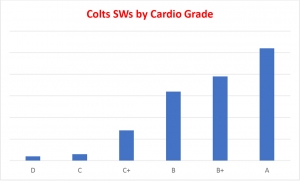
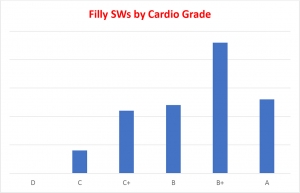
The dividing line was even stronger when it came to stakes winners which, after all, is what everyone wants to buy. Below are the distributions per Cardio Grade of black-type winners in North America and countries to which 2-year-old graduates were exported. As the charts indicate, more than 80% of the fillies and colts that won stakes races had Cardio Grades of B or better.
With data such as this, one can appreciate the irony of lyrics of a tune from Damn Yankees…

“You’ve gotta have heart,

All you really need is heart

When the odds are sayin’ you’ll never win,

That’s when the grin should start.”*

… which these days can apply with equal meaning to humans and those who breed, own, train, ride and bet on Thoroughbreds.

*Composed by Richard Adler & Jerry Ross

Bob Fierro is a partner with Jay Kilgore and Frank Mitchell in DataTrack International, biomechanical consultants and developers of BreezeFigs.  He can be reached at bbfq@earthlink.net

The post Body & Soul: Home Is Where The Heart Is appeared first on TDN | Thoroughbred Daily News | Horse Racing News, Results and Video | Thoroughbred Breeding and Auctions.

Source of original post

Verified by MonsterInsights