The First Steps Towards Inclusiveness in Racing

On a sparsely traveled road in downtown Lexington, African Cemetery No. 2 sits encircled by a worn iron fence. The sounds of cars flashing by nearby busier streets, the incessant barking of a neighboring dog and the harsh droning of a drill from the adjacent auto parts shop carry through the isolated eight-acre plot.

Opened in 1869, the site now contains over 5,000 graves, of which fewer than 600 are recognized with markers. The plot inters hundreds of enslaved African Americans, as well as members of the U.S. Colored Troops in the Civil War. It is the burial grounds for attorneys, political activists, doctors, lawyers and, some of the best jockeys the Thoroughbred racing world has ever known.
Leon Nichols, the co-founder and CEO of the Project to Preserve African American Turf History, has traversed the grounds many times.

“These were people who made lasting impacts on society and rallied their knowledge together to carve out a space in their respective fields,” he said. “These people gave us a legacy that they created in the most trying of times in America, but they still prevailed and left us with a tremendous amount of stories that we can forever hold onto and help shape future generations.”
A native of Lexington, Nichols grew up hearing the tales of many of the equestrians laid to rest at the site. Much of his family, from uncles to brother, were involved in the industry as trainers, grooms and hot walkers.

It’s just something that was always a part of our family heritage,” he recounted. “As a kid, I grew up following in those footsteps and hanging around the racetrack and working on the farms. I guess what really struck me is that being in those environments, everyone talked about the contributions of African American jockeys and trainers back then, but as a young kid, I never saw any representation.”

As time went on, Nichols was continually struck by the minimal recognition given to those African American jockeys who defined the early years of horse racing. He said there was always a thought in the back of his mind that perhaps there was something he could do to help bring their stories to light.

In 2007, while working at the Kroger Distribution Center in Louisville, Nichols was approached by co-workers Calvin Davis and Jerry Fife. The men had heard about his racing background and wanted to learn more.

Soon after, the trio formed the Project to Preserve African American Turf History (PPAATH).
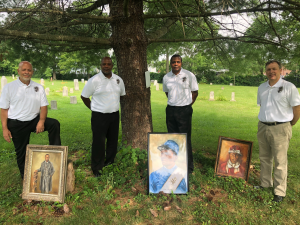
From left: James Natsis, Calvin Davis, Leon Nichols, Jerry Fife

“We just felt like there needed to be representation in terms of the African American contributions to horse racing,” Nichols said. “The overall mission is that we wanted to find ways that we could integrate the history into the equine industry and really have some outreach to set up the next generation in terms of learning about this forgotten past.”
Through this outreach in educating the general public, the program hopes to widen horse racing’s audience.

“We wanted to reconnect the fanbase and show the collective contribution of people of color to the sport, as well as make the sport more relevant than what it is currently,” Nichols said. “I think the way you do that is through the narration of these stories and this history, and then you get a greater appreciation of the sport, the Derby, and horse racing in general.”

Much of the history that the group aims to highlight is centered around the over 150 equine industry participants buried at African Cemetery No. 2.

Towards the back of the cemetery, beneath an ancient oak tree, a three-foot tall headstone commemorates the Lewis family.

Oliver Lewis was born into slavery in Lexington in 1856. While still a teenager, he became the first jockey to win the Kentucky Derby aboard Aristides in 1875. He was one of 13 African American jockeys in the 15-horse field, and would go on to run second with Aristides in the Belmont S. He never raced in another Kentucky Derby, and little is known about his life beyond that bright moment in the spotlight. Lewis died in 1924 and while records indicate that he was buried in a family grave at African Cemetery No. 2, his name is not listed on the family monument.

Just a few years after Lewis rode to victory in Louisville, James “Soup” Perkins was born in 1880 in Lexington. He began riding at the age of 11, and then at the age of 15 became the youngest jockey to ever win the Kentucky Derby, a distinction that he still shares with fellow African American jockey Alonzo Clayton, who was victorious in the prestigious event just three years prior. Perkins is buried in a family plot along with his brother Frank, who was a successful trainer until he was killed in 1900.

Perhaps the most famous person buried at the historic site is Isaac Murphy. Born into slavery in 1861, Murphy moved to Lexington with his mother following the Civil War. He would go on to ride in 11 Kentucky Derbies, and come out on top in 1884, 1890 and 1891.

“Isaac was able to communicate with the horse through his hands and his warm personality,” Nichols said. “He rarely used the whip, and was revered for his strict honesty.”

From 1892 through 1895, Murphy achieved an incomprehensible winning percentage of 44%.

“One of his biggest claims-to-fame was the overall impact that he had on the industry,” said Nichols. “You have to understand the times. Being in the 19th century, being an African American, he was able to really bring people together. White and Black alike flooded to see this man in all his glory, and what he brought to the sport of horse racing.”

Nichols said that Murphy was well known for his vibrant personality, and was always a favorite with the media because of his articulateness and honesty. He was also the individual that set the standard for fashion at the race track.

“He was the Michael Jordan or the Tiger Woods of horse racing,” Nichols said. “His legacy in the culture of racing is undeniably embedded in the sport, from fashion to etiquette. He was that transcendent figure in sport that really helped create opportunity for everybody.”

Murphy was not only the first jockey to win three Kentucky Derbies, but also the first to do it back-to-back and eventually the first jockey to be elected to the Hall of Fame.

For most of his career, Murphy was revered as a celebrity, with appearances in newspapers and magazines, and his likeness displayed on tobacco cards. But before the turn of the century, rampant racism took its toll and he was resented for taking money and fame from white jockeys.

The eventual Hall of Famer was forced to retire prematurely due to health issues, and he died of pneumonia at the age of 35 in 1896. He was placed in an unmarked grave at African Cemetery No. 2. and for many years, his burial site was nearly forgotten. It wasn’t until 1967 when a researcher discovered the grave and his remains were exhumed and reinterred at the old Man o’War burial site, and then moved again to the Kentucky Horse Park in 1978.
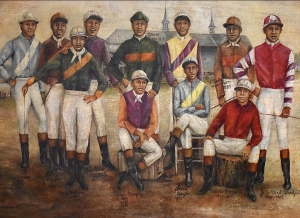
From 1921 to 2000, not a single African American was represented in the Kentucky Derby | Audrey Menefee

The gradual disappearance of African Americans in racing continued into the early 20th century, with many of the sport’s best African American jockeys leaving the country to ride overseas. Jim Crow laws all but banned African Americans from race tracks. From 1921 to 2000, there was not a single African American jockey represented in the Kentucky Derby.

Despite this extreme absence of African Americans in the sport for nearly a century, Nichols said that the ripple effect of their talent and strong presence in those early days is still felt today.

“When we really get down to the nuts and bolts of it, these stories give us a lesson in terms of diversity and inclusion that I think is very relevant to today because it proves that we worked together then to help Kentucky’s signature industry become what it is today,” Nichols said. “It provides us with a blueprint to really amplify that message nationwide, especially in times like this.”

When PPAATH began their program fewer than 20 years ago, they knew that they would need a way to represent the important stories they were trying to share.

They enlisted the help of Georgia-based fine arts painter Audrey Menefee.

The artist had no background in horse racing, but was interested in sharing the unknown tales of African Americans in the industry. She found that there was not much to go off of in terms of information or images of the jockeys they wished to highlight, but still she was able to create a collection of over a dozen jockey portraits.

In 2010, the “Forgotten Black Jockeys” exhibit was featured at the National Black Arts Festival in Atlanta, Georgia.

The collection has traveled to several venues nationwide.

Two years ago, Dr. James Natsis, a Kentucky-based writer and assistant professor at West Virginia State University found out about the project. He eventually became a vice present of PPAATH, and led an effort to bring the collection to West Virginia State University.

Another major undertaking for the program has been the Isaac Murphy Image Awards.

“We wanted to do something that was really going to bring Isaac’s legacy to the national stage,” said Nichols. “We created the Isaac Murphy Image Awards to honor prominent African Americans in business, education, entertainment and sports who left an indelible mark in their respective fields. We wanted to do that by bringing them to the Kentucky Derby, [so they could] learn a little bit of the history.”

Award recipients include actors Angela Bassett and Danny Glover, Super Bowl MVP and coach Doug Williams, and Olympic medalist Peter Westbook.

PPAATH is now working to grow the span of their awards show, and is collaborating with production companies in hopes to make it into a national awards celebration that runs in conjunction with the Kentucky Derby.
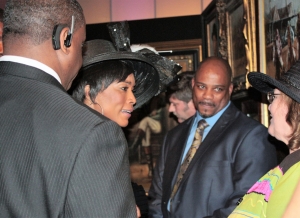
2013 Isaac Murphy Image Award Recipient Angela Bassett | PPAATH

“We still think that this sport is one of the greatest sports in the world, and we want to add a diversity spin to it to help rein in new fan bases,” Nichols said. “It’s a foundational sport for everything we do today in North America, whether it’s the NBA or the NFL, horse racing in its earliest days set the foundation for a sporting culture that far exceeded anyone’s expectations. I think if we can get the sport back to its days of glory and prominence, but more importantly, its impact on diversity and inclusion, everyone wins in that situation.”

Beyond an induction to the National Register of Historic Places in 2004, African Cemetery No. 2 has seen little recognition in this century, even after the graves of those prominent jockeys were re-discovered. PPAATH has been working to change that. In recent years, they’ve partnered with the University of Kentucky to create on-site posters commemorating some of the historical figures laid to rest at the cemetery.

The headstones are still cracked and crumbling, the landscaping is still in need of much attention, but still, it’s a step. Through these series of small strides taken in collaboration, Nichols and his team are working to prevent history from rewriting itself, and initiate the growth of a more diverse horse racing audience.

“It has to be a collaborative approach,” Nichols said. “We have to learn that we can work with one another. This history, in terms of the legacies that we were left with, gives us that blueprint- that when we do work together, amazing things happen. We see an opportunity for this industry to take those very first steps of inclusiveness. It has to be an amicable approach. We have to learn to trust the fact that we can work together, and we can use this history as a frame of reference to help us do that.”

The post The First Steps Towards Inclusiveness in Racing appeared first on TDN | Thoroughbred Daily News | Horse Racing News, Results and Video | Thoroughbred Breeding and Auctions.

Source of original post

Handle Off to Strong Start at Spa with Help of Increased TV Exposure

SARATOGA SPRINGS, N.Y. – At the very bottom on the left-hand side of the daily recap sheet you can find the answer to why the New York Racing Association opted to run at Saratoga this fan-free summer instead of staying downstate and operating at Belmont Park: All Sources Handle.

Though they were acutely aware that New York State’s COVID-19 protocols prevented spectators from attending professional sporting events, NYRA officials projected that handle on Saratoga racing would be stronger than on 40 days at Belmont. The early returns are showing they were correct. The opening day handle was up 21% from the rainy Saratoga opener in 2019. The first weekend, a total of four days, showed a 9.4% increase. The trend continued on Wednesday, the first day of the second week, with a jump of 38%.

Tony Allevato,  the Chief Revenue Officer & President of NYRA Bets, said officials spent a lot of time considering whether it made sense to add the expense of opening Saratoga Race Course for the 152nd season of Thoroughbred racing in the city.

“From a management standpoint we got together with the horsemen and talked about it, looking at the Saratoga brand and what it means to racing. It’s the best in Thoroughbred racing,” he said. “When you think of Saratoga, you think of premier horse racing. I think it was important to maintain that season and have the racing come up here, knowing that it would be reflective in the numbers, in our opinion. The same race at Belmont would generate more handle and more money back to the industry if that race was run at Saratoga versus Belmont.”

Allevato said confidence in the power of Saratoga was borne out by the handle numbers during the first year of an exclusive television deal with Fox Sports and the MSG networks. Saratoga’s opening four days had a combined handle of $80.3 million, nearly double the final four days of the Belmont meet, which generated a combined handle of $41.4 million.

“I would not say we were surprised,” Allevato said. “We were reassured that we were doing the right thing, is the way to put it.”

However, noting that the stats have been solid, Allevato said it is too early to celebrate.

“We are living in a time where you can plan a lot, but things seem to change every two weeks,” he said. “You are always trying to be cautious and this move up here, just like the move that we made on the television side, there is always some risk involved with what we’re doing.”

Allevato, a California native, brought a deep resume of experience in racing and television sports with him to NYRA in 2016. Since his arrival, he has overseen the development and growth of the company’s advance deposit wagering platform, NYRA Bets, and its television programming. In 2016, the inaugural season of Saratoga Live had 80 hours of national broadcast time on the Fox Sports Network’s FS2 channel. Last year, the total grew to 190 hours. This year, the partnership expanded again, as NYRA left the long-established racing channel TVG for the commitment to Fox and MSG and 700 hours of live national TV exposure. The package includes America’s Day at the Races, as well as NYRA and Churchill Downs racing. Fox’s main sports channel, FS1 will carry 32 hours of Saratoga Live and the G1 Runhappy Travers will be shown live in a 90-minute program on Fox on Aug. 8.

Allevato worked for TVG for 14 years earlier in his career and said he had a strong relationship with the channel

“Any time that you are going to move away from a significant partner like that there is always going to be some kind of risk,” he said. “For us, the reason that we went exclusive this year with Fox, it was about being able to showcase New York Racing and our content and our horses and our horsemen on a national scale. It really came down to numbers in terms of programming. If you look at our shows we show two races an hour from New York. If Churchill is running we’ll show four races an hour, which is a race every 15 minutes.

“When we are on TVG we’re sharing the spotlight with sometimes five other race tracks. For us, it was important to try and get as much time around our signal. We are the New York Racing Association.  We are very biased, but we think our racing is the best racing in the country. And we feel that it deserves 60 minutes of every hour in terms of coverage and that’s what we have been able to provide by being on Fox.

Moreover, Allevato said that the Fox deal has the potential to expand racing’s audience.

“By being on a mainstream sports network we are giving the sport an opportunity to reach out to new fans, something that horse racing has been preaching for decades and decades that needed to be done,” he said. “NYRA has now taken that step.

“We will be coming out of all different types of sporting events, whether it’s soccer games, baseball, NASCAR, you name it, we are capturing eyeballs that aren’t traditionally watching horse racing. With sports betting now growing across the country it’s a critical time for horse racing to get that crossover fan. We feel like the shows give us the best opportunity to expose those people to what we feel is the best racing in the country. With all the technology we have all the cameras, we are showing them a product that looks like a major league sporting event. We don’t see any scenario where that is bad for horse racing.”

Still, Allevato said there were questions about whether it was the right move to leave TVG, the go-to racing channel in the U.S.

“There was some criticism when we made the decision by a small number of people that there would be an inconvenience for viewers who would have to find the network,” he said. “Sometimes we are on multiple Fox networks. One day we might be on for two hours on FS2 and then the rest of the day on FS1. For me, as a person who watches sports television, if I want to watch an event I find it. I think the inconvenience, if it exists, is a 30-second inconvenience in terms of locating where it’s at.”

At the same time, every NYRA race is available every day in HD on NYRA’s YouTube channel, which is also shown on the TDN homepage.

“There are multiple ways for people to see the show,” Allevato said. “We are exposing horse racing to more eyeballs than ever. It’s pretty significant. While there were some complaints, we had a pretty long list of all the positives that came out of us being on Fox. One thing that was missing is that people who were criticizing us were working under the false assumption that Fox would still be giving us all these hours if we were non-exclusive. That was not the case.”

Allevato said that NYRA was building it television department before he arrived and that it has committed to investing in TV and its ADW platform.

“Technology is always going to come. If you try to avoid it, it’s going to run you over,” he said.  “From a horse racing standpoint, we have embraced technology. It started 20 years ago with the advent of advanced deposit wagering. At the time, people looked at it as a way to keep people away from the races. Now, fast forward 20 years later, imagine where horse racing would be today during in this pandemic if there was no advanced deposit wagering. Literally, the sport would be dead. Horse racing has put themselves in a position where they can at least continue and operate during these difficult times.”

The increasing television exposure has helped the NYRA Bets business. Allevato said that new accounts are up 150% over last year. With that fact in mind, the NYRA programming approach is aimed at embracing new and seasoned fans.

“It’s a very intimidating sport for people who are just tuning in for the first time,” he said. “That’s what we really pride ourselves on trying to do that and make it as accessible for the average person.  We do a lot of free-to-play things for people who watch the shows. We do a lot of offers for new customers that are low introductory offers to get them engaged. And we really try to make it as user-friendly as possible.

“It’s interesting with all the sign-ups and all the additional people that are betting the average amount being bet per customer is down, year over year, which is a really positive thing, if that makes sense. So we have more people betting but they don’t bet as much per person. That’s because we’ve got that more casual fan that is playing now.”

Once NYRA was given permission to re-open at Belmont in early June, Allevato and the other executives came to the conclusion that Saratoga, even without fans in the stands, was better for business than continuing on at Belmont Park.

“Looking at the numbers that we’ve seen so far, that would seem to solidify our beliefs,” he said. “There is also the TV element of this, as well. The entire industry has now become television and internet viewing. There is something about Saratoga from a historic standpoint–not taking anything away from Belmont Park–but there is that certain appeal that it has crosses over to that mainstream sports fan. That was the opinion we had going in. Nothing we have seen so far, granted we are one week into the meet, would suggest that we were incorrect in that thinking.”

The post Handle Off to Strong Start at Spa with Help of Increased TV Exposure appeared first on TDN | Thoroughbred Daily News | Horse Racing News, Results and Video | Thoroughbred Breeding and Auctions.

Source of original post

WTBOA Sale to be Held As Scheduled Aug. 18; Online Bidding Available

The Washington Thoroughbred Breeders and Owners Association’s 53rd annual summer sale will take place as scheduled on Tuesday, Aug. 18 at the WTBOA Sales Pavilion at Emerald Downs. The catalog features 123 yearlings, 17 broodmares and one broodmare prospect. COVID-19 protocols will be in place and published at washingtonthoroughbred.com. Online bidding will also be available (click for more).

The post WTBOA Sale to be Held As Scheduled Aug. 18; Online Bidding Available appeared first on TDN | Thoroughbred Daily News | Horse Racing News, Results and Video | Thoroughbred Breeding and Auctions.

Source of original post

Momos Has Ironhorse Thinking Big–And That’s No Joke

In Greek mythology, Momos is “the personification of satire and mockery.”

In horse racing, Momos is a very talented and very fast son of Distorted Humor and Inspeight of Us (Speightstown) who delivered the first ‘wow’ performance in the first 2-year-old maiden of the Saratoga meet July 18 (video), earning TDN Rising Star status.

“I think everybody that buys a horse that wants to win that first maiden special at Saratoga realizes that you’re going to be running against some of the best horses that have been specifically targeted for those races,” said Harlan Malter, the managing partner of Ironhorse Racing Stable, which owns Momos in partnership with Tami Bobo’s Secure Investments.

“No matter how good your horse is training, it’s difficult to expect to win,” he continued. “The reports I got were that the horse is healthy and training great and, something you always like to hear–‘This is a fast horse.’ We were concerned about a possible speed duel or running into a monster, but I was cautiously optimistic. We felt like he was going to run well, but I don’t think anyone goes into those races thinking that you’re going to win. But we were thrilled with the way he did it.”

Turns out Momos was the monster.

Momos was bred by Bobo and the Distorted Humor syndicate and was purchased for $75,000 as a short yearling at the 2019 OBS Winter Mixed Sale. Entered for, but withdrawn from the Fasig-Tipton July sale, the colt was rerouted for the breeze-up sales, where De Meric Sales was tasked with the prep work ahead of this year’s OBS March sale.

Malter has a soft spot for OBS, owing in no small part to the fact that it was at the auction house’s June sale in 2014 that he and his partners acquired a chestnut colt by Kantharos for $43,000. An Indiana-bred, Bucchero took the Ironhorse partnership on the ride of a lifetime, winning back-to-back renewals of the GII Woodford S. at Keeneland leading to consecutive appearances in the GI Breeders’ Cup Turf Sprint. The over-achieving near-millionaire also represented Ironhorse at Royal Ascot in 2018, finishing a highly creditable fifth in the G1 King’s Stand S.

While in England, Malter–an enormous fan of Cigar–made the acquaintance of Riley Mott, the son of Cigar’s Hall of Fame trainer Bill Mott, who was to be represented on the same opening-day program by Yoshida (Jpn) (Heart’s Cry {Jpn}) in the G1 Queen Anne S. The junior Mott recommended to Malter that he consider bloodstock agent Phil Hager if he was looking for advice on any future purchases. In July 2018, Hager, a one-time employee of the Mott barn, left a position in bloodstock services at Crestwood Farm to launch Taproot Bloodstock. A partnership was struck.

Ultimately, there was a fair bit of synergy between Malter–‘the pedigree guy’–and Hager, who concentrates more on the physical in front of him without regard to the page, where it came to the Distorted Humor colt, who hammered for $180,000, with Taproot signing as agent for IHR.

“What we’ll generally do is not put any horses in his mind,” Malter said of the team’s approach. “He’ll do his list and then we’ll see if there’s overlap and go from there. What was great about this one, which rarely happens, this was basically on the top of our list going into the sale. The horse obviously worked very, very well (:21 flat) and Phil was very happy with the work, specifically–the way he did it, how professional and forward the horse was. Once we had that overlap, it was basically the target of our whole sale. Phil does a tremendous job. Tami Bobo expressed an interest to stay in for part, and it’s been a pleasure to have her as part of the team.”

He added, “When you have a horse that you kind of model everything after–with Bucchero being in my mind’s eye–I like to see very efficient movers and when we saw him in the work, he just did everything the right way. He kind of just drove himself into the ground, low, a very driving and efficient mover. There was no wasted energy. He galloped out extremely well. We were also really happy that he was coming out of the de Meric consignment. We have a relationship with Tristan and Valery de Meric, we know how well they prep them and we knew he’d probably come out ready to go.”

Malter admitted that the colt was at the upper limits of what they wanted to spend, but that circumstances dictated that they be aggressive.

“We felt with what was going on in the world that (a) potentially this was going to be the last time to buy for a little bit; and (b) there also may be a little reluctance to spend as much money at that sale. We did see it as a potential value play, so we were ready to spend a little bit of money. As far as Ironhorse, we try to offer a wide range, from $30,000 up to $200,000, which is about as much as we want to spend. We’re really looking for value. We were looking to try to get a $300,000 horse for $150,000, and we weren’t too far off that. We are going to have to do a little bit of zigging when other people are zagging and this is a little bit of where I blend my other business, being a financial planner, with looking at horses.”

Ironhorse campaigns its horses with Tim Glyshaw–who called the shots on Bucchero’s career–Mike Trombetta and Mott, but Malter was keen on getting a horse to Christophe Clement.

“I met [Clement’s son] Miguel at last year’s OBS sale and that got the wheels in motion. I’ve really enjoyed working with Christophe and Miguel, they make a very strong team,” Malter explained. “When we gave the horse to Christophe, we said, ‘Maybe this is the horse that gets us back to the Breeders’ Cup Turf Sprint down the road,’ but the feedback we got was, ‘This horse can really run on dirt, let’s not worry about grass now.’ Initially the goal on this horse was turf sprinting and I don’t think there are a lot of trainers better at training turf sprinters than Christophe. But, obviously he showed what he could do right now on the dirt.”

With that in mind, Momos is a candidate for the six-furlong GII Saratoga Special S. Aug. 7 and/or the GI Runhappy Hopeful S. over seven furlongs Sept. 7.

As for Bucchero, he has completed his second year covering mares at Pleasant Acres Stallions in Florida. As hands-on as he was during his racing career, Malter has taken an active role in aggressively marketing his stallion to the breeding public.

“I grew up with the Todd Marinovich story, where his father was so heavily involved with managing his whole development and career,” Malter said, referring to the former professional football quarterback. “I often feel like if Bucchero could talk, he’d say, ‘Who is this guy and why is he always around?’ I’ve tried to take the bull by the horns and do the best that I could by this horse. But he’s done all the speaking. It’s been unusual that we’ve had an even bigger second year than we had the first year.”

Malter reports that Bucchero’s first crop numbers a healthy 76 foals.

“There’s really only one thing I was hoping for with the babies–that [Bucchero’s] mind would come through,” he said. “The feedback I am getting from the breeders on a consistent basis is ‘solid, balanced, athletic,’ but they almost always emphasize these horses’ minds. When I hear people describing these foals, it’s like they’re describing Bucchero to me.”

The post Momos Has Ironhorse Thinking Big–And That’s No Joke appeared first on TDN | Thoroughbred Daily News | Horse Racing News, Results and Video | Thoroughbred Breeding and Auctions.

Source of original post

Verified by MonsterInsights