Doug Peterson’s Son Wins in MLB Debut

David Peterson, the son of Doug Peterson, who trained Seattle Slew during his 4-year-old year, had a night to remember Tuesday as he was the winning pitcher in his MLB debut.

Peterson, 24, led the Mets to an 8-3 win over the lowly Boston Red Sox.

“This is one of the greatest days of my life,” Peterson said. “This is something I’ve wanted to do since I was a little kid, and to go out there and make my first major league start, we got the win and I couldn’t have asked for much more.”

Doug Peterson, just 26 at the time, was a little known trainer when Seattle Slew’s owners called on him to take over for the fired Billy Turner. Peterson guided Slew to wins in the GI Marlboro Cup, the GI Woodward and the GIII Stuyvesant H. He was named champion older male of 1978.

Peterson’s story ended in tragedy in 2004 when he died of an accidental drug overdose. David, his only child, was nine at the time. David subsequently moved to Colorado, where he was raised by his grandmother.

Peterson, who is 6′ foot 6″, two inches taller than his father, was taken in the first round of the draft by the Mets in 2017. He was a standout pitcher at the University of Oregon.

The post Doug Peterson’s Son Wins in MLB Debut appeared first on TDN | Thoroughbred Daily News | Horse Racing News, Results and Video | Thoroughbred Breeding and Auctions.

Source of original post

McGaughey Looks to Add to Whitney ‘Honor’ Roll

SARATOGA SPRINGS, N.Y. — Following the draw for the GI Whitney S. Wednesday morning, trainer Shug McGaughey answered more questions about his previous Whitney winners than this year’s runner, Code of Honor (Noble Mission {GB}).

McGaughey, a member of racing’s Hall of Fame since 2004, will try for his fourth victory in Saratoga’s premier dirt race for older horses Saturday with William Farish’s 4-year-old homebred colt.

The chestnut drew in the middle of the strong five-horse field, that features Tom’s d’Etat (Smart Strike), who has won four straight stakes, and GI Hollywood Gold Cup winner Improbable (City Zip), trained by Bob Baffert. Last year, Baffert won the Whitney with McKinzie (Street Sense).

The Whitney field also includes three-time graded stakes winner By My Standards (Goldencents) and Mr. Buff (Friend Or Foe), the massive New York-bred division champion seeking his first graded stakes victory.

With Whitney winners Personal Ensign (1988) and Easy Goer (1989), both Hall of Famers, and Honor Code (2015) on his vast stakes resume, McGaughey, 69, spent a fair amount of time talking about the present and the past.

Code of Honor was moved up to second in the 2019 GI Kentucky Derby following the disqualification of Maximum Security (New Year’s Day) and won last year’s GI Runhappy Travers and GI Jockey Club Gold Cup via the disqualification of eventual GI Breeders’ Cup Classic winner Vino Rosso (Curlin).

Code of Honor enters the Whitney following a third-place finish in the GI Runhappy Metropolian H. July 4.

Though the Whitney field is the smallest since Personal Ensign beat just two others 32 years ago, McGaughey said it is deep in quality and will be a big test for his late-runner. Tom’s d’Etat with Joel Rosario up, is the 6-5 morning-line favorite in the “Win and You’re In” race for the GI Breeders’ Cup Classic.

Improbable and Code of Honor are listed at 5-2. On June 27, Tom’s d’Etat extended his win streak in the GII Stephen Foster at Churchill Downs.

“It won’t be easy,” he said. “I’ve just got to hope that Code of Honor runs a monster race. It will be kind of interesting to see what the tactics are with only five. I know where I’m going to be, but I’m not sure what the others are going to do or how much they’re going to press. You know that Joel isn’t going to do anything stupid. Hopefully, he’ll be up there fairly close, as he was, I think, in the Stephen Foster and we are able to pick him up. It’s a pretty solid field. I feel like we’re lucky to be in it. If he runs his race, they’ll know he is there.”

McGaughey said that Code of Honor is better suited for the two-turn 1 1/8 miles of the Whitney than the one-turn Met Mile at Belmont Park. Code of Honor is two-for-two at the Spa.

“I have a lot of confidence,” McGaughey said. “He was so fresh last year for the Travers. I think it will be a little different kind of a race this year because he ran on June 6 [winning the GIII Westchester] and ran back in the Met Mile. He’s bounced out of it good. His two works here were good. I’ve got confidence that he will run his race. If that is good enough, we’ll get our picture taken. If not, we’ll figure out something else.”

McGaughey was in his third year training for Ogden Phipps and his family when he ran Personal Ensign in the Whitney. She had recovered from an injury–a broken bone in a rear leg–that had kept her away from the races for almost a year. The 4-year-old filly faced two very capable runners, Gulch and King’s Swan, and McGaughey said he had some concerns about asking her to face males over a sloppy track.

“The rain came up early, so I came over here to kind of see what was going on with the track,” McGaughey said. “They ran a sprint race earlier in the card–I remember Angel Penna had a horse in there–and it looked like to me that the water was just on top of the track. I told Mr. Phipps that I thought they were going down into a drier track and I didn’t think it would be a problem. I knew she didn’t mind the mud.”

Personal Ensign prevailed by 1 1/2 lengths over Gulch at 4-5 and is the last female to win the Whitney.

“She was able to run an incredible race,” he said. “It’s funny, one of the numbers guys called me earlier in the week and said ‘She can win this race if she gets the perfect trip.’ If you remember, [jockey Angel] Cordero and King’s Swan pushed her way out in the middle of the racetrack. She was out there kind of the whole way, but she was good enough to win.”

Three months later, Personal Ensign finished her career at 13-0 record with a heart-stopping victory by a nose over Kentucky Derby winner Winning Colors in the GI Breeders’ Cup Distaff at Churchill Downs.

McGaughey said the Whitney was part of the plan to silence some critics and put her at the top of the older female division.

“I remember on the West Coast they said, ‘She only wins at Belmont.'” McGaughey said. “So I said, ‘Well, I’ll take care of that part of it.’ We took her down to Monmouth and she won the Molly Pitcher from here to across the street. Mr. Phipps was anxious to start her against the colts and I thought this was the perfect place to do it. In case we were wrong and it took too much out of her, we would still have enough time for the fall racing. We thought this was a pretty good opportunity. Plus, he didn’t want to duck and run to some place, like Chicago, to run against the colts. He wanted to do it here.”

The following summer, McGaughey became the first trainer to win-back-to-back Whitneys in over 50 years with the 3-year-old Easy Goer. After runner-up finishes to Sunday Silence in the Kentucky Derby and the Preakness, Easy Goer beat Sunday Silence by eight lengths in the GI Belmont S.. Rather than prep him for the Travers in the Jim Dandy, McGaughey put him in the Whitney and ran Fast Play in the Jim Dandy. Easy Goer, the last 3-year-old to win the Whitney, won as he pleased by three lengths over Clever Trevor at 1-5.

“We knew that Easy Goer was an exceptional horse,” McGaughey said. “He came out of the Belmont–and I wouldn’t have done it–but he gave you the feeling that you could run him back in two weeks. We obviously didn’t do that, but we pointed for here. Mr. Phipps was anxious to do something of that sort and we had an alternative, too, with Fast Play, who we could run in the Jim Dandy. Obviously, it was the right decision and I thought it was the right decision going in, too.”

Hall of Fame jockey Jacinto Vazquez provided some drama by pinning Easy Goer along the rail behind the pacesetter for a while, but he took advantage of an opening.

“He had to come through there, but he was in a little bit of trouble,” McGaughey said. “I can remember watching Pat Day and thinking, ‘He’s got a lot of horse. Whenever it opens he’s going to be there.'”

McGaughey was second to Criminal Type with Dancing Spree by 1 1/2 lengths in 1990 and Out of Place was second by a nose in 1992. He added his third Whitney five years ago with Honor Code, who edged Liam’s Map by a neck at 7-2. It followed his victory in the Met Mile and was the last of his six wins in an 11-race career.

“Honor Code was an exceptional horse,” McGaughey said. “He wasn’t the easiest horse to train. He kind of did a little bit of what he wanted to do. After he won in the Whitney, he didn’t want to go back to the training track. I had to bring him up here and train. I don’t know why.”

The post McGaughey Looks to Add to Whitney ‘Honor’ Roll appeared first on TDN | Thoroughbred Daily News | Horse Racing News, Results and Video | Thoroughbred Breeding and Auctions.

Source of original post

Pandemic Affects Visas, Limiting H-2B Workers

SARATOGA SPRINGS, N.Y. — George Weaver feels it. So do Chad Brown, Todd Pletcher and Shug McGaughey. Among the many new issues that Thoroughbred trainers across the country must contend with during the 2020 pandemic is a shortage of skilled staff.

In recent years, it has become more difficult for horsemen to secure all the H-2B visas that they desire to legally bring foreign nationals into the country as guest workers. The arrival of COVID-19 in late winter closed U.S. consulates, compounding the problems, preventing visa holders from getting their entry documents from the State Department. On June 22, President Donald Trump signed an executive order suspending the visa program through December, a move designed to help the tens of millions of unemployed Americans find jobs.

“It is a problem,” said McGaughey, who is missing some of his hotwalkers and could use another exercise rider. “The bad part about it is that Trump, or the government, just does not realize that these are jobs that American people refuse.”

That’s the rub. One of the key provisions of the H-2B visa program is that the jobs must first be offered to Americans before foreign residents can be hired. Trainers say they are always interested in hiring U.S.-based employees for the positions, primarily grooms and hotwalkers.

“The people that are needed, nobody wants to do this work,” Weaver said. “It’s not even about the money, nobody wants to wake up at 3:30, 4:00 in the morning every single morning or even six mornings a week. They don’t want to do it.”

Immigration attorney Will Velie of Norman, Oklahoma, is an expert whose Horseman Labor Solutions company has been helping trainers staff their stables with guest workers for 15 years. Velie estimated that approximately 1,500 people come into U.S., primarily from Mexico and Central American countries to work in the Thoroughbred racing industry. He said it costs trainers between $1,500 and $2,000 per worker in fees and legal expenses. In addition, trainers must pay for travel back and forth to the employees’s home countries and other costs.

“They would not do this if they didn’t have to,” Velie said. “The only reason they are doing this is because they don’t have the people to do the work anymore.”

Velie said the pandemic, which led to border closings and the pause on the admission of people who do already had been approved for visas, has made a tough situation worse.

“It’s particularly bad this year,” he said. “It’s always bad. It’s been bad for a long time. So you’ve got this confluence of factors that make it to where it is very difficult to find enough workers on the backside of the track, even with 25 million unemployed people.”

Weaver said none of the dozen or so internationals he had planned for are with him this summer at Saratoga Race Course. His exercise riders are helping out with hotwalking and he said that some of his grooms have to deal with six or seven horses every day, rather than the norm of four or five.

Like the other trainers, Weaver said his stable is getting by, but he is frustrated by how the situation played out despite doing the proper planning.

“It cost a lot of money, and when you pay the lawyer and you pay the stuff and you don’t get your people, it’s like you just [wasted] a bunch of money and you don’t have your help,” he said.

Pletcher’s stable has been hit hard. He said that none of his 35 guest workers was able to come into the country before the program was closed.

“It has affected everyone,” he said. “We have a large number of visa employees that were approved but have not been allowed to come over. We’ve had to have our staff pull off some overtime, put in extra hours and extra work. Yeah, it has been a hardship for a lot of people. This would be our peak time of the year, so we would have over 100 employees. We have similar numbers, in some cases less-experienced.”

Pletcher nodded at the suggestion that some of his staff is receiving on-the-job training.

“Pretty much,” he said. “At the same time you want new people coming into the business and learning. A lot of our visa workers have been with us for a long time, know the system and are skilled professionals.”

Eric Hamelback, the CEO of the National Horsemen’s Benevolent and Protective Association, said that the jobs Pletcher and the other trainers must fill might seem to the casual observer to be low-level duties easy for most people to handle.

“It is a skilled labor. Yes, it’s hard work. It is agricultural,” he said. “But it’s skilled when you are dealing with animals, whether they are a multi-million dollar horse or one that is a $5,000 claimer. They can kill you in a heartbeat and it takes a certain strength and skill to work in this field. You can’t just grab someone off the street and expect them to be able to hotwalk, much less groom.”

Hamelback said that his organization, which represents nearly 30,000 trainers and owners, is working with the National Horse Council and the National Thoroughbred Racing Association to build congressional insight and support for changes to help the industry with the visa program.

Every year, the Thoroughbred industry is vying for a share of the 66,000 H-2B visas that are allotted. During the year, the White House may add more visas to the pool. The demand is intense: 100,000 applications for the 33,000 H-2B visas available in the first round for 2020.

“This is a big topic and it is a lot of work,” Hamelback said.

Much like Pletcher, Brown has a very large operation and relies on foreign workers to fill some of his staff positions.

“It’s been challenging,” he said. “Thankfully, we have some of our workers who have been able to successfully come in before some stuff got shut down. Not all of them. I know some other trainers that are not in a good spot. It has really affected us. It has caused us to really change the management of our stable, such as how many we are able to have in New York.”

Brown continued, “Thankfully, our team has all pulled together and everyone has picked up the slack. Our business is no different than a lot of other businesses, probably, just trying to get through this pandemic, knowing that there is probably light at the end of the tunnel, that it’s not going to be this way forever. Keeping that mindset. Getting through each day the best we can.”

The post Pandemic Affects Visas, Limiting H-2B Workers appeared first on TDN | Thoroughbred Daily News | Horse Racing News, Results and Video | Thoroughbred Breeding and Auctions.

Source of original post

Cheri Manning Enjoys a Decorated Start to Ownership

   For red hot trainer Christophe Clement, there’s much to look forward to as his blossoming turf star Decorated Invader (Declaration of War) progresses through his sophomore season. But for owner Cheri Manning, the talented colt has already given her the ride of a lifetime.

In partnership with West Point Thoroughbreds, William Freeman and William Sandbrook, Manning has watched her horse cross the wire first in a juvenile maiden race at Saratoga, then the GI Summer S., the Cuter Bay S., the GII Pennine Ridge S. and most recently, the GII National Museum of Racing Hall of Fame S.

Even with such a lengthy collection of victories, the Virginia resident still has yet to join her colt in the winner’s circle.

“I almost don’t even want to say this out loud, but I’ve never seen him win in person,” Manning said. “The only races I’ve been to were his first start [a close second at Saratoga] and the Breeders’ Cup [Juvenile Turf, where he finished fourth after a troubled trip]. So now I’m a little nervous to go see him run.”

Although she’s just getting started in her journey as an owner, Manning has been a fan of the sport since childhood.

“Even as a little kid, I enjoyed horse racing,” she recounted. “I was lucky enough to grow up in the ’70s, so Secretariat, Affirmed and Alydar are the first horses I remember. My dad was into horse racing, so we would watch on TV. I was your typical horse-crazy kid.”

It wasn’t until a few years ago that her interest in racing became something more.

“When I went to college, I stopped riding and horses kind of slipped out of my life,” she said.  “But I always continued to follow racing. Then I started to get closer to the age of 50. And when that happened, I started thinking, ‘Alright, I’m going to do something for myself.'”

Manning bought in on two 2-year-olds through West Point Thoroughbreds in 2016 and as she notes, “away we went.”

“Ownership was way more than I expected going in,” she said. “That first summer, coming up to Saratoga for the first time was quite the experience- being a total newbie on the backstretch and watching one of my horses run there. I felt like everyone in the industry was so welcoming. Even if you don’t know what the heck you’re talking about, everyone wants to help give you the information you need without making you feel stupid.”

That same year, a third juvenile on the West Point roster named Arch of the Diver (Arch) caught her eye.

“He was a bit more on the expensive side, so I tried to be practical and buy into two horses for the price of one,” Manning said. “But I couldn’t stop thinking about him, so I ended up buying into him.”

Arch of the Diver showed promise early on, but endured several injury-induced setbacks. It wasn’t until he was a 4-year-old that he broke his maiden at Saratoga by almost 10 lengths.

“I cried so hard,” Manning said with a laugh.

The gelding later won at Delaware Park, scoring a 93 Beyer Figure, but soon after an injury forced the West Point team to retire him. They turned to Manning to ask if ‘Archie’ could find a new home with his biggest fan.

“They knew I loved him and that he would be going to a really good home,” Manning said. “So when they asked me I said, ‘Yes. We will figure it out. We will make it happen.'”

While Archie has yet to start a new career under saddle, he is thriving at his new home in Virginia.

“This horse is the biggest klutz. It’s a miracle he raced at all, let alone won two races,” Manning joked. “The hope is to eventually get him under saddle and see what he wants to do, even if it’s just hack around and be a trail horse. But if he ends up being a pasture pet, that’s great too.”

Even though Manning has only been involved in racing for five years, she’s already giving back to the sport through her dedication to aftercare and has big plans to do more.

“Eventually I could see myself having the Northern Virginia Home for Wayward Thoroughbreds, or something like that,” she said.

At around the same time of Arch of the Diver’s retirement, a yearling with Arch as a broodmare sire became available.

“I really like turf horses, and the fact that he was out of an Arch mare really sold him for me,” Manning recalled.

Soon after, she was in on Decorated Invader’s ownership.
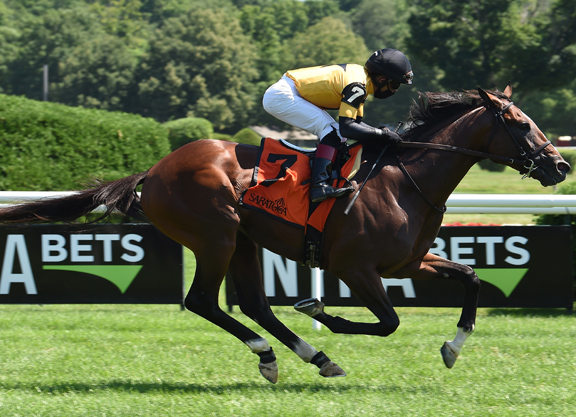
Decorated Invader claims the GII National Museum of Racing Hall of Fame S. | Coglianese

“If you could line up Northern Dancer, Danzig, War Front, and Decorated Invader, the similarities would be so striking. It’s quite a lineage,” she said.

Her ownership on Decorated Invader has quickly become a family affair.

“When we were in Saratoga last summer, my sister Cathy fell in love with him,” Manning said. “She was going on and on about how amazing he was after his first race when he ran second. I had an odd percentage on him, so I said, ‘happy birthday’ and gave her a small percentage. She says it was the best birthday present ever. She always liked horses and enjoyed going to the track with me, but with Decorated Invader, she knew he was The Horse, and now she’s gotten the bug.”

Manning has also introduced her 13-year-old niece Vivienne to horse racing.

“From day one, Vivienne has been my silent partner,” she said. “She unofficially owns half the horses I partner in. She’s your typical horse-crazy girl. What did we do for her Christmas break? We went to Florida to visit Payson Park and she was thrilled.”

For years, Vivienne and Manning also had their own riding horse that they owned together.

“Unfortunately he passed away in February of cancer,” Manning said. “So this year has really sucked, but Decorated Invader has sort of made up for a lot of not-so-great things.”

Manning remembers the Cutler Bay S. in March at Gulfstream as her favorite race of the season.

“Midway through the race he was totally out of it,” she said. “And you’re like, ‘Oh that’s fine, it’s his first race this year.’ And then all of a sudden, he turns on an extra gear and wows us all. The way he won that day was amazing.  That’s when we knew it was going to be a fun year.”

Of course, having one of the hottest trainers on the Saratoga backstretch in Christophe Clement is a definite asset.

“I can’t believe that barn,” Manning said. “They so deserve it. One of the deciding factors for me in buying a horse through West Point is if it’s going to Clement.”

Manning shared that while Clement’s assistant trainer and son Miguel says Decorated Invader acts studish whenever he’s working with the colt, Manning finds that the bay is nothing less than a gentleman when she comes to the barn with carrots in hand.

“He’s a very nice horse,” she said. “He’s so smart, you get that vibe from him right away. He’s got that intelligent eye. I’m so thankful to Terry Finley, Bill Freeman, Bill Sandbrook, as well as the West Point buying team and David Ingordo for finding Decorated Invader and letting me join the party. He’s definitely special, and he knows he’s special..”

West Point’s COO Tom Bellhouse said that Decorated Invader has an equally-special owner.

“Cheri is a dream partner,” he said. “She’s a great person. She takes the good news with the bad, and is always so supportive. She’s a big believer in the animal and for caring for the animal. Any time you spend with Cheri, it will put a smile on your face.”

The post Cheri Manning Enjoys a Decorated Start to Ownership appeared first on TDN | Thoroughbred Daily News | Horse Racing News, Results and Video | Thoroughbred Breeding and Auctions.

Source of original post

Verified by MonsterInsights