Faiza For Fun In the Santa Anita Oaks

Michael Lund Petersen's 'TDN Rising Star' Faiza (Girvin) was never really asked for a full effort by Flavien Prat in extending her unbeaten streak to five with a facile success in Saturday's GII Santa Anita Oaks at the Great Race Place.

Beaten for speed and content to sit wide off a longshot front-runner, the $90,000 Fasig-Tipton July yearling turned $725,000 Fasig-Tipton Midlantic breezer was patiently handled down the backstretch before making a run towards the front on the turn. Dueling briefly with Clearly Unhinged (Into Mischief) into the stretch, Faiza put the race to bed within a few strides, scampering clear to win as much the best. And Tell Me Nolies (Arrogate) ran on for second ahead of Window Shopping (American Pharoah) in third. Clearly Unhinged faded to fourth. Faiza remains under the care of Bob Baffert, making her ineligible for a start in the GI Kentucky Oaks.

“I'm very excited,” said Petersen, who also campaigned champion and fellow Fasig-Tipton purchase Gamine (Into Mischief). “Five out of five that's more than you ever dream about. It's very nice being on day like this and winning a race. It makes it all worth it.”

A supremely easy winner of her Nov. 12 debut at Del Mar, for which she was accorded 'Rising Star' status, Faiza was fully extended in winning the GI Starlet S. at Los Alamitos Dec. 10. A hard-fought, half-length winner of the GIII Las Virgenes S. Jan. 28, Faiza remained in this barn past the Feb. 28 transfer deadline that would have allowed her to run in the GI Kentucky Oaks and went on to best And Tell Me Nolies by 2 1/4 lengths in the GIII Santa Ysabel S. Mar. 5.

Pedigree Notes:

Faiza is out of a daughter of MGSW & MGISP Pomeroy's Pistol, also the dam of $1-million KEESEP yearling Thousand Words (Pioneerof the Nile), a graded winner at ages two and three and now standing stud at Spendthrift Farm. Sweet Pistol, who was purchased by Brereton C. Jones for $33,000 at the 20176 Keeneland November Sale, is the dam of the 2-year-old filly Her Best Friend (Cairo Prince), a $160,000 graduate of last year's Keeneland September sale and currently in training at The Thoroughbred Center. She produced a Complexity filly in 2022 and was most recently bred back to the son of Maclean's Music.

Saturday, Santa Anita
SANTA ANITA OAKS-GII, $401,500, Santa Anita, 4-8, 3yo, f, 1 1/16m, 1:43.27, ft.
1–FAIZA, 124, f, 3, by Girvin
1st Dam: Sweet Pistol, by Smart Strike
2nd Dam: Pomeroys Pistol, by Pomeroy
3rd Dam: Prettyatthetable, by Point Given
'TDN Rising Star' ($90,000 Ylg '21 FTKJUL; $725,000 2yo '22 EASMAY). O-Michael Lund Petersen; B-Brereton C Jones (KY); T-Bob Baffert; J-Flavien Prat. $240,000. Lifetime Record: GISW, 5-5-0-0, $642,000. Werk Nick Rating: B+. Click for the eNicks report & 5-cross pedigree. Click for the free Equineline.com catalogue-style pedigree.
2–And Tell Me Nolies, 124, f, 3, Arrogate–Be Fair, by Exchange Rate. ($70,000 Ylg '21 KEEJAN; $230,000 2yo '22 OBSAPR). O-Peter Redekop B C Ltd; B-Lara Run LLC (KY); T-Peter Miller. $80,000.
3–Window Shopping, 124, f, 3, American Pharoah–Delightful Joy, by Tapit. 1ST BLACK-TYPE, 1ST GRADED BLACK-TYPE. ($700,000 Ylg '21 KEESEP). O-Perry R Bass II & Ramona S Bass; B-International Equities Holding Inc. (KY); T-Richard E Mandella. $48,000.
Margins: 6HF, HF, 4 1/4. Odds: 0.80, 6.40, 5.30.
Also Ran: Clearly Unhinged, Venganza, Don't Get Pickled, Cliquish, Gila. Scratched: Princess Bettina. Click for the Equibase.com chart and the TJCIS.com PPs. VIDEO, sponsored by TVG.

The post Faiza For Fun In the Santa Anita Oaks appeared first on TDN | Thoroughbred Daily News | Horse Racing News, Results and Video | Thoroughbred Breeding and Auctions.

Source of original post

Johannes Providing a String of Firsts for McCloskeys

After watching the races just across the street from their home in Del Mar, Joe and Debby McCloskey decided to take the plunge into racehorse ownership with the purchase of a filly by Congrats at the 2014 Keeneland September sale. Now, nearly a decade later, Johannes (Nyquist)–the first foal out of that first filly–has become the couple's first stakes winner and the 3-year-old gave promise of more firsts to come in the near-future with an authoritative second stakes victory in the Pasadena S. at Santa Anita last Sunday.

Johannes began his racing career on the main track, but immediately found success on the turf where he broke his maiden by nine lengths at Santa Anita Dec. 31. He overcame a world of trouble to win the Mar. 5 Baffle S. before making his two-turn debut in the Pasadena.

“It was our very first stakes win,” Joe McCloskey, a retired businessman, said of the Baffle. “Obviously, it was fantastic and to be able to back it up with another stakes win, you talk about firsts. Cuyathy was our first horse, and this is her first foal, and now two stakes races back-to-back. There are a lot of firsts with that horse.”

Recalling his first foray into racing, McCloskey said, “We have a condo that is right across the street from Del Mar, so it was convenient to go over and watch the horses. Eventually we got hooked up with a couple of trainers and said, 'Let's give it a shot.'”

The California couple headed to Kentucky with a plan–sort of– and a dream.

“We were pretty naive back then,” McCloskey said with a chuckle. “We put a budget together of $100,000, with $50,000 for a horse. And we thought we would get one out at Keeneland and start there. We thought that was going to be plenty of money.

“So we went out to Keeneland and my wife Debby and I were wondering how we would know if it was the right horse, when will we know? So Debby put it out there and dreamt about and said, 'I know if there is a heart on the horse somehow, a heart comes into my mind, that will be our horse.' We get to our book–when you can get a horse for $50,000–and the first one comes up and the hair on the cowlick kind of looked like a heart, maybe this is it? So we bid on it, but we got outbid. Maybe there needs to be a better heart? Surprisingly when Cuyathy came by, our trainer said what do you think? And lo and behold, we look down at the chestnut and it was in the shape of the heart. And the hammer dropped at exactly $50,000. Our trainer thinks we are nuts at this point, but anyway that's how we got Cuyathy.”

The McCloskeys ended up taking another filly home from Keeneland that year, going to $8,000 to acquire a daughter of Curlin they named Reiki Baby.

Cuyathy went on to win three times in 20 starts, including a third-place effort in the 2018 Kalookan Queen S., and earn $107,923. Reiki Baby, who didn't make it to the races until she was four, was a first-out winner at Santa Anita in 2017 and twice second before being retired after four starts. Both mares, now 10, ultimately became the McCloskeys' broodmare band.

“People told us, if you think racing is tough, breeding is even worse, it's tougher,” McCloskey said. “So we looked at each other and said, 'Let's give it a shot.' We are a micro-breeders, those are the only two mares that we have. But they were our first two horses. Literally, Cuyathy was the first horse we bought and Reiki Baby was the second one.”

The breeding operation got off to a slow start when Reiki Baby's first foal, Lightheart (Blame) failed to make it to the races. But it has picked up steam thanks to Johannes, whose dam was producing her first foal by Nyquist at about the same time Reiki Baby was producing another colt by the GI Kentucky Derby winner.

“We bred both Reiki Baby and Cayathy to Nyquist,” McCloskey said. “People said we were nuts. I said, this whole game is nuts, let's just go all in, let's breed both to Nyquist and maybe one will catch.”

Johannes, along with Reiki Baby's second foal Reiquist, began his racing career back east with trainer Bill Morey, but both suffered some bad luck.

“Billy had both our horses at Churchill and in one day, I get a phone call he goes, 'Joe, Reiquist has a fracture, we have to ship him back to Rood and Riddle in Lexington. And Johannes has some chips. I said, 'You've got to be kidding–this is one phone call and my first two horses. Long story short, we brought Johannes over to Rood and Riddle, took out a few small chips and Dr. Bramlage saw a little issue on the other leg, so they took it out and we gave him time off to come back. And then Rood and Riddle repaired Reiquist's fracture and he's at Santa Anita. He just breezed three furlongs twice already and he's looking really good.”

Both horses are now in the Southern California barn of trainer Tim Yakteen, who McCloskey credits with a slow and steady approach to the races.

“Tim Yakteen is probably one of the best, most conservative trainers there are when it comes to getting your horse back in good shape,” McCloskey said. “People say you have to have patience in this business. In this business with Tim, you have to have glacial  patience. But he knows his business.”

In his first start for Yakteen, Johannes was a solid third behind Fort Warren (Curlin), subsequently third in the GII San Vicente S., and Spun Intended (Hard Spun).

“He was just coming back off a layoff and he came in third, but he really challenged Fort Warren,” McCloskey said of that effort last October. “I was sitting in a box next to Bob Baffert and Bob came down and said you've got a nice horse there. So the dirt looked really good then.”

Johannes took a step back next time out, however, finishing a well-beaten fifth at Del Mar in November.

“We brought him over to Del Mar, but we shipped him in the day before the race and he got very nervous and he was washed out and he didn't perform well there,” McCloskey said. “At that point, we decided to see what would happen if we put him on the turf because his mother had success sprinting over both Tapeta and turf.”

Of that first try on the lawn that resulted in an emphatic maiden score, McCloskey said, “Boom. We put him on the turf and it was like, I guess he likes the turf. He won by nine lengths and he wasn't even asked.”

Making his next start in the 6 1/2-furlong Baffle S., Johannes was mired in traffic down the hill and had nowhere to go turning for home, where things only got worse for the dark bay colt as he was jostled about before ultimately slicing between foes and bounding away once in the clear in the final strides (video).

“I've never seen a horse get into that much traffic, have to steady that much, and then he sliced and diced picking his path,” McCloskey recalled. “I tell you, I would have taken all my money off the table halfway through the race. I thought there was no way this horse could do anything, but he popped out and still won by 1 1/2 lengths. I went up to Umberto [Rispoli] after the race and his head was still shaking. I said, 'You got in a little trouble?' and he said, 'This horse is a freak to be able to come through there.'”

After the drama of the Baffle, Johannes's win when stretched to one mile in the Pasadena S. was somewhat ho-hum. Settled at the back of the pack, the heavy favorite powered to the lead at midstretch and sauntered clear to an easy 3 1/2-length victory (video).

The pair of stakes victories have likely earned Johannes a spot in graded-stakes company, but connections are still weighing their options.

“Right now, we are pointed towards the [GII] American S. [at Churchill Downs] on Derby Day,” McCloskey said. “We know we want to keep him with 3-year-olds at this point. So that's the race that is on screen. But because it's Derby day and because of the way he got a little nervous just shipping in to Del Mar, we might look for some other options, so maybe instead of 75,000 people, we have 10,000. We will get a couple 3-year-old races in him and from there, if he continues to do what we think he can do, we will look at the 3-and-up races. Then, in the best of all worlds, of course, you look at the Breeders' Cup in November. Do we even have a shot at that? We hope so. It's one step at a time in this business for sure.”

The McCloskeys also have plenty to look forward to from their two-horse broodmare band. Reiki Baby has a 2-year-old colt by Mendelssohn and a yearling filly by Practical Joke. Cayathy has a 2-year-old filly named Sea Dancer (Mastery) who is in training with Morey at Keeneland, as well as a yearling filly by Gun Runner. She produced a filly by Knicks Go this year and will be bred back to Mandaloun.

“We are smart enough to know that you can't make a lot of money in this business unless you are super lucky,” McCloskey said. “But with that Gun Runner filly out of Cuyathy, it's giving us cause for pause to think maybe we sell that filly–because you can't keep them all–or do you maybe say, if Reiki Baby isn't doing what we want, do we keep that filly and still have two [broodmares]. But it's not like we are going to have five or six more. We are happy with two, we get to see them, and maybe we would have one more.”

McCloskey said he and his wife have no specific goals for their racing and breeding operation, but are content to enjoy the ride.

“I've seen a lot of smart people lose a lot of money in this business,” he said. “So we will just try to keep it balanced, to have fun and, as long as we are having fun and the horses are helping pay for some of the bills, we are happy. This is a crazy business. It's just a matter of making sure that you're enjoying it every day. And we are right now.”

While they are enjoying the business, they are also very focused on paying it forward.

“We balance everything we do back on the other side,” McCloskey stressed. “We are big supporters of a place here in California called Laughing Pony Rescue, which is in Rancho Santa Fe, and we save a lot of horses there. We donate to CARMA and New Vocations, some of those people have taken our horses. We think it's important that anybody who is in this business balances it out by helping the other side of the equation, the ones that are retired.”

The post Johannes Providing a String of Firsts for McCloskeys appeared first on TDN | Thoroughbred Daily News | Horse Racing News, Results and Video | Thoroughbred Breeding and Auctions.

Source of original post

Winter Quarter Remains Evergreen

In most respects, the years have passed very lightly over Don Robinson. He remains vigorous and full of verve. But the one thing he really hasn't clung onto is the hair he wore as a teenager in the 1970s, when shaking the Bluegrass from his feet and embracing an alternative lifestyle in Northern California.

“Oh man, the hair,” he says. “Depending who you talk to, it just gets longer every time. It really wasn't that long. Probably over my collar. But they love to tell the story that it was waist length or beyond.”

His strong, chiseled features crease into one of those huge Don Robinson smiles, which you'll know very well if you're among his many friends in Kentucky. We're sitting in the kitchen at Winter Quarter Farm–just about as anomalous a name as you could find, for a place so irradiated by this human sunbeam. Nor is there any quarter given, in terms of his unstinting devotion to the horses grazing here, who have ranged from Zenyatta herself to the granddam of Kelso.

Harking back to his youth, however, Robinson admits that he was happy to be half a world away. Out in Humboldt County he had a young bride, a young son, and was hand-milking four cows.

“Just 'back to the land' stuff,” he recalls. “My grandmother had left me some stock. With the proceeds I bought a lovely, south-west face hillside and I built a house, built a barn, we grew food, grew hair, did the whole thing. Had some great neighbors, some that I still keep up with. It was really neat.”

But then, in 1977, came the awful summons home. Dad had Lou Gehrig's Disease. It was time to rally round, see if Robinson could piece back together the horsemanship he'd learned as a kid. Truth be told, he was already restless. He sensed an urban contamination seeping into their idyll–Eden was on its way to becoming a weed plantation–while their own, bucolic lifestyle would soon have been consumed by industrialization of dairy farming.

“Anyway Dad had been diagnosed, and everything was just falling apart,” Robinson recalls. “Even as it was, there wasn't much business here. Cattle, tobacco, a core of clients and horses. I don't think Dad owned any horses at all, at that time. His passion was training. He'd kept a barn at Keeneland for years. He loved to background horses, year round, pre-training. The nomadic trainer's life was not for him, he wanted to sleep in his own bed every night. So this place was perfect: he loved the farm, and the barn was 10 minutes away. It was a great life.”

Sadly his father could hold out only until 1980. On his own, Robinson felt like an impostor. He remembers coming clean to Jimmy Conway–Hall of Famer James P. Conway, “a great man”–after their mutual client Geoffrey C. Hughes indicated that he would be sending horses to Winter Quarter.

“Mr. Conway, I've got to tell you, I don't know a thing. Really I don't.”

He'll never forget the response.

“Donnie, you are a worker,” Conway said. “You'll be fine. You've got the right ethic. Don't worry about any of that other stuff, it'll come to you.”

And it did, Robinson concedes now. Not that the sweat of his brow was adequate on its own. His father had an expression about people who could work, only without ever getting on a wavelength with horses.

“That old boy,” he'd say, “could sleep with a horse and still wouldn't understand.”

“Either you have it naturally or you don't,” Robinson reflects. “And I've always just been able to connect with an animal. Just organically. I didn't have any teaching, any schooling. As a kid I'd hang out in the barn with the grooms. The more I look back, just the demeanor of those old timers was so impactful, the way they related to the horses. Back then it wasn't just a job. They lived with those horses. They were older men and you'd only call the veterinarian if a horse was dying. The grooms and trainers could do the rest: blistering, soundness, everything. If you had a pneumonia, I'd hear stories of them piling on newspapers and a blanket to sweat the horse.”

Those remedies go back centuries. No less timeless, however, was the loyalty of the farm's patrons, who gradually drew out an inborn vocation in Robinson.

“I mean, just think about those two,” he says of Conway and Hughes. “Both real characters, and both real mentors to me. Geoffrey was British, he'd inherited a shipping company, he lived by himself in Utah, skiing. He would hotwalk his own horses at Saratoga. And Jim Conway, he had been real tight with my father. So the reason I survived, when I came back from California, is because those two adopted me: the son of a New York beat cop, and this fascinating English gentleman, this man of the world.”

It feels like we're doing Robinson a disservice to dwell on those distant days, when the here-and-now remains so full of vitality. It was fully 42 years after his return, after all, that the Winter Quarter consignment broke the record for the New York Sale in Saratoga with a $775,000 Malibu Moon filly; and within the month scored the top two prices of a Book 2 session at Keeneland, at $1 million and $650,000. (This latter turned into Rock Your World (Candy Ride {Arg}), now standing at Spendthrift after becoming Winter Quarter's second graduate–emulating Midnight Interlude (War Chant)–to win the GI Santa Anita Derby. Both were out of mares sent by cherished friend and longstanding client Ron McAnally.) Farm graduates to have succeeded Zenyatta include Audible (Into Mischief), who emulated the GI Florida Derby success of Vicar (Wild Again) 19 years previously. Earlier breakthroughs, meanwhile, had been made by two GI Arlington Million winners in four runnings, Golden Pheasant (Caro {Ire}) and Star of Cozzene (Cozzene).

But the fact remains that none of that could have happened unless Robinson survived the initial crash course.

“So those clients were all like my uncles,” Robinson says, further invoking the names of Charles and Eddie Theriot. “[Mrs. Charles] Theriot had a really nice Sir Ivor filly. I was just barely cutting my teeth, so she was advised to have Lee Eaton sell her. I was not hurt but I did think, 'Oh gosh, that'd have been nice.' And that fall, out of the blue, Eddie sent me a commission. I just couldn't believe it. Those relationships, they were just very, very personal.”

Besides, the real start of this whole story goes a lot farther back. It takes a long time just to get through the hallway at Winter Quarter, so compelling are the photographs recording the era of Duntreath Stable, owned by Robinson's grandmother Suzanne, Mrs. Silas B. Mason. These include the iconic image of the stretch duel for the 1933 Kentucky Derby, Head Play versus Broker's Tip with the jockeys practically hauling each other out of the saddle. (Head Play put things right in the Preakness.) There's also a photograph of Mrs. Mason with Samuel Riddle, giving a 20th birthday cake to Man o' War.
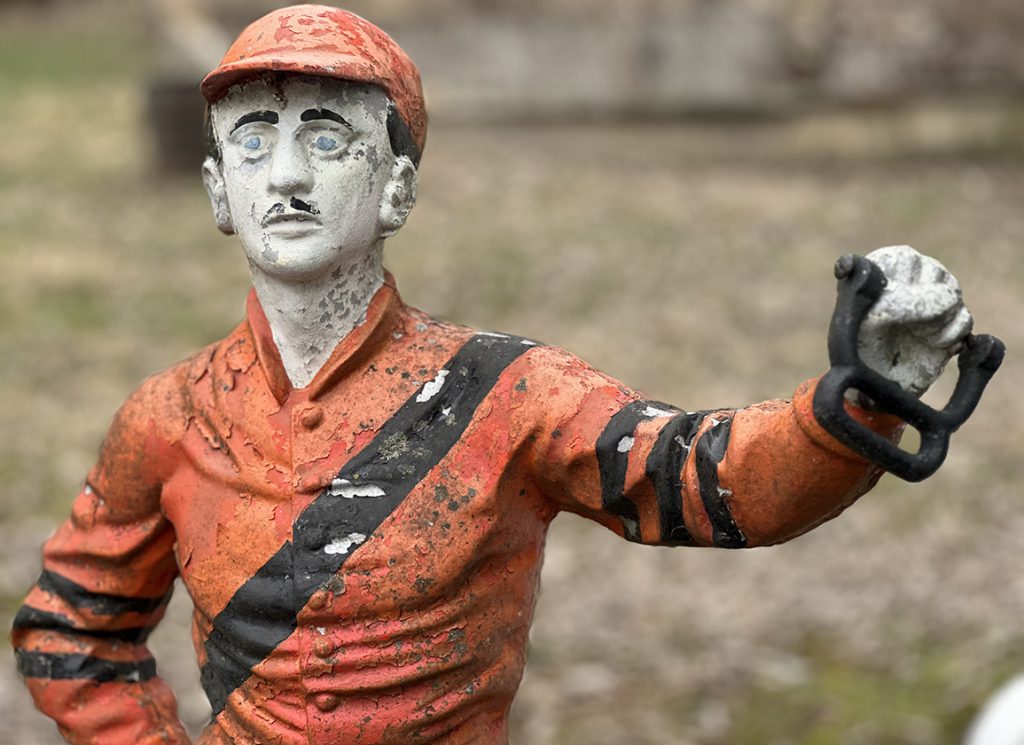
Winter Quarter Silks | Sue Finley

“Oh, she was a force!” Robinson says. “She loved the horses, and she loved entertaining. I was only a little kid but remember her very well. She was scary, because she was such a huge personality, but always very gracious and I loved visiting her.”

Her stable had to be dispersed after the death of her husband, but their son Burnett had by then inherited a passion for horses. He wanted to drop out of school and ride steeplechases, so Mrs. Mason sent him to James Cox Brady in New York, to have some sense drummed into him. Brady, either misreading or ignoring his brief, told the young man to follow his dream.

The war interrupted Burnett's turf career, but did at least yield a name for the Fayette County farm he bought in 1948: Winter Quarter had been a coastguard lightship off Virginia, where he rode mounted patrols securing the shore against the contingency, presumably fairly remote, of sabotage by German frogmen.

Robinson was born the same year. Granted the depth of his own pedigree–his father also resurfaced Keeneland, incidentally, and laid out the training track–he was honored to revive his grandmother's silks to campaign Cambodia (War Front), bred in partnership with Eric Kronfeld, to win four graded stakes between 2015 and 2018.

“That was fantastic,” Robinson reflects. “I'd had the whole page for clients, and ended up buying into the family which was durable as hell. I'd bred and raced the mother, and I'd got to War Front at $25,000. But when we did the screening X-rays on the yearling, my vet just said, 'You're done.' He's pretty blunt! I was crushed.

“But I don't think she had three lame days that spring, and we did a stem cell procedure at his suggestion. We broke her in the fall and she was a star from the beginning. We gave her time, she didn't really get going until she was four, but she ended up winning $860,000 and Grade I-placed. And of course she was one of our own. There's been no thrill like Zenyatta. But to breed a racehorse as good as that, when you'd had the mother and grandmother, that was incredibly rewarding.”

Cambodia's first foal, a Medaglia d'Oro colt sold for $575,000, is now in training with Zenyatta's trainer John Shirreffs, which brings many things full circle. Shirreffs, a near-contemporary, himself had his drifting years in the 1970s, and the pair forged a great bond during the rise of the champion bred by Kronfeld and raised at Winter Quarter.

Kronfeld had arrived at the farm fairly circuitously. It had initially seemed an ample boon, to Robinson, simply to receive some Marshall Jenney and George Strawbridge mares when King Ranch was sold.

“I don't do much seasonal stuff anymore,” Robinson says. “It was a lot of work. But these magnificent mares, when they came in, gave me chills. It was like when I first got some King Ranch yearlings to break: I'd been used to Chevrolets and Fords, and then these Ferraris come in. I said to Helen [Alexander] that she taught me what pedigree was all about, just by seeing that difference. They could be crooked-legged or anything, but they just had that fire.”

Jenney brought in Kronfeld, too–and when that pair fell out, the music executive declared that he would leave his couple of mares at Winter Quarter.

“Eric was gruff, and Marshall was gruff!” says Robinson, by way of humorous explanation. “Anyway one of Eric's mares was For The Flag (Forli {Arg}), the granddam of Zenyatta. Over time Eric and I became fast friends. We were night and day, but somehow a great match. He was the New York lawyer, so sharp, knew a lot of stuff I didn't. But I knew stuff he didn't know, too. He was a real curmudgeon, but I had a lot of affection for him. I still miss him.”
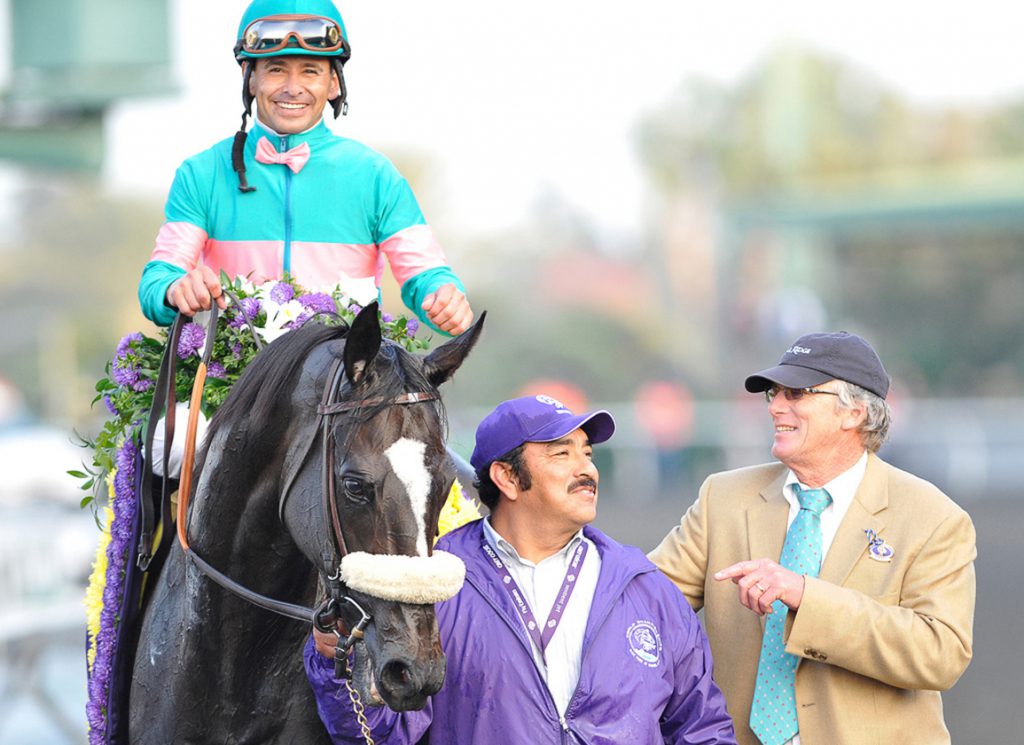
Zenyatta | Sarah Andrew

When they were selling Zenyatta, they argued over the reserve. Kronfeld got his way and David Ingordo was bewildered to get her for just $60,000. But then Robinson had opposed the Street Cry (Ire) cover, as too European, so nobody got everything right!

Here, then, is a man who has not only seen an awful lot over the years, but can entwine it with many rich strands of the past. And who can say what fresh chapters may yet be written by the couple of dozen mares on these 300 fertile acres?

Sure, our world has changed a lot over the last 75 years. Robinson remembers chatting with Bernie Sams at a sale, maybe 25 years ago now, and the Claiborne manager commenting: “You know what's changed, Donnie? These days, people would rather make $1 million in that ring than win a Grade I.”

“Believe me, I love to sell a horse,” Robinson says. “But boy, the reward is on the track. I mean, that's why we're doing this.”

Sure enough, this relatively small farm has consistently produced elite runners decade after decade.

“First of all, it's great ground,” Robinson says. “My father knew what he was doing. You can't raise them on a rock pile. I always say Kentuckians aren't very smart, but the smartest thing we do is take care of this land that we're lucky enough to be on.”

Robinson has certainly walked the walk, on that account, having long since gone in “with all four feet” on local land use policy. In fact, he started out by suing the planning commission–and ended up being asked to join it. Subsequently he was a founder of the Fayette Alliance, a local land use advocacy organization.

“Farm land's under threat, but it feels like we've got the community's ear,” he says. “In polling, what do people consistently value? The farms, the green space. They feel they own that. Now, you have to buy into that. It can't just be us guys behind the black fences, that won't work. But people get it: the rings of economic impact, what this business means to the state, and how this land really is a finite resource.”

With the parcel under his direct stewardship, however, Robinson is happy to play a rather shorter game: taking and enjoying each day as it comes.

“I'm still out getting horses every day of the week, all year, in all weather,” he says. “It's what I do, and it's what I love. I don't do nearly as much as I used to, thanks to great staff, but the hands-on is so important.”

He exudes such boyish enthusiasm, in fact, that you can still discern the teenager who used to go to Saratoga with Charlie Nuckols.

“I was about 14 or 15 and we worked the sale and really thought of ourselves as grown men,” he recalls. “And then Charlie, who was a little older, told me about riding the train to Santa Anita with horses. I said, 'You got to be kidding me.' Because I used to love to ride vans with horses. So I got myself introduced to Tex Sutton–another guy, thank God, that took me under his wing.

“So for the next couple of summers I got to take horses through Cincinnati, St. Louis, all the way to Santa Anita, on a baggage car. I could have done it the rest of my life. It was the most magnificent deal ever. The door was wide open and you're just sitting there watching the country pass by. And if a horse ran a temperature, you just let the conductor know–and at the next stop the vet would come and, though there were passenger cars too, that train did not move till that horse was treated and cleared, or else needed to be offloaded.”

That opens a still farther horizon of memory: his father and his farm manager, telling him about how horses would be led into the branch stations from outlying farms in Scott County, Georgetown, Jessamine County.

“Kids would be paid 50 cents to take them downtown, to load on the box car to Saratoga,” he recalls. “They'd start at dusk and lead them by lantern. There was a one urban streetcar to Georgetown. They had to wait till that stopped, because all the horses would freak out. But once the last car had gone through, then they'd walk the horses in and put them on the train at 2 a.m.”

No less a man than John Magnier, coming to Winter Quarter to appraise Zenyatta's dam, once congratulated his host: “Don, this is a magnificent place.”

“I knew that to be no idle compliment,” Robinson says proudly. “But here's the thing, my people all had patience. They had a program, and they stuck with it. To me, that's for all time. If you're not patient in this, you'll be a flash in the pan.”

And that still applies at his time of life, no less than when he was gazing at the continent unscrolling from a train car. That's why Robinson has decided not to sell Cambodia's yearling filly by Tapit.

“I'm an old man now, and I have a great partner in Allen Schubert,” he explains. “We were little kids together, and he loves to race one. I'm not sure I really have an exit strategy, anyway. Mostly, I don't want one. The life, this farm, this land: no kidding, I just got lucky that my father started a small horse business. It's been pretty remarkable. I've had a lot of good horses. I've worked really hard, but I've always had wonderful people. And that's key. Wonderful people I think can bring wonderful horses.”

The post Winter Quarter Remains Evergreen appeared first on TDN | Thoroughbred Daily News | Horse Racing News, Results and Video | Thoroughbred Breeding and Auctions.

Source of original post

Exaulted Stays Perfect On The Grass In American S.

Exaulted didn't even try the turf until his 11th career start back on Jan. 2 but the 6-year-old has more than made up for lost time with his third straight win on the Santa Anita grass course, taking the GIII American S. Sunday.

Entered off a pair of 93 Beyer Speed Figure efforts–a career high–against allowance and optional claiming company respectively, Exaulted earned 9-5 second choice honors for his first graded-stakes race since contesting the GII Triple Bend S. last May. Sent to the front after a sharp beginning from the middle of the gate, the bay was outsprinted to the lead by Bob and Jackie (Twirling Candy) to his inside as the field passed the wire for the first time in the one-mile event. Positioned just off that rival's hip up the backstretch through an opening quarter in :22.71, Exaulted stayed in that stalking spot as the top pair raced a few lengths ahead of favored Du Jour (Temple City) and Earls Rock (Ire) (Fascinating Rock {Ire}) who raced together in third and fourth. With a slight cue from jockey Juan Hernandez, the 6-year-old began to eat into the margin into the far turn, grinding away until the pair was head and head at the top of the stretch. The field swung out four wide for the battle to the wire but Exaulted had plenty left, pulling clear as 13-1 shot Irideo (Arg) (Easing Along) closed in behind him to be a non-threatening second.

“We just kind of ran out of options,” said winning trainer Peter Eurton.  “He wasn't running as well as a 5-year-old…[something] just wasn't right, so I think as a last resort we thought we'd give him a try on the grass.  I think [spacing] is the key for him with a long year.  He is big, he's heavy…(Juan Hernandez) is just phenomenal, this guy. [He] is riding with no fear, he just so confident in his abilities and it shows you right there and in many other [cases].”

“We broke a little slow because he kind of moved before we broke, but it worked out fine,” added Hernandez. “The other horse went and I just stalked him and I was just really confident in him.  He was in the bridle and around the three eighths, I thought I had a lot of horse.

Pedigree Notes:

A $200,000 Fasig-Tipton Saratoga Yearling back in 2018, Exaulted becomes the 18th graded-stakes winner for his sire, GI Malbiu S. winner Twirling Candy who had a strong week in the sales ring at OBS March last month, with a colt selling for $1 million and a filly bringing $900,000. This is the female family of GSW Rogue Romance (Smarty Jones) and MGSP Tizbig (Tiznow). Gilded Miracle, herself a half-sister to GSW Wonderlandbynight (Sky Mesa), has not produced a foal since 2019.

Sunday, Santa Anita
AMERICAN S.-GIII, $100,500, Santa Anita, 4-2, 4yo/up, 1mT, 1:33.65, fm.
1–EXAULTED, 120, h, 6, by Twirling Candy
          1st Dam: Gilded Miracle, by Gilded Time
          2nd Dam: Onemiracleatatime, by Gulch
          3rd Dam: Katie Love, by Manila
1ST BLACK TYPE WIN, 1ST GRADED STAKES WIN.
($77,000 Wlg '17 KEENOV; $200,000 Ylg '18
FTSAUG). O-C R K Stable LLC; B-Jack Swain (KY); T-Peter
Eurton; J-Juan J. Hernandez. $60,000. Lifetime Record:
MSP, 14-4-3-4, $303,660. Werk Nick Rating: F. Click for the
eNicks report & 5-cross pedigree. Click for the free
Equineline.com catalogue-style pedigree.
2–Irideo (Arg), 124, g, 7, Easing Along–Infiltrada (Arg), by
Footstepsinthesand (GB). O/B-Pozo de Luna (ARG); T-Marcelo
Polanco. $20,000.
3–Bob and Jackie, 124, g, 7, Twirling Candy–Fateer, by
Eskendereya. ($190,000 4yo '20 KEENOV). O-Calvin Nguyen
and Joey C. Tran; B-Zayat Stables, LLC (KY); T-George
Papaprodromou. $12,000.
Margins: 1HF, HF, NK. Odds: 1.90, 13.50, 10.30.
Also Ran: Du Jour, Earls Rock (Ire), Vanzzy.
Click for the Equibase.com chart and the TJCIS.com PPs. VIDEO,
sponsored by TVG.

The post Exaulted Stays Perfect On The Grass In American S. appeared first on TDN | Thoroughbred Daily News | Horse Racing News, Results and Video | Thoroughbred Breeding and Auctions.

Source of original post

Verified by MonsterInsights
