Letter To The Editor: From Starvation To The RPP Makeover

On an impossibly sunny day in October 2022, I found myself at L&D Stables in Nicholasville, Kentucky, looking at a very handsome chestnut gelding for my first OTTB restart project.

Despite his flashy presence, my eye kept drifting to a small herd of mares in a nearby paddock. I made my way to the fence line and was met immediately by a pair of kind eyes and an inquisitive pink nose, searching for my face and neck. Sixty seconds later that nose was gently resting on my shoulder. I was won over. Three days later, Hoosier Artist came home as 'Frida'.

This chance meeting was not the beginning of Frida's story of course. Not even close! By the time we were serendipitously united, this little five-year-old mare had already endured and overcome so much.

Hoosier Artist was rescued from an extreme neglect situation in April 2021 by Lonnie and Diana Winkelspecht, the owners of L&D Stables. Literal skin-and-bones and struggling to stand, she was fighting for her life. After weeks and weeks without food, water and care, other horses on the same property had already perished and for some the only option was euthanasia. The scene was a nightmare. Despite her condition and against the recommendations of veterinarians, Lonnie and Diana knew they had to give this little filly a chance. They began nursing her back to health, sparing no resources. She was small, weak and unable to eat anything, but water-soaked hay and she was scared of everyone. Over the next few months they not only nourished and strengthened her body, but earned her trust.
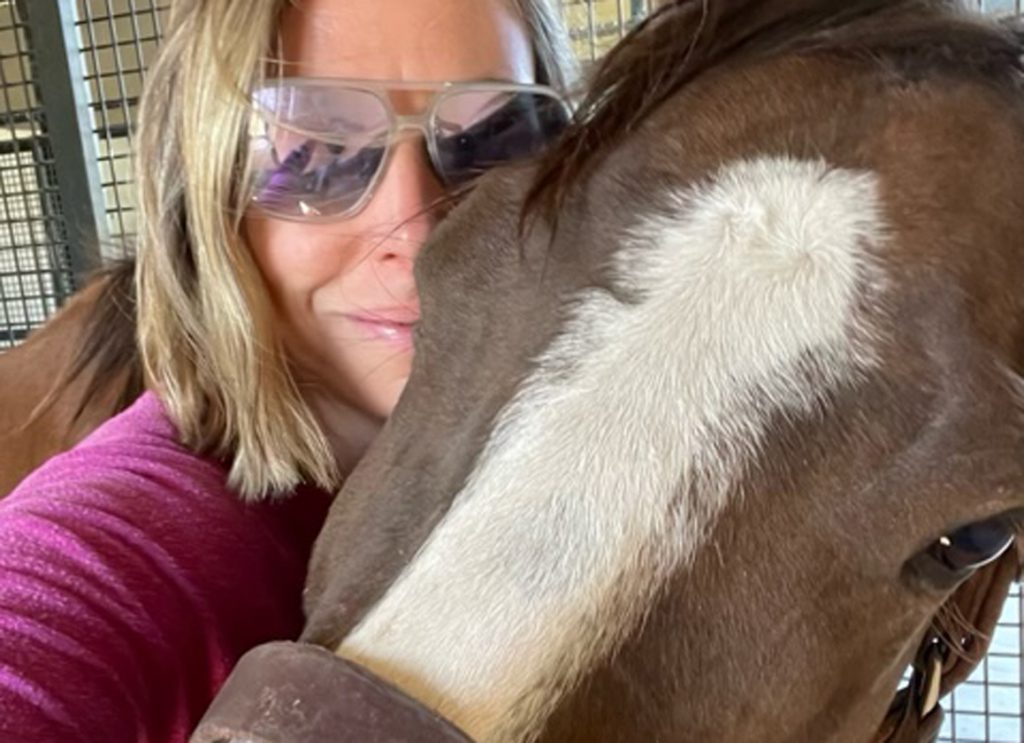
Frida with Taylor | Taylor Tricarico

Hoosier Artist exceeded everyone's expectations and by mid-summer she was thriving! She began race training in earnest and showed grit and grace. Her first race left everyone who knew her in awe, and in some cases tears of joy. How was this the same horse that had to be supported to stand? How was this the same filly that had a body score of one, not six month earlier? And now she was doing what she was bred to do.

Despite a promising first time out, her racing career was short-lived, lasting only a half dozen times. Following a mismatch of training styles, the difficult decision was made not to push her, but to bring her back to L&D. This is where she stayed as the farm favorite, for several months before our accidental meeting.

I had no specific plans for Frida when she stepped off the trailer at my little farm in Versailles, Kentucky. All I knew is that this was a special soul and I was lucky to now call her mine. During our first off-track ride she couldn't turn right to save her life, as her gates were erratic and she held her head so high I wondered how she could see where she was going. But she was reasonable, responsive and had the best stop I'd ever sat. Two weeks later, we were riding bareback in a halter. Two months after that, she'd mastered all the groundwork I could throw at her. Before I knew it, my seven-year-old son was piloting her. This was a good horse. But what to do with her?

I'd missed the application window for the 2023 Retired Racehorse Project Thoroughbred Makeover (RRPTM), when a ISO Facebook post caught my eye. A young trainer was looking to buy an RRPTM horse that matched Frida's description exactly: kind, quiet, slow, small. I messaged her asking, “I know this is a long shot, but would you be willing to partner and take my mare to the RRPTM? She's not for sale, but she is just what you are looking for.” The next day Blakely Releford was in my round pen working with Frida, swooning over her quick brain and sweet demeanor. I could tell immediately that this was a perfect match. A partnership was born and Hoosier Artist, the little-mare-that-could, was RRP bound!

–Taylor Tricarico, Versailles, KY

The post Letter To The Editor: From Starvation To The RPP Makeover appeared first on TDN | Thoroughbred Daily News | Horse Racing News, Results and Video | Thoroughbred Breeding and Auctions.

Source of original post

Letter To The Editor: Actions Detrimental Or An Inconvenient Truth?

by Brent J Malmstrom

“Leave no authority existing not responsible to the people.”-Thomas Jefferson

I was made aware The Jockey Club published an article “HISA is Necessary” which appears to be a direct response to my letter to the Editor Actions Detrimental.

I would like to thank all the various industry participants who have reached out in support of what I shared and the concerns which were raised.

The Jockey Club is a breed registry. The author perhaps without knowing has acted as an agent for the Authority and or the person most knowledgeable and your commentary can only be interpreted as an on-the-record factual basis.

A more appropriate response could have been, `we appreciate you raising your concerns, we appreciate your perspective as an owner, and we acknowledge despite best intentions things haven't always worked the way they are intended.' This could have been used as a learning moment for the betterment of the collective. Or, they could have said, `we disagree with your point of view.' The question remains: how many industry representatives need to come forward before constructive dialogue is allowed to occur?

According to the author, I should be ashamed for raising concerns regarding the implementation of this Act and the potential material consequences the integration represents to the industry and the participants. A little reminder that we live by the rule of law and protections where the government can't deprive any person of “life, liberty, or property without due process.”

Contrary to the representation raised by the author, I am not a party to or affiliated with any lawsuits pertaining to this integration and adoption. Also, as a point of fact, it wasn't my horse in question, as the author suggests. I just happen to own around 30 other racehorses. Also, to date there has been no email or communications from HISA or HIWU regarding what happens when one of your covered persons (i.e. your trainer) has been provisionally suspended.

The author suggests that it is not possible to have any contamination event and the presumptive position would be anyone taking any of these types of medications under the general care of their doctor should not be training and or be involved in this sport as the tolerance level is zero. (Trainers, owners, grooms, track employees, racing officials, anyone…)

We should recap the significant events since my article was published. The Authority changed the Provisional Suspension rule to not to take effect until the “B” sample results were complete.  I believe they should have taken it one step further and waited until the provisional hearing; that would seem appropriate. Allow the labs to confirm the results and allow due process to the parties involved.

With regards to my statements about the permissibility of the medication in question, “Metformin”. I drew those statements from publicly available information: USADA;, WADA;, FEI (indeed, FEI even acknowledges some substances “are more likely to have been ingested by Horses for a purpose other than the enhancement of sport performance, for example, through a contaminated food substance); ARCI (see links below).

Why is all of this important?  There is a subset of medication that is common within our environment and the list of Atypical Findings as well as the “Banned vs Controlled/Prohibited” lists should continue to be reviewed. At issue is the difference in how these determinations were made and how they are treated (a monetary fine, points on your record, a suspension). Gone are the days of a fine and a few days suspension – we are now saying you could be out of the industry for months and or years for a violation from a positive caused by an environmental transfer. Why when these concerns are raised, must the attitude be, “you are anti-HISA” vs “it's in everyone's best interest to get this correct?”

What hasn't been discussed is what happens when the Authority doesn't follow their stated protocols i.e. Timelines for test samples, chain of custody of the samples (split samples not traveling together to the second lab), confirming the testing procedures are followed. Just because they say this happens doesn't necessary reflect what happens, unless the author is suggesting they will attest and stand behind this certification under penalty of perjury that everything is correct all the time. Remember the industry participants are paying four to five times more for these tests as it has been stated the costs were negotiated to ensure speed and accuracy.

There continues to be a significant lag when test results are returned vs. when horses competed. We continue to see issues related to results vs. claimed horses. In several examples the horse may have changed hands several times before an original test of an altered chemical finding was produced. The pervasive question continues to be now what?

The request from HISA and now The Jockey Club is to allow time for the failures to be corrected. The issues raised by my article were about the material impacts an altered chemical result could have on someone (any trainer). The suspension, the loss of income, the brand reputation risk of being labeled a cheater before any due process. Your asset being stranded and or impaired without any remedy and the inevitable issue of defending yourself with the IRS Section 185 the “Hobby Loss rule” just to name a few. Unattended consequences are particularly concerning as most if not all of this could have been predicted had the execution phase of this been well thought -out.

The Jockey Club statement asks us to give the Authority time because “this is a start-up,” as though we should just write a check and let the Authority learn the business and just trust them, they will get it correct. The inconvenient truth is a vast majority of this industry can't afford the pervasive “let me swing until I get it right” mentality.

The response simply ignored another concern raised the need for disclosures. Disclosures are the mechanism in place to ensure concerns raised are answered. To reiterate HISA representatives, continue to make representations about transparency and ethical conduct. I am struggling with this, given they make little to no disclosures around their overall operations. They are operating with an unchallenged budget with no certifications or disclosures. Perhaps this Start-up should understand the shareholder value proposition be accountable and be transparent to the collective.

If the talking point is correct there was collaborative engagement with all the various industry representatives, then why the roll-out challenges and the need for time to get this correct? Contrary to what The Jockey Club writer stated, it is the big-picture considerations which prompted my article. As I shared before, unless there can be balanced enforcement that affords equal protections to all parties we will continue to lack the necessary progress to move the industry forward.

The post Letter To The Editor: Actions Detrimental Or An Inconvenient Truth? appeared first on TDN | Thoroughbred Daily News | Horse Racing News, Results and Video | Thoroughbred Breeding and Auctions.

Source of original post

Letter to the Editor: ‘Fans Could be Racing’s Best Cheerleaders’

Dear TDN Editor:

Some may argue that Thoroughbred racing is a contact sport. Twelve-hundred-pound athletes running at 40 mph around an oval and navigating through holes as tight as the eye of a needle might support that reasoning. Our racing stewards are there to guard against the worst from happening and protecting the integrity and safety of the sport of Thoroughbred racing. With the eyes of a hawk, they are doing their job well from their perch atop the clubhouse. All are accredited with experience and must be commended for what they do. For example, in just 18 days of the 2023 Saratoga meeting, five jockeys have been censured for careless riding. All but one, Tyler Gaffalione, was suspended. Gaffalione appealed and had his suspension stayed.

It becomes less effective when their on-track decision making fails to be communicated to fans and players. In each of the incidents above, stewards were silent to racing constituents about why they made their decision. The reports on the New York Gaming Commission site refer to careless riding. Without the details, damage occurs. With the lack of information, the rumor germinates in social media. Thousands of fans conveniently grow their own explanations without facts and embellish the rumor. Soon the stream flows to enemies of racing and we are under attack. The last thing racing needs is the unnecessary promotion of more racing haters. Like brushfires, lies about racing and the unethical that run it and the cruel that participate in it will saturate social media. Not necessary; there are solutions.

First, each track that runs a Thoroughbred racing meet could host a symposium, virtual or live, before a meet begins where the track's stewards explain the rules that apply and how they might adjudicate an inquiry. Vignettes, real or fictional, could be used to underscore the points made. Fans and players could interact and raise questions. Such a forum would be educational. When an inquiry sign appears fans and players would better understand the stewards' thought processes as they evaluate the incident. The emotions of the pending decision would be less fueled by the loss of a wager or placement of a horse.

Second, when an inquiry is decided the stewards might immediately appear on the tote board and video feed explaining how and why in this specific case they arrived at their decision. The current approach of a flashing inquiry or objection sign followed by minutes of silence and selected replays and then the public address officer announcing, there would be “no change in the finish position” doesn't serve racing well. This model frustrates fans and players and fosters conspiracy theories and fictional explanations by anyone dissatisfied with the outcome. If there is a legitimate reason to withhold an explanation it could be offered by the stewards or their spokesperson. Fans understand the litigiousness in gambling and would accept the explanation without blame.

Finally, racing would do well to recognize the value of the millions of racing fans and players across the country. Inviting them to participate on committees or workgroups that advise racing/gaming commissions or for that matter HISA would be an initiative-taking move. In this time where transparency is a buzz word for ethical behavior more would be gained than lost by such a move.

The call to action from fans of Thoroughbred racing is “keep us in the loop.” Many of us come to this sport from professions that would benefit racing if included. Fans, if their voice is recognized and matured, could be racing's best cheerleaders.

Michael Amo

ThoroFan

Editor's Note: The Stewards' Corner section of the NYRA website has now been updated with explanations of recent decisions at Saratoga Race Course, including last Saturday's GII Jim Dandy S.

The post Letter to the Editor: ‘Fans Could be Racing’s Best Cheerleaders’ appeared first on TDN | Thoroughbred Daily News | Horse Racing News, Results and Video | Thoroughbred Breeding and Auctions.

Source of original post

Letter to the Editor: Clark Shepherd

   In Response to Beau Lane's Letter to the Editor from July 31:

Bravo, my friend!

The discussion on the impacts of public accusations, even before any form of due process takes place, cannot be understated. I liken the scenario to a judge telling a jury to “disregard that last statement” painting a vivid picture of the harsh reality we face. This metaphor cogently emphasizes the irreversible harm that can befall individuals and organizations alike when accusations are prematurely thrown into the public sphere.

The court of public opinion, bolstered by the immediacy of today's media landscape, can irreversibly tarnish a reputation in the blink of an eye. This should serve as a wake-up call to us all. It is our collective responsibility, as part of this industry and society, to uphold the principles of due process and to tread with caution when dealing with potentially reputation-damaging information.

We must always seek to ensure fairness in our dealings, refraining from passing judgement before a comprehensive and fair process has taken place. Swift conclusions and reactions can lead to lasting damages, often affecting those who've devoted their lives to the industry, and once tarnished, a reputation can rarely be fully restored.

The integrity of our industry depends on our commitment to these principles. Our actions today will shape the future of horse racing, and we must navigate these complex issues with wisdom, patience, and a dedication to justice.

Clark Shepherd

Shepherd Equine Advisers, Inc.

The post Letter to the Editor: Clark Shepherd appeared first on TDN | Thoroughbred Daily News | Horse Racing News, Results and Video | Thoroughbred Breeding and Auctions.

Source of original post

Verified by MonsterInsights