In-Form Sibelius Sets His Sights on Breeders’ Cup Sprint

After airing in front-running fashion in Pimlico's Lite the Fuse S. with a career-high 105 Beyer Speed Figure earlier this month–his second straight triple digit rating–progressive 4-year-old sprinter Sibelius (Not This Time) is getting good at the right time.

Just how good, exactly? That question will be answered in Keeneland's 'Win and You're In' GII Stoll Keenon Ogden Phoenix S. on opening day Oct. 7.

“I'm a big believer in horses getting confident when they win,” trainer Jerry O'Dwyer said. “When they back it up, back-to-back like he has, he's walking around there with his chest out and looking and feeling good.”

The Jun H. Park and Delia Nash colorbearer ended a five-race losing skid with a sharp victory over a trio of next-out winners while cutting back to six furlongs in an optional claimer at Saratoga Aug. 10, good for a 100 Beyer, prior to his aforementioned 7 1/2-length romp in Baltimore Sept. 10.

The chestnut gelding also ran well in defeat in his two previous trips to the post while third with first-time blinkers behind subsequent GIII Monmouth Cup winner Highly Motivated (Into Mischief) going a one-turn mile at Belmont May 28 and also filled that same slot behind GISP Baby Yoda (Prospective) in upstate New York going seven furlongs July 16, respectively.

“He's a horse that we've always liked and he's always shown some natural ability,” O'Dwyer said. “I think now being a 4-year-old, he's reaching his peak performance, maturity and strength wise. Mentally, he's in a great place. He couldn't have been any more impressive in his last win at Pimlico. Just the way he jumped out and traveled nicely and opened up in hand. After running a big number in Saratoga the time before, you like to see them back it up to something equivalent. He stepped up again, which is nice.”

The six-furlong Lite the Fuse was Sibelius's first attempt versus stakes company since a trio of disappointing stakes tries last season, including a distant fifth in a sloppy renewal of the rained-off GIII Penn Mile S. in his first go versus winners last May. He was previously a big-figure maiden winner at second asking at Keeneland, site of this year's GI Breeders' Cup Sprint.

“I think it took him a little while to get his confidence back,” O'Dwyer said. “His works at home were always very good. You could tell he had a lot of ability. I started stretching him out a bit because in the sprint races, he wasn't traveling strongly on the bridle like he is now. Even when we stretched him out, he ran super [finishing second] over the one-turn mile at Aqueduct [Apr. 2].

O'Dwyer continued, “But then his works just started getting so much stronger and sharper. He's been giving us all the right signals. We started gradually cutting him back in distance and he's been showing us that he's just an out-and-out sprinter now. Super fast and sharp.”

With six starts at three and already eight attempts under his belt this season, Sibelius isn't the kind of horse that needs a lot of work in between starts. Currently residing at the Thoroughbred Training Center in Kentucky, Sibelius is slated to join the South Florida-based O'Dwyer's Keeneland string Friday.

Bred in Kentucky by Taylor Brothers Properties LLC, Pollock Farms, Patrick H. Payne, et al, Sibelius brought $100,000 as a KEENOV weanling. He subsequently RNA'd twice–for $62,000 at KEEJAN and for $75,000 at KEESEP. Out of the unraced Pulpit mare Fierey Pulpit, he is a half-brother to MSP Dypsy (Broken Vow), dam of MSW & MGISP Edwards Going Left (Midnight Lute). Sibelius is one of 22 stakes winners for promising young sire Not This Time.

“He's very straightforward,” O'Dwyer said. “He's not a big, robust horse. He looks very muscular and doesn't carry too much excess flesh. He'll get a lot out of his gallops if you let him. So, we keep him under wraps a little bit. He'll just have a blowout on Friday, maybe an easy half mile in :49 or something like that. I'll see how he is over the next couple of days.”

After beginning his career as a jockey in Ireland and England, O'Dwyer came to the U.S. to gallop for trainer Al Stall, Jr. He also worked under trainers Bill Mott, Michael Matz and Andrew McKeever before going out on his own in 2014. Shotski (Blame) became the first graded winner for O'Dwyer with an upset victory in the 2019 GII Remsen S. at Aqueduct.

Should Sibelius earn his way to the Breeders' Cup Sprint via next week's Phoenix, it would be the first starter in the World Championships for O'Dwyer.

“We want to be there on the big days,” O'Dwyer said. “We're fortunate that he's given us a bit of a highlight this year. We're hoping he can continue to do that.”

The post In-Form Sibelius Sets His Sights on Breeders’ Cup Sprint appeared first on TDN | Thoroughbred Daily News | Horse Racing News, Results and Video | Thoroughbred Breeding and Auctions.

Source of original post

Depth Takes Market to Giddy Heights

The phrase is traced to Bob Hope, apparently when challenged by a heckler during one of his military morale-boosters to explain why he wasn't in uniform. “Don't you know there's a war on?” he replied. “A guy could get hurt!”

It would have been perfectly legitimate for one of the Keeneland auctioneers to respond in similar vein to the torrent of bidding that elevated the September Sale to unprecedented highwater marks. Somehow, the kind of factors that traditionally send markets into nauseous free fall have failed to stem a breathless bull run in international bloodstock. Don't these people have televisions, or newspapers?

The market's resilience through Covid was startling enough. Many of us sought to explain that by a pent-up thirst to make the most of life, after being so bleakly confined. There was also the sense that the most affluent tier of society, on which our industry so candidly depends, had been insulated from the kind of financial stress being experienced lower down the pyramid.

After all, the wealthy had benefited through the previous decade from the liquidity deployed (via cash-doping instruments such as quantitative easing) to put out the fires of the banking crisis; and those taps had never really been turned off, even after the flames abated. But now we have runaway inflation, we have the horrifying return of territorial invasion in Europe, we have ubiquitous forecasts of recession. And still the value of Thoroughbreds continues to soar.

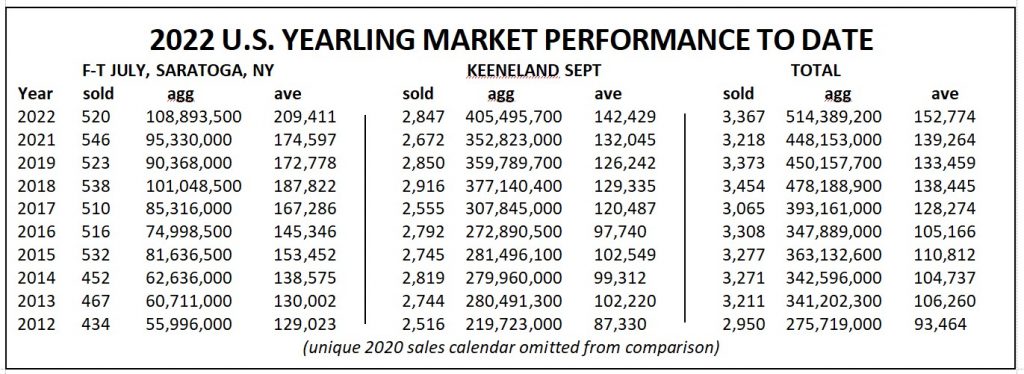
The table below shows that the average cost of a North American yearling, in 2022, has breached $150,000 in a market that has passed another historic barrier, for this stage of the calendar, at $500 million. This is calculated from aggregate business at Fasig-Tipton's three summer auctions-the July Sale in Lexington, plus the elite and New York catalogues at Saratoga-combined with turnover at Keeneland over the past two weeks, where transactions spanned $2,000 to $2.5 million. Together, as such, these comprise a comprehensive snapshot of the marketplace at all levels.

Turnover at the September Sale advanced 14.9% on last year to exceed $400 million for the first time (missed by a few cents in 2006); while the Fasig-Tipton summer calendar advanced in step by 14.2% to achieve a record aggregate of its own at nearly $109 million. Collectively, an additional $66,236,200 has been spent on North American yearlings so far this year, an increase of 14.8% to $514,389,200. That represents an 86.6% gain on the equivalent stage in 2012!

These numbers translated to record averages of $209,411 for Fasig-Tipton, up a staggering 20% on 2021; and $142,429 for Keeneland, an increase of just under eight%. Blended, the average yearling is costing you $152,774 in 2022, up $13,510 or 9.7% on this time last year.

Now a lot of this has a very edifying impetus. A number of regions, not least Kentucky itself, have been developing a purse structure that threatens to introduce something resembling coherence-even, whisper it, viability-to investment in Thoroughbreds. Nor should we forget our collective debt to those who have heroically restored the sport in California from an existential brink, renewing geographical balance to opportunity. And of course the circuit there has meanwhile produced a racehorse that has made even a seven-figure tag look cheap.

But perennial growth, in a market like this, is impossible. Capitalism has always depended on cycles, requiring troughs to generate the conditions for the next peak. Just conceivably, globalization may have so skewed the system that the elite can remain blithely immune to street-level difficulties. But if recession does end up penetrating the entire economic organ, the way it always has in the past, then we must give Cassandra her say. Because the bloodstock market has tended to absorb trends from the wider economy slowly, whether in recession or recovery.

The Dow Jones, having plunged 33.8% in 2008, recovered 18.8% as soon as the following year and maintained solid gains annually until 2015. The overall North American bloodstock market, in contrast, lost 21.2% in 2008; 32.2% in 2009; and another 6.5%, even on those compound losses, in 2010. It was not until 2011 (up 18.2%) and especially 2013 (up 27.9%, in tandem with the biggest spike in the Dow Jones) that its own recession leveled out.

For the time being, however, we must acknowledge a wholesome depth to the current market. Vendors always complain about polarization, about a soft center and all-or-nothing engagement (often contingent on vetting). But this feels different. Among the many records set at Keeneland, perhaps the most significant was one of 82% clearance.

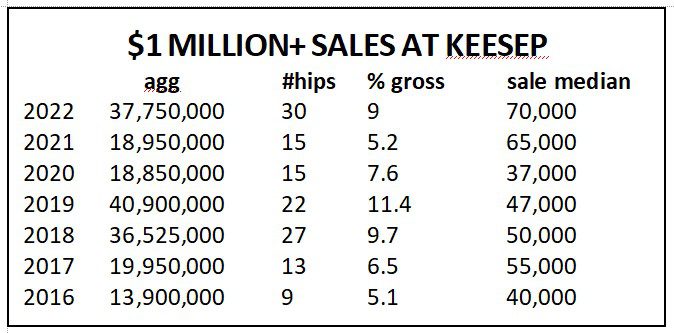
While 30 seven-figure sales headlined the feel-good stories at that auction, the fact is that they only narrowly surpassed the 27 recorded in 2018. In each case, moreover, their collective cost represented a very similar portion of overall turnover: nine% this year, against 9.7 per cent in 2018. (The spike to 11.4% in 2019, by the way, was largely the work of the ill-fated $8.2 million daughter of Leslie's Lady and American Pharoah). As the table below demonstrates, however, the median across the two weeks was wildly higher this year, at a record $70,000 against $50,000 in 2018.


This depth is reciprocated by the sheer breadth of investment, with no fewer than 88 different signatories to dockets together worth $1 million or more.

For years, people asked queasily what would happen to the market if deprived of support from a family that had, globally, done so much to assist the evolution of a commercial breeding industry. As recently as 2019, Godolphin and Shadwell topped the September action with an outlay of $16 million and $11.07 million respectively for a total of 28 yearlings. Since then, we have mourned the passing of Shadwell's founder Sheikh Hamdan, albeit that firm did acquire four yearlings for a total $2.5 million this year. And Sheikh Mohammed, meanwhile, has become conspicuous by his absence at this sale.

In the event, however, the defection of spenders apparently able to bid indefinitely has only cleared the field for competition. The best prospects have not become more affordable, in themselves. But they have become more accessible. As a result, competition has been intensified, not diluted, even as powerful domestic interests have increasingly collaborated in pursuit of common targets.

This September it was only by a single nod to the rostrum that the charismatic duo behind Repole Stable and St. Elias Stables edged out another powerful partnership to finish the auction once again as leading buyer: their $12,840,000 outlay (for 31 yearlings) shading Donato Lanni's $12,825,000 on behalf of SF/Starlight/Madaket. But that was barely half the story, as West Bloodstock signed as agent for Repole Stable for 27 additional head at $7,940,000; while Michael Wallace corralled 15 at $4,475,000 for St. Elias Stables. These extra investments weighed in respectively as the fourth and eighth highest of the sale; and that's besides a series of individual plays with other partners.

The latter included M.V. Magnier, whose $1.1-million Curlin colt with Repole Stable was one of a handful such investments made with partners. Magnier, representing the Maktoums' traditional antagonists at Coolmore, actually signed for only a couple of colts outright. With the strength of the dollar steepening the gradient against overseas currency, Hideyuki Mori had to settle for five head at $2,545,000, compared with a dozen at $4,415,000 in 2021. That left agent Richard Knight's dazing spree in the second session as the only really striking external contribution to the top end of the market, his total spend (#7 for the sale) comprising $4,875,000 across half a dozen hips.

So much for the joys of being able to travel freely again! In the longer view, however, what we saw is consistent with ongoing European mistrust of Kentucky sires, and the lamentable transatlantic schism between perceived dirt and turf bloodlines.

As for the corresponding local neglect of grass stallions, there was at least some belated respect for two outstanding turf stallions recently lost to the Bluegrass: English Channel tipped six figures for the second year running, after averaging no more than $33,167 only in 2020, while Kitten's Joy averaged $138,632 for 19 yearlings (up from $103,457 last year).

As anticipated from the conspicuous distribution of his stock towards the front of the catalogue, this sale proved another major landmark in the career of Quality Road. With several proven titans approaching the evening of their careers, the 16-year-old Lane's End stallion sealed his accession to that level by again keeping even champion Into Mischief (58 sold at $525,776) from the top of the averages, processing 37 at $533,514. That was a further advance on the $472,794 by which Quality Road shaded Curlin and Into Mischief in 2021, having the previous year slipstreamed Medaglia d'Oro, Into Mischief, Tapit and Curlin at $339,939.

The much younger Gun Runner meanwhile maintained his stratospheric rise, processing 40 hips at $461,875, good enough for third with yearlings still conceived off his $70,000 opening fee. (And remember that his current weanlings came into the world at $50,000! What kind of fee, you wonder, will register the upgrade in his mares guaranteed in 2023?)

As always, however, most curiosity was reserved for those newcomers who nowadays comprise the bedrock of the commercial market. Their window of opportunity is so fleeting as to make it seem almost cruel to examine their performance too closely, when really they should not be judged at all until their stock reaches the racetrack. But if that's how the market will insist on behaving, then that's how we must assess their debuts to this point.

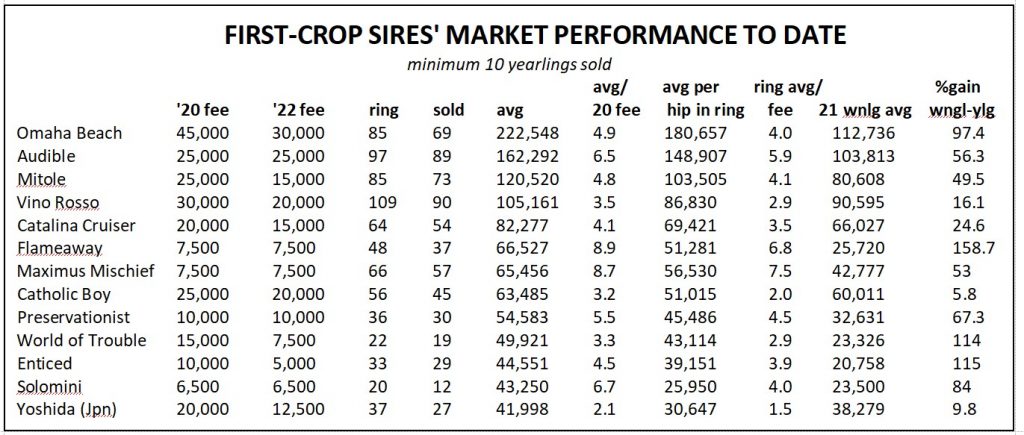
Obviously there are several auctions still to come, but the pyramid of business to date plainly provides a valid sampling. The table below charts those sires whose debut crops have so far mustered at least 10 sales.

Now some people feel it's a little strange that sires are given a pass on stock they can't sell. The difficulty is that a yearling that fails to reach its reserve will sometimes be among the very best of a sire's crop, its vendor only receptive to the kind of offer that can't be refused. Equally, however, an RNA can often reflect a simple failure of traction. Arguably data should give some credit to the sire who processes a high percentage of his stock. For the little it may be worth, then, our table also includes average revenue per hip into the ring, as an extra snapshot of how he might be working out, overall, an investment vehicle.

Because while the table is sorted according to average sales, we do know that the market tends to be pretty obedient in that respect. Year after year, first crops tend to end up being valued more or less in line with the pecking order invited by opening stud fees.

Just as well, then, that Omaha Beach has done exactly what he was priced to do, averaging five times his opening fee at $222,548. He has looked value throughout, to be fair, and has certainly been kept in the game with consecutive fee cuts since siring these yearlings. Having retained his opening fee, equally, Audible has arguably done no less than required in averaging a whopping 6.5 yield.

If these two haven't put a foot wrong, others who have not done quite so well-in what remain, after all, extremely early skirmishes-have tended to have their fees trimmed as an incentive to keep the faith. But I think one or two sires deserve a little extra attention, at this stage, if we put on the pinhooker's hat.

Again, this is an inexact exercise. Different horses are different projects. But let's take a look at the advances made by these stallions between their weanling and yearling averages, as a possible gauge of the kind of physical progress their stock can make.

Omaha Beach has excelled in this respect, certainly, essentially doubling his weanling average. But let's shine a torch at the other end of the spectrum. While cheaper stallions are obviously obliged to make pretty brisk gains just to cover keep, smaller breeders are grateful even for modest margins.

Flameaway owes his vivid climb on these indices partly to a single $425,000 colt at Saratoga, but his weanling median of $17,500 has also been hoisted at a comparable rate, to $50,000. Overall, his revenues, for sales achieved and per hip into the ring, respectively represent almost nine and seven times his fee. Darby Dan knows how to put numbers behind a cheap young stallion and perhaps Flameaway, who beat Catholic Boy and Vino Rosso on the Derby trail, will take his chance after the fashion of Dialed In. Apart from anything else, his third dam is a turf matriarch and, with his flexible sire-line, the son of Scat Daddy merits close attention from European breeze-up pinhookers seeking an export bargain.

Another who started with a very big book on the same basement fee, Maximus Mischief, achieves the highest ratio of all per hip into the ring (7.5 times his fee; also nearly nine times his fee on sales completed) after finding homes for 57 of 66 yearlings offered to date. He has added 53% to his weanling average and, with his profile, looks a blatant vehicle for the next pinhooking cycle, too.

Preservationist was unfortunate that the colt he got into Book I-a rare achievement for a $10,000 sire-had to be scratched from the September Sale. Even without his star turn, however, he achieved some outstanding dividends, including colts at $280,000, $260,000 and $250,000 deeper in the catalogue. Overall he has put two-thirds onto the average value of his weanlings, and his yearling sales are averaging 5.5 his fee. This guy offers exemplary genetic depth, remember, and don't be deceived by the hold-ups that delayed his bloom on the racetrack. He got a 31/2 Ragozin breaking his maiden over six furlongs, and the platform he has already built for himself suggests that there will be precocity to match that speed.

All these are just straws in the wind, of course, and far-sighted supporters of some that have failed to achieve gaudy overnight dividends will be wisely content to wait until actually able to test the water on the racetrack. Because there's one big problem with a market like this one: it fosters the perilous fallacy that a Thoroughbred foal is brought into the world to stand on a dais for a minute or two. For the good of the breed, ultimately we must reinforce the connection between commercial value and racetrack performance.

In the meantime, however, let's toast those hard-working and skilful people who have celebrated a bumper harvest. While the factory operations naturally headed the consignors' table by gross, the averages were again dominated by smaller outfits. All of us, scrolling down that list, will recognize names that warm the heart: friends, maybe kinsmen, lots of small farms that we admire.

Hats off to them, and also to those energetic and ambitious rivals, Keeneland and Fasig-Tipton, who have provided a trading environment equal to the current boom. Even if the cold winds out there soon come blasting through their pavilions, perhaps the next Flightline will meanwhile be getting to know the feel of a saddle on some dreamer's farm. Because we started with a person named Hope-and really that's every single one of us.

The post Depth Takes Market to Giddy Heights appeared first on TDN | Thoroughbred Daily News | Horse Racing News, Results and Video | Thoroughbred Breeding and Auctions.

Source of original post

Secretariat Center To Host Movie Night

The Secretariat Center will host “Movie Night Under the Stars,” featuring the movie Dreamer Oct. 1. The event opens at 6 p.m. with the movie starting at 7:30 p.m. Tickets are $20 a person and are on sale at www.secretariatcenter.org.

There will be food available for purchase from Salsarita's, Mr. Gyro, and Mister Softee Ice Cream and beverages from Blue Stallion Brewery. They will have a Keeneland Kid Zone, mini ponies, a Lexington FD fire truck and horse jumps for kids. Popcorn is free and there will be special giveaways and raffles.

The post Secretariat Center To Host Movie Night appeared first on TDN | Thoroughbred Daily News | Horse Racing News, Results and Video | Thoroughbred Breeding and Auctions.

Source of original post

The TDN In Spanish: A Keeneland Sales Report

From time to time, the TDN receives queries from individuals interested in seeing our stories presented in different languages to appeal to populations around the world. Here, we present the Keeneland sales wrap-up in Spanish, provided by Herman Guanipa van-Grieken. We are very interested in your feedback as to the viability of a project like this. Please email suefinley@thetdn.com with your comments. 

¿Te interesa leer la TDN en español? Envíe un correo electrónico a suefinley@thetdn.com

Keeneland Septiembre 2022 Bate Todos Los Records De Ventas

by Herman Guanipa van-Grieken

La subasta de potros menores de dos años o potrillos más importante en el mundo rompió su récord de ventas, al superar los $399.791.800 alcanzados en el año 2006, llegando a la asombrosa cifra de $405.495.700, con un total de 2.847 potros vendidos en subastas, cifra que aumenta a $418.288.700 y 2.964 potros vendidos, si le sumamos los 117 potros negociados después de la subasta por no alcanzar el precio reserva cuando salieron a la venta.  (RNA sus siglas en ingles)

El éxito se dio en gran parte al cambio de formato llevado a cabo este año. Se fortaleció el libro 1 vendiendo en 2 sesiones, reuniendo lo mejor de lo mejor del criatorio norteamericano, con lo cual despertó el interés de los principales actores internacionales que concurrieron a la cita, estando muy activos, que conjuntamente al grupo élite de inversores norteamericanos llevaron a que el libro 1 alcanzase $113.660.000 de ventas acumuladas, 20,27% arriba de los $90.622.000 recaudados en el año 2021, con un promedio de $516.636; 18,58% superior al año 2021 y una media de $450.000, +28,57% por encima al del año anterior. El máximo precio de los potrillos vendidos fue de $2.500.000; mientras que en el año 2021 fue de $1.600.000. 22 de los yearlings de este año lograron ser vendidos en el libro 1 por un precio de al menos $1.000.000; el doble (11) de los vendidos en ese rango de precio en el 2021. Todos estos números positivos se mantuvieron a través de los días, generando la conformación de un mercado fuerte para los vendedores, logrando también batir los récords por promedio y valor medio alcanzados el año pasado. El precio promedio fue de $142.429, 7,83% por encima de los $132.091 del año 2021; mientras la media fue de $70.000, $5.000 por arriba de los $65.000 del mismo año, lo que significó un 7,69% arriba.

En el renglón de los compradores el Repole Stable & St. Elias Stables fueron los líderes del mercado, logrando comprar 31 potros a un precio total de $12.840.000, con un promedio por compra de $414.194, secundados muy de cerca en cuanto al total de dinero dispensado por Donato Lanni, Agt. para SF/Starlight/Madaket que firmaron 21 tickets de ventas por la totalidad de $12.825.000, generando un promedio de $610.714.

El promedio más alto entre los compradores estuvo a cargo del grupo formado por Talla Racing, Woodford Racing y West Point LEB, Agt. que en 2 compras alcanzaron un total de $3.275.000, para un promedio de $1.637.500.

Taylor Made Sales Agency nuevamente fue el mejor consignador o agente de venta de estas subastas, llegando a negociar 273 ejemplares por un monto de $38.969.000, a un promedio de $142.744; esta fue la octava ocasión consecutiva que la poderosa agencia de ventas logra ser el líder de este mercado y la vigésima cuarta vez en total, desde mediados de los años 80.

Gainesway fue el segundo mejor consignador por monto producido, con un total de $33.263.500, esta organización vendió 141 potros a un promedio de $235.911.

Entre los sementales, el tres veces Líder Semental, Into Mischief, también ratifica su éxito en el ring de ventas, logrando encabezar por tercer año consecutivo el monto total de las ventas de Keeneland Septiembre. El castaño alojado en Spendthrift Farm vendió 58 potros por un monto de $30.495.000, para un promedio de $525.776, con 8 de sus hijos vendidos por encima de $1 Millón.

Lo siguieron en orden de dinero Curlin $20.075.000 (48 productos vendidos) promedio: $418.229.

Quality Road (06, Elusive Quality en Kobla, por Strawberry Road) $19.740.000 (37 productos vendidos) promedio: $533.514.

Uncle Mo (08, Indian Charlie en Playa Maya, por Arch) $19.340.000 (65 productos vendidos) promedio: $297.538.

Constitution (11, Tapit en Baffled, por Distorted Humor) $19.069.000 (74 productos vendidos) promedio: $257.689.

Gun Runner (13, Candy Ride en Quiet Giant, por Giant's Causeway) $18.475.000 (40 productos vendidos) promedio $461.875.

Justify (15, Scat Daddy en Stage Magic, por Ghostzapper) $16.459.000 (52 productos vendidos) promedio: $316.519.

City of Light (14, Quality Road en Paris Notion, por Dehere) $12.887.000 (51 productos vendidos) promedio: $252.686.

Omaha Beach (16, War Front en Charming, por Seeking The Gold) $12.667.000 (59 productos vendidos) promedio $214.695, líder entre los sementales debutantes.

Arrogate (13, Unbridled's Song en Bubbler, por Distorted Humor) $10.812.000 (44 productos vendidos) promedio: $245.727. Audible $10.609.000 (66 productos vendidos) promedio $160.742.

Es un éxito para el mercado de ventas de los potrillos o potros menores de 2 años sumado a otras anteriores que muestra un gran empuje a la industria del purasangre de carreras.


Omaha Beach Y Audible Lideraron Entre Los Ementales Debutantes En Las Ventas De Keeneland

El zaino Omaha Beach, tres veces ganador G1 a los 3 años, la única temporada en la que fue ganador, triunfando en 5 de sus 7 actuaciones, debutó como semental con un excelente apoyo entre los compradores de las ventas de potros de Keeneland Septiembre, encumbrándose como el líder entre los sementales de primera generación a ventas, tras la venta de 59 productos en subasta por un monto acumulado de $ 12,667,000, lo cual le permitió ubicarse en la 9ª posición en la lista general de sementales según el monto total de sus ventas. Con ese nivel de ventas, los primeros hijos de Omaha Beach se negociaron a un excelente precio promedio de $ 214,695.

Sin embargo, añadiendo los resultados de las ventas después no alcanzar la reserva, el total de los productos por Omaha Beach negociados aumenta a 72 productos, mientras que el monto total vendido alcanza a $ 14,317,000, para un valor promedio de $ 198,847, con el precio medio ubicado en $157,500. Habiendo sido recibido con gran optimismo en el ring de ventas sus productos, Omaha Beach estuvo representado por tres productos adquiridos por encima de $500.000, todos machos, incluido el precio tope entre sus productos, el catalogado con el número 336, un hijo de la ganadora clásica Maybellene (12, por Lookin At Lucky), una medio hermana del trascendente Elusive Quality (93-18, por Gone West), comprado por la exitosa sociedad de Repole Stable & St. Elias Stables mediante una oferta final de $900,000.

El 2° semental debutante en las ventas según lo vendido en el ring de ventas fue el ganador del Florida Derby (G1) Audible (15, Into Mischief en Blue Devil Bel, por Gilded Time), concretándose la venta de 66 yearlings por un monto total de $ 10,609,000, para un precio promedio por ejemplar de $160,742. Pero si se agregan sus hijos vendidos después de no alcanzar la reserva, el total de sus productos vendidos sube a 99, elevándose el monto total de sus ventas a US$ 14.261,000, quedando el precio promedio por potro en $ 144,051, con una media establecida en $115,000. También con tres productos vendidos por encima de $ 500.000, todos machos, el producto mejor vendido fue el catalogado # 1952, negociado por $ 725.000, obtenido del vientre de la yegua madre Oh Boo Hoo (11, por Kafwain), productora de tres corredores, todos ganadores, medio hermana de las madres de tres ganadores selectivos, incluyendo al castrado Threefiveindia (13, por Street Hero), productor de $ 502,947. El ticket de compra del potro fue firmado por un representante de Flurry Racing Stables.

El tercer semental debutante en la preferencia de los compradores fue el Campeón Maduro Vino Rosso (15, Curlin en Mythical Bride, por Street Cry), ganador de la Breeders' Cup Classic (G1) 2019, en la arena de Santa Anita Park. El hijo del multicampeón Curlin, uno de los mas buscados de las ventas, subastó 67 potrillos por un monto acumulado de $ 6,214,500, lo cual permite calcular un valor promedio de $ 92,754 por ejemplar. Tal como en los dos casos anteriores, si se agregan las ventas realizadas por haber quedado RNA, en total Vino Rosso vendió 103 yearlings por una cantidad de $9,526,500, con lo que el precio promedio de sus productos quedó en $92,490 y la mediana se ubicó en $70.000. Con seis productos vendidos por $300,000 o más, su producto de mayor valor fue el #240 del catálogo, que pasó a ser propiedad de la poderosa sociedad Repole Stable & St. Elias Stable, mediante el pago de $400,000.

Los tres siguientes sementales debutantes según los montos de venta tramitados en subasta fueron el cinco veces ganador G2 a los 4 y 5 años, Catalina Cruiser (14, Union Rags en Sea Gull, por Mineshaft) con 40 yearlings vendidos por $ 2,801,000 (promedio: $68,317)

El ganador G1, en pistas de grama y arena, a los 3 años, Catholic Boy (15, More Than Ready en Song of Bernardette, por Bernardini), que negoció 40 potros por un monto acumulado de $2,653,000 (promedio: $66,325); y el ganador G2 a los 2 años, Maximus Mischief (16, Into Mischief en Reina Maria, por Songandaprayer), responsable por la venta de 40 hijos, mediante un pago total de $ 2,378,000 (promedio: $59,450).

De tal manera que, entre los 6 líderes sementales debutantes por ventas acumuladas, se encuentran dos hijos (33,3 %) del semental de moda, el múltiple Líder semental Into Mischief, una rama paterna en pleno desarrollo, que se presenta con un futuro amplio por la notable calidad de los representantes que se están añadiendo, temporada por temporada, a los planteles de padrillos de los más importantes haras de USA.

La Linea Paterna de Mr. Prospector Domina Los Potros Sobre $1 Millon

30 potrillos fueron vendidos por un valor igual o superior a $ 1 millón y evaluando ese grupo de ejemplares, se evidencia que la línea paterna del inolvidable Mr. Prospector (70-99, Raise A Native en Gold Digger, por Nashua) fue la que destaca entre este selecto grupo. En tal sentido, de esta treintena un total de 17 productos, que representan el 56,7 %, descienden por línea paterna del citado gran padre de padrillos, a través de cuatro descendientes, a saber, Quality Road, Gun Runner, Curlin (04, Smart Strike en Sherriff's Deputy, por Deputy Minister) y City of Light. Asimismo, del monto total de $ 37.850.000 por el que fueron vendidos los 30 potros “millonarios”, un 58,6 % ($ 22,2 millones) correspondió a lo pagado por los descendientes de la línea paterna de Mr. Prospector.

El mayor representante entre las cuatro fuentes de Mr. Prospector es Quality Road, nieto paterno del influyente Gone West (84-09, Mr. Prospector en Secrettame, por Secretariat), contando con 7 potrillos, cinco machos y dos hembras, que se vendieron por un monto acumulado de $10 millones, para un promedio por producto de $1,43 millones. Entre ellos estuvieron los potros con precios topes de las jornadas primera y cuarta, incluido el líder de todas las 12 sesiones, vendido por $ 2,5 millones el día inaugural. La presencia de Quality Road se hace mayor aun cuando consideramos que una de las cuatro fuentes de Mr. Prospector, es el semental de primera generación City of Light, uno de sus primeros hijos en la cría, padre ya de 2 ganadores selectivos con apenas 18 corredores activos, hecho ya valorado, pues vendió dos productos por $ 2,1 millones, para un promedio de $ 1,05 millones por potro.

Segundo entre este grupo aparece el poderoso Gun Runner, nieto paterno de Cryptoclearance (84-09, Fappiano en Naval Orange, por Hoist the Flag), que vendió 5 potrillos en este selecto grupo, dos hembras y tres machos, por un monto acumulado de $ 5,9 millones, para un promedio por ejemplar de $ 1,18 millones, siendo el mejor cotizado de sus productos, una potra vendida por $ 1,5 millones, también en el día inaugural de las ventas.

La tercera fuente en preferencia resultó ser el consagrado Curlin, nieto paterno del propio Mr. Prospector, él en sí mismo convertido en una rama paterna en pleno desarrollo, siendo el abuelo paterno del ganador del Kentucky Derby (G1) esta temporada. Curlin vendió 3 potrillos en el grupo que se analiza, por un acumulado de $ 4,0 millones, para un promedio por potrillo de $ 1,33 millones, apenas inferior que el valor promedio alcanzado por los Quality Road. El precio máximo para un hijo de Curlin lo logró el negociado por $ 1,7 millones, de nuevo, el día inaugural de las ventas.

Mr. Prospector trasciende en este grupo a través de tres ramas distintas de su tronco paterno, la primera a saber el ya mencionado Gone West, que persiste vía Quality Road; la segunda del extraordinario Fappiano (77-90, Mr. Prospector en Killaloe, por Dr. Fager), representada por Gun Runner; y tercera la del influyente Smart Strike (92-15, Mr. Prospector en Classy 'N Smart, por Smarten), con Curlin siendo sin duda su mejor exponente.

Sólo otras dos líneas paternas estuvieron incluidas en el selecto universo de los 30 productos “millonarios”. Como era de esperarse, la línea paterna del insustituible Northern Dancer (61-90, Nearctic en Natalma, por Native Dancer), es la 2ª en la entre la élite del millón de dolares, representada por 10 productos, exactamente, un tercio del total (33,3 %), los cuales provienen de tan sólo dos descendientes del espectacular padre de padrillos: el múltiple Líder Semental Into Mischief (05, Harlan's Holiday en Leslie's Lady, por Tricky Creek) y el Triplecoronado Justify. En lo referente a los precios, casi el tercio del grupo, 30,3 % ($ 11,45 millones) alcanzaron los 10 yearlings que descienden del gran Northern Dancer.

Into Mischief es responsable de 8 potrillos dentro del grupo “millonario”, cuatro hembras y cuatro machos, que fueron vendidos por un total de $ 9,3 millones, para un promedio de $ 1,16 millones. El precio máximo entre los Into Mischief lo obtuvo uno vendido en la 3ª jornada por valor de $ 1,4 millones. Por su parte, el Triplecoronado Justify, con sus primeros corredores debutando este año, contando ya con 4 ganadores selectivos, repartidos en América y Europa, apenas con 41 corredores, vendió 2 productos por un total de $ 2,15 millones, es decir, a promedio de $ 1,075 millones. Su pieza más cara costó $ 1,1 millones y se negoció en la 2ª jornada de las ventas.

En el caso de Northern Dancer, sus dos descendientes con productos “millonarios” provienen de un mismo ramal de su tronco paterno, el de su prolífico nieto Storm Cat (83-13, Storm Bird en Terlingua, por Secretariat). En el caso del encumbrado Into Mischief a través de la rama de Harlan (89-99, Storm Cat en Country Romance, por Halo), muy fortalecida recientemente. El invicto Justify, surge de la rama de Hennessy (93-07, Storm Cat en Island Kitty, por Hawaii), que se empoderó con la aparición del trascendente Scat Daddy (04-15, Johannesburg en Love Style, por Mr. Prospector), su nieto paterno, hoy una sólida fuente de padrillos.

Los 3 productos restantes, justo el 10 % del grupo “millonario”, son de la línea paterna del Triplecoronado Seattle Slew (74-02, Bold Reasoning en My Charmer, por Poker), en su caso, a través de dos representantes, el consagrado Tapit (01, Pulpit en Tap Your Heels, por Unbridled) y su destacado hijo Constitution (11, en Baffled, por Distorted Humor). Este trío se vendió por $ 4,2 millones, un 11,1 % del total acumulado por el grupo líder por precios de la subasta. El precio máximo en este trío fue para un hijo de Constitution, subastado por $1,8 millones el 2° día de las ventas. El tronco paterno del Triplecoronado Seattle Slew está acá a través del fuerte ramal que creó el Campeón A.P. Indy (89-20, Seattle Slew en Weekend Surprise, por Secretariat), a su vez, trascendiendo a través Pulpit (94-12, A.P. Indy en Preach, por Mr. Prospector), que se engrandeció con la aparición de Tapit.

Es importante destacar, la notable influencia Secretariat (70-89, Bold Ruler en Somethingroyal, por Princequillo), presente como abuelo materno en las fuentes de las tres más importantes líneas paternas de las ventas, ejerciendo ese rol en Gone West (línea Mr. Prospector), en Storm Cat (línea Northern Dancer) y en A.P. Indy (línea Seattle Slew).


The post The TDN In Spanish: A Keeneland Sales Report appeared first on TDN | Thoroughbred Daily News | Horse Racing News, Results and Video | Thoroughbred Breeding and Auctions.

Source of original post
Verified by MonsterInsights