Veterinarians at Rood and Riddle Equine Hospital answer your questions about sales and healthcare of Thoroughbred auction yearlings, weanlings, 2-year-olds and breeding stock.
QUESTION: What is “parrot mouth” in a horse, and can it be resolved?
DR. BRAD TANNER: Horses come in all shapes and sizes and so do their mouths. A parrot mouth describes the upper lip that hangs forward and down ahead of the lower lip. This term is synonymous with overbite malocclusion of the incisors of a horse. As the top jaw grows, if it grows at a faster rate than the lower jaw, the front teeth will be extended forward and no longer make contact with the lower incisors. This is what gives the characteristic large, goofy lip of the top jaw that we so often call “parrot mouth.” When an owner raises the top and lower lips, you will notice that those front teeth often times barely contact or sometimes don't contact at all.

Dr. Brad Tanner
Is it a problem?
Yes and no. While it's cosmetically unpleasant to look at for some people, does it really affect performance? The answer is that it doesn't if managed correctly. These horses will continue to eat, they will continue to grow and they will not be skinny because of this malocclusion. However, this can be a problem for some horses. The question is whether the only malocclusions present impacting the incisors; if the front teeth that no longer contact, it's possible the entire top jaw could have shifted forward, which can create a ripple effect. This means that the first cheek tooth on top may no longer be grinding on the first cheek tooth on the bottom. Conversely, the last cheek tooth on the bottom may no longer be chewing in contact with the last cheek tooth on the top and the results of this will be large hooks and excessive growth of these teeth.

This image shows the “hooks” that can appear when the top and bottom jaws don't align properly and part of a tooth is not worn down as normal. Photo courtesy Dr. Brad Tanner
This can cause significant problems and pain for horses, as these large hooks cause collateral damage to the soft tissues, gums, and cheeks. This is compounded when a bit is applied to the horse's mouth and a rider asks the horse to put the head into a frame/collection, causing increased contact of these teeth overgrowths and the soft tissues surrounding them. In Thoroughbred racehorses the effects are less dramatic than in dressage and other disciplines. This is due to the fact that racehorses run largely on looser reins with an extended head and neck rather than in flexion of the poll.
Can it be corrected?
While this is a permanent deformity in adult horses, it can be corrected in young growing foals. Correction should take place between four to six months of age, ideally. As the maxilla (top jaw) is growing ahead of the mandible (lower jaw) at a higher rate, an orthodontic appliance can be applied with orthodontic wires to halt the growth of the maxilla allowing the mandible to catch up. Additionally, an inclined plane is applied in the form of an aluminum plate allowing the lower teeth to engage with it during each chewing motion.
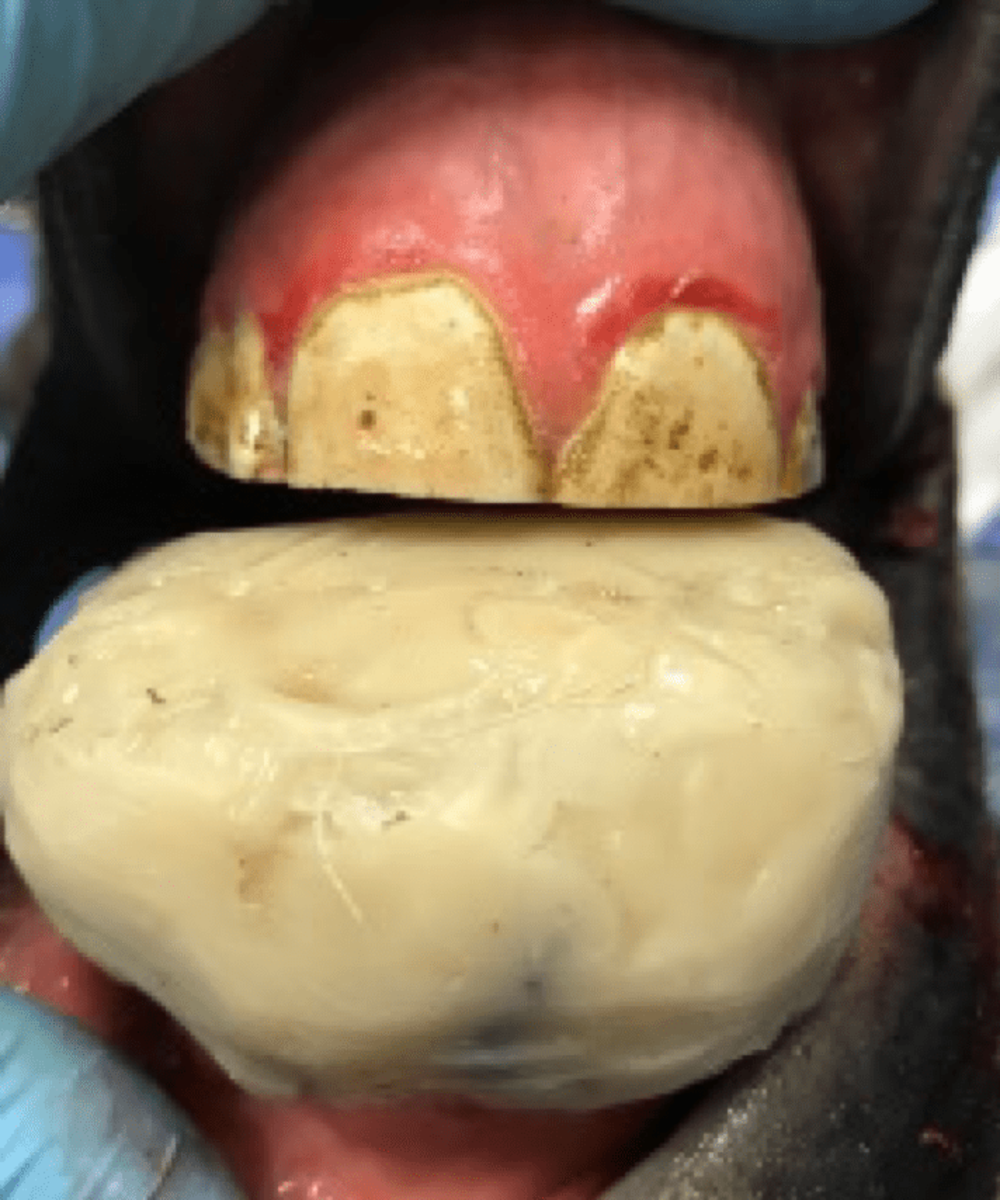
Corrective devices can fix parrot mouth if it is caught early in a horse's life, before skeletal development is complete. Photo courtesy Dr. Brad Tanner
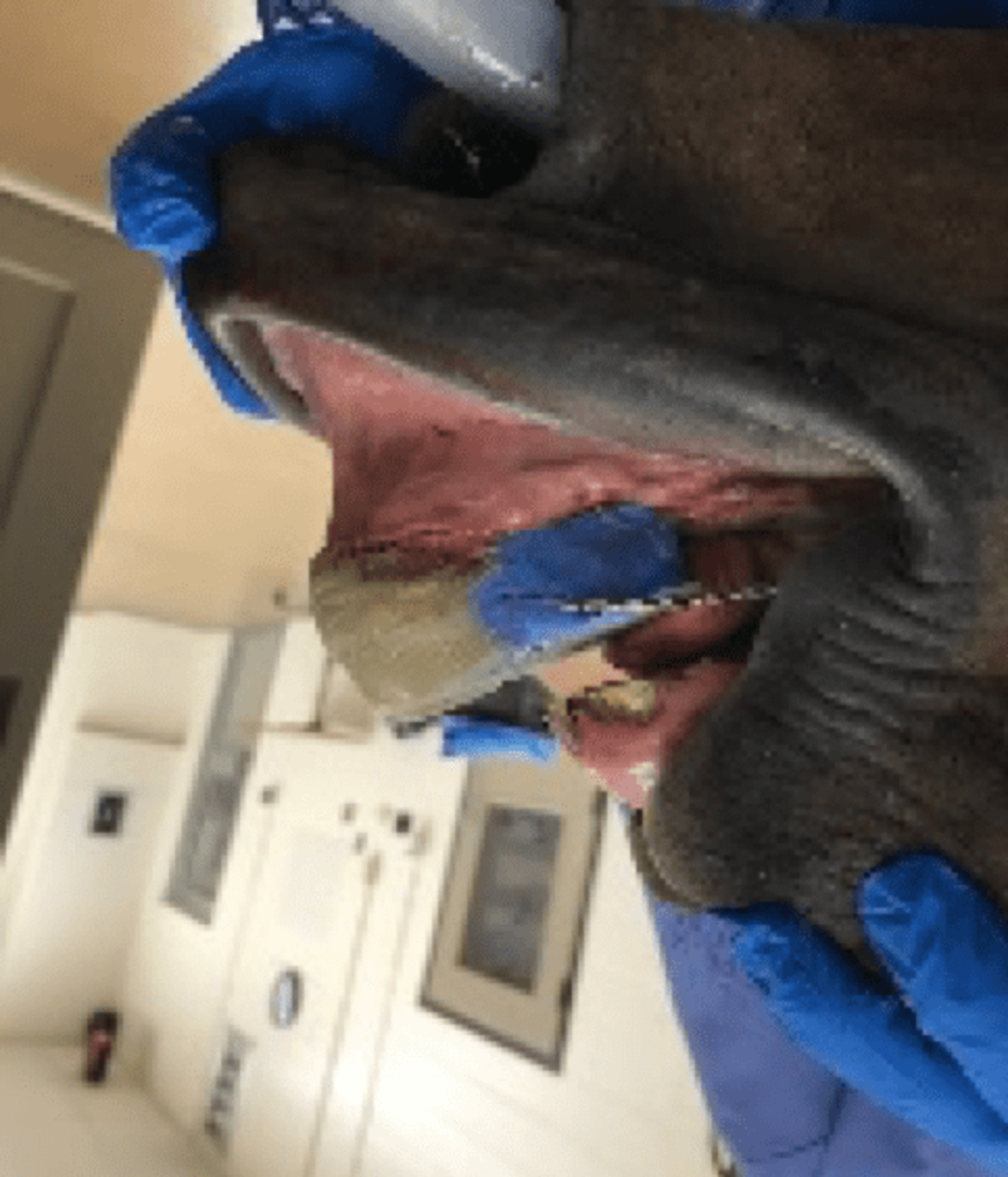
Corrective devices can fix parrot mouth if it is caught early in a horse's life, before skeletal development is complete. Photo courtesy Dr. Brad Tanner
Once the skeletal development of the horse is complete, there is no way to effectively correct the overbite/parrot mouth malocclusion.
How do you manage this problem long term?
Long term management of these malocclusions should be focused on effectively floating and reducing the large overgrowths. These are the overgrowths that form because some teeth are not in occlusion and chewing along one another. Normally, the teeth will grind and wear out at the same rate but when one tooth is not in contact it is allowed to continue to grow through the life of the horse at a rate of three to four millimeters per year. Left unchecked, this can wreak havoc on the horse's mouth and be a painful situation.
Long term management often will require routine floating examinations at six-month intervals on horses that have these types of malocclusions. So long as these are managed effectively the horse will be able to have normal dentition and perform at a normal level. Horses will not run faster or slower because of the parrot mouth. So long as they are managed effectively it should have no influence on performance.
The heritability of a parrot mouth has been called into question for some time. It's often viewed as a heritable trait that can be passed along from generation to generation and is therefore undesirable in breeding stock. Unfortunately, while much research has been done in this area, the heritability of overbites/parrot mouth is a very complex genetic trait. Recent studies have shown there are complex patterns of genetic alleles that are involved in the expression of the genes that lead to this defect. It is difficult to pinpoint exactly which foals could develop this trait and which sires are more or less prone to passing it along because of the complexity of alleles that are necessary to give this result and deformity.
In summary, parrot mouths are not really a big deal for a lot of horses. They have managed to survive for millennia this way and will continue to eat and graze. Proper management of a mature horse with parrot mouth will lead to decreased dental problems, decreased pain, and better performance in a show ring or racetrack. Recognition at an early age does allow for surgical correction and normal dentition for the rest of the horse's life.
Dr. Brad Tanner received his DVM from Auburn University in 2005 and completed an internship at Rood and Riddle thereafter. He is a shareholder in the clinic, where he focuses on advanced dentistry, primary care and reproduction. Tanner became board certified in equine dentistry in 2019.
The post Ask Your Veterinarian Presented By Kentucky Performance Products: What To Do About ‘Parrot Mouth’ appeared first on Horse Racing News | Paulick Report.
Source of original post
