This Side Up: Haskell Throwbacks to the Future

So the big question is whether the out-of-town jocks, in the heat of a $1-million battle for the GI TVG.com Haskell S., can master the instinct to reach for the whip?

If any lifelong flagellants are anxious of their self-discipline, then they need only play back the 1988 running and remind themselves how Laffit Pincay, Jr. coaxed Forty Niner home, in withering heat, by a nose from Seeking the Gold. The whip is unsheathed, for sure, but so seamlessly with the horse's own efforts that the overall effect is like watching St. Francis of Assisi helping a fledgling back into its nest.

If only wider standards of horsemanship had maintained similar levels of empathy, then our house might never have become so divided against itself. As it stands, any hope that people might someday look back at Saturday's race after an equivalent interval of years may depend on the outcome of the experiment being boldly embraced this year, in defiance of some aggressive lobbying, by the New Jersey Racing Commission.

Like it or not, a first Grade I race without recourse to the whip feels like a big moment in the story of the American Turf. Our community has to remember two things. One is that we tend to be inured to the shock experienced by the layman who comes fresh to the ugly coercions of cruder riders. And the other, closely related, is that public policy in these matters will always be driven by mass perception, rather than any informed mitigations grasped by those inside the business. As one leading driver has wisely acknowledged of harness racing: “It doesn't matter if it's real or perceived. In our game, once it's perceived, it becomes real.”
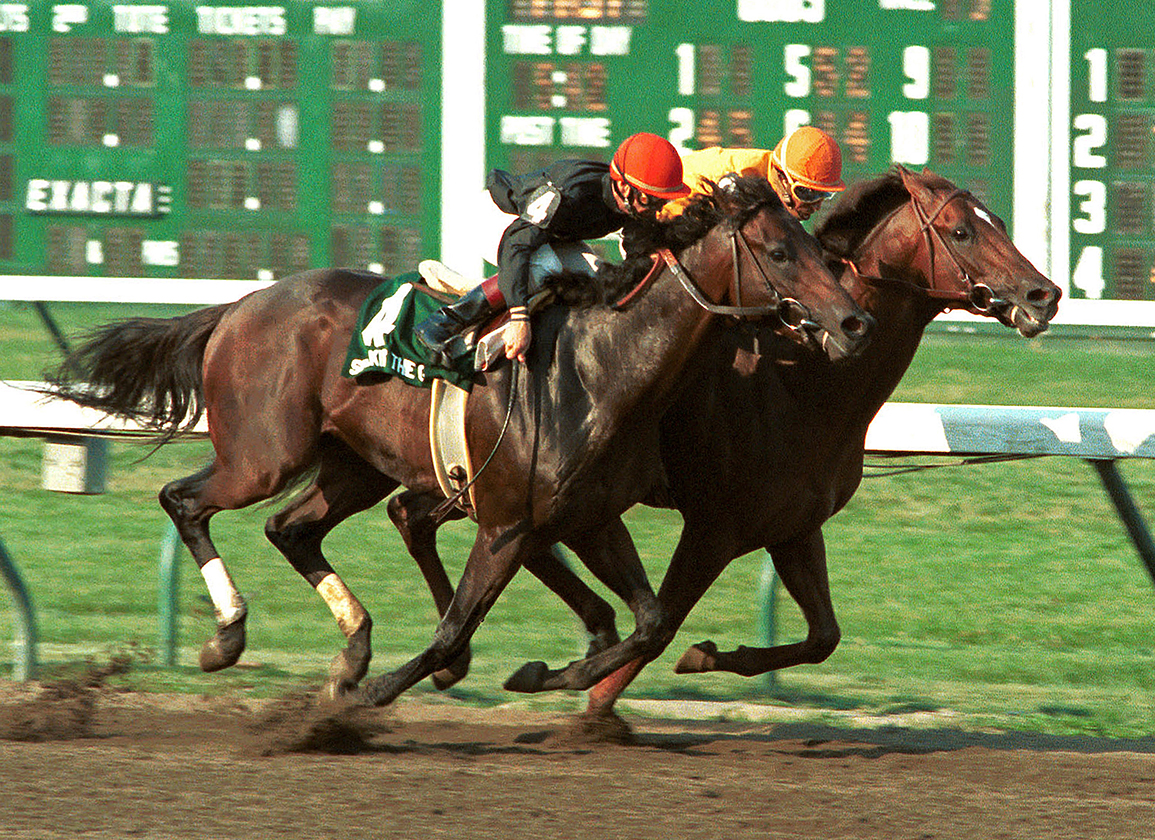
Forty Niner prevails in the 1988 Haskell | Equi-Photo

As it happens, pretty much the same might be said of the damage done to our sport by the charges against the Derby winner, which loom over the Haskell even in the absence of a trainer who last year won it for a record ninth time. For these leave the Derby runner-up Mandaloun (Into Mischief) striving awkwardly to live up to his potential promotion, and the burden of the accompanying asterisk; while Following Sea (Runhappy) has meanwhile defected from Bob Baffert's barn after Spendthrift “hit the pause button” on their association.

Whatever the ultimate determination of due process, in this particular instance, overall it seems fair to ask Baffert to understand that you can't push regulatory boundaries without doing the same to public confidence. He would not be the only trainer to view a veterinary toolbox rather as many jockeys do the whip, as somehow combining their own competitive interests with those of the horse. (Precepts of health and safety certainly seem usefully flexible.) But it is a wider failure to deal adequately with more flagrant offenders, whether with the crop or pharmaceuticals, that has only encouraged the wider world in judgements, however superficial, that authentically menace our sport's survival.

Races like this one, as cherished staging posts in our calendar, remind us that we are only ever passing a baton from one hand to the next. Pincay and Forty Niner are part of Monmouth Park heritage–and so, too, is the Virgil “Buddy” Raines Distinguished Achievement Award conferred on Baffert in 2015 for his commitment to the Haskell. Devised to salute integrity and professionalism in the service of New Jersey racing, this is exactly the kind of honor that should reinforce in its recipient an obligation to take no risks with the reputation of his community.

Buddy Raines, after all, was the incarnation of the fine character that can be drawn out of humankind by the Thoroughbred. His 80-year Turf career began when a trainer passing through rural Illinois was given hospitality by his parents. Gazing at so many hungry brothers seated round the table, the guest wistfully remarked that he could do with a strong young helper to help around the barn. “Well, hell, take that one,” said Mr. Raines, pointing at Virgil.

Buddy Raines came to mind this week on the passing of Hall of Fame jockey John L. Rotz, with whom he shared a career pinnacle in the 1962 GI Preakness S. won by Greek Money. Rotz had an exemplary career, working his way up from hotwalker to Midwest fairs to the George Woolf Memorial Award, and the manners that earned him the soubriquet “Gentleman John” also extended to his mounts, gaining him a particular reputation for the management of difficult temperaments.

Greek Money's Preakness is remembered best for Joseph di Paola's iconic photograph of Manny Ycaza on Ridan apparently trying to elbow Rotz as their tumultuous stretch duel neared the line. (Nor was Ycaza done, then having the temerity to lodge an objection for interference.) Rotz later absolved his rival of any contact, but also wondered whether Ycaza might have won had he confined himself to riding his own horse, rather than trying to control both.

Rotz rode enough good horses virtually to guarantee that you'll find his fingerprints somewhere behind the Haskell winner. In Mandaloun himself, for instance, the second dam of his sire is by Stop the Music, famously awarded the Champagne S. after Rotz took exception to a brief deviation in Secretariat's march to greatness; while Midnight Bourbon (Tiznow) is by a grandson of Relaunch, whose sire In Reality and damsire The Axe II were both partnered by Rotz.
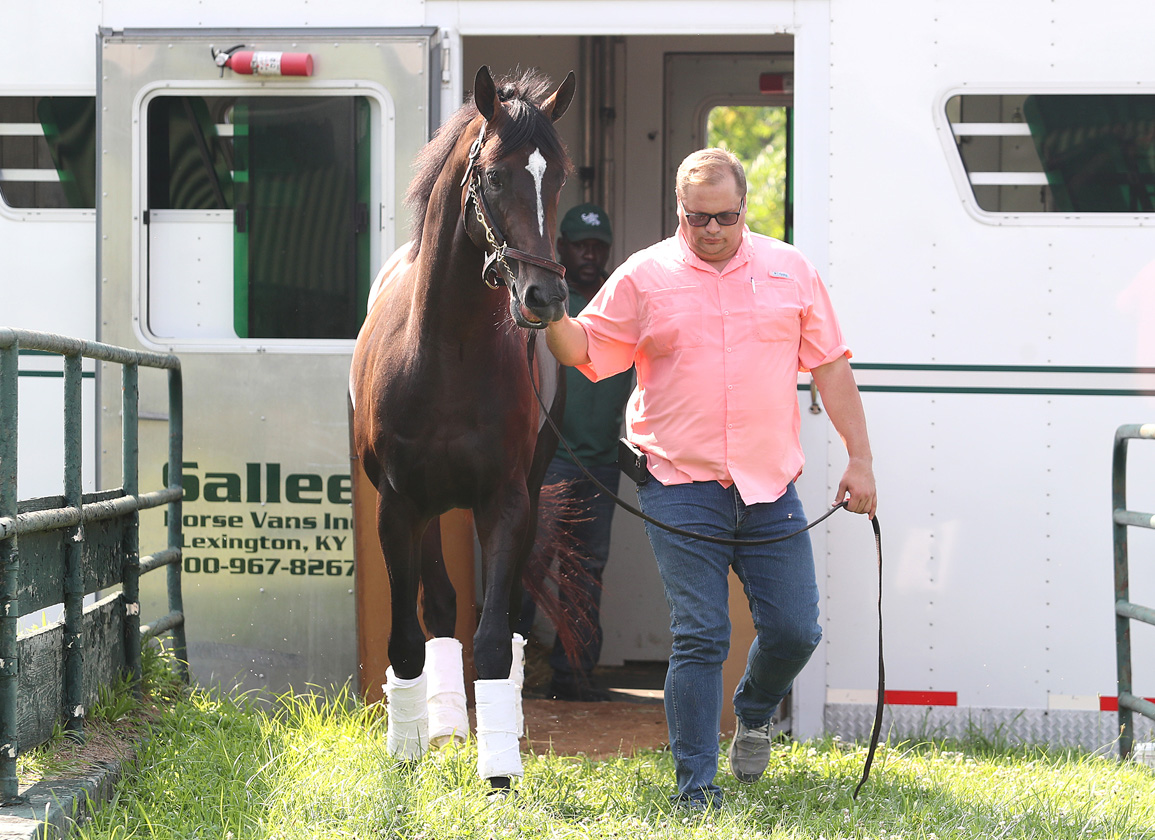
Midnight Bourbon arriving Thursday at Monmouth | Bill Denver/Equi-Photo

It's a fascinating race, pitching three Classic runners-up against the flagship of Runhappy's brilliant revival after a disappointing freshman campaign. Trying a second turn against elite opposition will certainly tell us what substance may underpin the dazzling style of Following Sea, but many neutrals will be hoping for a merited Grade I success for Hot Rod Charlie (Oxbow). As has been widely celebrated, “Chuck” set the fastest opening quarter in the long history of the GI Belmont S., and a :46.49 half bettered only by Secretariat, yet retained the reserves to pull 11 lengths clear of the rest in harrying crop leader Essential Quality (Tapit) all the way down the stretch. Perhaps the sport might have been spared much of its present embarrassment if he had been ridden with similar aggression in the Derby, instead of gifting control to Medina Spirit (Protonico), but the notion that he can eyeball a rival even better without blinkers (as well as without the whip) looks an intriguing gamble.

However things play out between them, the fact that all three of the Triple Crown protagonists converging here completed their springtime preparations in the GII Louisiana Derby means that there is already one guaranteed winner. And that's the Fair Grounds management, for having the enterprise to stretch out a race that has come to seem too close to the first Saturday in May–too close for the trainers of today, at any rate–to permit equivalent grounding with another rehearsal in between.

We credit much of “Chuck's pluck” to Oxbow, whose ardent Triple Crown campaign so shames the current crop–not one of whom contested all three legs this time round. True, the Mid-Atlantic stalwart Raines chose to sit out the Derby to bring Greek Money relatively fresh to the Preakness, but that didn't stop him running in the local prep race the previous Saturday. Who knows? Even as a son of Oxbow, Chuck might not have been able to dig so deep in the Belmont had he also contested the Preakness. But he's certainly made of the right stuff.

That, and an ownership team that transcends generations, gives us plenty of optimism for the future of the game. A precious commodity, right now, but this is a race (and racetrack) that has always engaged dynamically with challenges. That's how we can try a Haskell without whips; a Haskell with a $1-million bonus backed by the operators of a pioneering venture in fixed-odds wagering; a Haskell headlining a meet of boosted purses and turnstiles clicking cheerfully once again.

So, if it can also be a Haskell that honors the memory of “Gentleman” John Rotz, and indeed that of Buddy Raines, then people out there might once again start to accept our claims that we treat every horse right–not because of rules and regulations, nor because of cosmetics, but because it wouldn't even occur to us to do anything else.

The post This Side Up: Haskell Throwbacks to the Future appeared first on TDN | Thoroughbred Daily News | Horse Racing News, Results and Video | Thoroughbred Breeding and Auctions.

Source of original post

Baffert Prevails In Suit Over NYRA Suspension

After hearing attorney arguments on July 12, a U.S. District judge has ruled in favor of trainer Bob Baffert's motion for a preliminary injunction against the New York Racing Association. Judge Carol Bagley Amon of the Eastern District of New York determined on July 14 that NYRA's suspension of Baffert should not have taken place without some sort of hearing allowing him to address the organization's accusations against him.

NYRA notified Baffert ahead of the Belmont Stakes that it was suspending his ability to enter horses in races or have stall space at its racetracks due to his recent history of medication violations, the conflicting statements he provided to media around the Media Spirit scandal, and Churchill Downs' suspension of the trainer.

Amon determined that the exclusion of Baffert from the Saratoga meet caused him significant harm, particularly as he was able to demonstrate several owners had withdrawn horses from his stable or planned to, based on the inability to start them in races there. She pointed out that the organization's suspension of Baffert had no time limit on it and was left open-ended with a final suspension length potentially coming some time after Aug. 11.

Although NYRA was asserting its private property rights in the case, Amon said the organization is closely entwined enough with the state that its suspension of Baffert constituted a state action, thereby requiring due process.

As to Baffert's history of recent drug violations in other states, Amon pointed out that NYRA has not taken similar actions against other trainers with similar records.

“…As uncontested data show, NYRA has permitted numerous trainers to race at NYRA this season who have medication violation histories comparable or more serious than Baffert's,” the ruling read. “These data belie NYRA's claim that integrity or safety demand the exclusion of someone with a violation record like Baffert's.”

Amon concluded that Baffert was entitled to notice and a pre-suspension hearing from NYRA or, in lieu of that, a prompt post-suspension hearing, although the organization did suggest it would allow the trainer to submit written arguments after informing him of the suspension.

“Numerous rules and regulations already safeguard the interests NYRA argues for here, and enjoining this suspension of Baffert will not prevent the continued enforcement of those rules,” Amon wrote. “The hardships that Baffert would suffer absent an injunction weigh heavily on the other side of the scale. The suspension is indefinite, and NYRA concedes at most that Baffert's claims might 'be decided within the year.' But the 2021 Saratoga meet is a one-time opportunity.

“…I am sensitive to NYRA's concerns about Baffert's involvement in the events surrounding Medina Spirit's Kentucky Derby performance, and the fear that history might repeat itself in New York. But for the reasons stated, the actual and substantial harm that Baffert will suffer absent an injunction outweighs the speculative harms that NYRA raises.”

Read the ruling here.

The post Baffert Prevails In Suit Over NYRA Suspension appeared first on Horse Racing News | Paulick Report.

Source of original post

Baffert Gets Injunction to Race in New York

A federal judge at 5 p.m. Wednesday granted trainer Bob Baffert a preliminary injunction in his lawsuit against the New York Racing Association (NYRA) that will allow him to race at New York's three major tracks pending the resolution of the case.

In a civil complaint filed by Baffert June 14, the seven-time GI Kentucky Derby-winning trainer had alleged that NYRA's banishment of him since May 17 over the issue of his repeated equine drug violations violates his constitutional right to due process. That same day he moved for an order to keep NYRA from enforcing its suspension while the lawsuit played out.

“This suspension is likely to cause multiple irreparable harms,” Judge Carol Bagley Amon of United States District Court (Eastern District of New York) wrote in her 28-page order, which was handed down on the eve of the lucrative Saratoga Race Course season.

The order later continued: “In sum, I find that Baffert has established a likelihood of proving that NYRA's suspension constituted state action, and that the process by which it suspended him violated the Due Process Clause of the Fourteenth Amendment of the United States Constitution.”

Yet Amon also wrote that “although NYRA's actions have functionally deprived Baffert of his trainer's license, NYRA has not formally suspended that license. In sum, it is not likely that Baffert will be able to prevail on his claim that NYRA had no legal authority to take the action that it did.”

Amon addressed Baffert's claims of harm first:

“First is the irreparable harm from the loss of unique competitive opportunities. Part of that harm is monetary….

“Second, Baffert has persuasively argued that NYRA's action will damage his 'reputation and goodwill' in a way that could not readily be remedied should he prevail at trial….

“Finally, to the extent that NYRA contends that Baffert's one-month delay in seeking a preliminary injunction precludes his claim, this argument is unpersuasive,” Amon wrote.

NYRA had excluded the Hall-of-Fame conditioner in the wake of five positive drug tests in horses Baffert has trained over the last 12 months. It has repeatedly termed the suspension “temporary,” but Amon noted the banishment is now nearly two months old, and that “indefinite” would be the more accurate descriptor.

As a threshold matter, Baffert had argued that NYRA lacks the power or authority to suspend him indefinitely from all New York race tracks because the New York State Gaming Commission is the sole entity with general jurisdiction over all gaming activities within the state.

Amon wrote that “In a similar vein, he argues that NYRA failed to follow the procedures set forth in regulations that govern the suspension of trainers' licenses. One such regulation requires an 'adjudicatory proceeding' prior to any action being taken related to the suspension of a licensee. Another requires the provision of formal notice to the licensee. As to this argument, Baffert has not shown a likelihood of success on the merits or serious questions going to the merits.

“The claim that NYRA had no right to take the action it did would appear to be foreclosed by the New York Court of Appeals decision in Saumell v. New York Racing Association,” Amon wrote (see TDN's story from earlier this week on how that legal precedent might affect this case).

“In that case, NYRA summarily excluded a licensed jockey, based on an assertion that he had violated a racing regulation. The jockey contended that NYRA 'was without authority to do so,' because in suspending him NYRA had 'usurped the power of the Board.' The Court of Appeals rejected the jockey's argument. It held that '[t]he common-law right of [NYRA] to exclude persons from its premises includes the right when there is reasonable cause to believe a jockey licensed by the [state] guilty of misconduct to deny him access,'” Amon wrote.

“The fact that NYRA leases rather than owns the tracks does not alter its right of exclusion,” Amon wrote, referring to another issue Baffert's legal team had raised. “The lease agreement for the Saratoga Race Course expressly states that NYRA receives 'all rights, privileges, easements and appurtenances belonging to or in any way pertaining to the Leased Premises…' And a lessee maintains the right to lawfully exclude, even where its lessor is the state.

“Nor does it help Baffert that NYRA's exclusive franchise right is 'subject to appropriate racing laws and regulations.' He contends that the regulations provide that only a state official may suspend a license. The regulation he cites, however, 9 NYCRR § 4022.12, expressly states that “[n]othing in this section shall be construed to limit any racing association or track licensee's power to exclude or deny any individual from its grounds or privileges thereon.'”

Three of Baffert's recent equine drug violations occurred in Grade I stakes. The most recent drug positive, for betamethasone in Medina Spirit (Protonico) after the colt won the GI Kentucky Derby on May 1, has yet to be adjudicated by the Kentucky Horse Racing Commission. Churchill Downs Inc., however, has already barred Baffert from participating at any of the gaming corporation's five Thoroughbred tracks for a period of two years.

“The most significant circumstance–and the one which primarily motivated NYRA here–was the 2021 Kentucky Derby, including Medina Spirit's alleged betamethasone test, Churchill Downs' suspension of Baffert, and Baffert's post-Derby statements,” Amon wrote. “But these events were not so straightforward as to deny Baffert an opportunity to address them before being summarily suspended.

“The allegation that Medina Spirit had tested positive for betamethasone was only an allegation, and one that Baffert contested. He had admitted at most that a 'possible explanation' was that the horse had been given a topical ointment containing the substance. But whether the test result was accurate, what the results would be of the split sample testing, and whether Kentucky would take any action against Baffert were uncertain matters of ongoing investigations. Both Baffert himself and the Kentucky authorities are still investigating the matter. Baffert was entitled to a pre-deprivation hearing to address these claims.”

Amon continued: “Reliance on Baffert's statements to the press following the Kentucky Derby without giving him an opportunity to address them was similarly problematic. The suspension letter stated that Baffert 'provided the media with different accounts and theories as to why Medina Spirit tested positive for betamethasone….' NYRA continues to suggest that Baffert spoke in a duplicitous or at least inconsistent manner in his public statements regarding Medina Spirit….

“NYRA's belief that Baffert's public statements were unreliable put his credibility in issue. When the credibility of a property-holder is in issue, that is exactly the situation when a hearing is necessary so that the individual may be heard directly. At a hearing, Baffert would have the opportunity to present his version of the events, and to address any perceived inconsistencies in the statements he had given to the press. But NYRA's failure to provide a hearing deprived him of a meaningful opportunity to provide his side of the story,” Amon wrote.

“Baffert was likewise denied an opportunity to be heard regarding the four fines from the prior year upon which NYRA partially rested its suspension decision…. NYRA considered only the fact of the violations, rather than the circumstances surrounding them. A hearing would have allowed Baffert to submit evidence and make argument regarding these events.”

Amon continued: “NYRA's reliance on 'other related information' obviously raises a notice problem. Needless to say, the risk that Baffert was suspended for improper reasons–or reasons for which mitigating information existed that he was unable to provide NYRA–increases dramatically when the decision to suspend him was based upon unspecified reasons.

“Baffert should have been given notice of all of the reasons that NYRA intended to suspend him.

I find that in light of the foregoing facts, there was a risk of erroneous deprivation, and the benefits of providing notice and a pre-suspension hearing would likely have been substantial.”

Amon also wrote about the state's interest in the matter.

“NYRA surely has an 'important interest in assuring the integrity of the racing carried on under its auspices.' Also important is the safety of jockeys and horses, which can be put at risk through the use of injury-masking substances such as betamethasone. Although I recognize these weighty concerns, they are somewhat ameliorated here by the existence of numerous New York racing laws (including drug-testing), all of which Baffert would be required to follow in any NYRA races.

“NYRA's assertion of these interests is also to some extent undermined by the fact that apparently it has permitted other trainers with similar or more serious histories of medication violations to continue racing at NYRA racetracks. Likewise undercutting the invocation of integrity and safety here is the fact that Baffert has raced for many years at NYRA racetracks in over one-hundred races, and has never been found to have violated any of the state's regulations.

“Although I recognize the special concern given Baffert's and Medina Spirit's high profile, it is at least of note that when NYRA issued its decision, the horse had run the [GI] Preakness S. two days earlier without any incident,” Amon wrote.

“I accordingly conclude that, although NYRA invokes important interests here, those interests do not outweigh Baffert's weightier interest in being able to practice his chosen profession, especially given the risk of erroneous deprivation and the likelihood that additional procedures would have been valuable,” Amon wrote.

“Even if NYRA had probable cause to suspend Baffert without a pre-deprivation hearing, a 'prompt' post-suspension hearing would have been required. NYRA argues that Baffert cannot bring a due process claim because he was 'provide[d] apparently adequate procedural remedies' but 'has not availed himself of those remedies.' But NYRA has held no hearing–let alone a prompt one. Its after-the-fact offer to Baffert of an opportunity to submit written evidence or arguments within a seven-day window was plainly not a hearing….

“At oral argument, counsel for NYRA indicated that a 'final determination' as to the length and terms of Baffert's suspension would be made by Aug. 11, and that NYRA would provide him with the opportunity for a hearing after that time. Such a timeline cannot reasonably be deemed 'prompt,' especially in light of the upcoming Saratoga meet.

“NYRA has provided no explanation for why it could not have offered Baffert a hearing in the two months since he was suspended, nor any explanation for why it must wait another month to make a 'final determination.'

“With so much on the line, Baffert was entitled to (at least) a 'prompt' post-deprivation hearing which should have already occurred,” Amon concluded.

TDN left several messages with Baffert seeking comment on the decision. Neither yielded a reply prior to deadline for this story.

NYRA issued a press release quoting its president and chief executive, Dave O'Rourke, which read, in part:

“NYRA is reviewing the court's decision today to determine our legal options and next steps. What is clear, however, is that Mr. Baffert's actions and behavior can either elevate or damage the sport. We expect Mr. Baffert to exert appropriate controls over his operation.

“Importantly, the court upheld NYRA's authority to exclude individuals from its racetracks whose conduct is contrary to the best interests of Thoroughbred racing. The court also rejected Baffert's argument that NYRA had no legal authority to take the action that it did,” O'Rourke said.

The post Baffert Gets Injunction to Race in New York appeared first on TDN | Thoroughbred Daily News | Horse Racing News, Results and Video | Thoroughbred Breeding and Auctions.

Source of original post

Crawford: Racing Needs ‘Fair, Transparent, And Timely Resolution’ To Medina Spirit Case

Sports journalist Eric Crawford of WDRB urged the Kentucky Horse Racing Commission to issue a decision on whether or not Bob Baffert trainee Medina Spirit will be disqualified from his victory in this year's Kentucky Derby.

He points out that in the only other similar case, when 1968 Derby first-place finisher Dancer's Image was disqualified over a post-race drug test, that decision was handed down three days after the race. Crawford acknowledged that the lawsuits dragged on for another four years, but adds that the lawsuits are “inevitable.”

“The state racing commission should do all it can to make sure Baffert and Medina Spirit's owner, Amr Zedan, get due process,” Crawford wrote. “But in the end, that body must also realize that racing as a sport needs a fair, transparent and timely resolution of this high-profile situation.

“For the sport of horse racing, which long has been (rightly) accused of capitulating to big-name trainers, dragging its feet on potentially controversial drug rulings or washing its hands of them altogether, the public nature of this particular allegation adds an urgency to getting it right – and doing it in the right way.”

Read more at WDRB.

Additional stories about Baffert's Kentucky Derby positive and ensuing legal battles can be found here.

The post Crawford: Racing Needs ‘Fair, Transparent, And Timely Resolution’ To Medina Spirit Case appeared first on Horse Racing News | Paulick Report.

Source of original post

Verified by MonsterInsights