The New York State Gaming Commission (NYSGC) on Tuesday fined trainer Linda Rice $100,000 in a re-adjudication of her “improper practices” case that has persisted at the commission level and in the New York courts for more than two years.
In 2021, the NYSGC fined Rice $50,000 and revoked her license for three years after investigating claims that Rice received favorable treatment from the New York Racing Association (NYRA) and that the racing office was releasing to her the names and past performances of horses that had already been entered in races, giving her an unfair advantage.
The NYSGC initially had alleged that Rice had paid racing officials in exchange for the information, but that bribery charge–which Rice had denied–was later dismissed by the commission.
On June 8, 2023, the New York Supreme Court Appellate Division ruled that the three-year banishment imposed by the NYSGC was “entirely unwarranted.”
But that same court also upheld the commission's determination that the “improper practices” rule had been violated, and ordered the matter back to the NYSGC to reassess the penalty “with the constraint that any reassessed penalty cannot contain a license revocation.”
At the Oct. 3 monthly meeting, NYSGC chair Brian O'Dwyer read into the record a brief explanation of Rice's revamped penalty.
As per the NYSGC's custom, the commissioners did not discuss or debate the matter in an open-public session prior to voting upon it. Their voting happened prior to the start of the meeting and O'Dwyer only reported a summary of the decision.
“The appellate division agreed with the Commission's findings that trainer Rice had blatantly broke the rules of racing by conspiring with others to choose the optimal races for her horses. The appellate division determined, however, that any revocation was unwarranted,” O'Dwyer said.
“We respectfully disagree with that decision, but are constrained by law to follow it. The original fine of $50,000 was predicated on a three-year revocation. Since that is now not extant, we have decided, on the basis of the record, [to] increase the fine to $100,000. And we therefore impose a penalty on trainer Rice of $100,000. The vote was unanimous in that regard,” O'Dwyer said.
Rice did not respond to messages requesting comment prior to deadline for this story, but her attorney, Andrew Turro, indicated to TDN in an email that Rice is ready to move on.
“I'm very, very happy that this is over for Linda and that she can now focus on what she loves and does best,” Turro wrote.
As uncertainty over the potential end (or not) to racing at Golden Gate Fields and Turf Paradise continues to bubble, people have wondered what will happen not just to the trainers based at those racetracks, but to their horses if and when the tracks call it quits.
For those who envisioned a mass exodus of racehorses suddenly swarming overtaxed rescue organizations in Arizona and California after these closure announcements, rest easy – for now. Those on the ground in those places say that, so far, there hasn't been a significant change in the number of horses seeking placement as a result of the uncertainty at either track.
Track owner The Stronach Group announced Golden Gate Fields in Albany, Calif., would stage its last race in December, but then agreed to run for the first half of 2024. Turf Paradise owner Jerry Simms said last month the Phoenix, Ariz., track would not reopen after a deal to sell fell through, but then said a new buyer stepped forward to run an abbreviated live race meet beginning in January.
We spoke to longtime Arizona trainer Cynthia George before last week's news about the potential new buyer of Turf Paradise. George said she's been working with the Arizona Horsemen's Benevolent and Protective Association to secure funding and placement for former Arizona runners in need of second careers and soft landings, but she's not hearing from people who need her help because they're liquidating their entire barn.
George is working with Teri Ferguson (her partner on the Turf Paradise Race Horse Feed Angels program that provided feed and hay to horsemen in need at the start of COVID-19) to put together a non-profit called A Love 4 Horseracing Aftercare. The group is awaiting IRS approval of its 501(c)3 status and its purpose will be to serve the typical aftercare needs of the circuit.
“We place horses and we also watch for retired horses that end up in bad situations,” said George. “We did buy one off the Stroud kill pen and rehabbed him and he's currently looking for a new home. That's more what our efforts are towards, the aftercare, second careers, keeping the integrity of the sport by helping people that get in hard times.
“If people do need help they can reach out. we'll either take on the horse — we have several people who have offered to be foster homes until we can get horses placed.”
[Story Continues Below]
George said she heard from an older gentleman who asked for her help to sell his two pony horses after the original Turf closure announcement, but otherwise she's not aware of the potential closure pushing anyone else to retire horses.
Rumors about the future of Turf Paradise have circulated for years, and rose to a fervor earlier this year. George said that meant horsemen were ready for the possibility they may need to go somewhere else to race.
“From what I've seen, other people picked other racetracks,” she said. “Some of the people that would return from Emerald Downs in Washington are going to Golden Gate Fields because it's open an additional six months. We have some people going to Louisiana. A lot of people are filtering into New Mexico. People are going to Kentucky, Iowa; Indiana has year-round training, Florida has year-round training. People have been researching all summer, and they were prepared.
“We've been ready. It's been ongoing since the beginning of summer. It's nowhere near a dire situation. Horses are all still in good hands with owners and trainers, and they're trying to just support the industry as best they can.”
In Northern California, CARMA executive director Lucinda Lovitt agreed that if and when racing does end at Golden Gate Fields, there will still be a market for runners based there in other places.
Support our journalism
If you appreciate our work, you can support us by subscribing to our Patreon stream. Learn more.
CARMA (California Retirement Management Account) provides funding for retirement of California-raced Thoroughbreds and serves as an education resource for the public and racing community.
“I recognize there is an overall concern by horsemen, track management, etc., that there will be a significant influx of horses into the aftercare system with the closure of any racetrack and that makes sense,” she said. “However, I know from all my years working at TOC (Thoroughbred Owners of California) that most owners are in this as a business or at least to attempt to break even and if they have stock that is viable in other places, my thinking is many of them will try to sell their horses to other jurisdictions where they will be frankly more competitive and run for twice as much money.”
Lovitt said she could see NorCal runners who don't ship to Southern California ending up in New Mexico, Texas, Indiana, or maybe Louisiana. She has fielded a couple of calls from people who are opting to do an off-track placement for their horses rather than selling them on, but is not seeing an enormous change in demand for placement services as of now.
Any time a track closes, however, it impacts not just horses stabled there, but the supply of horses who would have been headed there at some point in the future – and that's where Lovitt is a little more concerned about ripple effects.
“I think the challenge is going to be what the challenge always is, which is those individuals that are not 100% racing at the moment,” she said. “If they're laid up, if they have a recent injury, breeding stock, 2-year-olds that are at a farm and haven't started yet, yearlings — to me that's what I'm more worried about, the hard horses to place.”
Despite the announcement that Golden Gate will run at least six more months, Lovitt said now is the time for owners and trainers to be preparing for their horses' futures. Most of the charities within CARMA's network have a minimum wait time of three to four weeks before they can accept a horse into their program, because the majority of facilities are at or near capacity the majority of the time.
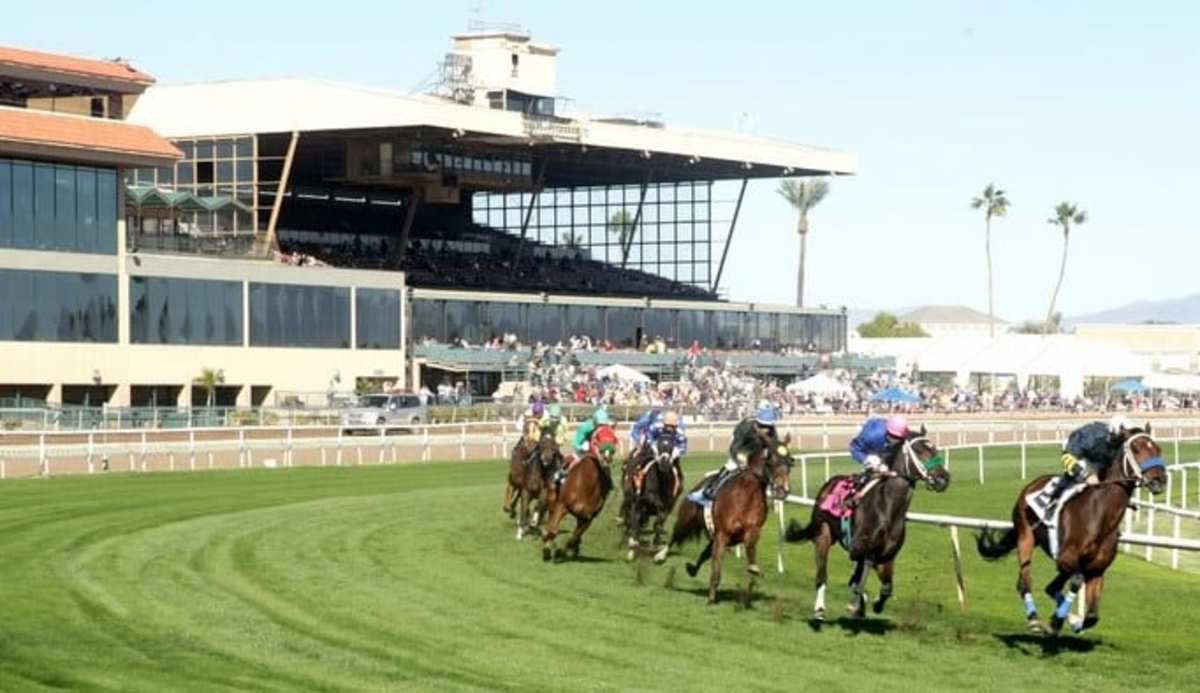
Turf Paradise in Phoenix, Ariz.
Many of the aftercare organizations Lovitt works with are boarding horses that are in the process of retraining, and horsekeeping costs in California remain extremely high. The low end of board is $600 to $750 per month per horse, and many horses who are eligible for retraining and adoption end up requiring six to nine months for training, marketing, and adoption at a pricetag to the non-profit of $5,000 to $7,000. For that reason, owners are expected to help foot the bill for a horse they want to donate into an aftercare program – either by paying to board the horse someplace until a space can open up, or by sending the horse for placement with a check.
Not everyone is thrilled to hear this, but Lovitt said it's the reality for accredited organizations. Those that are accredited by the Thoroughbred Aftercare Alliance are held accountable to the organization, which scrutinizes their finances and stocking rates. Becoming overcrowded or financially strapped could risk the grant money they rely on from TAA.
“From the aftercare community's perspective, we are getting much better at saying 'Sorry, we can't help you,'” she said. “It used to be everybody was scared to say no. These charities would take horses all the time. They felt so bad, everybody was so worried about the welfare of the horse that they would just take it. That's how organizations go broke. I don't think they do that as much anymore.”
The best thing she can advise for horse owners? Use this grace period to plan – for your horses' sake.
“For CARMA the important message to owners, trainers, horsemen, breeders — you need a plan,” she said. “You need to plan for retiring your horse. That may mean setting some money aside, that may mean reaching out to organizations before the horse needs to retire so you have information on what the expectations will be. That means making retiring your horse a part of your business plan.”
Multiple group winner Pretty Tiger (Ire) (Sea The Moon {Ger}–Fast And Pretty {Ire}, by Zamindar) will stand as part of a partnership between Haras d'Etreham and Haras de Cercy next year at the former's NH branch, Haras de la Tuilerie, the studs announced on Tuesday.
A fee for the G1 Prix Ganay second and G1 Prix d'Ispahan third will be announced later. There are also breeding rights available in the G2 Prix Eugene Adam hero, who was bred by Haras de Chevotel. Also a winner of the G3 Prix Exbury and a pair of listed races, the €105,000 Arqana August yearling won six times from 17 starts and has $479,162 in earnings for racing owner Bernard Giraudon and trainer Fabrice Vermeulen.
The partners already jointly manage the stallion career of fellow Sea The Moon stallion Wonderful Moon (Ger) who is based at Haras de Cercy, and will do the same with Pretty Tiger, while supporting both stallions with mares. After 2024, the pair will be rotated between the two studs annually.
Etreham's Nicolas de Chambure said, “We are delighted to have purchased Pretty Tiger to join our stallion roster. He has an exceptional physique, size, speed, and a colossal acceleration; all of which will make him a great match for French National Hunt broodmares. It is fantastic to have Haras de Cercy as our partner for these two sires, Wonderful Moon and Pretty Tiger.”
Jacques Cypres, president of Haras de Cercy, said, “Pretty Tiger and Wonderful Moon ran over the Classic distance and performed at a high level early in their respective racing careers, making them valuable assets to French National Hunt breeding.”
RP Racing's Big Evs (Ire) (Blue Point {Ire}) will make his next start in the Nov. 3 GI Breeders' Cup Juvenile Turf Sprint at Santa Anita, trainer Mick Appleby confirmed on Tuesday. The colt has won three of five career starts, including the G2 Flying Childers S., G3 Molecomb S. and Listed Windsor Castle S. at Royal Ascot, and has banked £180,665.
“He's in good form, we've just freshened him up a bit and he seems in good order,” said Appleby. “Hopefully he stays that way until he goes, he flies out on Oct. 26. He's got to have 48 hours in quarantine then he'll be able to go out on track two or three times before the race.”
“We're going to take him for a racecourse gallop so we can run him around a bend, obviously he's never raced around a bend before but I don't think it'll be an issue,” Appleby said. “He's got to do a bit of stalls work with a bell but I think we're going to do that when he's out there so he can get used to the stalls there.
“He's doing very well and hopefully it's all systems go.”