Ask Your Insurer Presented By Muirfield Insurance: Covering Your Home With An Equine Farm And Ranch Policy

Equine insurance experts answer your questions about insuring Thoroughbreds for the breeding and auction realms.

Email us at info@paulickreport. com if you have a question for an insurer.

QUESTION: How does insuring your home on a farm through the usual homeowner channels compare with lumping it in with a Farm and Ranch Policy?

BRYCE BURTON: Equine Farm and Ranch Package policies are designed for people who own or lease farms where horses, or other livestock, are boarded and pastured. If you own or lease a farm, the chances are that both your Farm Property and Liability coverage needs would be best met under an Equine Farm and Ranch Package Policy. If there are owned dwellings on the farm, from a cost perspective, it makes the most sense to include these dwelling property coverages within the Farm Package policy, in order to have all coverages bundled together.

The main difference between your run-of-the-mill homeowner's policy and a Farm and Ranch Policy is the liability coverage. As a horse owner, or farm operator, you face unique risks that are not covered under a homeowner's policy. If you own horses that are boarded on the property, the package policy includes liability for your owned horses while on and off premises, including but not limited to the racetrack, show ring, breeding shed, etc. Farm owners that board non-owned horses also have the option to place care, custody, or control insurance, which covers the insured in the event that something were to happen to a non-owned horse while in their care.

The liability portion of the package covers the owner or lessee's business pursuits, such as boarding, training, riding instructions, etc., which would otherwise be excluded under a homeowner's policy. Any litigation that may arise as a result of the farm and equine operation, including pending litigation costs, would be covered under the Farm and Ranch Policy, but may be excluded under a homeowner's policy.

Regarding coverage for property, most homeowner's policies exclude farm outbuildings, so appurtenant structures used for business purposes such as barns, offices, and arenas are often excluded from homeowner's policies. Additionally, coverage for business personal property is also typically inadequate or excluded on a homeowner's policy, which results in inadequate or no coverage for farm equipment such as machinery, tack, tools, feed, and hay. On a Farm and Ranch Policy, farm personal property can be scheduled to provide replacement cost and there is no limitation for the business use of the property.

Bryce Burton is a property and liability specialist for Muirfield Insurance. He is from Frankfort, Ky., where he grew up an avid race fan. His Thoroughbred racing fandom combined with a collegiate internship in the insurance industry, culminated in a start in the equine insurance field. Bryce has been with Muirfield Insurance since 2014, following his graduation from Transylvania University in Lexington.

The post Ask Your Insurer Presented By Muirfield Insurance: Covering Your Home With An Equine Farm And Ranch Policy appeared first on Horse Racing News | Paulick Report.

Source of original post

How Tasso’s Turned-Away Sale Made Breeders’ Cup History

One of the early mileposts for just about any racehorse purchased at a 2-year-olds in training auction is to finish that season with a win in a Breeders' Cup race.

By that standard, Tasso's road from the sale ring to the Breeders' Cup Juvenile winner's circle was an unmitigated success, making him the first 2-year-old sale graduate to win the race in the same year. By the standards of a commercialmarket racing prospect, Tasso was an economic dud whose true value would only be appreciated after his time in the ring.

From the first crop of Grade 1 winner Fappiano, Tasso was bred in Florida by Timothy Sams of Waldemar Farm and his business partner Gerald Robins. The same operation had produced Hall of Famer Foolosh Pleasure a decade earlier. Both men owned five shares in Fappiano, purchased during his racing career, meaning their incentive to get the stallion off to a fast start was high.

The Waldemar Farm consignment had a pair of Fappiano colts on offer for the 1984 Fasig-Tipton Saratoga Yearling Sale, with the first selling to $250,000 – the most anyone paid for a foal by the stallion at the marquee auction. Tasso, on the other hand, was brought home after hammering at $50,000, under his reserve.

In the months that followed, Tasso was trained toward the 1985 Fasig-Tipton Florida Selected 2-Year-Olds In Training Sale at Calder Race Course. After being the less-impressive half of the Fappiano tag team among Waldemar's Saratoga consignment a year earlier, the bad luck continued for the colt who was cataloged as Hip 1; a notoriously hard spot for a horse to maximize its value, while buyers are still straggling onto the sales grounds, finding their seats, or saving their bullets for later offerings or sessions.

Sams knew he was going to be up against it in that spot, so called in a favor from prominent owner Bertram Firestone, a Virginia-based horseman who earned the 1980 Eclipse Award for outstanding owner with his wife Diana. That early in the sale's proceedings, Sams knew he'd need someone to prime the pump for him.

“Bert is a good friend of ours, and I saw him in the walking ring before the sale and asked him if he would bid this horse up to $100,000 for us,” Sams said in a 1985 interview with BloodHorse. “He said 'Sure.' Then he came up to me later and asked me if I liked the colt, and I told him that I did. He suggested that we send the horse to Aiken to Marvin Greene and see what Marvin thought about him, and said 'If Marvin likes him maybe we can make a deal.'”

The colt went to South Carolina to begin his formal racetrack training, but an injury kept him on the shelf for much of his time there, Greene decided there wasn't room for him in his barn, and Firestone walked away from the arrangement.

Newspapers reported that Tasso's beleaguered owners spent more time trying to shop the horse out for private sale, but at some point, a juvenile has to prove himself on the racetrack to be worth selling. Tasso was placed in the California barn of Neil Drysdale, and he made his debut in May of his 2-year-old season, three months after his trip through the sale ring at Calder.

Tasso quickly cast aside whatever the buying public failed to see in him, winning five of seven starts during his juvenile year. Showing the ability to win from a deep close or a stalking trip in the preceding starts, Tasso earned his first major win in the G1 Del Mar Futurity. The going was much smoother two starts later when he dusted the G2 Breeders' Futurity at Keeneland by six lengths.

The colt was not nominated to the second-ever Breeders' Cup in 1985, but his purse earnings from his Breeders' Futurity rout were just enough to cover the $120,000 late entry fee, ensuring him a spot in the gate at Aqueduct.

Despite coming into the race off an impressive victory, Tasso left the gate in the Breeders' Cup Juvenile as the field's third choice. Everyone looked up to even-money favorite Mogambo, a homebred for Peter Brant who obliterated the G1 Champagne Stakes by 9 3/4 lengths, and beat several of the field's hopefuls in the process.

The betting public's second choice was Storm Cat, a Grade 1 winner who appeared to have the race in hand after a well-placed stalking trip until the very last jump, when Tasso and jockey Laffit Pincay Jr. completed a wide-running closing move to outkick the future superstar sire by a nose. Mogambo never threatened, and ran sixth.

The Breeders' Cup win later clinched Tasso's case for the Eclipse Award as champion 2-year-old male of 1985.

Tasso wasn't the first graduate of a 2-year-old sale to win a Breeders' Cup race. That honor went to Wild Again, the winner of the inaugural Breeders' Cup Classic, who was an RNA during the 1982 Fasig-Tipton juvenile sale at Calder. However, Tasso's victory was proof of concept that a young horse could go through the ring at a 2-year-olds in training sale and win at the fledgling marquee event just a few months later. The fact that he was essentially unwanted at the sale is just icing on the cake.

Tasso continued to race into his 4-year-old season, but he never won another graded stakes contest after his juvenile season.

He retired to Lane's End in Kentucky for the 1988 breeding season, but he never found significant footing at stud domestically. Tasso finished his stud career in Saudi Arabia at Al Janadriyah Farm, an operation once owned by the late King Abdullah bin Abdul Aziz that became a popular stop for visiting U.S. presidents.

The post How Tasso’s Turned-Away Sale Made Breeders’ Cup History appeared first on Horse Racing News | Paulick Report.

Source of original post

Body & Soul: Home Is Where The Heart Is

by Bob Fierro

With apologies to Pliny the Elder, who more than two centuries ago penned those words in the headline, and also to Elvis, who expanded their meaning in a modest ballad of the same name in 1962, we are about to examine what has evolved after at least 40 years as a science-based axiom of racing efficiency and success: How much of a factor does the cardio system of a Thoroughbred influence its ability?

Let us state up front that the answer to that question may depend on which scientific tools or evaluation programs are used to gather the data required. That’s because there are a number of providers which offer services that purport to determine whether a horse’s cardio system (not just the heart, which is part of the system) is capable of generating enough fuel to provide the energy needed to achieve success at either a distance or class level. Your correspondent has been using one such system for more than 30 years.

However, we are here to report a deeply researched study of a particular group of racing prospects and how they fared on the racetrack after their hearts were scanned by ultrasound and their body sizes calculated to determine whether the cardio system “passes or fails” various criteria, described further on in this essay.

The study in question is based on data gathered by DataTrack’s BreezeFigs™ system and published daily since 2005 by Daily Racing Form online (www.drf.com). Simply stated, BreezeFigs is a speed-and-stride-length based “fig” which was earned by every horse that breezed at every major 2-year-old sale held from 2012 through 2017.
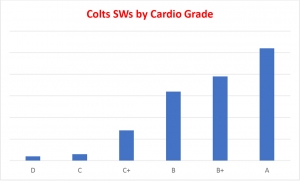
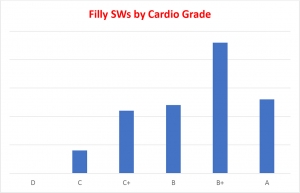
Those which pass conformation inspection at the barns are selected for cardio ultrasound scans. Thus, this study concentrated on a focus group of 865 fillies and 1,253 colts whose performance at the sales prompted our analysts to obtain those scans.

The data gathered from each scan is run through an algorithm that takes into consideration the size of the heart, its pumping efficiency and the horse’s body size. This gives us a Cardio Score which is based on a numerical system that is akin to a “report card” of six grades of equal decimal distance: A, B+, B, C+, C, D–the higher the numerical score the higher the “report card Cardio Grade,” ergo the more efficient the system for that horse.

What the system does not do, however, is disqualify a racing prospect based on the size of the heart alone because body size and cardio pumping efficiency play a big role in the score. A simple analogy might be to compare the size and structure of the horse to an automobile model and the efficiency of the cardio system to horsepower of the engine, to wit:

A horse which is a Maserati in structure with what appears to be an average size heart may generate a B+ Cardio Grade because that heart (engine) can rev up quickly to deliver the right amount of fuel for that chasis. However, if the heart is more like the engine of a Chevy Suburban, it will most likely take a longer time to pump up to overall efficiency and the race could be over, and thus wind up with a C+ Cardio Grade.

The first conclusion reached was that, in general, the higher the Cardio Grade the more starts and average earnings. For example, fillies that won only one race but had a B or B+ Cardio Grade averaged more starts and twice the earnings of those with a Cardio Grade C that won one race. Similarly, colts with a Cardio Grade B that won three or more races earned 50% more on average than colts with a Grade C average that won three or more races. There are plenty of other examples, but one should get the drift.

The dividing line was even stronger when it came to stakes winners which, after all, is what everyone wants to buy. Below are the distributions per Cardio Grade of black-type winners in North America and countries to which 2-year-old graduates were exported. As the charts indicate, more than 80% of the fillies and colts that won stakes races had Cardio Grades of B or better.

With data such as this, one can appreciate the irony of lyrics of a tune from Damn Yankees…

“You’ve gotta have heart,

All you really need is heart

When the odds are sayin’ you’ll never win,

That’s when the grin should start.”*

… which these days can apply with equal meaning to humans and those who breed, own, train, ride and bet on Thoroughbreds.

*Composed by Richard Adler & Jerry Ross

Bob Fierro is a partner with Jay Kilgore and Frank Mitchell in DataTrack International, biomechanical consultants and developers of BreezeFigs.  He can be reached at bbfq@earthlink.net

The post Body & Soul: Home Is Where The Heart Is appeared first on TDN | Thoroughbred Daily News | Horse Racing News, Results and Video | Thoroughbred Breeding and Auctions.

Source of original post

Lightly Raced Runners Loom Large in CCA Oaks

While two-time GSW Tonalist’s Shape (Tonalist) is favored at 9-5 on the morning line for Saturday’s GI Coaching Club American Oaks at Saratoga, she’ll have to fend off several well-bred and promising up-and-comers if she’s to get the job done.

Perhaps the most formidable challenger is WinStar Stablemates Racing’s Paris Lights (Curlin). The Bill Mott trainee was third in a sloppy-track sprint at Gulfstream on debut Apr. 26, but took a big step forward to romp on the stretch-out at Churchill May 31 and then paired up 85 Beyer Speed Figures when taking a first-level allowance June 27 in similarly facile fashion. That 85 Beyer is the field’s best last-out number and is only eclipsed by an 89 and 87 earned by Tonalist’s shape several starts back. Mott, who won this race in 1997 with Ajina, will also saddle Godolphin’s versatile GII Fair Grounds Oaks and GIII Wonder Again S. third Antoinette (Hard Spun).

Crystal Ball (Malibu Moon) also carries the WinStar Stablemates silks and was third in her debut, going a mile at Santa Anita May 17 for Bob Baffert. The $750,000 Fasig-Tipton Gulfrstream grad aired by 6 1/4 lengths on the stretch-out June  14. Baffert took the 2017 CCA Oaks by a head over Mott-trained Elate (Medaglia d’Oro).

The Chad Brown stable took the GIII Peter Pan S. for sophomore boys with Country Grammer (Tonalist) on opening day, and could double up with Altaf (Medaglia d’Oro) here. The Shadwell homebred was just seventh in her grassy unveiling in Florida Apr. 2, but uncorked a visually impressive sweeping rally to don cap and gown by 6 1/2 lengths under the Twin Spires May 23.


The post Lightly Raced Runners Loom Large in CCA Oaks appeared first on TDN | Thoroughbred Daily News | Horse Racing News, Results and Video | Thoroughbred Breeding and Auctions.

Source of original post

Verified by MonsterInsights