Played Hard Could Start Next in Grade I Personal Ensign

SARATOGA SPRINGS, N.Y. – Though Rigney Racing's Played Hard (Into Mischief) will miss the GII Shuvee because of a fever, trainer Phillip Bauer said Friday that she might run in the GI Personal Ensign on Aug. 25.

Bauer said it's a moving target that he could set his sights on.

“We'll hopefully get time to get a breeze into her next week and see what she does,” he said.

Another possible start could be in the GIII Locust Grove on Sept. 16 at Churchill Downs in the race she won last year.

Played Hard was found to have the fever before Bauer entered her Thursday in the Shuvee, where the GI La Troienne winner would have faced Clairiere (Curlin) and Nest (Curlin). He said she bounced back quickly after receiving treatment.

“She's good,” he said. “It was one of those things that maybe we could have entered and ran, but if she did run bad, then you're mad at yourself. So, with that caliber horse you've got to do the right thing.”

The Shuvee was the race Played Hard was pointed to after her third-place finish in the GI Ogden Phipps on June 10, with the Personal Ensign an option.

“It wasn't 100% sure,” he said, “but it was definitely something that we're considering between that and the Locust Grove. It might be a blessing in disguise.

It seems like her races, when she comes back in four weeks aren't her best. So maybe skipping this heat, maybe we'll run into a situation like last year where Clairiere doesn't fire her shot in the next month. It's one of those deals. We'll be fine. We'll just play the hand we're dealt and move on.”

The post Played Hard Could Start Next in Grade I Personal Ensign appeared first on TDN | Thoroughbred Daily News | Horse Racing News, Results and Video | Thoroughbred Breeding and Auctions.

Source of original post

Co-Owner Restrepo to Donate Portion of Mage’s Earnings to Cancer Charity

GI Kentucky Derby winner Mage (Good Magic) is owned by OGMA Investments, LLC, Ramiro Restrepo, Sterling Racing LLC and CMNWLTH, but when he tackles a tough group of opponents in Saturday's GI Haskell S. he will be running for more than just the four ownership groups. Restrepo announced Friday that, starting with the Haskell, he will be donating a portion of Mage's earnings to the Dwoskin Children's Cancer Research Fund at the University of Miami's Sylvester Comprehensive Cancer Center.

The story was first reported by the Daily Racing Form's Mike Welsch.

The fund was named in honor of Steve Dwoskin, a veteran trainer on the South Florida circuit, who estimates he has donated $15 million to cancer related causes.

Though a successful trainer, much of Dwoskin's income has come from a career selling auto parts.

“What Ramiro is doing, it's unbelievable,” the 80-year-old trainer said. “It's a really beautiful gesture on his part. This is a good story. I think a lot of people will see this and they'll all be rooting for Mage.”

Dwoskin started donating to cancer-related charities 22 years ago after his father and brother died of the disease. About eight years ago, he started to focus on cancer research for children. With Dwoskin's help, the Dwoskin Children's Cancer Research Fund at the University of Miami's Sylvester Comprehensive Cancer Center was started.

“I met this woman whose husband was a big doctor down here,” Dwoskin said. “She lost an 8-year-old son to cancer. I saw it on TV, on channel 7, and I went to meet her. I just realized I have a calling. If somebody is 80 or 90-years-old and dies of cancer I can handle that. When someone who is 8-years-old dies, I can't handle it. I just don't understand it.”

Restrepo said he had long admired Dwoskin for his work and for his philanthropy.

“Steve has been a local, Florida horseman for many, many years and is real supportive of the South Florida racing industry,” Restrepo said. “He's also a huge benefactor to the Sylvester Comprehensive Cancer Center at the University of Miami. I am a Miami alumni. I have lost two family members to cancer, my grandfather and an uncle on my father's side. So I am sensitive to that disease. There's a synergy between the University of Miami, Steve Dwoskin and the disease itself which has hit close to home for me. That all came together. I met with Steve and some of the fundraisers and chair members over at the University of Miami on the pediatric cancer side. We chatted about working with each other. This opportunity came up and I was more than happy to contribute. Mage is a horse that has many followers and it's nice to be able to use his platform to create awareness for what Steve has been doing. There is such a depth to his commitment. Steve has donated so much money toward the pediatric cancer research foundation. When you sit down with him and hear it from the horse's mouth it's pretty impressive.”

.

The post Co-Owner Restrepo to Donate Portion of Mage’s Earnings to Cancer Charity appeared first on TDN | Thoroughbred Daily News | Horse Racing News, Results and Video | Thoroughbred Breeding and Auctions.

Source of original post

Saturday Insights: Mage Full-Brother Entered ‘MTO’ at the Spa

1st-SAR, $136k, Msw, 2yo, 1 1/16mT, post time: 1:10 p.m. ET
His full-brother Mage is about three hours south at Monmouth Park to contest Saturday's GI TVG.com Haskell S., but DORNOCH (Good Magic) could still represent the family should the Saratoga opener be transferred to the main track. Whereas Mage cost $235,000 at Keeneland September in 2021 (before fetching $290,000 at the Fasig-Tipton Midlantic Sale last year), Dornoch was a $325,000 acquisition in Lexington. The pair's dam SW & GSP Puca (Big Brown), a 'TDN Rising Star' and also responsible for MSP Gunning (Gun Runner), is a half-sister to GISW Finnegans Wake (Powerscourt {GB}). Also entered for the main track only is Deterministic (Liam's Map), a $625,000 KEESEP purchase who hails from the Helen Alexander family of champion Althea. TJCIS PPs

7th-SAR, $136k, Msw, 2yo, 6f, post time: 4:26 p.m. ET
BC Stables co-principle John Bellinger's name was on the docket when DAILY GRIND (Medaglia d'Oro) was hammered down for $1.35 million at last year's Fasig-Tipton Saratoga Sale, and the dark bay debuts for the operation's Hall of Fame trainer D. Wayne Lukas. Lochlow Farm acquired dam Walk Close (Tapit) for $550,000 in foal to Uncle Mo at the 2018 Fasig-Tipton November Sale and the mare's value appreciated over the course of the next 12 months, as her foal of 2017 Anneau d'Or (Medaglia d'Oro) was runner-up in the GI Breeders' Cup Juvenile and GII Los Alamitos Futurity. Daily Grind, whose second dam is SW & GISP Spring Awakening (In Excess {Ire}), is bred on a foal share with Godolphin. Anointed (Justify) is a maternal grandson of Pearling (Storm Cat)–a full-sister to the 'Iron Horse' Giant's Causeway and You'resothrilling, et al–whose son Decorated Knight (GB) (Galileo {Ire}) was a two-time Group 1 winner in Ireland and victorious at Group 1 level in Dubai. Also in the mix is Dive Bomber (Omaha Beach), a $400,000 KEESEP grad and half-brother to this year's Bourbonette Oaks heroine Botanical (Medaglia d'Oro). TJCIS PPs

8th-DMR, $82k, Msw, 2yo, f, 5f, post time: 8:35 p.m. ET
HOPE ROAD (Quality Road) is the first produce from Marley's Freedom (Blame), easy winner of the 2018 GI Ballerina S. for Cicero Farms and Bob Baffert. Connections elected to enter the Jan. 15 foal for last year's Fasig-Tipton Saratoga, but they took her home after bidding fizzled out at $575,000. John Sadler conditions the bay, who breezed a smart five furlongs from the gate in 1:00 flat (5/44) at Santa Anita July 16. C R K Stable's Ashley (Into Mischief) draws the fence for this debut run for John Shirreffs. A $385,000 KEESEP buyback turned $400,000 OBSAPR breezer (see Summer Breezes below), the April-foaled bay is out of a full-sister to Japanese Group 1-winning sprinter Mozu Superflare (Speightstown) and a half to GSW Sacristy (Pulpit). Mocha Grande (Uncle Mo), a $475,000 KEESEP purchase by Talla Racing and West Point Thoroughbreds, is out of a daughter of GSP Stage Magic (Ghostzapper), of course the dam of Triple Crown-winning Horse of the Year Justify (Scat Daddy). TJCIS PPs

The post Saturday Insights: Mage Full-Brother Entered ‘MTO’ at the Spa appeared first on TDN | Thoroughbred Daily News | Horse Racing News, Results and Video | Thoroughbred Breeding and Auctions.

Source of original post

Greg Ferraro Q&A, Part II: HISA Rollout “Inconsistent and Uneven”

After Sunday's announcement that The Stronach Group (TSG) will close at the end of the year its flagship Northern California racetrack, Golden Gate Fields, the company at the helm of the sale has gone silent, ignoring all of TDN's requests for comment this week.

To bring much-needed illumination on this seismic decision, the TDN spoke Thursday morning with Greg Ferraro, the California Horse Racing Board (CHRB) chairman.

Among several points raised, Ferraro shared his thoughts on the need for a fixed hub of racing in Northern California to secure the long-term viability of the state's racing industry, and for necessary renovations of Santa Anita's backstretch accommodation as a condition of licensure at the track.

Ferraro also expressed concern that TSG has not fully considered the potentially stark ramifications from Golden Gate's closure on the rest of the state's stakeholders, including the breeders, owners, trainers and other licensees.

“I have the feeling–I don't know–but I have the feeling since The Stronach Group hasn't put anything out there yet, that perhaps they don't have their plans fully developed,” Ferraro said.

Read part one of the interview here.

The CHRB chair, however, didn't just speak on Golden Gate Fields. Ferraro also shared his thoughts and concerns surrounding the ongoing rollout of the Horseracing Integrity and Safety Act (HISA)'s Anti-Doping and Medication Control (ADMC) program.

Part two of this interview has been lightly edited for brevity and clarity.

TDN: Let's shift gears and move on to the ongoing rollout of HISA's Anti-Doping and Medication Control program. Very broadly, how would you assess the job they've done so far?

GF: I would say it's inconsistent and uneven.

Their rules are somewhat complicated for people. Sometimes they haven't made things completely clear. But their application of the rules and their disciplinary actions have been uneven and inconsistent.

What the basic plan is, is to make a major cultural change in the way racing operates. And in order to do that, you have to have some trust within the industry. I don't think their initial steps have built any sense of trust. So going forward, the industry's a little reticent, let's put it that way.

TDN: What specifics can you point to when you say, 'inconsistent and uneven'?

GF: The incident with the joint injections where some trainers were fine and others weren't. Some horses were disqualified and others weren't. They withheld the names of violating trainers for a long time. Nineteen trainers.

Then there's the inconsistency in the enforcement of this provisional suspension [in the event of a positive for a banned substance]. That's been quite a concern to trainers because a trainer could be put out of business with basically no warning, the way they are going about it.

From a California point of view, we're always quite concerned about due process. [Trainer Ray] Handal is a perfect example. They suspended him. Then, once they looked into it, they found out it was contamination in the feed. It's happened before. The mill runs the cattle feed before they run the horse feed, and the horse feed is contaminated.

So here, this guy is knocked out of business for [nearly] a week, traumatized financially and emotionally, and then it's reversed.

[Note: Read more on the Handal situation here.]

Instead, if they had they just notified the trainer, investigated for a few days and had a hearing before [potentially] suspending somebody, it seems to me that's a fairer way to go. I think most of the trainers in California are used to that kind of system, and that's their feeling as well.

TDN: What you're saying is the current system of an automatic provisional suspension after a positive for a banned substance needs to be eliminated or modified?

GF: Yes. Given the American jurisprudence system of innocence until proven guilty and due process, I think it needs to be reorganized.

TDN: You mentioned joint injections. In California prior to HISA, the intra-articular corticosteroid fetlock injection rule mandated a 30-day stand down period prior to racing, and all intra-articular corticosteroid joint injections had a 10-day stand down before workouts. HISA's intra-articular joint injection rule requires a 14-day stand down before racing and a seven-day stand down before workouts. Do these weaker intra-articular joint injection rules concern you?

GF: Yes, that's a concern to us. It's a step backwards for California. We noticed once we put that rule in place in California, we dropped the musculoskeletal breakdowns dramatically. So, we think it's important.

We tried to get HISA to go along with [California's rules], but they wouldn't. We're still in discussions with them about it. We've cooperated a lot with HISA and we've been supportive of them. And I don't want to come across as being negative of HISA. But for California, you know, it's a bit of a step backward. It's a big expense. And we're not getting that much out of it because we've been ahead of the game nationally for quite some time now.

The corticosteroid issue is something they need to take another look at. Corticosteroids are not bad per se. But corticosteroids and high-speed works combined are not good at all.

Take any athlete that goes into training. Over time, their joint health degenerates. It's just part of what happens. You wear the surfaces down. You can't really slow that [process] down, but you can certainly speed it up. And one way to speed it up is to inject joints [with corticosteroids] in close proximity to high-speed works.

And so, what we've done in California–and what HISA needs to do–is impress upon the trainers that they need to discontinue this attitude of injecting to run or to work and look at corticosteroids as something that they use as a medical treatment combined with rest and other rehabilitative procedures.

Long-term, intra-articular corticosteroids should be eliminated completely from racing.
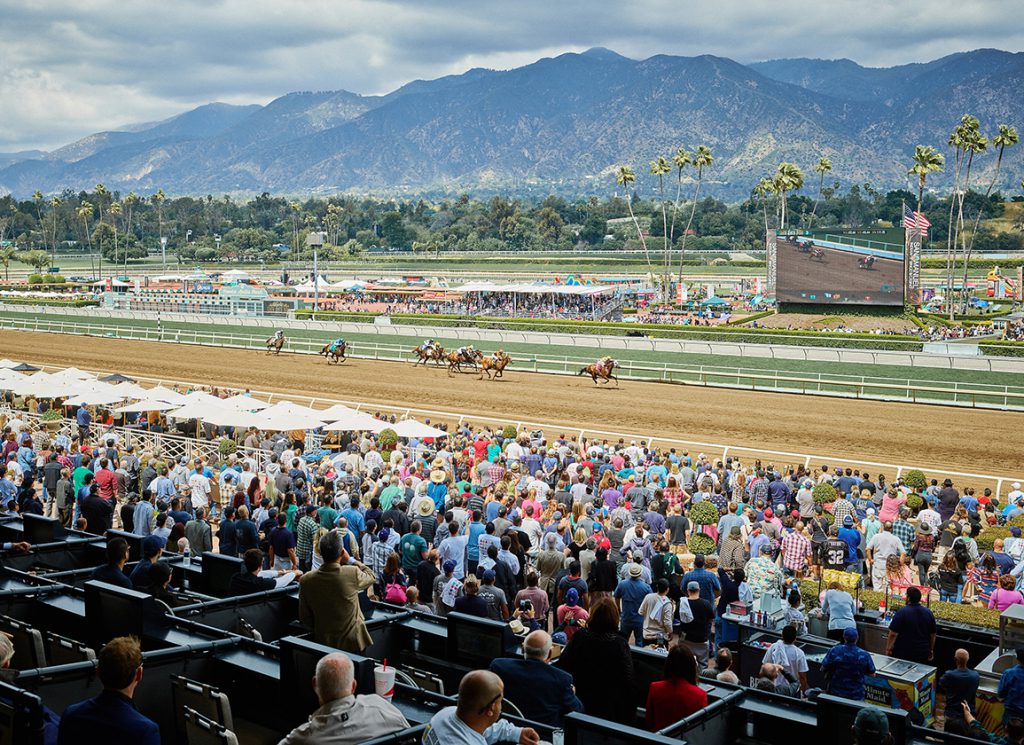
Santa Anita | Benoit

TDN: What argument does HISA give in pushing back against adopting California's stricter rules?

GF: You have to realize that much of the rest of the country had [weaker] rules [than California]. And so they say, 'we're getting so much pushback from the rest of the country that we can't do it.'

But what we've argued is to let California have its stricter rules and use us as a model. Then, at some point in time, you can go back to the rest of the country and say, 'well, California's had this rule in place and look what it's done. It's been beneficial. Why don't we adopt it nationwide?'

California is the point of the spear in terms of dealing with the public and the liability of horse racing. I think they should use us as a sort of leader in animal welfare and jockey welfare.

TDN: Do you think HISA's approach on this issue runs counter to their stated mandate of animal welfare and safety?

GF: Correct. What it takes is somebody with enough backbone to stand up to the pushback.

I mean, we got pushback in California, too. But we did what we thought was right and it's proven to be beneficial. Now, the horsemen look at us and say, 'well, we didn't like it in the beginning, but we realize it was worth the sacrifice.'

TDN: Are you worried California, after a sharp downward trend in equine fatalities in recent years, might now see an uptick in fatalities and injuries as a result?

GF: Absolutely. That's what our worry is.

TDN: Wow. Because of this, has the CHRB thought about the possibility of California opting out of HISA–at least until these fixes have been secured?

GF: No, we wouldn't do that. We're supportive of HISA overall. We think the concept of a standard rule nationwide is beneficial to the industry overall. These are growing pains. I think we're better off to work within [HISA]. Us pulling out is just not an option.

The post Greg Ferraro Q&A, Part II: HISA Rollout “Inconsistent and Uneven” appeared first on TDN | Thoroughbred Daily News | Horse Racing News, Results and Video | Thoroughbred Breeding and Auctions.

Source of original post

Verified by MonsterInsights