Florida Trainers Sure to Feel Impact of Draconian New Immigration Law

Last month, Florida Governor Ron DeSantis signed into state law the self-described “strongest anti-illegal immigration legislation in the country.”

Under the new statute–the bulk of which goes into effect on July 1–business owners with 25 or more employees must use E-Verify to confirm the immigration status of new hires, and be subjected to enforceable penalties for employing undocumented workers, as well as stricter penalties for sending undocumented workers across state lines to work in Florida, among other provisions.

When enforced, the new stringent laws are highly likely to impact everyone in the industry from trainers, farm managers, and the workers themselves. The TDN reached out to several stakeholders either based in Florida or who regularly race there. Some were unaware of the new law, while others downplayed its impacts.

According to Julio Rubio, backstretch services coordinator and Hispanic liaison for the Kentucky Horsemen's Benevolent and Protective Association, an unusual amount of backstretch workers have recently come to Kentucky from Florida.

Rubio has also fielded calls from trainers in Florida who have already lost employees. “Some of them left for South Carolina. Illinois. They're just getting out of there,” Rubio said.

Immigration experts warn that the bill contains key provisions that employers should be aware of if they're planning to do business in Florida.

According to Will Velie, an immigration attorney with many clients in the racing industry, what is startling about the bill is that it co-opts state governmental agencies into enforcing federal immigration laws.

“The state is creating its own role in this which is unprecedented,” Velie said. “This is by far the biggest incursion of state law into the federal immigration domain.”

For trainers shipping horses into Florida to race from out of state, a notable provision under Senate Bill 1718 is the criminalization of “knowingly or willingly” sending into Florida an undocumented individual across state lines–what could amount to a state felony.

According to Albany-based immigration attorney, Leonard D'Arrigo, of the law firm Harris Beach, the language of the bill is frustratingly vague. For example, the bill states that the employer would only be at risk of prosecution if they know, or “reasonably” should have known, that the employee is undocumented. Nevertheless, he recommends that employers take nothing for granted.

“You have to be thinking about, 'who are we driving into the state if they get pulled over by the police and asked for documentation to prove legal status?'” said D'Arrigo. “If they're unable to prove legal status, there's liability–the employer could ultimately be responsible.”

Another key change is that employers with 25 or more employees must now use the electronic employment verification system, E-Verify, to check the immigration status for all new employees. If the system red-flags the individual as undocumented, then the business employs that person at its own risk.

Importantly, an employer must retain a copy of the documents used by an employee to prove their immigrations status, along with the official verification generated by E-Verify, for at least three years.

This requirement for employers is important. The bill authorizes the state to request any copies of documents used for employment verification purposes from business owners. And come July 1 next year, state law enforcement will be able to perform audits of businesses it believes isn't following E-Verify requirements.

According to D'Arrigo, the added layer of paperwork from E-Verify will likely hamper hiring practices for trainers and farm owners in Florida. This is a state where 25% of the workforce are immigrants, and where about 65% of agricultural and equine-related jobs are filled by immigrant workers.

Furthermore, there are estimated to be over 710,000 undocumented individuals in the Florida workforce. A 2021 report found that some 42% of Florida's farm workers are undocumented.

“They've been getting by for years without this additional scrutiny,” said D'Arrigo, of the current system whereby immigrant workers present “I-9 documentation” to illustrate proof of work status–what often proves a “good faith” arrangement.

“Now, employers are going to know immediately whether those documents are fake or whether they're real,” D'Arrigo said, who emphasized how the new E-Verify requirements only apply to new hires.

The possible sanctions aren't exactly chump change.

For employers who fail to use E-Verify as required three times in any 24-month period, for example, the state can impose fines of $1,000 a day “until the employer provides sufficient proof to the department that the noncompliance is cured.”

Furthermore, the new law also creates incrementally more serious violation sanctions to business owners pinned to the number of undocumented workers employed there and frequency of violations, said D'Arrigo. In a worst-case scenario, the employer could lose their state business license.

At the same time, a worker found to use false identification to gain employment faces a possible $5,000 fine and a five-year prison sentence.

While the new E-Verify requirements apply only to companies with 25 or more employees, D'Arrigo cautions for smaller businesses and their workers to be mindful in other ways.

Trainers and farm owners near the 25-employee cut off need to be vigilant if they exceed that threshold at any time, as this will dramatically affect their hiring practices.

Another important wrinkle in the new immigration landscape in Florida concerns the ability to legally take to the road. According to D'Arrigo, the state Department of Motor Vehicles is expected to maintain a list of drivers' licenses that other states issue to undocumented individuals. Why is this important?

The new law bars counties and municipalities from issuing identification documents like drivers' licenses to individuals unable to prove their legal immigration status. At the same time, Florida law enforcement officers will be ordered to issue citations to anyone using one of the out-of-state licenses listed by the DMV who is unable to prove legal immigration status, said D'Arrigo.

“It's only going to come up if somebody gets pulled over in the normal course of a traffic violation. At that point, the law enforcement officer is directed, if it's one of those out-of-state licenses, to ensure that the person is legally in the U.S.,” said D'Arrigo. “If not, they're to issue them a citation.”

Then comes the issue of workplace injuries. “If somebody gets injured at the track and they're undocumented, they can usually get emergency aid,” said D'Arrigo.

As of July 1, Florida hospitals accepting Medicaid are required to collect patient immigration information on administration or registration forms. These same hospitals are also required to provide a caveat on forms stating that the response will not affect patient care or result in a referral to the immigration authorities. But that's still not enough to allay workers' fears, warned D'Arrigo.

“Although the law says that they cannot share that information, it's still possible it will be shared nonetheless, and potentially transmitted to immigration authorities,” said D'Arrigo. “So, [undocumented] workers are now going to be hesitant to get the medical care that they need because they're going to be fearful from being on the record.”

For Velie, the most chilling provision in the law is that it opens the door for individuals to report to the authorities a “good faith” belief that certain employees are unauthorized. Such a report would require the Florida Department of Economic Development to investigate the complaint–a new dynamic that is likely to generate a “climate of fear” among businesses and immigrant workers, said Velie.

“If I'm [someone looking to make trouble], all I have to do is say with a good faith belief that there's somebody employed without authorization [on the backstretch], and the Florida Department of Economic Development has to investigate,” said Velie. “If somebody's just bent on causing problems, they've got a good way to do that.”

When asked about the immigration climate in Florida, Tom Rooney, National Thoroughbred Racing Association (NTRA) president and CEO, pointed to the H-2B guest worker program as a labor safety net.

Because of the sheer demand for H2-B visas and the limited supply, however, it's unlikely to prove an adequate fix to Florida's immigrant labor gaps.

“The National Thoroughbred Racing Association has long advocated on the Federal level for solutions for the industry, like a permanent returning worker exemption, and will continue to do so,” wrote Rooney in an email, pointing to long-identified problems with the H-2B system.

“For those trainers with over 25 employees for which this law applies we will continue to work diligently at the federal level with our partners in the H-2B Coalition to push for more workers to help fill the need,” Rooney added.

The post Florida Trainers Sure to Feel Impact of Draconian New Immigration Law appeared first on TDN | Thoroughbred Daily News | Horse Racing News, Results and Video | Thoroughbred Breeding and Auctions.

Source of original post

Survey: 83 Percent Of Horseplayers Want Access To Fixed Odds Betting

More than four out of five horseplayers in the United States want access to fixed odds betting options, according to a survey commissioned by BetMakers Technology Group, a global leader in wagering technology and provider of the only legal, regulated fixed odds horse racing solution in the U.S.

The findings illustrate a clear desire from consumers for innovation in horse race wagering, where traditional pari-mutuel betting pools dominate the landscape. Fixed odds wagering — which locks in a price at the time of the wager, like sports betting — is only available currently in the state of New Jersey, where BetMakers' technology powers MonmouthBets, the first and only legal fixed odds wagering platform in the country. Fixed odds also has been legalized but is not live yet in Colorado, while several other states are working on legislation to do the same.

“BetMakers understands the drivers of a thriving horse wagering ecosystem, including giving horseplayers more options for betting,” said Jake Henson, CEO of BetMakers Technology Group. “That 83 percent of surveyed horseplayers would like fixed odds to be added to pari-mutuel betting on racing is a resounding figure that speaks to the opportunity racing has in the United States to tailor a product that speaks to a new generation of horse player.”

“These survey results, along with the successful launch of fixed odds betting at Monmouth Park and via their MonmouthBets' digital offering, should serve as motivation for other states to make changes that will deliver returns to the regulated wagering industry and, more broadly, the entire racing ecosystem, including the owner and trainer groups and horseplayers across the country.”

Other notable findings from the survey include insights into the potential crossover effect of fixed odds in American sportsbooks. More than two-thirds (67 percent) of sports bettors surveyed said they would be more likely to wager on horse racing if it was available in their sportsbook app. A similar number (66 percent) confirmed they would be more likely to wager on horse racing if they had access to fixed odds pricing.

“This speaks to the opportunity in front of the industry. We firmly believe that fixed odds can be a stimulus for growth in the U.S. racing industry. We've already seen that in New Jersey the product has opened horseplayers' eyes to new possibilities, and the rise in sports betting has created an opportunity for the racing industry to reach new players through American sportsbooks,” Henson added.

Related to the challenges associated with betting on horse racing for newer fans and other interested parties, 20 percent of U.S. sports bettors surveyed listed horse racing as being 'too complicated' as a barrier to betting on it.

Other key findings from the survey include:

  • 64 percent of U.S. horseplayers surveyed have wagered on horse racing through a method outside of the pari-mutuel system, including offshore sportsbooks or racebooks.
  • The top wager type for U.S. horseplayers is Win, Place, Show (WPS) (32%).
  • More than half of U.S. horseplayers surveyed bet more than $200 on a typical racing day, with 32 percent betting between $200-$499 on a typical racing day and 20 percent betting between $500-$999.

The survey drew responses from 1,500 participants, half of whom were self-described sports bettors and the other half self-described horseplayers.

BetMakers Technology Group Ltd is a leading provider of racing and betting solutions that monetize horse racing for stakeholders. BetMakers provides licensed betting operators, rights holders, racing authorities and bookmakers with solutions for every stage of the racing and betting life cycle across both fixed odds and tote betting markets. For more about BetMakers' advanced solutions for racing and betting, visit www.betmakers.com.

The post Survey: 83 Percent Of Horseplayers Want Access To Fixed Odds Betting appeared first on Horse Racing News | Paulick Report.

Source of original post

Report: Stabile Resigns From NYRA Television, Handicapping Duties

Anthony Stabile Jr. is no longer employed as a handicapper and television host for the New York Racing Association, Daily Racing Form reports, having resigned from those positions weeks after being involved in a stable area altercation with trainer James Chapman.

A NYRA employee since 2016, Stabile also filled in as track announcer on occasion at Aqueduct. He co-hosted the popular “Talking Horses” pre-race handicapping show with Andy Serling, was part of the “America's Day at the Races” on-air team and was a content contributor to NYRA's website.

Last month, Stabile was seen in a video that surfaced on social media taunting trainer Chapman, who was subsequently arrested  and charged with misdemeanor stalking of trainer Amira Chichakly, with whom he had a dispute over round pens between their two barns. Stabile was also licensed as a stable agent for one of Chichakly's owner.

At the time, according to the New York State Gaming Commission, Stabile's licenses were both listed as “unable to participate.” NYSGC staff declined to give a reason.

Stabile was taken off the air after the backstretch incident with Chapman. He officially resigned June 8, according to Daily Racing Form. A New York native, Stabile is now serving as part-time announcer and handicapper for Yonkers Raceway.


The post Report: Stabile Resigns From NYRA Television, Handicapping Duties appeared first on Horse Racing News | Paulick Report.

Source of original post

Breeders’ Cup Presents Connections: Henrietta Topham Shows That Good Things Come To Those Who Wait

In 2001, Geoff Mulcahy took out his trainer's license in the United States, having spent the past few years working in Ireland, South Africa, and Saudi Arabia for an array of trainers. A few years later he and his wife Sandra started their own breaking and pre-training business as well at their farm in Lexington, Ky. 

Around the same time Michael and Liz Campbell purchased the historic Cambus-Kenneth farm from the Bluegrass Trust for Historic Preservation, eager for a change of pace from their lives in Massachusetts working in academia. They began a small Thoroughbred breeding program after their move. It would be another 16 years before they crossed paths with Mulcahy and began their partnership. 

Mulcahy has now been in the business of breaking Thoroughbreds and getting them ready for the track for a little less than 20 years. While he currently has around 65 horses in his program at the Thoroughbred Center, the heart of his operation is a 5-year-old Lemon Drop Kid mare named Henrietta Topham. Owned by the Campbells, she is the lone horse that Mulcahy trains to race.

After 21 years of training mostly claiming and allowance level horses while also running his breaking business, Mulcahy decided that Henrietta Topham would be the last horse to run under his name. He goal is to shift his focus exclusively to working with young horses after one more racehorse of his own.

A little less than a year after breaking her maiden, Henrietta Topham gave Mulcahy his first graded stakes win in the Grade 3 Old Forester Mint Julep Stakes at Churchill Downs.

“I went hoarse,” Mulcahy said. “All I could say was 'Go on Henri, go on Henri.' I was roaring and shouting. It was great because coming off two weeks [since her last race] I was sort of second guessing myself. I basically left it up to Ricardo [Henrietta Topham's long time exercise rider]. I asked him after the final breeze before the race if she felt good and he said yes, so that made up my mind. We went into the race after the late scratches thinking we could definitely get graded stakes-placed, but then she went on and won and just what a day.”

[Story Continues Below]

It was also the first graded stakes win for the Campbells, who bred the mare as well as the prior two generations of her female line. Henrietta Topham is out of the Cozenne mare Miss Silver Brook, who raced 21 times over the span of four years, during which time she ran against the likes of Zenyatta and Stardom Bound. Henrietta Topham's female line eventually traces back to her third dam Secondfromthetop. Secondfromthetop was one of the first mares in the Campbells' broodmare band and had been left from the original owners of Cambus-Kenneth farm. She has produced the likes of G2 winner Why Change and stakes winner Jimmy Z, who were both sold as yearlings.

“Luck is the main ingredient, but you have to position yourself to take advantage of the luck,” said Michael Campbell. “My wife and I are very interested in pedigrees and breeding. We got right into analyzing pedigrees and calling on people who are experts on this. It's taken a long time. Most people aren't going to wait four generations, but there was so much talent that we knew about in these horses that had excuses for not showing up. We knew there was talent in that particular mare line.

“The keyword is patience. You really have to immerse yourself in the history and tradition of Thoroughbred breeding and learn the pedigrees, learn about the animal. I wish more people were horse people and they would really get to know the individual horses and how they behave and what they need. If they spent more time getting to know the horses that they own it would help them determine the next best step for that individual.

“You don't have to be fabulously wealthy, but you do have to be patient, which can be expensive.”

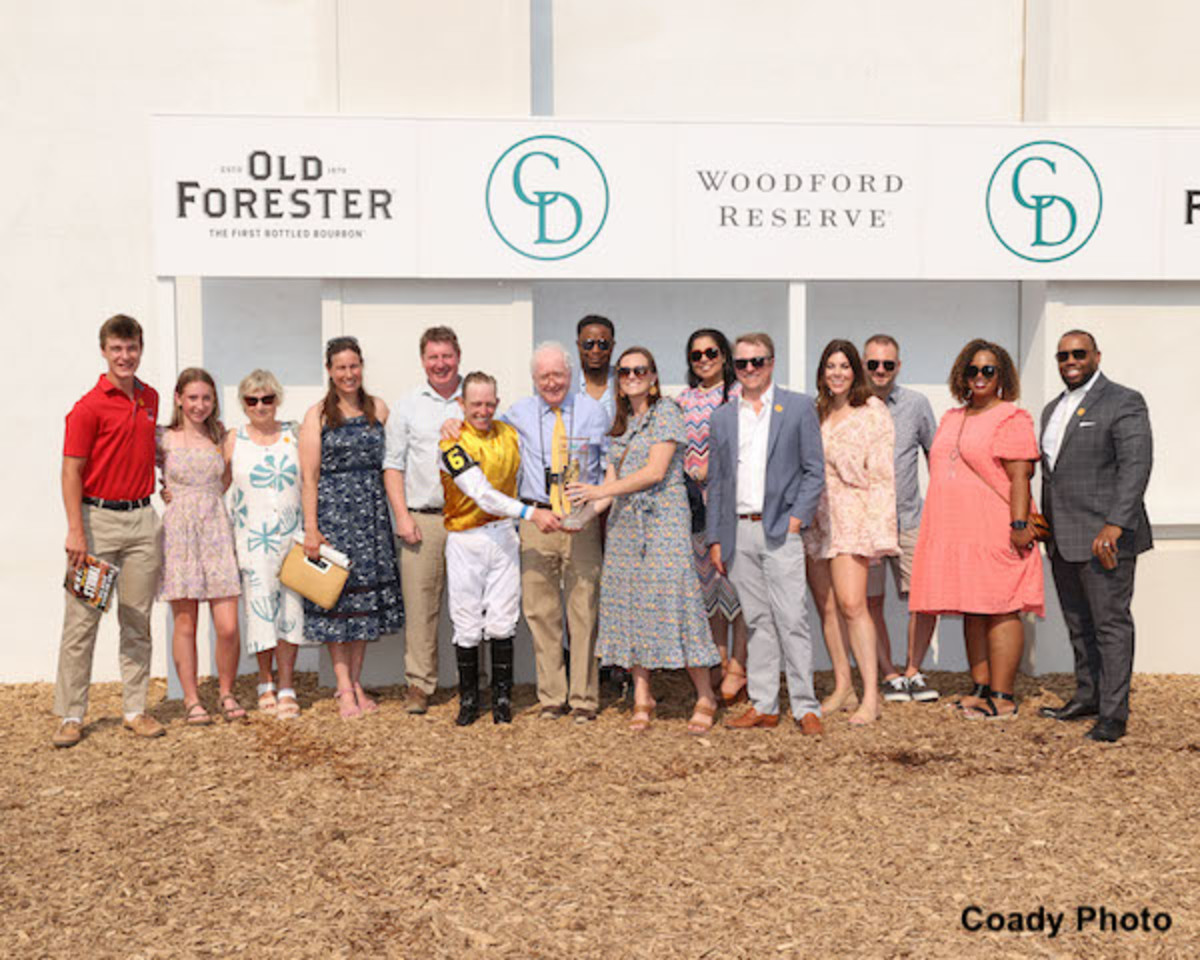
Henrietta Topham's connections pose with the trophy after the G3 Old Forester Mint Julep

The Campbells' thought process, dedication, and patience seems to have paid off in the case of Henrietta Topham. The same can surely be said for Mulcahy. 

Originally from Ireland, Mulcahy started spending his summers getting experience working with Thoroughbreds at the age of 13. Mulcahy had worked with yearlings, broodmares and foals, and 2-year-olds by the time he decided to make his way to the United States for the first time in 1995 to work for Garret O'Rourke at Juddmonte Farm in their breaking division. When he arrived, O'Rourke told Mulcahy that their yearlings wouldn't be ready to get started for another few months and he sent Mulcahy to work for Jimmy Corrigan, formerly of Pin Oak Stud, at the Thoroughbred Center starting their 2-year-olds. 

Support our journalism

If you appreciate our work, you can support us by subscribing to our Patreon stream. Learn more.

Six years later after completing his equine science degree in Ireland, working in South Africa, and working as an assistant for Niall O'Callaghan and Bob Baffert in the United States and Saudi Arabia, Mulcahy decided he was ready to settle down in Kentucky and go out on his own.

“I started out with one horse, then went up to two, then up to three, and just gradually went on from there,” Mulcahy recalled. “I remember having three horses in three different barns at one point. I remember having two feed tubs and having to wait for the first horse to finish eating so I could feed the third horse because I didn't have the money for the new feed tub. I just worked hard and made the contacts and built it up from there.”

Henrietta Topham is the icing on top of a two-decade training career that has often involved getting horses ready for other trainers to take over. As ever, Mulcahy has managed her with his trademark patience.

Following a productive 2022 that saw the mare break her maiden after four tries in 2021 and win her first stakes race, Henrietta Topham started out her 5-year-old campaign with a fifth place finish in an allowance race at Keeneland. Undeterred by the result, Mulcahy pointed her towards a start in the G3 Modesty Stakes at Churchill Downs on the Kentucky Oaks undercard. Fate, however, intervened when Henrietta Topham came up slightly unsound with a small cut on the bulb of her heel the day before the race so Mulchay rerouted her to an allowance race on May 21 at the same track. Henrietta Topham won the allowance race by a neck before going on to win the Mint Julep two weeks later. 

It took a lot to get there – four generations of breeding for the Campbells, 22 years of training for Mulcahy, and four tries for Henri – but Henrietta Topham's team is convinced now more than ever that the wait for something great can be worthwhile.

The post Breeders’ Cup Presents Connections: Henrietta Topham Shows That Good Things Come To Those Who Wait appeared first on Horse Racing News | Paulick Report.

Source of original post

Verified by MonsterInsights