Letter to the Editor: Armen Antonian

The “Quick Fix” of Synthetics is Not the Answer

Horse racing has been down the path of synthetics before at Santa Anita, Del Mar, Keeneland, etc. Much time was lost, approximately a decade ago, with a focus on changing surfaces as a panacea for horse racing breakdowns. We now know there are other causes for horse breakdowns that are more prevailing. The greatest single cause of racing deaths has to do with pre-existing conditions of the horse, and only in particular instances is the surface itself the primary reason for horses breaking down while racing. Synthetics have found a role to play in the Industry but racing on synthetics exclusively means to change the sport itself in a fundamental way: from breeding, to handicapping, to the aesthetic beauty of competition–the reasons we are all fans of horse racing. And, changing to synthetics will not appease the critics if that is the motivation to do so.

But statistics show that horse racing deaths are less on synthetics than either dirt or turf. Surely safety must be the main focus with racing today. Yes, safety must be a central focus but there has to be some perspective. Horses also die in nature. The thoroughbred industry cannot be expected to prevent ALL deaths of horses and a comparison must be made as to how often and how horses die in nature to reach a fair, concise view of horse racing. Such a comparison, of course, is extremely conjectural. There are no thoroughbreds in nature and not many other horse breeds in nature today at all. Experts from many areas would have to weigh in on such a comparison.

In other words, the approach to the issue of horse racing deaths in general, that is, how the question is posed, is false. So too is the case for synthetics falsely stated. Are we to believe that horses somehow have more trouble competing on dirt and turf than fabricated material? Biology and evolution would initially say otherwise. Similarly, are we to suppose that the breeding of thoroughbred horses is inherently producing unsound animals? Again, general evolutionary changes of such a magnitude would take time. To make such an argument, geneticists would have to be consulted to ascertain that thoroughbred breeding practices are actually producing inherently unsound horses. But first things first. Looking mainly into the track surface and or scrutinizing breeding operations are not the places to begin when investigating horse racing breakdowns.

Back to the statistics. Statistics don't lie. More horses break down on dirt or turf than synthetics per Jockey Club figures. But statistics don't always give answers either. Indeed, the overall sample size in the Jockey Club figures in the aggregate is large but the fact that the number of dirt races were about 7 times more than synthetic races is a cause for pause in a comparison.  Sample sizes are usually uniform in the scientific method. And when looking at individual tracks per year, the sample size is quite small when considering dirt races only. A track can thus vary markedly from year to year in horse fatalities as the Jockey Club statistics indicate.

And the sample has to be RANDOM.  Horses that are selected to compete on synthetics are not randomly chosen. That is, the two populations: horses that run on dirt and horses that run on synthetic are not uniform. So the synthetic numbers for horse fatalities that are generally lower than for dirt fatalities may or may not be because of the surface. The fact that both are samples of thoroughbreds is not rigorous enough to make a valid comparison. The sample population has to be random. A random sample also compensates for genetic variation in a species. The best argument for synthetics in terms of the data comes from Gulfstream Park in 2022. At Gulfstream, there were about 7000 starts on synthetic with one fatality whereas there were about 6000 starts with 8 fatalities on dirt. At least the number of starts were comparable at the same track for each surface but again, horses were selected by trainers for various reasons to race on synthetic rather than dirt. Better comparison of the two surfaces–but still not a random sample of the horse population at Gulfstream and one year is not nearly enough to draw any serious conclusions.
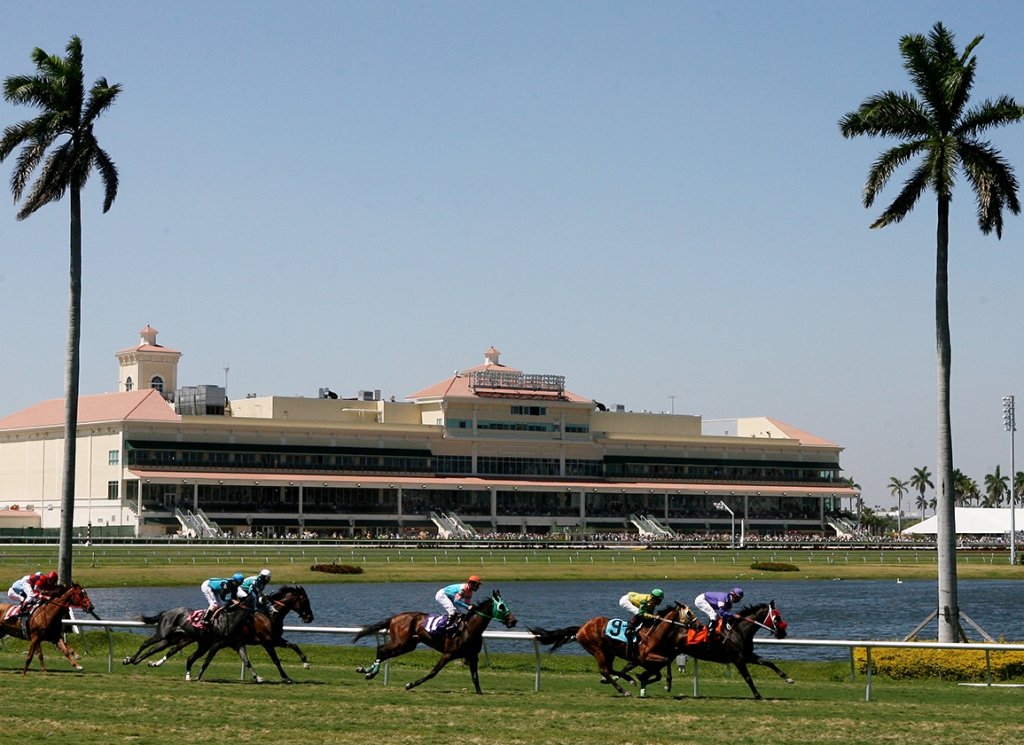
Action at Gulfstream Park in Hallandale Beach, Florida | Bill Denver/EQUI-PHOTO

Any glance at aggregate statistics for analysis would have to consider figures after 2019 after the implementation of new safety protocol stemming from the racing deaths at Santa Anita that year. But even here, with a seemingly logical approach to the data on racing breakdowns, a comparison is problematic. There are inexplicably low dirt rates of fatalities (say below 1 per 1000) before 2019 with dirt racing at various tracks that, in other years, had higher rates of about 2 per 1000. Such variability calls into question any definitive conclusion about track by track breakdowns relating to surface only.

What we do know is that Del Mar, Santa Anita and Keeneland have had remarkably low rates of fatality on dirt the last 2-3 years. For example, Keeneland had 3 deaths from 2020 to 2022 in almost 5000 starts or about 0.6 per 1000. Del Mar had none from 2021 to 2022 with almost 4000 starts. Such figures compare favorably with the lowest synthetic figures. Given these Keeneland and Del Mar figures it is a stretch to say that dirt racing is inherently or significantly more dangerous than synthetic racing. The question does remain: are these rates extendable over time? If the safety reforms in horse racing continue and are enhanced, the chances are they can be.

What we can say with some assurance is that all horse racing death rates are going down from year to year. The average rate of horse death for 2022, in an industry where safety reforms have not been sufficiently generalized, was 1.25 deaths per thousand. Still, it is too early to draw conclusions about horse racing deaths (especially in the wake of the recent spate of breakdowns at Churchill) until the new protocol is agreed to and generalized throughout the industry and a number of years with such protocol in place has passed. The hard work of putting in the safety measures is just beginning.

Horses run slower on synthetics than dirt. Is running fast then a problem? There are many misconceptions here. The issue is not speed but how often a horse is asked to race at high speed. Here the veterinarians can chime in to assist trainers with their training and racing schedules. A dialogue should ensue on best practices. A horse can race more often if it is running easily. A horse in a grade I race cannot race as often as winning at that level usually requires maximum effort. So comparisons by racing fans of one horse's schedule to another are not valid. Each horse is different both in terms of circumstance and genetic variation and trainers must be more in tune with their vets moving forward not just on a horse's ailments and therapeutic medication but on their racing schedule itself.

–Armen Antonian Ph.D

The post Letter to the Editor: Armen Antonian appeared first on TDN | Thoroughbred Daily News | Horse Racing News, Results and Video | Thoroughbred Breeding and Auctions.


Source of original post

‘We Have Come Here to Win’: Internationals Take on Ascot

NEWMARKET, UK– They've arrived. The young, the fast, the young and fast. From America, Australia, and Sweden, members of the international contingent for this year's Royal Ascot are now safely ensconced in temporary lodgings, their presence in the UK adding an extra sparkle to what is always one of the most special weeks of the sporting year. 

Cannonball (Aus) (Capitalist {Aus}) and Artorius (Aus) (Flying Artie {Aus}) have separate sprint engagements, in the G1 King's Stand S. and G1 Queen Elizabeth II Jubilee S. respectively, and with no fear of rivalry next week, the two made happy companions as they strolled along Newmarket Heath on Thursday morning.

A day after Cannonball's strong work on the track at Ascot, his co-trainer Peter Snowden remains delighted with the colt's preparation for his first start outside Australia next Tuesday. It's hard to fault the three-year-old. With a gleaming deep chestnut coat and relaxed demeanour, he looks to have taken the travel and change of scenery in his stride, and he will have Brett Prebble, who won the G3 Maurice McCarten S. on Cannonball in March, back in the saddle.

A year apart in age, Artorius and Cannonball previously shared the same training duo Anthony and Sam Freedman, with the latter having been moved to the Snowdens after his last start of 2022. For the next couple of weeks they are stabled alongside each other in a wing of Charlie Fellowes' Bedford House Stables. 

Sam Freedman has returned to Newmarket with Artorius, who spent a fair portion of last year in Europe, finishing third in both the G1 Platinum Jubilee S. and G1 July Cup before going on to Deauville to run sixth  behind Highfield Princess (Fr) (Night Of Thunder {Ire}) in the G1 Prix Maurice de Gheest.

There's talk of “unfinished business” from Freedman, who says that the four-year-old colt is thriving. He currently tops the market for the Queen Elizabeth II Jubilee S. a week on Saturday. He's not the only Aussie challenger for that prize as The Astrologist (Aus) (Zoustar {Aus}), who has been in town for a while at Marco Botti's yard, will make his third British start at Ascot, having most recently finished runner-up to Jumbly (GB) in the G3 John of Gaunt S. at Haydock last weekend.

Coolangatta (Aus) (Written Tycoon {Aus}) has kept her distance from Newmarket despite it being the former home town of her co-trainer David Eustace. His father James was spotted on board his hack as Cannonball and Artorius sauntered past on Thursday, perhaps keeping tabs on one of the filly's main opponents for the King's Stand on Tuesday.

Artorius and Cannonball on Newmarket Heath on Thursday | Emma Berry


Over on the other side of town in the Heath Stud yard at the National Stud are George Weaver's two juveniles No Nay Mets (Ire) (No Nay Never) and Crimson Advocate (Nyquist), each of whom won their respective Royal Ascot qualifying races over five furlongs at Gulfstream Park on May 13. Under the watchful eye and guiding hand of Blair Golen, riding the saintly Angus, borrowed for ponying duties from Jamie Lloyd, the filly then the colt had a gentle canter on the 'Between the Ditches' turf gallop and seemed unfazed by their new surroundings.

More on his toes on his first morning out on the Heath was the Kenny McPeek-trained Classic Causeway, ridden by the evergreen 72-year-old Danny Ramsey. Last year's G1 Belmont Derby winner looks set to take on Adayar (Ire), Luxembourg (Ire)  and co in what will be an intriguing edition of the G1 Prince of Wales's S., some 23 years after his late sire won the St James's Palace S., ushering in a run of five Group 1 victories through the summer of 2000.

Meanwhile, No Nay Mets is set to take part in what looks to be one of the hottest contests of the week, the G2 Norfolk S., a race his sire won a decade ago. Prior to that, he has an engagement in the Goffs London Sale on Monday.

“We have just been getting him accustomed to things,” said Golen. “Everything we run on in America is pretty much flat, so we have been taking him out on the seven-furlong stretch here to get him used to things.

“We have come here to win. In American racing, there is very rarely a big field, so that is a big challenge. Luckily, we have Frankie Dettori riding him and, if anybody knows how to ride the course, it is definitely him. So I think that is to our advantage. It means everything to have him riding and, if that makes Wesley Ward jealous, then even better.”

While McPeek arrives in the UK on Friday, Ward touched down on Wednesday afternoon, shortly before his horses arrived at Stansted airport and made the brief onward journey to Chelmsford City Racecourse, where they will stay until early next week. 

The quartet of runners, which was joined by a stable pony who is reportedly named Shanahan, contains one whose progress from his dazzling debut will be of huge interest next week and beyond. American Rascal (Curlin) is of course a son of the much vaunted Lady Aurelia (Scat Daddy), a dual winner at Royal Ascot in the G2 Queen Mary S. and G1 King's Stand S. Her firstborn has big shoes to fill.

Keeping Norfolk S. entrant American Rascal company is the Chasemore farm-bred Fandom (GB) (Showcasing {GB}), who has returned to not far from where he was born to run, most probably, in the Windsor Castle S.

The maiden Bundchen (Gun Runner) is Queen Mary-bound with the help of Joel Rosario, while Twilight Gleaming (Ire) (National Defense {GB}), who was runner-up in that race two years ago, returns for the King's Stand. 

Ward has stolen a march on all visiting trainers for Royal Ascot by saddling 12 winners at the meeting since his first–and second 24 hours later– in 2009. No Nay Never was his next four years later. 

Recalling his meeting the late Queen in the royal box following that victory in 2013, Ward said, “What was great about it was she did most of the chatting. When you first get up there you are nervous and she just starts firing questions at you and it puts you so at ease. She was just picking my brain and asking all these questions about how I train, how I came here and asking about all the success I had.

“It was unbelievable how much knowledge she had, not just of racing but myself–I couldn't believe the Queen of England even knew who a trainer like myself from a different country like America was and what I had accomplished.

“You would think she would just be coming to the races and focused on English racing and everything else she had going on in her life. She was just a wonderful person.”

She was indeed. The final Group 1 race of the meeting will be named in perpetuity in memory of the monarch who, for almost 70 years, cleared her diary for the week of Royal Ascot. The pandemic interrupted Queen Elizabeth II's attendance in recent years, and her absence from the royal procession next week will be keenly felt. The show goes on, however, and from the opening race named to commemorate Queen Anne, who founded the racecourse that is now one of the most famous in the world, right through to the longest Flat race in the calendar, the Queen Alexandra S., action of the highest calibre will be played out in front of a global audience.

The post ‘We Have Come Here to Win’: Internationals Take on Ascot appeared first on TDN | Thoroughbred Daily News | Horse Racing News, Results and Video | Thoroughbred Breeding and Auctions.

Source of original post

Freshman Sire Masar Off The Mark In Paris

Darley's first-crop sire Masar (Ire) (New Approach {Ire}) became Europe's latest freshman off the mark when Godolphin's homebred juvenile Will Scarlet (GB) eased to a smooth victory in Thursday's €34,000 Prix du Bassin Parisien over seven furlongs at ParisLongchamp.

1st-ParisLongchamp, €34,000, Cond, 6-15, 2yo, 7fT, 1:26.60, gd.
WILL SCARLET (GB) (c, 2, Masar {Ire}–Lady Marian {Ger} {G1SW-Fr, GSW & G1SP-Ger, $546,566}, by Nayef), a May 25 debut runner-up tackling 6 1/2 furlongs at this venue last time, recovered from a sluggish getaway to stalk the tempo in a handy third through the early fractions. Impeded along the rail by the errant Jojo Junior (Fr) (Hunter's Light {Ire}) soon after turning for home, the 2-5 favourite worked his way outwards into the clear passing the furlong pole and quickened smartly to deny Intellect (Fr) (Intello {Ger}) by an ultimately snug 3/4-of-a-length in the dying strides, becoming the first winner for his freshman sire (by New Approach {Ire}). Will Scarlet, half-brother to a yearling filly by Kingman (GB), is the ninth of 10 foals and fifth scorer out of G1 Prix de l'Opera heroine and G1 Preis der Diana (German Oaks) and G1 Prix Jean Romanet runner-up Lady Marian (Ger) (Nayef), who was the second highest-priced lot when knocked down for 1.8-million guineas at Tattersalls' 2008 December Mares sale. The February-foaled bay is also kin to dual Group 2-winning G1 Jebel Hatta fifth Loxley (Ire) (New Approach {Ire}). His dam is a half-sister to German Group 3 victor Lucidor (Ger) (Zafonic) and hails from the family of multiple Group 1-winning sire Lomitas (GB) (Niniski). Lifetime Record: 2-1-1-0, €23,000. Video, sponsored by TVG.
O/B-Godolphin (GB); T-Andre Fabre.

The post Freshman Sire Masar Off The Mark In Paris appeared first on TDN | Thoroughbred Daily News | Horse Racing News, Results and Video | Thoroughbred Breeding and Auctions.

Source of original post

American Horse Council Encourages Caution When It Comes To Kill Pen Bail-Outs

Posts on social media can tug on the heartstrings of horse lovers across the country when it comes to trying to find homes for retired horses. Posts that claim they need to raise money “as soon as possible” for a bail-out for a horse potentially in a kill pen created a larger tug and an even bigger sense of urgency that thousands can be raised in mere hours for that one horse.

But is it legit?

In an attempt to alert uninformed, yet sympathetic, individuals to the risks involved in sourcing animals from these operations, the American Horse Council (AHC) released the following statement in 2022:

The American Horse Council and its members are encouraging horse owners, horse rescues and equine enthusiasts to be extremely cautious before engaging with organizations and individuals promoting time sensitive rescue offers (often referred to as “bail” or “ransom”). Some horse traders contracted to fill orders for Mexican and Canadian horse processing have developed a scam targeting equine rescue operations and an uninformed general public. These “bail-out” or “ransom” operations are run in conjunction with feedlot operators who buy animals at low market prices. These order brokers then post the animals on social media platforms with exaggerated price tags and an arbitrary deadline implying a day of shipment across an international border where the horses will be processed for human consumption.

Due to the time sensitivity of the offer, people feel compelled to “save” the horse advertised on social media and purchase it sight unseen and are encouraged to utilize the seller's contacts to inspect the horse, attend to the horse, and transport the horse — all of which is done at additional cost and without traditional proof. As reported on and published in industry media and numerous social media platforms, incidents have been shared regarding sellers fabricating how much money has or hasn't been raised for a bailed horse; the horse delivered was not the one presented in photos or videos; the horse was not in the same physical condition as when payment was made; and in some cases, the animals themselves were never at risk of being exported and processed for human consumption, instead they were marketed as such to increase the sense of urgency.

Legal action has been taken against several individuals at the forefront of these practices. Law enforcement and regulatory officials at both the state and the federal level have, and continue to, investigate the practices of industry participants and enforce existing laws that are being broken, specifically animal cruelty, document forging, veterinarian malpractice, illegal transport and taxation issues. While the methods of marketing these animals may not be illegal, the U.S. equine community should not encourage or support the actions of these individuals and should instead support the many professional equine rescue organizations that exist in communities across the country, many of which can be found at https://unitedhorsecoalition.org/memberorganizations/#uhc-non-profit-members

“We aren't being critical of people that have good intentions and try to help horses in these situations but nevertheless it's not the ideal way to go about saving the horse, as it just feeds the system,” cautions Julie Broadway, president of the AHC.

Instead of contributing to what can be a problematic practice, the AHC strongly encourages interested parties who are willing and able to re-home a horse to utilize the numerous programs listed through the United Horse Coalition's Equine Resource Database, found online at https://unitedhorsecoalition.org

The post American Horse Council Encourages Caution When It Comes To Kill Pen Bail-Outs appeared first on Horse Racing News | Paulick Report.

Source of original post

Verified by MonsterInsights