First Captain to Skip Travers

SARATOGA SPRINGS, NY–Four-time GI Runhappy Travers S.-winning trainer Shug McGaughey said Thursday that First Captain (Curlin) will not run in Saratoga's signature race Aug. 28.

Godoplphin's Essential Quality (Tapit), the winner of seven of eight career starts, including the GI Belmont S., is the headliner for the 152nd running of the $1.25 million Travers.

Though the chestnut colt is fine following his third-place finish in the Curlin S. July 30, McGaughey decided to pass on the Travers and point to the GI Pennsylvania Derby Sept. 25.

“I just don't think he's ready for a mile and a quarter,” McGaughey said. “Essential Quality is pretty good.”

McGaughey said he thinks the 'TDN Rising Star' will benefit from having more time between races. Sent off as the 6-5 favorite in the 1 1/8 miles Curlin at Saratoga, First Captain ended up 8 3/4 lengths behind the winner Dynamic One (Union Rags) in third. First Captain entered the Curlin unbeaten in three career starts.

“I didn't think he ran that bad,” McGaughey said. “He was wide the whole way. He was seven-wide turning for home. First time around two turns. It was a little deeper water. These horses had a lot of races, a lot of experience.”

Bred by Bobby Flay, First Captain sold for $1.5 million, the co-topper at the 2019 Fasig-Tipton Saratoga sale. He is owned by the partnership of West Point Thoroughbreds, Siena Farm, Flay and Woodford Racing. He debuted Apr. 24 with a seven-furlong victory, and picked up a one-mile allowance win May 29. First Captain captured the GIII Dwyer S. prior to the Curlin.

McGaughey, 70, has won the Travers with Easy Goer (1989); Rhythm (1990); Coronado's Quest (1998) and Code of Honor (2019). He said First Captain is short on seasoning for the Travers.

“I look back to Code of Honor,” McGaughey said, “and he won the Dwyer and he won the Travers, but he had run as a 2-year-old and all winter as a 3-year-old and had run in the Kentucky Derby. He had a lot of experience. This horse didn't. He lost his whole 2-year-old year, so he's really playing catch-up, I think.”

Other Travers prospects are Keepmeinmind (Laoban), runner-up to Essential Quality in the GII Jim Dandy S., and the second-place horse in the Curlin, Miles D (Curlin).

The post First Captain to Skip Travers appeared first on TDN | Thoroughbred Daily News | Horse Racing News, Results and Video | Thoroughbred Breeding and Auctions.

Source of original post

Saying Goodbye to an Old Friend

GARDINER, NY-A 30-year-old gelding you surely never heard of who never did anything that special on the racetrack is scheduled to be put down Friday at his home, the Thoroughbred Retirement Foundation farm at the Wallkill Correctional Facility in upstate New York. It happens. They all get old and, for Renaissance Bob, it is his time.

This is not pressing news. Far from it. But it will be a sad, bittersweet day for me. I saved Renaissance Bob's life, plucking him out of a kill pen on Nov. 23, 1998 at the notorious New Holland, Pennsylvania sales. I did so as part of an investigative series I did for my employer at the time, the New York Daily News, that looked at how a race horse can get caught up in the slaughter pipeline.

If not for me, Bob would have died a grisly death in a slaughterhouse more than 22 years ago. Instead, he lived out his life happily and peacefully at Wallkill and other TRF farms.

But I am not here to take a bow. I didn't necessarily enter into this as a do-gooder. I was more interested in creating a compelling story that would shed light on what, back then, was an issue the racing industry very much swept under the rug. To make the piece work, I needed to tell the life story of a horse, from cradle to near grave. I could only do that if I identified a thoroughbred and got him out of New Holland and to safety.

Standing in the kill pen, literally surrounded by dozens of horses, I didn't pick out Renaissance Bob because he had a twinkle in his eye or I was enamored by his coppery coat or his friendly nature. Rather, I had identified him as a thoroughbred and he never veered too far away from me. Had he been standing on the other side of the pen, he would have been dead a long time ago. I could only save one horse.

So, yes, I did something for what was then a seven-year-old infirm gelding who was last seen running in a $5,000 claimer at Penn National and I was pretty sure that I had a good story. But I got a lot more out of this than I ever anticipated. It turns out I wasn't so good after all at playing the role of the unsentimental journalist who wouldn't allow themselves to get personally involved in a story. Even though he was sent to the TRF, I thought of Renaissance Bob as mine. While he was living at a farm near my house in New Jersey, I would visit him often. I introduced my children, then infants, now grownups, to him. I fed him carrots.

Here's what he had done for me: allowed me to feel good about myself. That's the sort of thing we all need.

About two weeks ago, someone at the TRF reached out to me to tell me that Renaissance Bob was scheduled to be put down. He's old and has lost most of his teeth, so they don't think it would be fair to him to ask him to get through the upcoming winter. I wanted to say goodbye and on Tuesday headed up to Wallkill to see him one last time. It didn't go so well. He had become set in his ways over the years and preferred to be left alone to roam around his paddock as he pleased. I didn't get the picture or get to pet him or even get close enough to say goodbye. It's ok. He's has earned the right to be a little cranky.

Renaissance Bob, a son of Cannon Shell, was born May 26, 1991 at Highcliff Farm in Delanson, New York and was bred by Seymour Cohn. He sold for $2,700 at OBS as a weanling before being bought by owner Bob Greenhut at the 1992 Fasig-Tipton New York bred sale in Saratoga. Greenhut gave him to trainer John DeStefano and Renaissance Bob made his debut April 5, 1994 at Aqueduct in a $35,000 maiden claimer. He finished eighth that day, but, three starts later, won a maiden special weight race at Belmont for New York breds. The highlight of his career came that August when he won a New York-bred allowance at Saratoga. Covering the meet for the Daily News, I am sure I was there that day, but have no memory of ever seeing the horse run.

That didn't make him a star and what so often happens to horses like Renaissance Bob is that their form goes bad because they are dealing with physical issues. His descent was all too typical. Bob struggled for DeStefano and after he lost a $15,000 claimer by 12 1/4 lengths he was sold to owner Chris Potash and sent to Laurel. It wasn't long before he couldn't make it at Laurel.  The next stop was Finger Lakes and then Penn National, where, through the claiming box, he bounced around from trainer to trainer.

He made his last career start on Dec. 13, 1996 for trainer Richard Wasserman, but he was not yet done. Bob's joints were deteriorating and his recent form was terrible, but Wasserman was able to find a buyer. He sold the horse for $1,500 to trainer Gina Kreiser, who spent nearly two years trying to get him sound enough to race. Kreiser, who has not started a horses since 2011, decided to cut her losses, selling Bob for $340 to a “killer buyer” named Charles DeHart. Beaten up by his 52 career starts, he was not sound enough to be adopted out as a riding horse.

“A lot of people would have sent him to the killers a lot sooner than I did,” Kreiser told me at the time. “Rick Wasserman kept saying to me, 'Why don't you get rid of that horse?' A couple of people were interested in him as a riding horse, but it didn't work out. Sure, I felt bad about this, but it comes down to whether or not a horse can pay for himself and, if he can't, he has no use to a lot of people. I needed him gone.”

Renaissance Bob was bought at the New Holland auction for $500 by Arlow Kiehl. He told me that the plan was to send Renaissance Bob and the other 37 horses he purchased at New Holland to a slaughterhouse in Ontario, which would pay him $540 for a horse of Bob's weight. I offered to give Kiehl $550 to take Bob off of his hands, and the horse was mine.

So much has changed since then, and for the better.

I made a return trip to New Holland in 2019 and found only one thoroughbred in the sale, and it was an old mare who hasn't raced in a decade.

Today, Kreiser's comments seem particularly cruel, and, though brutally honest, just the sort of thing no trainer would dare admit to. And admitting that she had sent a horse to New Holland would now have gotten her banned from Penn National and virtually every other track in the country. That threat has stopped the flow of horses from the tracks to the slaughterhouses.

Nor was the industry as a whole all that eager to help out financially. A plea to donate to the TRF ran with the New York Daily News story and hundreds of readers chipped in, with most of the contributions in the $1 to $5 neighborhood. There was only one donation from someone involved with the sport. Today, racing has come together to raise millions for aftercare and there are dozens of retirement groups working feverishly to find a home and a second career for every horse that comes off the track.

Bob was sent from a TRF facility in Virginia to Wallkill in 2006. Kelsey Kober took over as the Wallkill farm manager three years ago and, along with the inmates who make up her staff, has overseen Bob's care. Bob was assigned to what she calls the “old-timers' paddock,” which includes only horses that are 25 or older.

“Bob is a little bit stubborn but when you get around him, he can be extremely friendly,” she said.  “I will miss him.”

So will I.

The post Saying Goodbye to an Old Friend appeared first on TDN | Thoroughbred Daily News | Horse Racing News, Results and Video | Thoroughbred Breeding and Auctions.

Source of original post
Original Seven-Figure Race Exceeded Expectations

ARLINGTON HEIGHTS, IL–They are a dime a dozen nowadays, but back in 1981, the idea that a track would offer a $1-million purse for a Thoroughbred horse race was about as far-fetched as civilians building their own rockets for space travel.

As president and chief executive officer of Arlington Park, the late Joe Joyce conceived of and brought to fruition a race that would be called the Arlington Million, an event aimed at drawing the best horses to race over the renowned Arlington turf course not just those based domestically, but also from Europe. A race that would attract not only the best equine athletes, but also the most gifted jockeys and the most successful trainers.

“The concept of having a million-dollar race and making it international, that germinated and it was done in a short period of time,” Arlington's Richard L. Duchossois told ESPN's Thoroughbred Classics program. “Joe Joyce traveled around the world, Nick Clarke from the International Racing Bureau, everyone combined their thoughts and ideas and it became an instant success and immediately put Arlington back on the map.”

On Aug. 30, 1981, the dream became a reality. The inaugural Million drew the sort of field its creators could only have dreamt about. Representing the United States was 6-year-old John Henry from the California barn of Ron McAnally, who had won the first of his five divisional Eclipse Awards as this country's top grass horse with four Grade I victories in 1980. The former claimer had picked up in 1981 where he left off the previous season, winning his first four starts, including the GI Santa Anita H. on the dirt and the GI San Luis Rey S. and GI Hollywood Invitational H. on the grass. He was the pin-up horse that could help put the Million on the map, the one the organizers would have wanted most. Bill Shoemaker, who'd ridden him only once prior–a victory in that year's GIII Sword Dancer S., then run at Belmont Park–was in for the ride.

The domestic challenge also included the Rokeby Stable-owned Virginia-bred Key to Content, who earned his way into the Million courtesy of a narrow defeat of Canada's Ben Fab in that year's GI United Nations S. at Atlantic City Racecourse. George Martens had the riding assignment for MacK Miller. Leslie Combs' Rossi Gold was the local hero, having won the GII Stars and Stripes H. and Swoon's Son H. prior to the Million, for which he was the 19-5 second choice in the wagering with Pat Day at the controls.

Four horses were lured from Europe for the Million, the best-backed of which was French-based Argument (Fr), that country's reigning champion 3-year-old, whose first trip to the States yielded a narrow victory in the 1980 GI Washington D.C. International S. at Laurel with Lester Piggott up. Winner of the 1981 G2 Prix d'Harcourt and G1 Prix Ganay, Argument was a 7-1 chance with Angel Cordero, Jr. in the irons.

Piggott had the call in the Million atop 3-year-old filly Madam Gay, one of three females in the field, who had won the 1981 G1 Prix de Diane ahead of a runner-up effort behind Shergar in the G1 King George VI and Queen Elizabeth Diamond S. at Ascot.

In addition to the world-class riders already mentioned, the 1981 Million also featured jockeys named Delahoussaye, Samyn, Brumfield, Toro, Pincay Jr., Cauthen and Hawley. The stars had come to play, as hoped. And, as it turns out, the stars were aligned for a truly memorable two minutes and change of theater.


WATCH: John Henry noses out The Bart in Arlington Million I


A History-Making Day…

Broadcast by NBC to a worldwide audience in 27 countries, the Million was run on turf heavily affected by week-long rains. McAnally expressed some concern about the underfoot conditions, but John Sullivan, the trainer of 40-1 The Bart liked the way his charge had galloped over the track in the days leading up to the race.

Legendary track announcer Phil Georgeff exclaimed, “The flag is up,” as was his custom, and the inaugural Million field was sent on their way. Key to Content was kicked straight into the lead by Martens, but Eddie Delahoussaye asked The Bart to keep close to that one early and the duo had things mostly to themselves over the soggy going through a half-mile in :50 1/5. Shoemaker had John Henry positioned in about eighth spot with some cover as they turned up the backstretch. By the time they had reached the midway point, John Henry had found his way down to the inside as The Bart continued to hound Key to Content from the outside. Delahoussaye could wait no more and allowed The Bart to claim the pacesetter with a little more than 2 1/2 furlongs from home and set sail for the wire.

With Georgeff's trademark, “Here they come spinning out of the turn!” ringing through the grandstand, John Henry was finding his best stride and came out and around Madam Gay at the three-sixteenths pole with every chance if good enough. The Bart carried a clear advantage into the final eighth of a mile, boxed on gamely and looked to have the race won to the naked eye as John Henry came with one desperate final lunge. Georgeff was unwilling to call a winner, but NBC rolled the dice, declaring that The Bart had gotten the better of the photo. The picture told a different story and the Arlington Million was off to a flying start.


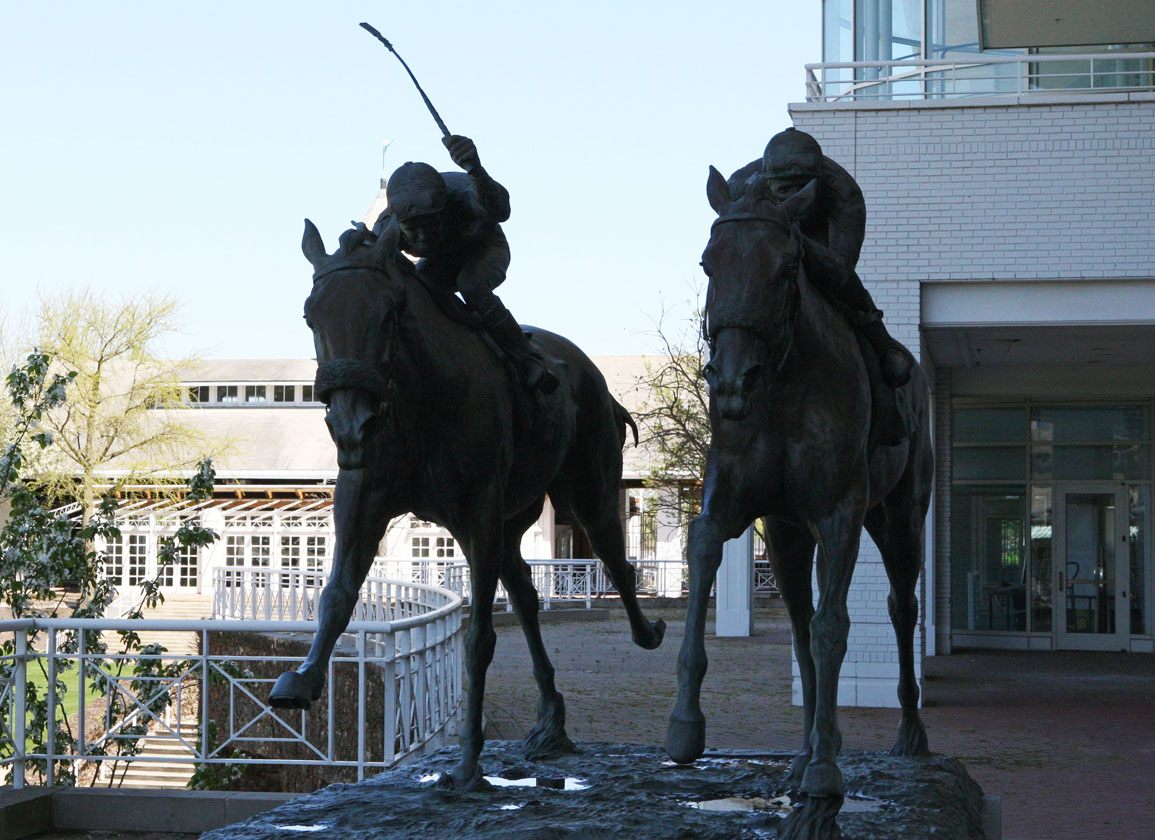
The 'Against All Odds' statue overlooking the Arlington paddock | Coady


“Right when we got about six jumps before the wire, I could see it was John Henry,” Delahoussaye told Thoroughbred Classics. “I looked out the corner of my eye, I knew who it was. I had a feeling if any horse was going to beat him, it was going to be him. I was right, unfortunately.”

For his part, Shoemaker wasn't convinced John Henry had gotten the better of the bob.

“Eddie was galloping out, I was trying to catch up with him, I was going to try to save $20,000 [of the purse money],” 'The Shoe' told Thoroughbred Classics. “I couldn't catch him.”

Shoemaker told the Associated Press after the win: “This is the greatest race I've ever ridden in. He's a great horse and this was a great field.” The finish of the inaugural Million is memorialized in the 'Against All Odds' statue that overlooks the Arlington paddock.

John Henry was upset in the 1983 Million by Tolomeo (Ire), but became the only two-time winner of the race with a more decisive victory in 1984.

The name has changed. The purse is now six figures, not seven. It figures to be the final renewal, sadly, at least at Arlington. But the memories of those 10 furlongs on that final Sunday of August now 40 years in the rear view will never be torn down.


The post Original Seven-Figure Race Exceeded Expectations appeared first on TDN | Thoroughbred Daily News | Horse Racing News, Results and Video | Thoroughbred Breeding and Auctions.

Source of original post

Verified by MonsterInsights