Doug O’Neill Talks ‘Questionable’ Haskell DQ, Whip Rules On Writers’ Room

Trainer Doug O'Neill experienced the agony and ecstasy of racing early Saturday evening at Monmouth Park, all in the span of less than 10 minutes. First, his star 3-year-old Hot Rod Charlie (Oxbow) won a hard-fought stretch battle in the GI TVG.com Haskell S., which would have been the colt's first Grade I victory after a handful of near-misses.

But quickly after the race, in which Hot Rod Charlie came in on Midnight Bourbon (Tiznow) and the latter soon stumbled and lost rider Paco Lopez, the red inquiry sign lit up on the toteboard. The stewards eventually disqualified 'Charlie', demoting him to last, a decision O'Neill expressed some issue with while sitting down with the crew from the TDN Writers' Room podcast presented by Keeneland for a wide-ranging discussion Wednesday morning. The podcast can be viewed here; the audio-only version can be found here or on Apple Podcasts or Spotify.

“Obviously, I'm so biased, but I thought the disqualification was a little questionable,” he said. “But that's part of the sport, right? It's part of all sports. Sometimes, you think you're safe at home and you're not. It's just a very unfortunate thing, but we're extremely fortunate that both Paco and Midnight Bourbon are OK.”

Debate has raged in the hours and days since the near-disaster in the Haskell about whether or not the whip ban instituted by the New Jersey Racing Commission at Monmouth took away a tool jockey Flavien Prat could have used to prevent the spill. O'Neill, the Green Group Guest of the Week, was cautious with his words, but made clear his disagreement with the new crop rules.

“It's interesting to me how a lot of people make rules who can't really relate to what's going on,” he said. “I wouldn't want to get too involved in the details because I've never been a jockey, but I know a lot of top riders [disagree with the ban]. The riding crop has evolved. It's so ridiculously subtle, and it really just serves as a reminder every now and then. These horses are big animals and the connection between horse and human is strong, but sometimes you need to encourage them to do something you want to do, which a lot of times is to separate from whoever they're running alongside. So yeah, I do wish they'd reconsider that.”

O'Neill, who got choked up on the NBC telecast of the Haskell, explained the roller coaster of emotions he felt from when the gates opened to the time the DQ was announced.

“I'm king of a big softie in that way,” he said. “I got a little emotional seeing Eddie, Hot Rod Charlie's groom, hand off Charlie to Lava Man leaving the paddock, because those two horses have been so amazing to me. I love them both. I watched the race on the apron and never saw anything happen. So I was just elated; I thought we won. All the hard work that Eddie and Johnny and the rest of the team had put in every day leading up to this, I was like, 'Wow, Charlie did it, man. Charlie did it.' Then when I got down there and they said a rider went down, I'm like, 'What?' So that added all kinds of craziness to it and it was a real unique experience. Again, I was just grateful when I heard Paco was going to be OK and that the horse was up running around. So that was all good.”

As for what's next for his current star as he continues to hunt that elusive Grade I, O'Neill was noncommittal, but indicated he was leaning towards either giving Hot Rod Charlie a slight break or running him against elders in the GI TVG Pacific Classic Aug. 21 at Del Mar.

“The beauty of Bill Strauss and Greg Helms and my nephew Patrick, who own him and are very connected with him, is they've been so patient along the way,” he said. “And I think that's why we're seeing a 3-year-old who ran in the Derby who seems like he's just getting better and better. A lot of that, I think, is due to spacing and patience. So under that mindset, I got a feeling that we might not run for a little bit. We'll just have to play it by ear. We're stabled here at beautiful Del Mar Racetrack and Del Mar management's been great. So the Pacific Classic is definitely circled on our calendar, but by no means will we force the issue if we feel we're not ready.”

Elsewhere on Wednesday's podcast, which is also sponsored by West Point Thoroughbreds, the Minnesota Racehorse Engagement Project and Legacy Bloodstock, the writers broke down a stellar opening week of racing at Saratoga and the injunctive relief Bob Baffert received last week to be able to race in New York.

The post Doug O’Neill Talks ‘Questionable’ Haskell DQ, Whip Rules On Writers’ Room appeared first on TDN | Thoroughbred Daily News | Horse Racing News, Results and Video | Thoroughbred Breeding and Auctions.

Source of original post

Oireachtas Hearings Conclude

The last of a series of Oireachtas Hearings into horse racing in Ireland concluded on Tuesday with representatives of the Department of Agriculture, Food and the Marine the latest to answer questions.

The independence of the Irish Horseracing Regulatory Board (IHRB) was a topic of discussion among deputies. Representatives of the IHRB were involved in two sessions this month along with Horse Racing Ireland (HRI), while the Irish Racehorse Trainers' Association (IRTA) were also invited to meet the joint Oireachtas committee. This followed a number of high profile comments made in the media by trainer Jim Bolger.

“We are satisfied with the structure of the organisation and the board which is in statute in Ireland,” said an IHRB spokesperson. “This was reiterated by the Minister for Agriculture, Food and the Marine last week in the Dáil. “During our hearings, we welcomed the opportunity to detail the regulatory structure of the IHRB and to clarify matters raised by the parliamentary committee.”

Last week Charlie McConalogue, Minister for Agriculture, Food and the Marine in Ireland, was asked in The Dáil if he was satisfied with the current structure of the IHRB. “I am satisfied the current structure of the IHRB is sufficiently independent to ensure maximum confidence that any allegations concerning doping, animal welfare abuses or other illegitimate activities are adequately investigated and will be followed up, where necessary,” he stated at the time.

The current IHRB board comprises of H.R.D. McCalmont (Chairman), Martin P. O'Donnell (Vice Chairman), John Byrne, Philip McLernon, J.J. Power and David McCorkell.

The post Oireachtas Hearings Conclude appeared first on TDN | Thoroughbred Daily News | Horse Racing News, Results and Video | Thoroughbred Breeding and Auctions.

Source of original post

KTFMC Meeting: Labor Crisis in the Thoroughbred Industry

LEXINGTON, KY-The ongoing labor crisis in the Thoroughbred industry was the focal point of discussion at the Kentucky Thoroughbred Farm Managers' Club's monthly meeting, which was held on Tuesday and brought in a large audience for a discussion on the talk.

A panel of five industry participants and educators was on hand to give their perspective on the history of the issue and how the situation has worsened over time. They also spoke on projects currently in the works that have potential to bring in skilled labor and shared their thoughts on the best methods for effectively recruiting a new generation of workers.

“We had a board meeting and discussed what would be relevant for this meeting and this is a topic that pertains to every farm right now,” KTFMC President Courtney Schneider said. “You hope that there's a light at the end of the tunnel, but it's an issue that needs to be addressed and we need to be educated about what we can do to bring in new people and keep them in the industry.”

“Our goal for the club is to refocus on issues that are important for farm managers–be it health and disease, operational issues or the bigger challenge of labor,” KTFMC Treasurer Gerry Duffy said. “It's an issue affecting every farm and everyone you talk to. Some people are in a desperate situation. Not only are you changing how you do things due to the absence of help, but it's putting an extra burden on the people you do have. It's not sustainable and we need to really get in front of the issue to try and solve it.”

Fasig-Tipton

Chris Baker was the first member of the panel to speak. The Chief Operating Officer of Three Chimneys Farm briefed the audience on the state of the issue when he first joined the industry through an entry-level position as a groom in 1986.

“It was a different time with 50,000 foals on the ground, the market was strong and input and labor costs were relatively low,” he said. “But even at that time, when labor was more abundant than it is today, I can still remember lamenting about finding the next group of people coming up to do this. The problem of identifying, recruiting and retaining a workforce isn't a new one, but it was less of an issue then.”

According to Baker, the connection with the horse–or lack thereof–is a main cause for today's limited employee pool and poor job retention.

“Finding help seemed easier [in 1986] and I think some of that was because we were less removed from an agrarian society. When you look now at the composition of the workforce, with a lot of Latinos, many of the people who have immigrated here are less removed from or are coming from an agrarian society. I think that's a big part of it–the connection with the horse. Without that, it can be hard to make sense of what you have to do and the sacrifices that need to be made in order to have a career in this industry.”

Baker emphasized that in order to recruit a strong, skilled workforce, finding the right person to fit the job is crucial.

“If you're going to come to work in the Thoroughbred industry, you probably have a different realistic financial ceiling than if you were going into medicine or finance,” he explained. “So why do you come to the horse business? It all comes back to the horse. I think if we can put the horse first in all we do, make people aware and make that focus on the horse as part of your recruiting, you're going to get the kind of people you want who are doing it for the right reasons.”

He continued, “We need to focus on a fair wage, a good work environment where people and horses are treated with respect, because that's part of making people feel like they're a part of something special, and then we need to train, develop and encourage so there is infrastructure in place for people to grow.”

Frank Taylor, Vice President of Taylor Made Farm, also shared his experiences as an employer. Taylor Made has several programs that Taylor said have been key to keeping their operation fully staffed.

This year, Taylor Made has started a pilot program called the Taylor Made School of Horsemanship. Created in partnership with Shepherd's House, a transitional residential drug addiction treatment center in Lexington, the program set a goal to bring in five trainees every 90 days. The workers spend their days on the farm and then return to the Shepherd's House every evening, where in addition to food and housing, they are also provided with counseling services.

“We have one barn set up where they are all working together and we also have a director there, someone who is good at teaching,” Taylor said. “I think it could be huge in the future. It's such a win for everybody. Obviously it's a win for society, it's a win for the horse business and a win for Taylor Made, and if we can give these people second-chance employment and help them get on their feet, I think we can do a lot of great stuff.”

While the project is still in the beginning stages, Taylor said he envisions future expansion.

“When you give these people a second chance and they are fully recovered, they become an example for everybody else,” he said. “For people dealing with addiction, one of the things that keeps them going is helping other people. So our hope is that we grow this and help a lot of people, who in turn help a lot of other people. We want to take this, get it perfected and show it to other farms. This has a lot of potential and we could envision 50 to 60 people a year graduating from this program and going out into the industry.”

Taylor said that his farm has also been a part of the H-2A Temporary Agricultural Workers program for four years.

“This program has been a godsend,” he said. “The thing about these guys is they're coming in and they're grateful and they love what they're doing. They can do two times as much work as the average person, maybe three.”

The Kentucky Equine Education Project (KEEP) Foundation and the Kentucky Chamber of Commerce Workforce Center has joined forces to launch the Equine Workforce Initiative in an effort to address the shortage of equine workers on a state level. Laurie Mays, another member of the panel, serves as the initiative's Equine Talent Pipeline Project Manager.

“We are in year three of this initiative,” she said. “We bring employers together and give them a safe space to discuss their struggles in terms of workforce development. We look at things like what skills go along with specific positions and how many people an employer might need in these positions.”

One problem her team has encountered, Mays said, is that accurate research on employment in the equine industry is difficult to pinpoint quantitatively due to the broad scope of data the state agency has to offer on employment in agriculture as a whole.

“One of the things we're doing is trying to get hard data for the needs of the industry,” Mays said. “This information and data can feed into our state's statistical agency so we can have a better idea of what our true needs are. This gives us a better way to talk to training programs when we can show them the actual number of positions we need to fill.”
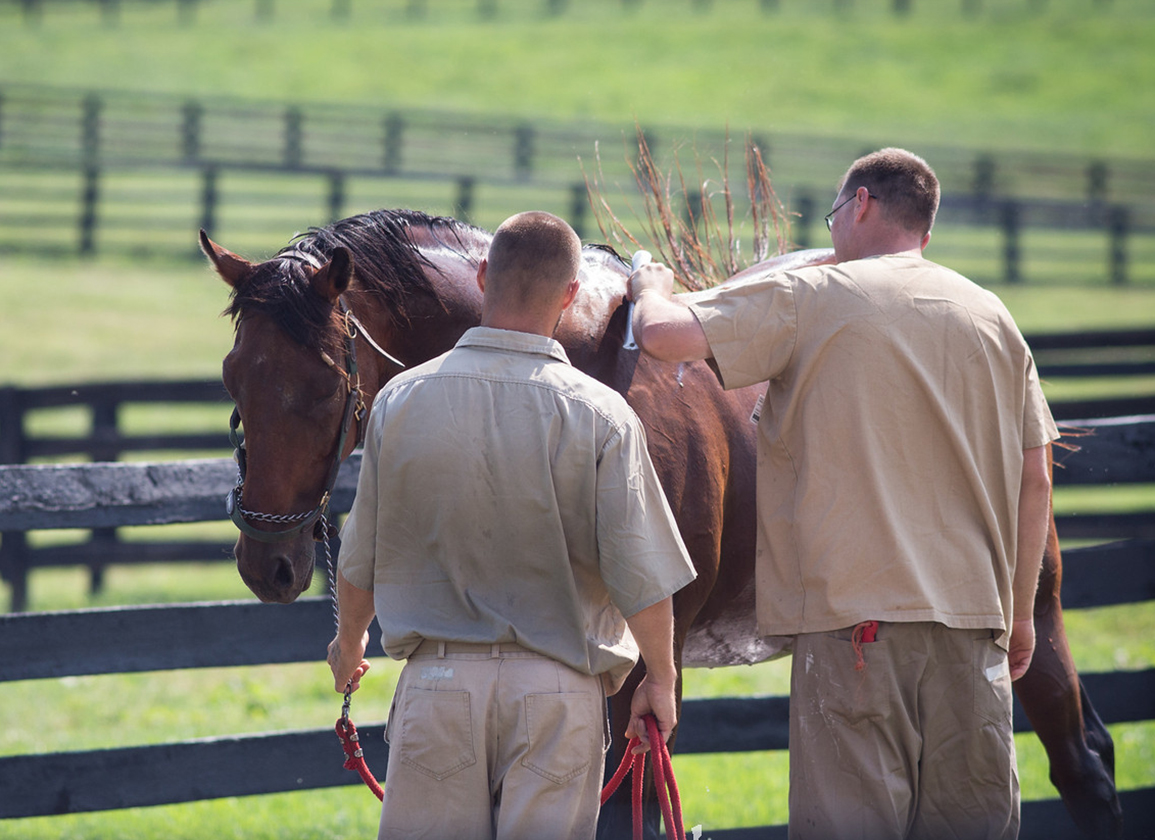
The program at Blackburn Correctional Complex currently has seven graduates working in the industry. | EquiSport Photos

The Equine Workforce Initiative is in the process of developing several other programs that could prove to be valuable resources for employers. In partnership with the Thoroughbred Retirement Foundation and the Blackburn Correctional Complex in Lexington, Mays and her team are working to create meaningful connections between inmates who have undergone training on the farm and potential employers so that graduates of the program have a job as soon as the time comes.

“As of yesterday, we've placed seven people in Lexington at farms and vet clinics and it's going very well,” May reported. “We've heard great feedback from the employers who have hired them. We're going to look at doing an educational tour for employers to meet the instructors and the gentlemen, see the facility and learn more about what they learn.”

Savannah Robin serves as the internship coordinator for the University of Kentucky's Equine Program. She joined the panel to speak on the growing population of higher-education graduates seeking a career in the equine industry.

Robin shared that seven institutions in Kentucky offer an equine program. At the University of Kentucky, 300 students are in the program at any given time and on average, 89% come from out of state.Each student is required to complete an internship in order to obtain their degree at UK, and Robin said that on average, 21% of these internships focus on horse and farm management. However, only 9% of the UK Equine Program's alumni base currently works in that same field.

“We need to figure out how to tap into that 21% and help retain them within an industry than can provide them with leadership experiences,” Robin said.

Katie LaMonica, the Charities Manager for Godolphin, closed out the panel by reminding the audience about the upcoming Thoroughbred Industry Employee Awards.

“We are heading into the sixth year of the TIEA Awards,” she said. “If we're looking for ways to reward and recognize our staff, this is a great way to do it. This year, all seven award categories have a sponsor. Our nominations are now open and we also have a new award. The Support Service Award is for your maintenance crew, gate grew, night watch team, farriers-people who don't necessarily work on the end of the shank, but they keep you going.”

The audience present at the meeting consisted of a diverse group of both well-established and up-and-coming industry participants, with UK Equine students and Kentucky Equine Management Internship (KEMI) members on hand. During the 'Q and A' session at the end of the meeting, much discussion was brought forth on the topic of work-life balance and the incoming generation's emphasis on the subject.

“Millennials and Gen Zers get beat up sometimes in terms of their work ethic, but the values of their generation won't disappoint you in what they can bring to the workforce,” Robin said. “These students need different things. They need different things than what I needed when I graduated. They're looking at work-life balance early on so that they don't burn out and can go on a long time within a career and be sustainable within that career.”

Baker and Taylor agreed that better working conditions and increased job flexibility are areas they could see evolving in the future, but said that participation in the Thoroughbred industry would always require hard work and sacrifice.

Baker said, “Do we need to adapt and provide opportunities to broaden the people that come to this business for a career? Yes. But on some level, I think the people that do the best, go the furthest and accomplish the most are those that embrace the lifestyle and the sacrifices that come with it in their personal life.”

“It is a lifestyle and it's not a job,” Taylor echoed. “If you're getting in the horse business and you want to be successful, it has to be a lifestyle. If you're going to get in this business, you better love it and be dedicated to it.”

“It's a matter of figuring out a way to make our industry available to the incoming generation who, quite rightly, doesn't want to work seven days a week,” Duffy said in conclusion. “We have competition from other industries who are paying more and making variable work times and conditions available to people, but behind that there's some great work going on here and some great initiatives. We have to keep the conversation going. We're here to get a discussion going and not necessarily present the answers, but just to get the industry talking and collaborating. As an industry, we need to come together and try to solve our issues together.”

The post KTFMC Meeting: Labor Crisis in the Thoroughbred Industry appeared first on TDN | Thoroughbred Daily News | Horse Racing News, Results and Video | Thoroughbred Breeding and Auctions.

Source of original post

Malathaat Puts Her Unbeaten Status On The Line In Saturday’s CCA Oaks

Shadwell Stable's undefeated Malathaat has demonstrated class and determination through five wins in as many lifetime starts and will vie to keep her perfect ways afloat in Saturday's 105th running of the Grade 1, $500,000 Coaching Club American Oaks going nine furlongs for 3-year-old fillies at Saratoga Race Course.

The Coaching Club American Oaks was named in honor of a club formed in 1875 for which a membership requirement was to be able to navigate a coach and four horses with a single group of reins. Inaugurated in 1917, the historic event often attracts the winner of the Kentucky Oaks and has seen 14 fillies sweep the Kentucky Oaks-CCA Oaks double, including Hall of Famers Princess Doreen [1924], Dark Mirage [1968], Davona Dale [1979], Bold 'n Determined [1980], and Open Mind [1989].

Multiple fillies have used the CCA Oaks as a steppingstone to Champion 3-Year-Old Filly honors, including Ruffian [1975], Wayward Lass [1981], Mom's Command [1985], Ajina [1997], Ashado [2004], Smuggler [2005], and Questing [2012]. Three of the last five winners of the CCA Oaks have notched such honors with Songbird [2016], Abel Tasman [2017], and Monomoy Girl [2018].

Two-time Grade 1-winner Malathaat arrives at the CCA Oaks off a hard-fought triumph in the Grade 1 Kentucky Oaks on April 30 at Churchill Downs, where she engaged in a stretch duel with graded stakes winner Search Results and won by a neck, garnering a career-best 95 Beyer Speed Figure.

The Kentucky Oaks triumph came after a successful sophomore bow in the Grade 1 Ashland on April 3 at Keeneland where she tracked leisurely fractions and closed in on Pass the Champagne in the final half-furlong to win by a head.

During her juvenile campaign, Malathaat notched stakes triumphs at Aqueduct in the Tempted and Grade 2 Demoiselle after giving Hall of Fame jockey John Velazquez his 2,000th Belmont Park victory in October.

Hall of Fame trainer Todd Pletcher will look to extend his seven-win record in the prestigious race when he saddles Malathaat. A victory would give Pletcher a third CCA Oaks triumph with a Kentucky Oaks winner, having sent out Ashado and Princess of Sylmar [2013].

“She's a very gifted filly,” Pletcher said. “She's just been perfect so far and she's a pleasure to train, and just does everything right. When you have one that's undefeated you just want to keep that intact and hope that everything goes smoothly and that she's able to show her capabilities once more.”

Malathaat could also provide her multiple champion-producing sire Curlin his third CCA Oaks winner after Curalina [2015], also trained by Pletcher, and last year's winner Paris Lights.

Bred in Kentucky by Stonestreet Thoroughbred Holdings, Malathaat is the first offspring out of the A.P. Indy broodmare Dreaming of Julia, who captured the 2012 Grade 1 Frizette and the 2013 Grade 2 Gulfstream Park Oaks for Pletcher.

“She's a bigger physical than Dreaming of Julia and maybe Dreaming of Julia was a tad quicker than she is,” Pletcher said. “But she's just so efficient and has a long stride and it seems like she's bred to get better now. She's growing into that big frame. She's fun to have in the barn and I'm looking forward to get her going again.”

Malathaat was initially campaigned for an earlier return to action.

“We did miss a little time with her and she was a little bit sore, so we took it easy with her,” said Shadwell Stable's vice president and general manager Rick Nichols. “Todd had her training real well into the Ashland. I loved the way that she fought in the Oaks. She just has so much class and determination.”

Malathaat has settled into her surroundings at Saratoga and recently breezed a half-mile in 48.05 seconds on July 17 over the main track in company with Grade 2 Mother Goose-winner Zaajel.

“She's doing great and seems to be loving Saratoga,” Nichols said. “The main thing about her is early on, she had such an effortless gallop. She covers the ground so easily. It doesn't look like she has to work hard at all.”

Pletcher said he is grateful for his relationship with Shadwell, for whom he also has campaigned recent graded stakes winner Mutasaabeq.

“We've been blessed to have received some of their horses and have built some good relationships so far,” Pletcher said. “To have [graded stakes winners] Mutasaabeq and Zaajel and Malathaat, we're off to a good start and happy to be part of the team.”

Shadwell purchased Malathaat for $1.05 million from the Denali Stud consignment at the 2019 Keeneland September Yearling Sale.

Shadwell Stable's founder Sheikh Hamdan bin Rashid al Maktoum passed in March, and Nichols said Malathaat could dawn a new era for the prestigious racing and breeding operation.

“Physically, she's about as perfect as you can get,” Nichols said. “She just looked like a horse that would have a lot of class. She had a very attractive head, beautiful balance, and her limbs were good. As soon as I saw her at the sale, I knew Sheikh Hamdan would love her. Malathaat could be the foundation mare of the next generation for his family.”

Velazquez, who has guided Malathaat to three of her five wins, retains the mount from post 1. A five-time winner of the CCA Oaks, Velazquez seeks to become the standalone winningest jockey in the race's history.

Two Kentucky Oaks participants face Malathaat once more, including Beach Haven Thoroughbreds' Maracuja, who was seventh in the Kentucky Oaks.

The Rob Atras-trained daughter of third crop sire Honor Code broke a touch slow in the Oaks, but made up considerable ground to run seventh.

“In the Oaks, she broke a little flat footed, but we're hoping she breaks sharper and won't be too far back in a shorter field,” Atras said. “She was down on the inside and going into the first turn she got shuffled back. She made a good run late and I was happy with the performance. She just needs to break sharper and get in a more tactical position.”

Prior to the Kentucky Oaks, Maracuja was a third-out maiden special weight victress going 6 ½ furlongs over the Aqueduct main track en route to a runner-up finish in the Grade 3 Gazelle on April 3 at the Big A.

“She came back really well, and we skipped the Acorn and were targeting the Mother Goose but she wasn't quite right,” Atras said.” She's doing well right now. She bounced out of it well. We worked her three times and I'm hoping she's good enough to run a top race.”

Jockey Ricardo Santana, Jr. will guide Maracuja from post 2.

Stonestreet Stables' Clairiere, fourth in the Kentucky Oaks, arrives off a close third to Zaajel in the Grade 2 Mother Goose for Hall of Famer Steve Asmussen.

The bay daughter of Curlin attempts a second graded stakes victory after notching her seasonal debut in the Grade 2 Rachel Alexandra on February 13 at Fair Grounds Race Course over Travel Column. Clairiere was second to Travel Column in the next out Grade 2 Fair Grounds Oaks.

A Kentucky homebred, Clairiere is the first offspring out of the three-time Grade 1-winning Bernardini mare Cavorting, who earned over $2 million through a lifetime record of 13-8-1-1.

Jockey Irad Ortiz, Jr. earned his first Grade 1 victory when guiding Questing to victory in the 2012 CCA Oaks and will ride Clairiere from post 4.

Completing the field is allowance winner Rockpaperscissors for WinStar Stablemates Racing, who swept the exacta in last year's CCA Oaks with Paris Lights and Crystal Ball.

Trained by Rodolphe Brisset, the daughter of Distorted Humor broke her maiden at a one-turn mile in September at Churchill Downs and did not race again until June 21, where she defeated older allowance company at Indiana Grand Race Course by 9 ¾ lengths.

Breaking from post 3, Rockpaperscissors will be ridden by Luis Saez.

The Coaching Club American Oaks is slated as Race 5 on Saturday's 11-race card, which also features the Grade 3, $200,000 Caress. First post is 1:05 p.m. Eastern. Saratoga Live will present daily television coverage of the 40-day summer meet on FOX Sports. For the complete Saratoga Live broadcast schedule, and additional programming information, visit https://www.nyra.com/saratoga/racing/tv-schedule.

The post Malathaat Puts Her Unbeaten Status On The Line In Saturday’s CCA Oaks appeared first on Horse Racing News | Paulick Report.

Source of original post

Verified by MonsterInsights