It may have been “just” a West Virginia-bred maiden race at Charles Town on July 16, but there was a time that 54-year-old owner Bill Goodman considered it a win just that Eternal Heart was still alive.
The filly, a 3-year-old daughter of First Samurai, has already endured and overcome more adversity than most horses face in a lifetime. As a yearling, Eternal Heart's nervous system was attacked by a parasite, Sarcocystis neurona, the culprit behind the debilitating and often deadly disease Equine Protozoal Myeloencephalitis (EPM).
Her recovery is a story about perseverance, about faith, and, above all, about the people who work incredibly hard to do right by the animals with whose lives they are entrusted.
“This business gets a really bad rap, but I've seen some people do some amazing things,” Goodman said, his voice wavering as the emotion overwhelmed him. “They get this horse, this West Virginia-bred with these issues, and just treated her like she was Ruffian or something. That's just the kind of people who are in this business. People like this need to be known. And the little guys don't get the chance for these good horses, and they should, because she would never be where she is if she had been in any other barn.”
Like any good blockbuster film, the journey began with a midlife crisis.
In 2011, Goodman was managing an Irish pub for a friend in Miami, Fla., and had never worked around horses. He loved the races, however, and spent many an afternoon playing the ponies at Gulfstream Park.
“One morning at like six a.m., as I was putting the night deposit in the bank, I just had this thought, 'I don't want to be here, I don't want to do this anymore,'” Goodman explained. “I said to myself, 'I think I'll go to Gulfstream Park, and I'm gonna get a license, and I'm gonna get a job there. So I walked through the back gate, having never walked a horse in my life.”
Goodman was told no at almost every barn, but trainer Peter Gulyas saw him walking the backside and quickly agreed to show Goodman the ropes. That lasted for several months, but when Gulyas got down to just four horses, he had to let Goodman go.
Ever the pragmatist, Goodman called the phone number on trainer Todd Pletcher's website, and got connected with assistant Whit Beckman at Keeneland. Beckman hired him to hot-walk over the phone, and Goodman drove up to Lexington that very night, arriving at Keeneland at three in the morning.
“I worked for Todd for just three weeks, and then I got to go to the Derby at Churchill with Gemologist,” Goodman said. “I was just in heaven. We went from there to Saratoga, and I started asking about learning how to groom. By the time we went to Florida, I had my first four horses.”
Goodman cared for some top horses for Pletcher, attending three Kentucky Derbies and three Breeders' Cups with his charges. Among his favorites were We Miss Artie, My Miss Sophia, Competitive Edge and Ectot.
“I learned a lot from Todd,” said Goodman. “I was very lucky.”
Tragedy struck in 2017 when Goodman's father died. Pletcher told the groom to take as much time off as he needed, that he would always have a job when he was ready to come back.
Goodman had been thinking about shifting into the bloodstock business anyway, and his father's passing allowed him to step back and start working toward that goal. In 2018, he started looking for his first horse, and he finally found her at the October Fasig-Tipton Midlantic yearling sale at Timonium.
Under the banner WJG Legacy Equine (his father's initials), Goodman purchased Eternal Heart for $50,000. He'd gone a bit above his budget, but he just felt there was something special about the compact chestnut filly.
Eternal Heart was sent to Susan Montanye's farm in Florida for her early education, and everything proceeded according to schedule for the first several weeks.
On Oct. 28, Goodman got the call.
“I remember it like it was yesterday,” Goodman said. “It was 11:31 in the morning, and the phone rang and it was Susan. I knew right away something was wrong. I remember picking up the phone, and I just said, 'Uh oh.' And she said, 'Yeah, Uh-oh.'”
Eternal Heart's right ear was at a 90-degree angle to her head, her right eye wasn't blinking, and the skin was sagging on the right side of her face.
“She looked like she'd had a stroke, basically,” said Goodman.
Veterinarians quickly diagnosed the filly as neurologic, and started treating her intensely right away. She regained the blinking in her right eye after 24 hours, but two weeks later Goodman got another call.
The parasite, which had originally attached to the filly's brain stem, had migrated to her spinal cord after the aggressive treatment. Now, Eternal Heart was losing control of her hind end, and the prognosis wasn't good.
Goodman was told that euthanasia was the best remaining option, and his insurance company called to offer him a full payout for the filly's $50,000 value.
“I couldn't make the decision, and the vet said she wasn't in pain,” Goodman said. “So I put my head in the sand like an ostrich and said, 'Keep treating her.'”
Montanye suggested that it might not be a bad idea to have Nieke Mailfat, an Eastern medicine specialist, take a look at the filly. Goodman agreed.
“Nieke looked at the filly and she told me, 'I can't make her a racehorse, but I think I can make her a horse,'” Goodman remembered. “Right then it was like, what do I do now? If I put her down now, what kind of a person am I? Yeah, I could get my money back, but how am I gonna live with that?
“I thought I was prepared for it, but you're now in charge of this life. I knew right away when they told me, I knew it was going to be a moral decision.”
Prior to treatment, Eternal Heart registered about a 4.5 on the neurologic scale, which runs from 1 to 5 with 5 being the worst. Mailfat told Goodman that if there was no improvement in three weeks, the filly would never get better.
In just four days, though, Eternal Heart was showing marked improvements. She'd moved to about a 3.5 on the neurologic scale, and after two weeks she was able to go out in a little round pen.
“She was wobbly but she never fell, and she was just happy to be out,” Goodman said. “I was down there constantly, and she didn't look like the same filly. She's always been a good keeper, though. She'll eat you out of house and home, so that probably saved her.”
In January 2019, Montanye called to say the filly was doing so much better that she wanted to put a saddle on her and tack walk her. Taking small steps forward, Eternal Heart progressed to walking around with a rider on, lunging in the round pen, then jogging on the track by mid-February. In March, they started to let her gallop a bit.
“She was still a little bit unsteady, but she never tripped or stumbled, she just continued to get better,” Goodman said. “Still, the thought process was, 'She can one day be a horse.'”
By May, Eternal Heart told her caretakers that she was ready to stretch her legs in her first “breeze.” By July, the filly showed off her improvement with a work in company, going a quarter in 25 ½ seconds.
“Now the thought process changes to, 'Wow, maybe she can race,'” said Goodman. “Susan said it was time for her to move on, and I decided to send her to Caio Caramori.”
The son of trainer Eduardo Caramori, Caio operates out of the Thoroughbred Training Center in Lexington. The two met because Goodman had become friends with Pletcher assistant Byron Hughes. Hughes and Caio Caramori were childhood friends, and Hughes brokered the introduction shortly after Goodman started working for Pletcher.
Goodman and Caramori started playing golf together and talking horses. Eventually, their friendship progressed to the point that Goodman would stay on Caramori's parents' farm whenever Pletcher's string was based in Lexington, and Goodman even lived there for a while after his father died.
“Sending her to Caio was unquestionably the best decision I've made, because she would never be where she is today without him and his wife, Emma,” Goodman said. “They're just good people.”
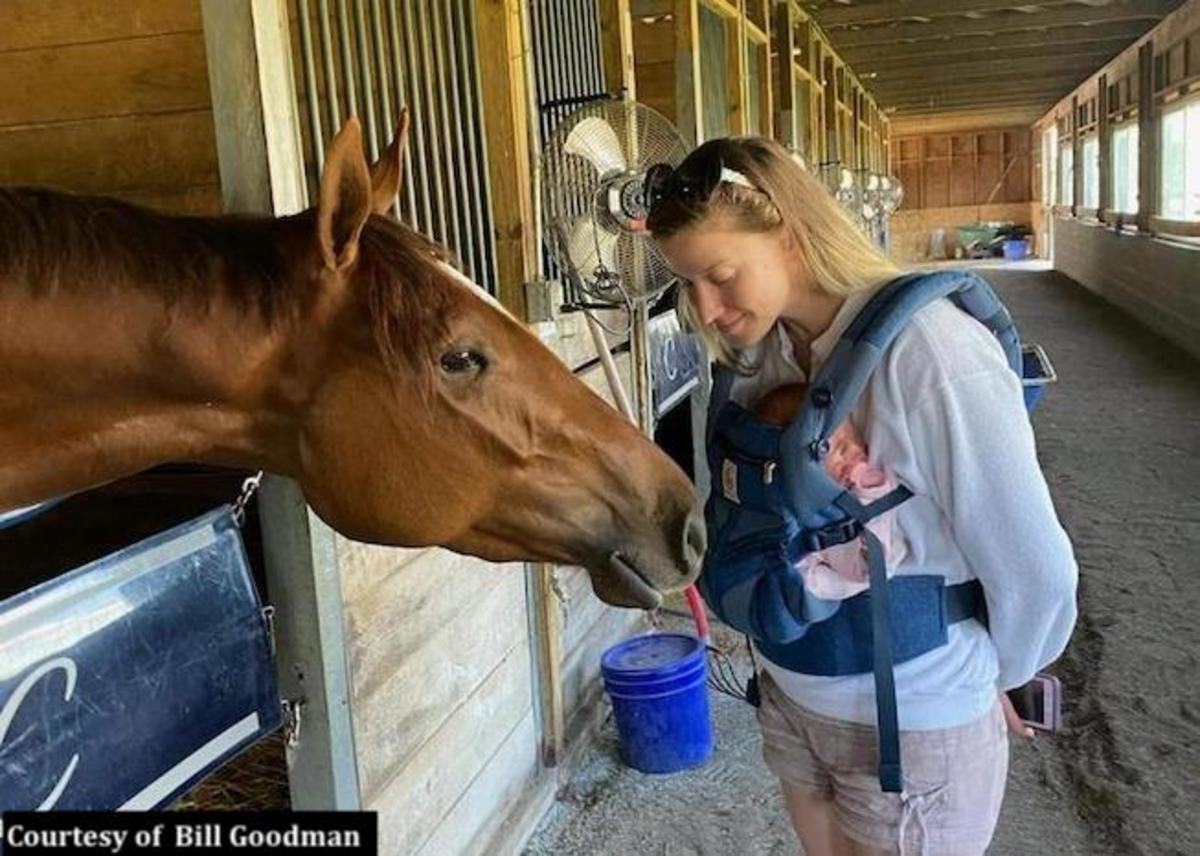
Emma Caramori and baby Cora visit Eternal Heart
Eternal Heart arrived in Lexington on July 17, and Caramori quickly suggested treating her for EPM once again. The trainer warned Goodman that treating the filly might cause her to regress in the short term, but he felt strongly that it was the best thing for her moving forward.
She did regress, but after a week Eternal Heart started going the right way again. Caramori was almost ready to start looking for a race for her in December, but since she'd missed out on so much early training, Eternal Heart just hadn't had the physical preparation to be ready to race at two.
Caramori turned her out for 90 days over the winter in Florida, then started to bring her back again. She'd jog one day, then be turned out the next day for nearly a month before Caramori resumed full training with her in April.
“Caio just treated her like she was his own horse,” Goodman said. “I was in the stall a lot, but when I had to leave Florida to go work for Dermot (Magner), I knew she was in good hands.”
When Eternal Heart was ready, Caramori set up a breeze with company, a filly who had won at first asking. Working from the gate, Eternal Heart was a couple steps slow at the start and got out-breezed.
“Caio called me and said, 'Don't be disappointed,'” remembered Goodman. “It was hard not to be, but the next week he called again and said, 'Eternal Heart told me she wants a rematch.'”
In their next matchup, Eternal Heart blew the doors off her rival. It was time to enter her in a race.
Goodman drove down to West Virginia on July 16 to watch Eternal Heart win at first asking, racing without Lasix and topping her nearest rival by three-quarters of a length to earn $16,125.
“I'll never forget when she turned into the paddock at Charles Town, she had this look on her face like 'I'm not in Kansas anymore,'” said Goodman. “In the race, she split horses and then she just never let anybody get by her. The jockey, J.D. Acosta, told me after the race, 'Man, she is so green but she has so much talent.' His agent called the next day and said he wants to keep riding her!”
Future plans for Eternal Heart call for the filly to stay in West Virginia, where there are multiple conditions she can run through.
“Even if she never wins again, just that she did what she did, it's so impressive,” said Goodman. “She's already paid me back, big-time. … She's just got this something about her, she just doesn't want to lose. It's pretty humbling, actually. For two years, she has consumed every moment of my thoughts.”
Working with horses has filled a place in Goodman's life he hadn't known was empty, and the journey with Eternal Heart has reemphasized just how important it is to find the right people and to never give up.
“Caio and Susan and everybody, they've made her into a racehorse,” Goodman said. “They've protected her and they've protected me, and they've put up with me. I've been fortunate to make good decisions, and those good decisions were a product of how I was raised and the people who raised me. Just hanging around people who are good people, and who are going to do the right thing.”
The post Breeders’ Cup Presents Connections: ‘What Kind Of A Person Am I?’ appeared first on Horse Racing News | Paulick Report.
