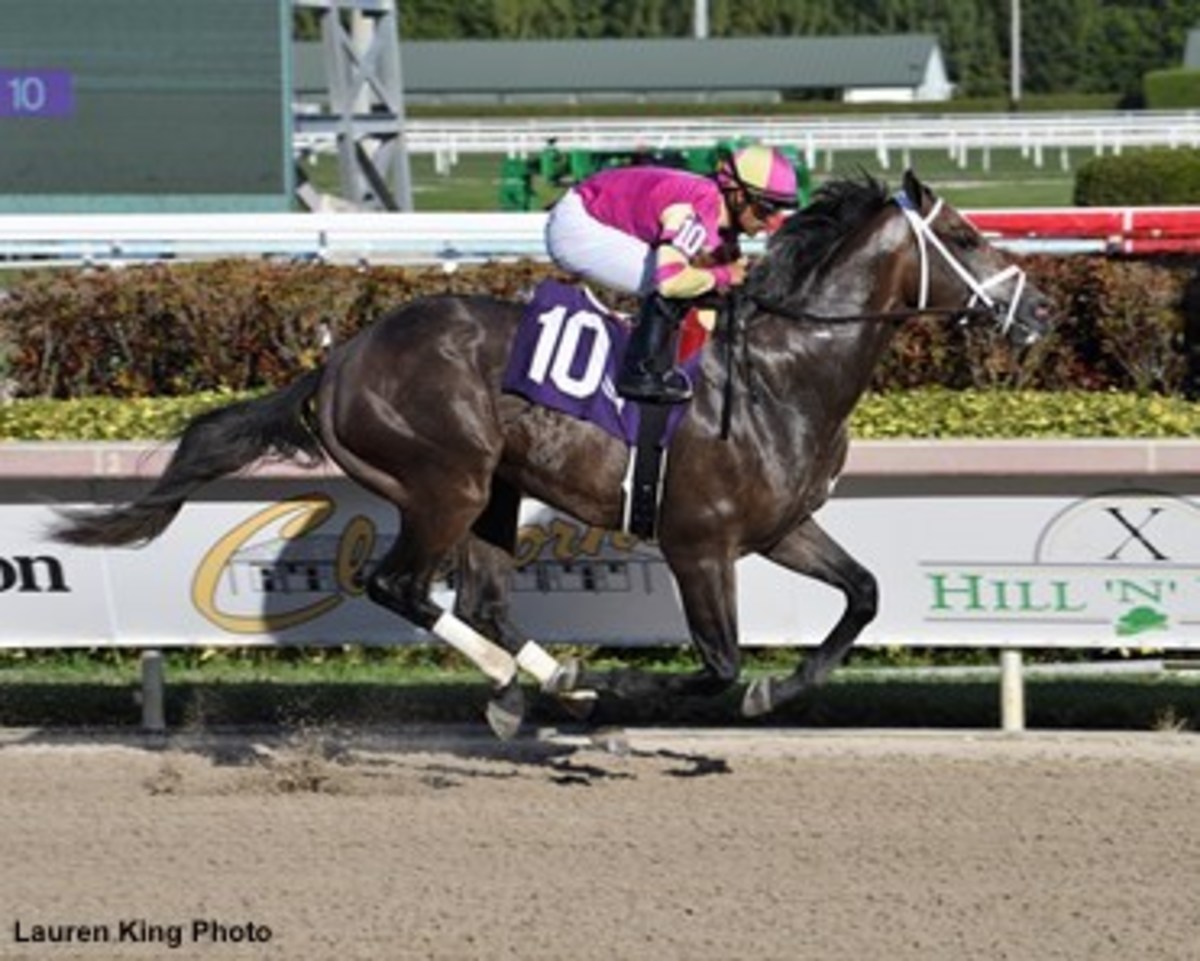
Go For Gin (Cormorant–Never Knock, by Stage Door Johnny), who was the oldest living Kentucky Derby winner, passed away Tuesday due to heart failure at the Kentucky Horse Park, where he had lived since retiring from stud duty in June 2011. The 31-year-old won the 1994 Kentucky Derby and was second behind Tabasco Cat in both that year's GI Preakness S. and GI Belmont S.
“We're honored that Go For Gin was an ambassador of the park for nearly 12 years,” said Kentucky Horse Park Executive Director Lee Carter. “As a visitor favorite, Go For Gin brought visitors from around the world to the Bluegrass and introduced new fans to the sport of Thoroughbred racing. He will be greatly missed by all of us at the Kentucky Horse Park.”
Go for Gin was bred in Kentucky by Pamela Darmstadt duPont, owned by William J. Condren and Joseph Cornacchia, and trained by Nick Zito. In addition to his Derby win with Hall of Fame jockey Chris McCarron, Go for Gin also won the 1993 GII Remsen S. He won 14 out of his 19 races and earned $1,380,866.
Go for Gin took up stud duty at Claiborne Farm and was later sold to Bonita Farm in Maryland, where stood from 2004 until his retirement. His progeny have earned more than $16.5 million and include Albert the Great, winner of the 2000 GI Jockey Club Gold Cup and more than $3 million.
“It saddens me to learn about Go For Gin,” said McCarron. “My memories of him giving me a second Kentucky Derby victory will remain indelible in my heart for as long as I live. Rest in peace, my old pal.”
Go for Gin will be buried at the Memorial Walk of Champions alongside past Thoroughbred residents Forego, Bold Forbes, John Henry, Alysheba, and Da Hoss.
A public memorial service will be held for Go For Gin at a future date.
The Kentucky Derby is fast approaching, which means it's time for detailed looks at the horses that could fill the starting gate with Andrew Champagne of Catena Media and The Saratogian's Pink Sheet.
Check the Paulick Report every week for updated rankings that include news, notes, and opinions on the 3-year-olds that figure to take center stage.
We're officially less than two months away from the Kentucky Derby, and this past weekend saw four prep races bearing Derby points.
As it turns out, last week's list wasn't a bad indicator of horses to watch. The eighth and 11th-ranked horses from those rankings ran 1-2 in the Grade 2 Fountain of Youth, and the 14th-ranked horse won the G2 San Felipe.
We've got some new arrivals this week thanks to the results of the Gotham and John Battaglia Memorial, and a few runners made significant moves up and down the list. Let's take a look!
Kentucky-bred contenders will be highlighted in red, and will receive additional analysis into their breeders, broodmares, and auction histories. Pedigree notes are written by Joe Nevills.
#1: Epicenter
Pedigree: Not This Time – Silent Candy (by Candy Ride)
Owner: Winchell Thoroughbreds
Trainer: Steve Asmussen
Kentucky Derby points: 64
Epicenter suffered a hard-luck loss in the G3 Lecomte, when he did all the dirty work up front and got nailed on the wire. However, the G2 Risen Star was a totally different story. He demolished what certainly appeared to be one of the stronger fields we've seen to this point on the road to the Kentucky Derby. Smile Happy might've needed the race, but even so, that was an exceptional effort, one that stamps this front-running type as a major player.
Epicenter was bred in Kentucky by Westwind Farms, out of the Grade 3-placed stakes winner Silent Candy. He sold for $260,000 at the 2020 Keeneland September Yearling Sale. Westwind Farms bought Silent Candy pregnant to Scat Daddy for $130,000 in 2014.
#2: Smile Happy
Pedigree: Runhappy – Pleasant Smile (by Pleasant Tap)
Owner: Lucky Seven Stable
Trainer: Ken McPeek
Kentucky Derby points: 30
Hopes were high for Smile Happy's 3-year-old unveiling in the Risen Star. He was a pretty distant second that day, but I think there's reason for optimism. He hadn't run in nearly three months, and he was pretty far behind a moderate early pace. That race wasn't the goal, and I think there's reason to believe he'll take a big step forward wherever he runs next.
Smile Happy was bred in Kentucky by Moreau Bloodstock International Inc. and White Bloodstock LLC, out of the winning Pleasant Tap mare Pleasant Smile, whose four starters are all winners, also including the stakes-placed Wilko Rum, by Wilko. Smile Happy sold as a weanling for $175,000 at the 2019 Keeneland November Sale, and later brought $185,000 at the Keeneland September Sale.
#3: Classic Causeway
Pedigree: Giant's Causeway – Private World (by Thunder Gulch)
Owner: Kentucky West Racing and Cooper Clarke
Trainer: Brian Lynch
Kentucky Derby points: 16
It's tough to poke too many holes here. He cruised to an easy win in the G3 Sam F. Davis at Tampa Bay Downs, and he's taken steps forward in each of his four starts. That's the trajectory we want to see heading into Saturday's G2 Tampa Bay Derby, where he'll line up against fellow top-20 members Shipsational and Major General, among others.
Classic Causeway is a homebred for Kentucky West Racing LLC and the Clarke M. Cooper Family Living Trust, out of the stakes winner Private World, who is the dam of five winners from eight runners. Private World is herself a Kentucky West homebred.
#4: White Abarrio
Pedigree: Race Day – Catching Diamonds (by Into Mischief)
Owner: C2 Racing Stable and La Milagrosa Stable
Trainer: Saffie Joseph, Jr.
Kentucky Derby points: 12
Saffie Joseph has emerged as one of the winningest trainers in Florida over the past few years, so it was only a matter of time before he found a serious Derby hopeful on his hands. In this case, White Abarrio stamped himself as one to watch with an authoritative score in the G3 Holy Bull. His lone loss came under the Twin Spires, when he was third in last year's G2 Kentucky Jockey Club behind Smile Happy and Classic Causeway. He's back on the work tab ahead of the G1 Florida Derby, where he may have a rematch with the next horse on this list.
White Abarrio was bred in Kentucky by Spendthrift Farm, and he is the first foal out of the Into Mischief mare Catching Diamonds. He sold as a newly-turned yearling for $7,500 at the 2020 OBS Winter Mixed Sale. Spendthrift purchased Catching Diamonds as a yearling for $425,000.
#5: Simplification
Pedigree: Not This Time – Simply Confection (by Candy Ride)
Owner: Tami Bobo
Trainer: Antonio Sano
Kentucky Derby points: 54
Somewhat lost in the roughly-run Fountain of Youth was the fact that Simplification ran a monster race to get the money. After another slow start, he was taken back and had to circle the field to have any chance. That's precisely what he did, and he hit the wire well clear of one of the best fields we've seen to date on the road to the Derby. We'll see if his connections opt to train up to the first Saturday in May or take another crack at White Abarrio (and others) in the Florida Derby next month.
#6: Mo Donegal
Pedigree: Uncle Mo – Callingmissbrown (by Pulpit)
Owner: Donegal Racing
Trainer: Todd Pletcher
Kentucky Derby points: 12
I can't penalize Mo Donegal too much for scratching out of the Fountain of Youth. He didn't run due to a low-grade temperature, and even if he'd been fully healthy, he'd have had to work out a trip from a terrible, far-outside post. The winner of last year's G2 Remsen will go back to that route for his next start in the G2 Wood Memorial. A top-three finish there will almost certainly punch his ticket to Kentucky.
Mo Donegal was bred in Kentucky by Ashview Farm and Colts Neck Stables. He brought $250,000 at the 2020 Keeneland September sale.
#7: Forbidden Kingdom
Pedigree: American Pharoah – Just Louise (by Five Star Day)
Owner: MyRacehorse and Spendthrift Farm
Trainer: Richard Mandella
Kentucky Derby points: 50
The big question: How impressed are you with Forbidden Kingdom's easy score in the San Felipe? It was one of the more visually-striking efforts we've seen to date, as he went to the front early and only improved his position from there. The problem is, he didn't beat a whole lot in that event. Doppelganger ran an OK race to be second, I suppose, but none of the other runners showed much of anything (or, for that matter, were expected to). I'm hoping Forbidden Kingdom runs back in the G1 Santa Anita Derby, where we may be able to get a better idea of his two-turn abilities against a field of the best 3-year-olds in California.
Forbidden Kingdom was bred in Kentucky by Springhouse Farm, out of the Grade 3 winner Just Louise. He sold to his current ownership for $300,000 at the 2020 Fasig-Tipton Selected Yearling Sale. Springhouse Farm acquired Just Louise pregnant to Malibu Moon for $150,000 at the 2013 Fasig-Tipton November sale.
#8: Call Me Midnight
Pedigree: Midnight Lute – Overseen (by First Defence)
Owner: Peter Cantrell
Trainer: Keith Desormeaux
Kentucky Derby points: 10
Call Me Midnight was sent away at odds of 28-1 in the Lecomte and proceeded to light up the tote board. In doing so, he rallied from last to first, and while the early pace was solid, it's not like they were flying, either. This pedigree doesn't exactly scream “two turns,” but Call Me Midnight beat Epicenter that day (among others) and showed maturity doing it. We'll see if he can repeat that performance in a major Derby prep.
Call Me Midnight was bred in Kentucky by Hartwell Farm, out of the Juddmonte Farms-bred Overseen. His siblings include the stakes-placed Bayerly Seen, by Bayern. Call Me Midnight sold as a weanling for $25,000, while Hartwell Farm bought the unraced Overseen as a broodmare prospect for $16,000.
#9: Early Voting
Pedigree: Gun Runner – Amour d'Ete (by Tiznow)
Owner: Klaravich Stables
Trainer: Chad Brown
Kentucky Derby points: 10
While the G3 Withers didn't move the needle on first viewing, that day's runner-up, Un Ojo, came back to pull off a shocking upset in the G2 Rebel. That may mean there's more than what meets the eye when it comes to that early-season prep at Aqueduct, which this son of Gun Runner won in convincing fashion. There's still a chance Early Voting moves forward with another start or two under his belt, and Aqueduct's road to the Derby could provide a low-resistance route.
Early Voting was bred in Kentucky by Three Chimneys Farm, and he sold as a yearling for $200,000. Three Chimneys bought Amour d'Ete, a half-sister to top sire Speightstown, as a yearling for $1.75 million.
#10: In Due Time
Pedigree: Not This Time – Sweet Sweet Annie (by Curlin)
Owner: Edge Racing
Trainer: Kelly Breen
Kentucky Derby points: 20
When the dust settled in the Fountain of Youth, In Due Time crossed the wire second, with rider Paco Lopez accused by many of causing the spills that occurred turning for home. Unfortunately for this horse, that saga overshadowed him answering that he can go two turns, which he did in the affirmative against a decent field. We'll see where he shows up next, and if the jockey in question keeps the mount.
In Due Time was bred in Kentucky by Gary and Mary West Stables Inc., and he is the first foal out of the unraced Sweet Sweet Annie. The Wests bought Sweet Sweet Annie with In Due Time in utero for $115,000.
[Story Continues Below]
#11: Morello
Pedigree: Classic Empire – Stop the Wedding (by Congrats)
Owner: Blue Lion Thoroughbreds, Craig Taylor, and Diamond T Racing
Trainer: Steve Asmussen
Kentucky Derby points: 50
Morello moved to three-for-three with a professional score in the G3 Gotham at Aqueduct. It's entirely possible he didn't beat much in that effort, but he did it the right way. There are still some stamina questions here, as he hasn't gone two turns yet, but he was moving away from that field late and doing so pretty easily. Much like with Forbidden Kingdom, Morello's next start will likely come in deeper waters, and we'll see if he sinks or swims.
Morello was bred in Kentucky by Robert B. Tillyer and Dr. Chet Blackey, out of the Congrats mare Stop the Wedding. The colt sold as a weanling for $140,000 at the 2019 Keeneland November Sale, then he brought $200,000 at the following year's Fasig-Tipton Select Yearling Sale. In 2021, Morello sold for $250,000 at the Fasig-Tipton Midlantic 2-Year-Olds in Training Sale. Stop the Wedding was an $11,000 purchase, pregnant to Cairo Prince, by Tillyer at the 2020 Keeneland January Sale.
#12: Charge It
Pedigree: Tapit – I'll Take Charge (by Indian Charlie)
Owner: Whisper Hill Farm
Trainer: Todd Pletcher
Kentucky Derby points: 0
Charge it was incredibly impressive in breaking his maiden at Gulfstream Park by nearly nine lengths. While he may be a bit late to the party, all it takes is one strong showing in a remaining Derby prep to ensure a spot in the starting gate for that race. Pletcher took a similar route with Always Dreaming, who had zero Kentucky Derby points on the morning of the Florida Derby and was wearing roses just five weeks later.
Charge It is a Kentucky homebred for Mandy Pope's Whisper Hill Farm, out of the Indian Charlie mare I'll Take Charge. Pope bought the dam as a yearling for $2.2 million at the 2013 Keeneland September sale.
Zandon ran Mo Donegal to a photo finish in the Remsen before finishing third in the Risen Star. If nothing else, we know that distance shouldn't be what gets him beat, as both of those races were contested at nine furlongs.
Zandon was bred in Kentucky by Brereton C. Jones of Airdrie Stud, and the colt is the first foal to race out of the unraced dam. Zandon sold as a yearling for $170,000 from the Airdrie Stud consignment.
Rattle N Roll made his first start since October in the Fountain of Youth, and he ran like a horse that needed the race. He crossed the wire sixth that day against one of the highest-quality fields we've seen to date, and while he does drop in these rankings, I can't eliminate him entirely just yet. We saw him show plenty of potential when he won last year's G1 Breeders' Futurity at Keeneland, and if he runs to that promise, he could still be a major player moving forward.
Rattle N Roll was bred in Kentucky by St. Simon Place. The colt sold as a weanling for $55,000 at the 2019 Keeneland November Sale, then brought $210,000 as a yearling. St. Simon Place acquired Jazz Tune pregnant to Mineshaft for $20,000 in 2016, and sold her for $585,000 pregnant to Liam's Map at the 2021 Keeneland November Sale.
#15: Shipsational
Shipsational wins the Bertram F. Bongard at Belmont Park.
A New York-bred, Shipsational won a pair of restricted stakes races at Belmont last fall before going to the sidelines for more than three months. He came back in the Sam F. Davis, and while no other runner was touching Classic Causeway, he picked up enough pieces to run second behind that much-the-best winner. He'll get another shot at that rival on Saturday at Tampa Bay Downs.
#16: Pappacap
Pedigree: Gun Runner – Pappascat (by Scat Daddy)
Owner: Rustlewood Farm
Trainer: Mark Casse
Kentucky Derby points: 14
Pappacap showed a lot during a busy 2-year-old campaign, when he was second in both the Breeders' Cup Juvenile and American Pharoah Stakes out west. He then ran third in the Lecomte behind Call Me Midnight and Epicenter, but flopped when eighth in the Risen Star. Perhaps that dud is an outlier, but it's worth noting that he's winless since being stretched out to two turns last fall.
#17: Un Ojo
Pedigree: Laoban – Risk a Chance (by A.P. Indy)
Owner: Cypress Creek Equine
Trainer: Ricky Courville
Kentucky Derby points: 54
The one-eyed New York-bred lit up the tote board by winning the Rebel and paying $152.80 to win. In doing so, he secured enough points to ensure a spot in the Kentucky Derby starting gate provided he stays healthy. Initial impressions from that race aren't great, as heavy favorite Newgrange failed to fire and the race didn't stack up well from a speed figure standpoint. The question is, can he channel that form moving forward when the waters get even deeper?
#18: Major General
Pedigree: Constitution – No Mo Lemons (by Uncle Mo)
Owner: WinStar Farm and Siena Farm
Trainer: Todd Pletcher
Kentucky Derby points: 10
One of Pletcher's most promising 2-year-olds last year, Major General broke his maiden in his debut at Saratoga and followed up with a win in the Grade 3 Iroquois at Churchill Downs. He's been away from the races since September, but will make his 3-year-old debut in Saturday's Tampa Bay Derby. If he's ready to run, he could earn plenty of points and rocket his way up the list.
Major General was bred in Kentucky by Circular Road Breeders, who also bred the unraced dam, No Mo Lemons. Major General sold as a newly-turned yearling for $265,000 at the 2020 Keeneland January Sale, then he brought $420,000 later that year at the Keeneland September sale.
Someone had to finish second behind Morello in the Gotham and earn 20 points. That was Dean's List, who'd topped two fields of sprinters at Gulfstream before suffering his first-ever defeat at Aqueduct. There are stamina questions here, especially since he hasn't gone two turns yet and the bottom-side of his pedigree is pretty sprint-heavy. However, it's likely we'll see him attempt to go long next time.
Dean's List was bred in Kentucky by WinStar Farm, out of the multiple stakes-placed Sharp Humor mare Mildly Offensive, whose runners also include the stakes-placed Brasstown, by Tiznow. Dean's List was offered at the 2020 Fasig-Tipton Select Yearling Sale, but finished under his reserve with a final bid of $220,000. Mildly Offensive is also a WinStar homebred.
Full disclosure: I have absolutely no idea what to do with this horse. His connections have stated the Group 1 Epsom Derby is a possibility. However, his win in the John Battaglia Memorial got him on the Kentucky Derby leaderboard, and that race is traditionally a springboard to the G3 Jeff Ruby Steaks. Unlike most of the years of its existence, that race now bestows 100 points to the winner and 40 points to the runner-up. Both totals, of course, would comfortably put Tiz the Bomb in the starting gate on the first Saturday in May. For now, he's here, and if the connections publicly say they're eyeing an English classic and foregoing an American one, I'll take him off the list.
Tiz the Bomb was bred in Kentucky by Spendthrift Farm, out of the winning Tiznow mare Tiz the Key. McPeek, acting as agent, purchased Tiz the Bomb for $330,000 at the 2020 Fasig-Tipton Kentucky Select Yearling Sale. Spendthrift bought Tiz the Key as a yearling for the same price at the 2012 Keeneland September Sale.
MyRacehorse and Spendthrift Farm's Forbidden Kingdom (American Pharoah) vaulted to second in the NTRA Top 3-Year-Old poll this week, following his dominant Saturday performance in the G2 San Felipe Stakes at Santa Anita Park. Prior to that first two-turn test of his career, Forbidden Kingdom was ranked 15th for his Hall of Fame trainer Richard Mandella.
The Three-Year-Old poll represents horses competing up and through the Triple Crown. Voting is conducted by national media.
Epicenter (Not This Time) retained his position atop the poll this week with eight first-place votes. The Steve Asmussen trainee has won three of his five starts and tops the Kentucky Derby leaderboard with 64 points earned. He is expected to target the G2 Louisiana Derby on March 26.
Fountain of Youth (G2) winner Simplification (Not This Time) moved up to the third spot from 18th last week. The Antonio Sano-trained colt has won three of his six starts and possesses 54 points on the Road to the Kentucky Derby.
The full 3-year-old rankings, along with points earned* and previous week's ranking, are as follows:
Epicenter (295 – 1st)
Forbidden Kingdom (281 – 15th)
Simplification (220 – 18th)
Messier (206 – 3rd)
Smile Happy (174 – 2nd)
Classic Causeway (161 – 4th)
White Abarrio (129 – 5th)
Morello (103 – n/a)
Secret Oath (88 – 7th)
Zandon (63 – 9th)
Meanwhile, Pegasus World Cup winner Life Is Good, trained by Todd Pletcher, continues to lead the NTRA Top Thoroughbred Poll. The Top Thoroughbred poll represents horses competing for Horse of the Year. The Top Thoroughbred Poll concludes on Tuesday, Nov. 8 following the Breeders' Cup World Championships.
The full Top Thoroughbred rankings, along with points earned* and previous week's ranking, are as follows:
Life Is Good (354 – 1st)
Letruska (268 – 2nd)
Colonel Liam (206 – 3rd)
Express Train (204 – 10th)
Hot Rod Charlie (203 – 4th)
Flightline (154 – 5th)
Mandaloun (94 – 6th)
Speakers Corner (84 – 27th)
Midnight Bourbon (79 – 7th)
Country Grammer (75 – 8th)
*Points earned on both polls are on a 10-9-8-7-6-5-4-3-1 basis.
Nobody has missed the explosive impact of Not This Time's second crop of sophomores on the Classic trail this year. But the fact remains that it's actually another stallion in his own intake that we find flirting most plausibly with an elusive distinction, with a chance of joining King Alfonso (1885), McGee (1918), Bull Lea (1952) and Native Dancer (1966) in siring the winners of both the GI Kentucky Derby and GI Kentucky Oaks.
Okay, so we're getting way ahead of ourselves here. With nearly two months to go, it would be quite something just to get Zandon and Kathleen O into the gate with as feasible a chance as they appear to have right now. But whatever happens from here, I think we need to salute the work of their sire in getting that pair even this far, while standing at just $10,000.
His name, of course, is Upstart–and a clever name it is, too, for a son of Flatter out of the Touch Gold mare Party Silks. And now it's proving a very apt one, as well, with Upstart showing a real flair for upward mobility.
His third crop of juveniles, now on the launchpad, graduate from a book of just 38 covers. We all know how childish is the attention span of commercial breeders, but this was still a pretty ridiculous drop after he had opened with 146 mares–which, on a farm as exemplary as Airdrie, absolutely represented full subscription.
From the moment he could be judged on his own merits, however, Upstart has decisively reversed that customary drift. His first yearlings averaged more than six times his fee, promptly renewing traffic to 90 mares the following spring. And then, sure enough, they went out and showed that they can run: initially as a knockout pinhook medium, his first two crops averaging $107,791 and $113,250 at the 2-year-old sales; and after that–as could be anticipated from his own record, dual Grade I-placed in three consecutive campaigns–when permitted to stretch their capacity for a bullet breeze to a more meaningful span.
Kathleen O. herself is a perfect example. She was discarded to Shooting Star Thoroughbreds for just $8,000 as a weanling, having been acquired in utero with a mare whose principal appeal to her purchasers, Gainesway and Bridlewood, was evidently to assist the launch of Tapwrit. The following fall Kathleen O. was back under the hammer, advancing her value to $50,000, sold by Stuart Morris to Aurora Bloodstock at the OBS October Sale. Returning to the same ring last April, however, she had blossomed so athletically (blasted a quarter in 21-and-change) that Shug McGaughey gave $275,000.
“Niall Brennan had told us a month or two before how much he loved his Upstart filly,” recalls Bret Jones of Airdrie. “And then when I saw that Shug had signed the ticket on her–as we know, Shug doesn't sign too many auction tickets–I took that as another very encouraging sign. It's been a lot of fun watching it play out the way we sure hoped.”
Yes, it has. Racing in the silks of debut owner Pat Kearney's Winngate Stables, Kathleen O. retains an immaculate record: pouncing late for an Aqueduct maiden on debut; then romping by over eight in the Cash Run S. at Gulfstream; and now, off a lay-off, wrecking the unbeaten record of Classy Edition (Classic Empire) in the GII Davona Dale S. over the same track last weekend.
Young stallions are under enormous pressure to deliver, in the narrowest of windows, and Upstart has unequivocally seized his chance. From the outset, he has achieved terrific yields at ringside and then shown why on the track. He was admittedly unlucky with his flagship Reinvestment Risk, who made good money for investors twice over as a $140,000 Fasig-Tipton July yearling and then a $280,000 OBS March 2-year-old, duly romping on debut at Saratoga before then finishing second in consecutive Grade Is. After disappointing at the Breeders' Cup, he made a single sophomore start and it was only last month that he resumed with a 103 Beyer on his comeback at Gulfstream–a performance that clearly sets him up for a return to elite company this summer.
“As a 2-year-old Reinvestment Risk had the bad luck to chase Jackie's Warrior through two very fast Grade Is,” Jones remarks. “I think his numbers would have won just about every other early graded 2-year-old race that year. So, while he didn't get that level of win, I think just about everybody shared the opinion that he had that level of talent.”
In his absence, Upstart's debut crop found a new focus in Masqueparade. Having raised $100,000 as a weanling and $180,000 as a yearling, he won the GIII Ohio Derby before finishing a good third to Essential Quality (Tapit) in the GII Jim Dandy S.
“Masquerade is also on the comeback trail,” Jones notes. “I spoke with Al Stall when I was down at the Fair Grounds and they're very bullish on what kind of 4-year-old he could be. He's big, beautiful and always seemed destined to be a good older horse. If you go back to his race on Kentucky Derby day [won optional allowance by a dozen lengths], he ran a very similar if not slightly faster Ragozin number than the best horses in the Derby.”
That renowned judge Mike Ryan had found Reinvestment Risk for the Chad Brown barn and the same pair returned to Upstart's second crop for Zandon, homebred from an unraced Creative Cause mare by Brereton C. Jones/Airdrie, as a $170,000 Keeneland September yearling. Zandon won a Belmont sprint on debut before losing out by a nose in the GII Remsen S., many being perplexed that he was not awarded the prize after being baulked late by Mo Donegal (Uncle Mo). On his return, he shaped really well against the flow of the GII Risen S., rank in the rear after a clumsy start but retaining enough energy to circle the field for third.
So anyone can see that we're already looking at a pretty impressive body of work for a horse standing for this kind of money. But there's something else I want to highlight that really sets Upstart apart. We've seen that he can look after breeders commercially; and we've seen that he can reward investors in the next cycle with real quality on the racetrack. But what I really like is that he's such a cast-iron source of “run”.
By the end of 2021, with a second crop of juveniles up and running, Upstart had managed to put no fewer than 114 of 149 named foals onto the track, including 65 winners. Those respectively represented 77% and 44% of his output. Compare those ratios with the handful who banked more prizemoney last year. Not This Time had 66% starters to named foals, and 35% winners; Nyquist, 61 and 26 %, respectively; Frosted 71 and 30%; Runhappy, 55 and 28%; and the lamented Speightster, 66 and 33%.
Those stats speak for themselves. Yet all bar one of these rivals, Runhappy, were working from books so much bigger than those assembled by Upstart that even their markedly inferior conversion rate–in terms of racetrack action–left them more starters. So his five stakes winners in 2021 stacked up admirably against all bar the freakish 13 assembled by Not This Time: Speightster had three, while Runhappy, Frosted and Nyquist had six apiece. We have meanwhile lost poor Speightster, but the fact remains that Upstart remains a lower fee than all the others.
This evolving trademark makes a lot of sense in a horse that showed up so reliably through three campaigns in the best company. Forward enough for a 102 Beyer at two, surely unique in a son of Flatter, Upstart started out winning a maiden and then a stake at Saratoga before placing in the GI Champagne and GI Breeders' Cup Juvenile; he then beat Frosted by five in the GII Holy Bull S.; and matured to a supporting role in races like the GI Haskell, GI Met Mile and GI Whitney.
Jones is duly unsurprised by Upstart's excellence in literally getting you a runner. “He was a very sound horse himself,” he stresses. “He was an early-developing 2-year-old of Grade I caliber, even though his pedigree may not have screamed that. Then as a 3-year-old, he was one of the best Derby hopes on the East Coast before training on to be right there in very big races at four. With that stout Flatter-A.P. Indy blood behind him, there were a lot of reasons to hope that he could get sound horses that would keep getting better with age. And that does seem to be the case.”
This profile is underpinned by a pedigree that has plainly imparted both precocity and refinement to the kind of rangy, two-turn physique associated with the sire-line. Touch Gold is indeed gold as a broodmare sire, combining Deputy Minister and another legendary distaff brand in Buckpasser; and Upstart's third dam is by another copper-bottomed such influence in Drone. Beyond that, the family was cultivated through four generations by Federico Tesio himself, rooted in his foundation mare Tofanella (GB) (to whom Upstart's fifth dam is inbred 3 x 3).
Though Upstart's dam was unraced, her half-sister won the
GII Raven Run S. during an 8-for-27 career spread seamlessly across four campaigns. And his third dam, herself a graded stakes-placed half-sister to a multiple Grade I performer, also produced a graded stakes winner plus the mother of a top-class Japanese sprinter in Nobo Jack (French Deputy).
Despite his name, then, it seems as though Upstart has been an aristocrat all along. Both Zandon and Kathleen O., remember, are the very first foals out of their respective dams to make the racetrack–and Upstart, straight off the bat, is moving them right up in the world.
“We love that these Upstarts can make money for their breeders, then can handle the 2-year-old sales and go on to be early horses that train on,” Jones observes. “That's not an easy combination to pull off, but he's giving us a lot of reasons to believe that he can. He has a chance to be that great blend: the stallion that can get you a runner, as well as an expensive sales horse. Hopefully, he will now keep developing that commercial profile, as these horses continue to run fast.”
Certainly Jones expects Upstart to be back to a full book this year, a vivid measure of the way he has seized the fleeting chances he was given. Those who can get aboard this spring, then, will surely be ahead of the game by the time they come to sell the resulting foals. After all, he has come up with Zandon and Kathleen O. from a phase when he was, relatively speaking, marking time. And pending the next cycle we can expect his stock, thriving with maturity, to keep his name in lights.
“We got 86 mares to him the second year,” Jones says. “And from those 86 mares bred, he has these two really outstanding 3-year-olds. So, he's shown that he doesn't need the big numbers to have success. And now that he's finally going to have that opportunity again, now that you can add the kind of quality and numbers we think are in his future, then there's a real pipeline taking shape behind him. To us, there are a lot of reasons to be excited about Upstart.”