If proponents of the Horseracing Integrity and Safety Act (HISA) get their wish, July 1 will be a day of cautious celebration-the law's first official birthday, and a time when its drug control program would also be more than a month old, barring any further last-minute legal interventions. In that event, most of the country will be operating under a federal racetrack safety and medication control framework for the first time in the sport's history.
Texas almost certainly will not be in on the party.
When HISA's racetrack safety program launched on July 1 last year, the Texas Racing Commission (TXRC) argued that it was statutorily barred from joining HISA. And because the HISA Authority has jurisdiction over the interstate simulcasting of races, the commission said it was therefore prohibited from permitting Texan tracks to export their signals.
But with the Fifth Circuit Court of Appeals set to soon rule on the constitutionality of the congressionally amended version of HISA, the commission could soon face a tricky dilemma.
If the Fifth Circuit finds the revised law unconstitutional, that sets up a “circuit split” with the Sixth Circuit Court of Appeals which could propel the case all the way up to the Supreme Court.
If the court upholds the constitutionality of the amended version of HISA, however, “the legal game is very close to being over for the opponents of HISA,” as constitutional law expert Lucinda Finley recently put it.
Either way, without the ability to beam is simulcasting signal out of state, Texas racetracks have taken a financial pounding.
Sam Houston's 2023 Thoroughbred meet ran from Jan. 6 through Apr. 8. During that time, the track handled roughly $6.39 million, according to Equibase-a drop of nearly 93% from the year prior, when the facility handled over $101 million with only 80 more individual races carded.
As for HISA, TXRC executive director Amy Cook remains adamant that the legal door to that barn is shut in Texas unless the law is restructured or replaced by a “cooperative agreement grant program”–what would be an alternative financial and regulatory model for the federal government to cooperate with individual states.
Cook, who said she spends a “great deal of time” at Texas racetracks, in barns and in public forums listening to industry stakeholders, claims she is aware of only “one human being that's upset in all of Texas about the approach that we're taking. Only one human being.”
It turns out that's an undercount.
Stakeholder Input
“We have some serious concerns about the direction that Texas Thoroughbred racing is headed given the resistance to participate with HISA,” said Jeff Hooper, chairman and CEO of Highlander Training Center, a Northeast Texas-based full-service training and equine fitness and therapy facility.
Hooper describes Texas racing as having been on “the up” because of state legislation passed in 2019, funneling to the purse account monies from a tax on equine products like feed and tack. But the uncertainty in Texas surrounding the commission's approach to HISA has stymied that progress, he added.
“We're certainly not saying HISA is 100% hitting on all cylinders. [But] we feel that it is in Texas's long-term best interests to find a way to participate with HISA,” said Hooper.
Corey Johnsen is a Texas owner and breeder who said he felt the same way.
“As an industry, we ask the tracks to offer quality live race meetings. How long can that go on without simulcast-out wagering?” said Johnson, stressing how “simulcast-out commissions” are a vital revenue stream for the tracks.
According to Chris McErlean, vice president of racing for Penn Entertainment, Sam Houston's parent company, the track largely met its 2023 financial projections for its Thoroughbred meet, which were based on numbers crunched with the expectation of a simulcast signal blackout.
Soon, however, “we're going to have to step back and evaluate at that point what the landscape is, and start making decisions for 2024,” said McErlean.
If the simulcasting signal out of Texas remains flatlined for the foreseeable future, could that mean an even more truncated 2024 Thoroughbred race meet at Sam Houston?
“Again, I think we'll have to see what we're able to do or not able to do,” McErlean replied. “We obviously want to get the races out to as many people as we can. Unfortunately, this is a complicated, multi-pronged issue. It's not as cut and dried as many people make it out to be.”
TDN reached out to Matt Vance, executive vice president of racing at Lone Star Park, but didn't receive a response before deadline. Lone Star Park is a plaintiff in litigation seeking to derail HISA.
At the same time, Texas's purse account is bolstered by as much as 85% from the state sales tax on equine products, meaning purse levels have remained relatively stable.
Indeed, purses at Sam Houston decreased by only about $2 million from last year, according to Equibase-from around $12.2 million in 2022 to $10.1 million this year. With 80 fewer races, the purse-per-race rate increased marginally.
The simulcasting blackout, however, has impacted horsemen other ways-frustrating out-of-state owners, for one.
“A lot of my clients don't come to the races. They like to watch their horses run remotely,” said a Texas-based horseman who asked to remain anonymous for fear of regulatory retaliation.
“You pay all these monthly fees, and if you can't watch your horse race in person and you can't watch it on simulcast and you can't even bet $2, it takes away a lot of the fun,” said the trainer.
Instead, the commission should have adopted a legal approach similar to the ones in Louisiana and West Virginia, which succeeded in getting an injunction to allow interstate simulcasting, but still operate outside of HISA's jurisdiction, said the trainer.
“People joke, 'we didn't even know you were still racing in Texas,'” said the trainer, who fears that the situation might have deterred new owners from investing in Texas racing. “I just don't like our options right now.”
A Texas mainstay, trainer Bret Calhoun said that his numerous concerns about HISA are outweighed by fears for the economic future for racing in Texas without the ability to export its simulcasting signal.
“People who are breeding, it's making them uneasy. People buying Texas-breds, I think it's making them a little more cautious. Obviously, these racetracks can't keep operating in the manner they're operating right now,” said Calhoun.
“At this point in time, HISA is the law of the land,” Calhoun said, adding that he would be reluctantly amenable to Texas joining HISA if the law continues to have legs into the future. In that scenario, “what is Texas's plan moving forward? I'm just hoping there is one,” he said.
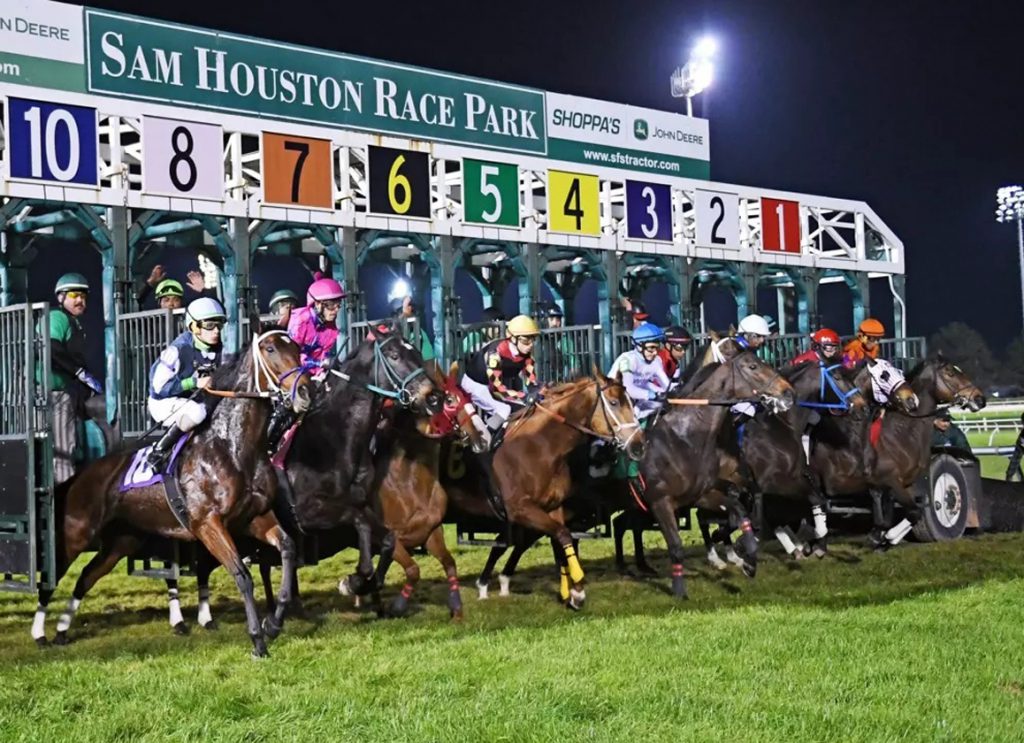
Sam Houston Race Park | Coady Photography
Texas Racing Commission
“I'm not sure I know the answer to that,” said Cook, when asked how long tracks like Sam Houston and Lone Star Park can continue operating without an exported signal.
“We just can't take the resources we currently have and give it to HISA to regulate us and the tracks understand that,” she said. “I would just say that we are hopeful that maybe at some point something will change to break the logjam.”
Could that break constitute a legal compromise?
While the TXRC has steadfastly maintained that Texas law bars HISA from being implemented in the state, HISA takes a different stance.
A legal analysis put together for HISA by the law firm Akin Gump found that “There is no legal impediment to reversal of the Texas Racing Commission's self-destructive policy decision of restricting interstate wagering on horseracing. Under State and federal law, the Commission may continue to regulate horseracing in Texas to the extent not preempted by HISA rules.”
When asked if the legal situation, therefore, is less black-and-white than has been the commission's approach to date, Cook remained unyielding.
“No, there's not a possibility unless HISA somehow becomes a cooperative agreement grant program,” Cook responded.
“Our statute doesn't even allow us to take grants,” Cook added. “We've actually made a request to have our statute conform, so, if HISA did become a cooperative agreement grant program, and the [Federal Trade Commission] FTC became a grantor, we could actually take that money and work with HISA. That's the only pathway I see.”
If the courts maintain HISA's constitutionality and the law remains unchanged, however, such a scenario could leave Texas in an increasingly precarious position if it continues its current trajectory.
Asked if Texas stakeholders should therefore be braced for a possible long-term simulcasting signal blackout, Cook demurred, saying that “it's not my job to send that message,” but that she was hopeful “something will change” for the 2024 racing season.
“I would say, and I've said to a few other folks I've talked to, if you're out of state and you want to watch Texas horses, then come to the track,” Cook said. “You don't have to watch it on TV.”
Budgetary Changes
Having assumed the position of TXRC executive director only about 18 months ago, Cook's tenure has overlapped arguably one of the most important junctures for the state industry-this, with no prior experience in the horse racing industry.
In that period, Cook's rigid stance on HISA has helped cultivate an industry-wide visibility rather atypical for the position, aided by appearances on popular horse racing radio shows and as a panelist at the HBPA's annual conference.
“I would say, and I've said to a few other folks I've talked to, if you're out of state and you want to watch Texas horses, then come to the track. You don't have to watch it on TV. —Texas Racing Commission Executive Director Amy Cook.”
“I'm not here to be on anybody's side other than perhaps the side of the horses, the jockeys and the Texans who are the licensees of the commission,” Cook responded, when asked about her suitability for the role, at the same time emphasizing her “35 years of military service” as an example of her commitment to public service.
While Cook has enjoyed a long and distinguished military career, it hasn't been without its missteps, most notably in 2014 when she was brought into the Arizona National Guard to supervise a financial audit of the Arizona U.S. Property and Fiscal Office (USPFO), which oversees state National Guard funds.
Several Arizona National Guard colonels suspended in that Cook-led audit over suspected financial wrongdoing were subsequently exonerated by an internal investigation, but not before their careers were ruined or finished in what they perceived as a leadership purge, according to an investigation by the Arizona Republic.
“[Cook] was in over her head and didn't grasp Army finances,” the former USPFO boss replaced by Cook told the Arizona Republic, claiming that false allegations, employee suspensions and transfers created havoc in the USPFO, including fiscal changes that cost the department millions of dollars in losses. “There is no excuse to have that kind of money leave Arizona because somebody doesn't know what they're doing.”
Cook characterized the Arizona Republic's reporting as incomplete and lacking in important details. At the same time, she pointed towards certain accolades awarded to her after the Arizona incident, including her 2020 promotion to Brigadier General.
“If I cared what was in the papers, I wouldn't be continuing my service for Texas,” said Cook. “I'm doing the best job I can do. I'm not perfect, but I show up every day and I try to do my best for the state of Texas.”
The TXRC is currently undergoing its own major financial reorganization by seeking to significantly revise its funding model, going from one financially self-sustained by the industry to an agency heavily reliant on taxpayer support.
“We are the only racing commission I found that is paid directly by its regulated industry, which has been problematic for the past 30 years,” said Cook, in explanation of the budgetary change. She pointed to a Texas governmental report that found the commission's current funding model dependent on sources like racetrack fees could undermine “effective” regulation.
“The general revenue [monies] would also pay for drug testing because I don't want to have to argue with someone over whether or not I can do a necropsy on their horse,” said Cook. “We should just be able to do it.”
According to figures provided by Cook, the TXRC had originally sought over $21 million from the state general fund to buttress its operations between 2024 and 2025, including dozens of new commission staff and a modernization of its online enforcement database. In the state's latest budget decision, that number is now just over $7.5 million in taxpayer revenues for the same period.
Interestingly, HISA assessed Texas the ultimately unpaid fee of around $351,000 for its 2022 operating expenses. According to sources familiar with the negotiations, HISA's 2023 fee assessments for both Sam Houston and Lone Star Park total around $1.5 million, with the opportunity for significant credits to be used against that amount.
“We'd like to see all revenue streams maximized, and that includes simulcasting,” said Hooper. As such, he added, “I just felt like the best thing to do was participate with HISA from its outset.”
The post Sam Houston Handle Down 92%, Texas Industry At Crossroads appeared first on TDN | Thoroughbred Daily News | Horse Racing News, Results and Video | Thoroughbred Breeding and Auctions.
