Fred Foley, who died Oct. 15 at age 68 (obituary here), was not a big-name jockey during the time he came up through the ranks in New England in the 1970s and 80s. But in terms of being an affable, even-keeled racetracker and the type of guy you always wanted to stop and chat with if you ran into him on the backstretch, he was of Grade I caliber.
Known for an easy, welcoming smile that his distinctive handlebar moustache could never conceal and an ever-present glint in his eye, Foley worked for more than three decades as an in-demand exercise rider after his jockey career ended. He also took a job as a valet on the New England circuit, and parlayed that gig into various racing official positions in the Suffolk Downs jockeys' room that he held until the East Boston oval ran its final races in 2019.
The combination of being a local kid with a reputation for aggressively riding claimers of dubious soundness endeared him to the hardscrabble Suffolk railbirds.
Growing up in the nearby Day Square neighborhood only a couple of furlongs from the track, “Fast Freddie” graduated from East Boston High and landed a job as a construction laborer before getting a late start in the saddle in his mid-20s. He used to laugh when recounting how he grew up right down the street from the track, yet never once attended the races until some buddies in an amateur hockey league suggested his lithe, 5'4″ 115-pound frame would suit him better to horsebacking than body checking.
“I used to go past Suffolk all the time, and I never realized what it really is–a city within a city,” Foley said in a 1983 press profile. “But once I went, I knew this is what I wanted. Once racing gets in your blood, forget it.”
So Foley quit his job and took a forty dollars-a-week gig as a stablehand in the 1970s. Even though the backstretch meant a cut in salary, he looked at the opportunity as “going to school and getting paid for it.”
Four years later, he finally got a leg up as an apprentice rider. But Foley was so raw and unpolished that he couldn't secure an agent to book his mounts.
His “bugboy” allowance lasted an unusually long three years (an apprenticeship in Massachusetts expires one year after a jockey's fifth win). It might have lasted longer had Foley not resorted to drastic measures to kick-start the process.
Two years into his apprentice period, at age 27, Foley decided to launch a gung-ho assault on the dangerous Massachusetts county fairs circuit. He said his logic in going all-out on the perilous half-milers during the summer and fall meets at Marshfield, Northampton and Great Barrington fairs was to make trainers think, “If this kid can ride these sore, old horses, we'll put him on some at Suffolk.”
The plan worked–sort of. In 1982, Freddie won the Great Barrington riding title. But a Boston Globe write-up the following season serves as the only documentation of his most remarkable riding feat: After winning four races one day on the Marshfield half-miler, Foley got dropped on his head by a subsequent mount while careening through the hairpin turn.
The next day he was still groggy, but insisted on riding at Suffolk because he had a rare opportunity to pilot a “live” horse named Royal Wedding. Then he had six more mounts at Marshfield that same afternoon. (This was an era of such abundant racing in New England that on some summer Fridays in the 80s, Suffolk ran in the mornings, Marshfield afternoons, and Rockingham Park at night. There are now no tracks operating in the region.)
“I got to the quarter pole on Royal Wedding, and my neck and shoulders were so sore from the Marshfield spill I couldn't move,” Foley told the Globe. “But the horse was still in contention, so I kept going.”
Royal Wedding won, igniting the tote board to the tune of $17.80. But it was Foley who paid the price. “I couldn't even pull the horse up, the outriders had to catch me. I couldn't even unsaddle. The stewards at Marshfield took me off my mounts there.”
Yet Foley concluded the interview in characteristically upbeat fashion: “I'll keep hustling,” he said, “because I don't know any rich people.”
Foley remained a long-shot specialist, good for 30 to 40 wins a year through the middle 80s. But injuries, illness and bad timing took their toll. In 1987, he flipped his car on a patch of ice and spent a week in an intensive care unit, where he was treated for a punctured lung and had his spleen removed. Shortly thereafter, Suffolk closed for two years. After the track reopened in 1992, open-heart surgery kept Foley off horses for longer than he liked.
Bowing to practicality, Foley traded his jockey license for a weekly paycheck. He settled in as a valet, and if he had any regrets about being forced into a less glamorous career switch, he didn't voice them publicly. Instead, he toned down his run-and-gun horsebacking style to better suit morning training, and was soon considered one of the most accomplished workout riders on the circuit because of his reliability, deft hands, patience with young horses, and level-headed demeanor.
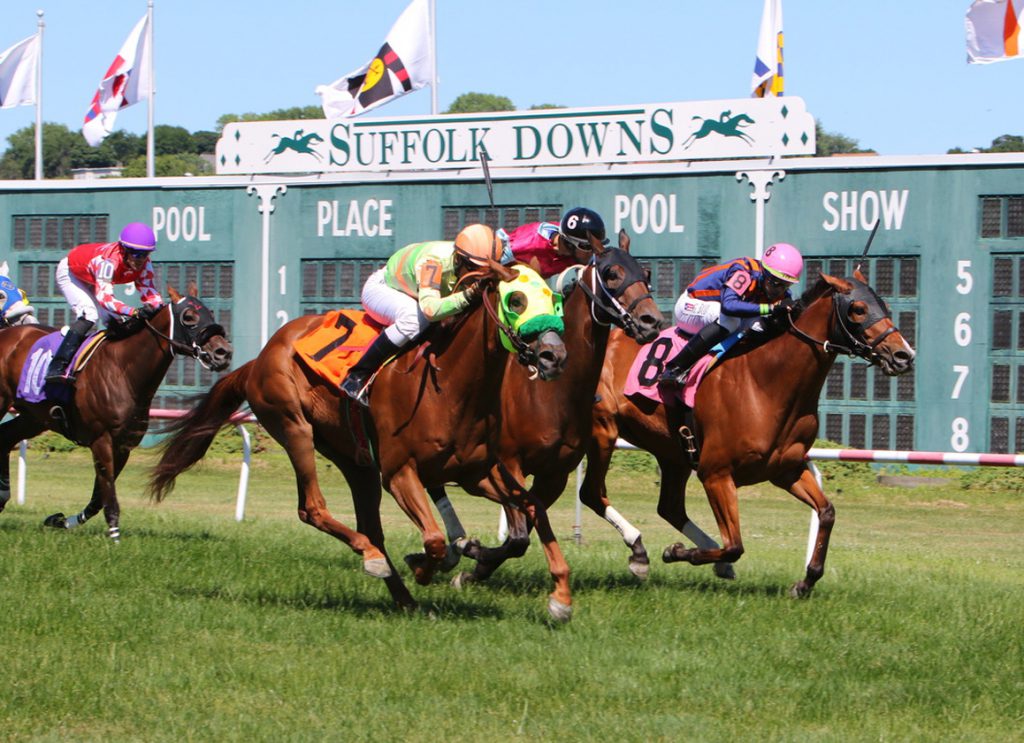
Suffolk Downs | Chip Bott
I vividly recall a conversation I had with Foley in the spring of 2000. Then 45 years old, Foley was in better shape than most racetrackers half his age. In addition to being a sought-after exercise rider, he kept fit by skiing and playing ice hockey, and was content to relax while fishing from his home's front porch alongside a quiet little pond up in New Hampshire.
At that time, Foley had not ridden in a race for 11 years. But he had started allowing himself the luxury of dreaming about the adrenaline rush of winning. When I ran into him that morning in front of the Suffolk Downs backstretch kitchen 23 years ago, Freddie was zipping from one riding engagement to another, flak jacket swinging cavalierly from his sinewy frame, battle-scarred riding helmet in hand. He told me, with his characteristic big grin, that what he really wanted to do, more than anything else, was to be a jockey again–but only for one more race.
Foley had been working out a maiden who had drawn rave reviews from clockers as a well-meant runner who would score first time off a layoff. Foley had previously schooled the colt's brother, a stakes winner. “I've been working him like this,” he enthused, jamming his fists together and pulling them close to his chest, the universal symbol for a horse hard held. “He's going to win. And I want to ride him.”
Foley didn't have grand, unrealistic aspirations. He fully intended to ride just once, on that one horse, for that one race. Foley had actually won the last race he rode back in 1989. But one more time, he wanted to go out a winner. The trainer told Foley she was all for it, and would even pay his license fee and vouch for him in front of the stewards.
When I next saw Foley a week later, I was shocked to hear his request for a jockey license had been flat-out denied. Apparently, the stewards nixed the idea for the one-time comeback because of his history of heart trouble. Their stated reason was that they feared being responsible if he suffered cardiac complications during the few minutes he'd be out on the racetrack.
Foley pointed out that his heart doctor had long ago cleared him to participate in any activity he wanted; that he was one of the fastest skaters on the Suffolk pickup hockey team, and that he already possessed a license–issued by those very same stewards–to exercise horses during morning training.
“They asked me for a reason, and I said because I thought it would be fun, that I wanted to ride one more time in my life,” Foley told me.
“Then the stewards told me that racing wasn't supposed to be 'fun,'” Foley added, a touch incredulously.
“'Fun,' they said, 'isn't the reason we're all here.'”
Although crestfallen, Foley not only hid his disappointment, but refused to bad-mouth the stewards or criticize their decision, taking the high road.
Yet he proved those officials wrong in the long run: Yes, racing is all about fun.
Fun–or at least the tantalizing possibility of it–is the very reason we're all here.
f you were lucky enough to hang around Freddie Foley on the backstretch or in the jockeys' room, there was no denying it.

The post An Appreciation: For Bullring Specialist Foley, Fun Was The Reason For Racing appeared first on TDN | Thoroughbred Daily News | Horse Racing News, Results and Video | Thoroughbred Breeding and Auctions.
Source of original post
