TIF Launching “Wagering Insecurity” Series Beginning April 13

Editor's Note: The following is an edited press release from the Thoroughbred Idea Foundation, which is beginning a 12-part series on wagering insecurity next week. The series will be released in two installments per week, and the TDN will carry summaries and links to the 12 articles.

The Thoroughbred Idea Foundation (TIF) will launch “Wagering Insecurity,” a multi-part series which will examine the current state of oversight of North American Thoroughbred racing and wagering, beginning Tuesday, Apr. 13.

In the aftermath of the infamous “Fix Six” at the 2002 Breeders' Cup, the American racing industry pledged millions of dollars to improve the monitoring of pari-mutuel betting and create a central office to oversee wagering security. While plenty was spent, the oversight never materialized. Vulnerabilities still exist, late odds changes impact many races and transparency is nowhere to be found.

TIF believes improved measures of integrity will boost customer confidence, which will lead to increased participation and put racing on a path to a more sustainable future, particularly in light of the rapid expansion of legal sports betting across the continent.

Customer confidence is crucial to any business, especially gambling, but North America's racing industry has done little to instill it over the last two decades.

“Automated bingo card devices in church basements have more independent monitoring than the tote systems,” said Kevin Mullally, Vice President of Government Relations and General Counsel for Gaming Laboratories International.

Track operators seem indifferent. As one 25-year U.S. state racing regulator told TIF for this series:

“Most tracks, confronted with a wagering integrity issue, would either bury the information or bury their heads in the sand and it would never see the light of day. That's not every track across America, but the majority would not want to make public any information that would question the integrity of wagering on their product.”

In 2005, when speaking of the racing industry's post-“Fix Six” efforts to upgrade wagering oversight which eventually failed, then Del Mar Thoroughbred Club President Craig Fravel acknowledged the track operators might fall short of the mark.

“We [track operators] are a little suspect because we are maybe overly confident at times. I think to allow customers to have sufficient levels of confidence in us, we have to not only demonstrate we are capable of reviewing things, but that there is a sufficiently independent and authoritative organization out there than can be the ultimate arbiter of those kind of decisions.”

Such a group still does not exist.


The TRPB

The Thoroughbred Racing Protective Bureau (TRPB) is North American racing's only provider of any wagering oversight, but the group has been defunded over years and is not independent. It is a wholly-owned subsidiary of a consortium of North American racetracks.

The TRPB provides member tracks a platform to monitor wagering on their own races and assist them when needed. The tracks essentially monitor themselves.

Given the consolidation which has taken place in horse racing over the last 20 years, tracks control most of the levers of the greater business. They own most of the online betting platforms which process the majority of bets on North American racing, known as ADWs. They own two of the three main tote companies which handle most betting activity. One conglomerate even owns at least part of a major off-shore rebate shop whose few customers account for an enormous amount of total handle.

Tracks fund the TRPB, which was once called horse racing's own “little FBI,” but has seen its policing functions largely reduced. Horse racing may have been once described as “the best policed sport of all,” but that has changed.

“It was an erosion, over time,” Paul Berube told TIF of the TRPB which he ran for nearly two decades after working as an investigator with the group for another two decades before that.

“Today, there is no national unity, but in the heyday of the TRPB, that was our strength.”

Despite several attempts from TIF, the TRPB's Executive Vice President Curtis Linnell declined the opportunity to answer questions for this series.


Suspicious Betting

While the TRPB has taken on an almost invisible profile to most bettors, there is an unexpected group which has started paying more attention to North American racing,

Unbeknownst to most American horseplayers, a large bookmaking market has emerged in Europe offering fixed-odds bets on North American racing. Total handle is believed to exceed $1 billion annually. Contracts enabling these relationships are often facilitated by XB-Net, a subsidiary of 1/ST, formerly The Stronach Group.

Bookmakers have their own monitoring group which examines wagering on all sports, investigates suspicious wagers and raises alerts to regulatory authorities with whom they have information-sharing arrangements. For the first time ever, they identified suspicious wagering on U.S. races in the fourth quarter of 2020.

According to Matt Fowler, Director of Integrity at the International Betting Integrity Association (IBIA), the recent alerts on U.S. races go “well beyond just an unusual betting pattern or unexpected price movements.”

European fixed-odds betting operators are identifying activity involving U.S. racing that should be concerning to all U.S. racing stakeholders. Where is the American oversight on American races?

At present, there is no reporting relationship between European bookmakers and any American counterparts, the TRPB, North American track operators or regulators. For now, the findings will inform bookmaking decisions but not the patrolling of American races, where pari-mutuel handle vastly exceeds bookmakers.

A world-wide market requires world-wide supervision. The TRPB is the closest thing North American racing has to self-regulation, which is fine…until it isn't.

What we have now is insufficient.

Racing on the continent in the 2020s is run with an integrity infrastructure better suited to the 1970s and a business model from the early 1990s. The oversight measures for the races themselves and their wagering systems have degraded over time. Racing's integrity infrastructure is falling farther behind that of the rest of the developed racing world, where more robust monitoring of all markets is far greater, transparent oversight is commonplace and customers are far better protected. Examples of these modern steps are plentiful throughout the series.


Opportunity

Improvements to racing's integrity infrastructure will improve customer confidence, increase participation in the sport and lead to a more sustainable future.

“Wagering Insecurity” provides several recommendations for North American racing to consider.

Notably, the new Horseracing Integrity & Safety Authority (HISA) must include elements of bet monitoring to its practices once launched.

Global sports and racing integrity expert Jack Anderson of the University of Melbourne, who was the keynote speaker at the University of Arizona's Global Symposium on Racing in 2018, highlights several key points throughout “Wagering Insecurity” which support this conclusion.

“Effective doping control is of course a vital element of the integrity objectives of a sport such as racing but it should not be the sole integrity concern and should not be seen in isolation. Doping in a sport such as racing is often intertwined with gambling interests,” Anderson said.

“The prevalence of doping in a racing jurisdiction may also be reflective of weaknesses in that racing organization's race day operations such as:

  • stewarding and standards of veterinarian oversight,
  • lack of capacity in intelligence gathering on and knowledge of industry participants,
  • vulnerabilities in the licensing and registration of industry participants,
  • and the ability of the racing organization or jurisdiction to punish misconduct by industry participants.”

The role of HISA can and should go farther than its more commonly understood functions which have dominated early dialogue around it–namely its racetrack safety and anti-doping and medication control programs.

The legislation which established HISA empowers much more, declaring that HISA shall “exercise independent and exclusive national authority over the safety, welfare and integrity of covered horses, covered persons, and covered horseraces.” The definition of covered horseraces includes those with interstate wagering and ADW account betting.

TIF makes several other recommendations in the series related to adopting modern, transparent best practices, many of which are in place in other racing jurisdictions and sports. Significant upgrades are possible and, fortunately, the proverbial wheel does not require reinvention.

The opportunity for significant reform is real, lifting the standards of North American racing like never previously considered and importantly, rebuilding confidence in racing's voluntary participants–horseplayers and horse owners.

“TIF's advocacy has focused on improving the business for horseplayers and horse owners as their participation in racing fuels everything,” said Craig Bernick, President and Chief Executive Officer of Glen Hill Farm and founder of TIF. “We need confidence in both groups to sustain the industry, and as the various installments of the series will reveal, it is frightening just how far behind we are in protecting customers.

“Industry consolidation of track operators, technology companies and other service providers has not improved the sport,” Bernick added. “As we move forward over the next two decades, racing needs to compete for customers. Meaningful integrity controls and better pricing are needed to meet the expectations of modern bettors. Right now, we are falling woefully short and present an increasingly uncompetitive wagering offering.”

TIF's Board of Directors established the Wagering & Integrity Issues Steering Committee in July 2020, which was instrumental in the development of this series.

Patrick Cummings, TIF's Executive Director, said: “We are incredibly appreciative of the dozens of current and former racing and gaming industry executives as well as regulators from North America and abroad who provided so much insight, both on the record and for background in this series.”

“This project pulled together many pieces that have not been connected previously, and I believe readers will walk away with a much greater understanding of what has happened for the last 20 years, the extent of the threats facing the business and the tremendous opportunity to bring about changes through HISA. We look forward to sharing the various installments in the coming weeks.”

The “Wagering Insecurity” series will be published free at RacingThinkTank.com, released to industry press, via Twitter and emailed to those on TIF's mailing list. Register to receive notifications here.

The post TIF Launching “Wagering Insecurity” Series Beginning April 13 appeared first on TDN | Thoroughbred Daily News | Horse Racing News, Results and Video | Thoroughbred Breeding and Auctions.
Source of original post

Alice Headley Chandler: 1926-2021

A life as long and rich as that of Alice Headley Chandler, which drew to a peaceful close on Tuesday, April 6, at her home in Lexington, Kentucky at the age of 95, is measured by four generations—from her surviving contemporaries to her great-grandchildren—for whom the black raiment of mourning will surely be brightened by cheerful scarves of pride.

And that's not just because of the consolations available in remembrance of a wonderful character or celebration of her wonderful achievements. For this iconic Kentucky horsewoman was always animated by a daily contribution, decade after decade, to a collective endeavor that transcends even lives as impressive in scope and achievement as the one that began in her hometown of Lexington on January 16, 1926. And if the Headley clan has resonated in the breeding of Thoroughbreds for nearly two centuries, few horsemen of any name or background will ever match the personal legacy she created within her allotted stewardship.

As long as the breed continues, Alice Headley Chandler will be honored: explicitly, among those curious to chart its long history; and vicariously, among the many more who will always recognize Sir Ivor as a transformative name in its genetic evolution.

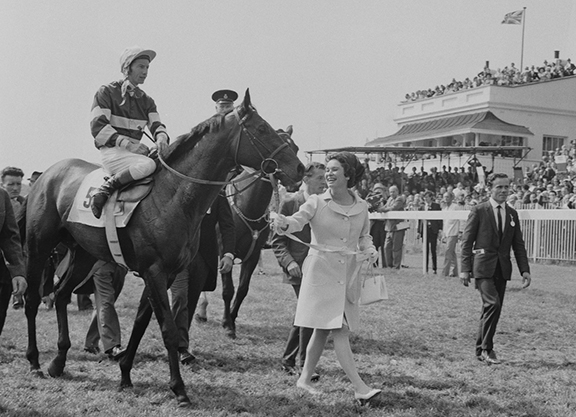
For the two, opposing themes that were uniquely combined in Chandler—cherished simultaneously as a link in a venerable family chain, and as a pioneer for the whole industry—were aptly condensed by this horse. On the one hand, he represented personal legacy: Chandler famously bred Sir Ivor from a mare bequeathed by her father. At the same time, he became an immediate symbol for what a woman could achieve, given the opportunity, in a conservative and patriarchal walk of life. As though born as a pathfinder towards modernity, he became the first American-bred Epsom Derby winner bought at public auction. In the process, he launched the era of international commerce that has sustained the bloodstock industry ever since—a revolution in which Chandler and her family would continue to share, notably when selling a $9.7 million Storm Cat colt, later Group 2 winner Jalil, at Keeneland in 2005.

Lester Piggott on Sir Ivor, led by Princess Caroline Murat after winning the Epsom Derby at Epsom Downs Racecourse, UK, 4th June 1968 | Getty Images

Yet both Sir Ivor and his breeder were also a credit to continuity, to bloodlines and inherited lore that had been patiently cultivated to stand the test of time.

Chandler bred him from Attica, a daughter of Mahmoud's largely forgotten son Mr. Trouble. The stallion had himself been sold in 1962 as part of the dispersal of stock owned by her father Hal Price Headley, who had been a key figure in the foundation of Keeneland and served as its first president from 1936 to 1951. Attica was one of just four mares he had left her, along with a parcel of 268 acres down the road from Keeneland. This, remember, out of a Beaumont Farm estate that had extended past 4,000 acres by the time of his death. Yet this would become the nucleus of an international brand, and a recognized symbol for integrity, heritage and excellence: Mill Ridge Farm.

In 1964, Chandler sent Attica to Sir Gaylord at Claiborne, where Bull Hancock was proving a valuable source not only of sage counsel but also of some early business, sending a few overflow mares to Mill Ridge. Chandler, to that extent, was certainly comfortable with the Bluegrass Establishment. But arguably her success duly made more substantial inroads on its misogynists than could more flagrant feminist campaigns of the 1960s. Because anyone, however set in their ways, could see that this woman owed her success to a tireless work ethic, elite standards of horsemanship, and a rare sensitivity to the rhythms of Nature.

Like the Hancocks, Chandler's father had played an important role in sowing the American breed with European Classic blood. In 1929, he had imported Pharamond II (GB) as a conduit for the core bloodlines of the breed-shaping stud assembled by the 17th Earl of Derby. At the time Pharamond began his Kentucky career, the star of Headley's stable was the champion filly Alcibiades. In 1934, he paired the two to produce Menow, the champion juvenile who later became sire of Tom Fool (and so grandsire of Buckpasser). Two years later, Alcibiades was sent to War Admiral and produced Salaminia, a high-class stayer. When herself mated with Pharamond, Salaminia produced Athenia, the dam of Attica.

In a way, then, the reverse passage of Sir Ivor was just another phase in the constant, mutual regeneration between the transatlantic gene pools. As it happens, it was Bull Hancock who purchased Attica's Sir Gaylord yearling on behalf of Raymond Guest, American Ambassador to Ireland, for $42,000 at the Keeneland July Sale of 1966. “He was a May 5 foal, a tall horse, just a little bit slab-sided,” Chandler remembered later. The colt still had some growing to do, but was sent to Vincent O'Brien in Ireland.

And that was how O'Brien and his son-in-law John Magnier discovered in Sir Ivor a template for the commercial transfer of the speed-carrying dirt genes to the demands of Classic racing on turf. Shortly after Sir Ivor won the Derby, O'Brien came back to America and bought a Northern Dancer colt for $84,000. (His dam, incidentally, was out of a Menow mare.) Two years later, as Nijinsky, he became the last winner of the English Triple Crown.

Besides his role as a pathfinder, Sir Ivor would also have a great genetic influence—notably as a broodmare sire, just like his sire and also his sire's half-brother Secretariat. Daughters of Sir Ivor, for instance, produced Green Desert and El Prado to become breed-shaping sires.

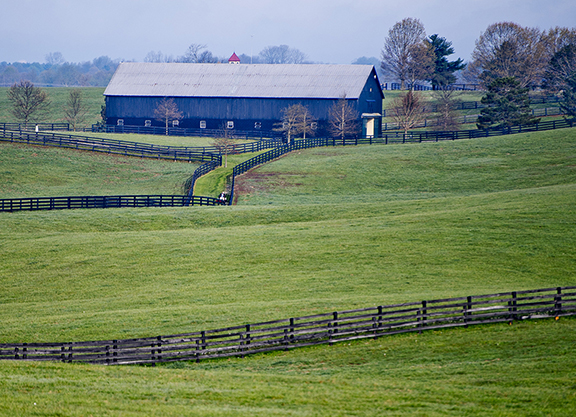
Mill Ridge | Eclipse Sportswire

Happily, Chandler was able to make the journey to Epsom, along with her mother Genevieve Molloy and her son Mike—who ended up dangling from a beam in Guest's box, to see over everyone's heads. After the race, no doubt, they must have remembered how Chandler's father had been forced to quit Princeton as a sophomore in 1908 when news came that his own father, Hal Pettit Headley, had suffered a stroke. Someone was needed to take over the farm, and he had shown a flair for horses even as a 14-year-old, when taking 1897 Kentucky Derby runner-up Ornament and 16 other Thoroughbreds to the World's Fair in St. Louis. He came back with a blue ribbon and $4,600 in prizes.

His, in turn, would eventually be an abrupt and premature departure, following a heart attack. But in the meantime he left an indelible stamp on his daughter, who inherited his reverence for the land and for the nuances of all husbandry. He raised cattle and tobacco, as well as horses, and did so with a respect that has filtered through to his grandson and great-grandson, so pivotal to the development of Horse Country tours.

Chandler's father allowed her to embrace life on the farm to the full. On one occasion she was found asleep with a pony when still a toddler. “He never said 'don't do it, 'cause you might get hurt',” Chandler remembered once. If that meant shooting craps with the grooms on the tack room floor, that was fine—though she had to renounce her winnings when she came home at lunch and announced that she had just won $600 and an automobile from the jockey Smokey Saunders.

“I went with Daddy as much as I could because I loved doing all the things he loved to do,” Chandler recalled. “Herding cattle, and breaking yearlings, all that kind of stuff, checking the tobacco.” The staff connived with her sense of adventure, too. “They let me do anything I wanted, I tried it all,” she said. “We used to sneak onto yearlings before they got broken.”

She missed all that, when sent away to convent school in Cincinnati, and later to schools in Virginia and Connecticut. But for the same reason she loved summers back on the farm; and hunting in winter; and, when Keeneland opened, she would go down there with Daddy at 4 a.m.

Chandler did have some time away from Lexington, raising four children—a daughter Patricia (“Tish”) plus three boys who all found careers in the Thoroughbred industry, in Mike, Headley and Reynolds Jr.—from her first marriages. (One evidently a rather callow wartime engagement; another to Reynolds Bell, himself from a family of horsemen but for a time then working in oil down in Texas.) But she had returned in 1959, and poor Mike was holding a shank when her father collapsed in front of him after breezing horses at Keeneland in 1962. He was 73. “But, boy!” Chandler would say. “A lot of miles! He didn't walk, he ran.”

Her marriage in 1970 to the South African-born veterinarian, Dr. John Chandler, would open up new horizons for Mill Ridge. Having arrived via Newmarket, and himself central to the development of Prince Khalid Abdullah's Juddmonte empire, he had an important role in developing an overseas client base. In time Mill Ridge imported Diesis (GB) from Europe to become another important transatlantic influence (three daughters won the Epsom Oaks) alongside a significant indigenous stallion in Gone West.

Emulating her father, Chandler became a respected industry leader. She served on the Keeneland Board for 23 years, and was also a director of the Breeders' Cup, the Thoroughbred Owners and Breeders' Association. She chaired the University of Kentucky Equine Research Foundation, and was president of the Kentucky Thoroughbred Association, and also served stints with the Equine Drug Council and Gluck Research Center. In 2006, Chandler was recognized by the Kentucky State Senate for her lifelong dedication to the community and to the equine industry; and three years later received the Eclipse Award of Merit.

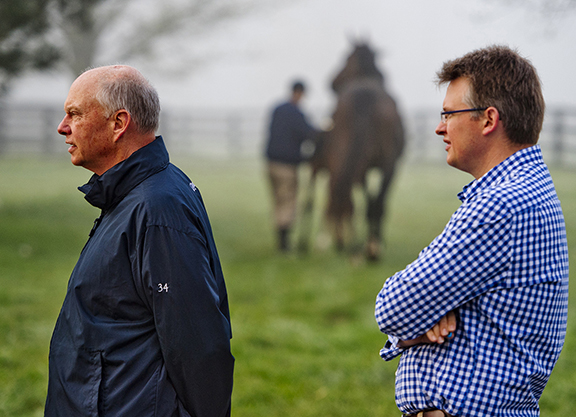
Chandler's son Headley Bell, and his son, Price, at Mill Ridge | Eclipse Sportswire

Chandler was inducted to the Hall of Fame at the National Museum of Racing only last year, as a “Pillar of the Turf” alongside her father, who had preceded her by a couple of years. This distinction had by then become a little poignant, as Chandler had lately been suffering from dementia, though tended devotedly by her caregivers and a large and loving family circle. In the event, of course, the ceremony was postponed anyway because of the pandemic. But her delayed induction will now become a chance to honor one treasured by the whole Bluegrass community, during her long and illustrious prime, as one of the most vivid and accomplished horsewomen in the story of the Thoroughbred.

Breeders will be indebted to her for as long as they continue to puzzle over pedigrees. Remember that Attica's son was not just a mighty broodmare sire himself, but that his daughters appear to have passed a similar potency to their sons. Alzao and Shareef Dancer, for instance, have respectively given us the dams of Deep Impact and Dubai Millennium.

But Alice could be still prouder of her very own genetic bequest. Her son Headley took over the running of Mill Ridge in 2008, and grandson Price was last year named general manager. Adhering scrupulously to her one, non-negotiable axiom—”take care of the horse, and the horse will take care of you”—they have maintained the farm as a thriving presence in the modern industry: it has raised 36 Grade I winners since 2000, including Horses of the Year Point Given (Thunder Gulch) and Havre De Grace (Saint Liam). Headley and Price named their Nicoma Bloodstock for one of the first mares Alice purchased, while they have recently revived the farm's stallion story by launching Oscar Performance (Kitten's Joy). As a top-class turf miler, he has every right to write a new chapter in the farm's international story. Fittingly, he extends the El Prado line—and so the legacy of Sir Ivor as a broodmare sire.

When she handed over the Mill Ridge reins in 2008, Chandler declared: “I have lived a blessed life, doing just what I want to do: associate with the finest horses, clients, friends, and an industry that I love.” Thanks to her, however, countless others have shared that same sense of benediction.

No doubt these will now pay tributes of due eloquence. But it is comforting to recall that many such were offered when Alice could still be touched by them herself, as the honor guest of the Thoroughbred Club of America in 2005. Tellingly, she was only the third female to receive this distinction, at its 74th testimonial dinner, following Mrs. Payne Whitney in 1939 and Isabel Dodge Sloan in 1951. Earlier that year, John Shirreffs had saddled the Mill Ridge graduate Giacomo (Holy Bull) to win the Derby—108 years after Chandler's grandfather had been foiled by just a neck with Ornament. (“Daddy” had tried 13 times, to no avail.) So Shirreffs spoke for many in explaining why he was often seen wearing a Mill Ridge cap, and it feels fitting to leave the last word to one who operates in the same rarefied register of horsemanship.

“Alice Chandler does it right,” Shirreffs said. “Her standards and attention to detail are special. The cap symbolizes for me the finest quality of horsemanship: the price of being a craftsman, the patience of a shepherd, and the creativity of an artist.”

Chandler is survived by her husband of 49 years, Dr. John Chandler; her children Patricia, Mike, Reynolds and Headley; 8 grandchildren, and 14 great-grandchildren.

Funeral arrangements are pending.

The post Alice Headley Chandler: 1926-2021 appeared first on TDN | Thoroughbred Daily News | Horse Racing News, Results and Video | Thoroughbred Breeding and Auctions.
Source of original post

Breeders’ Cup Launches Horseplayers Happy Hour

The HorsePlayers Happy Hour Tour, hosted by In the Money Media, will begin Thursday, Apr. 8, at 3:00 p.m. ET, Breeders' Cup announced in a press release.

The HorsePlayers Tour will coincide with the HorsePlayers Happy Hour livestream, featuring ITMM's Matt Bernier, Peter Fornatale and Jonathon Kinchen. Each week fans at home can play along with the ITMM team for a chance to earn tour points and qualify for the season-ending playoffs. One $10,000 Breeders' Cup Betting Challenge seat will be awarded to the player that finishes first on the regular season leaderboard and another will be awarded to the winner of the playoffs.

Breeders' Cup will donate all proceeds from the HorsePlayers Tour online contests to the Thoroughbred Aftercare Alliance and the Thoroughbred Retirement Fund. In 2020, Breeders' Cup raised over $6,500 for its charity partners through the HorsePlayers Happy Hour program.

“HorsePlayers are the heartbeat of our sport and this exciting new format is a great way to keep them engaged all season long and reward them for playing in our online contests,” said Justin McDonald, Senior Vice President of Marketing for Breeders' Cup. “Being able to follow along and interact with the In the Money Media team during our weekly livestreams is a unique and fun component of the tour that new and avid fans will really enjoy.”

The post Breeders’ Cup Launches Horseplayers Happy Hour appeared first on TDN | Thoroughbred Daily News | Horse Racing News, Results and Video | Thoroughbred Breeding and Auctions.

Source of original post

MSW Purses to Top $100K During Derby Week and at KY Downs

Purse levels for maiden special weight (MSW) races on the Kentucky circuit are projected to push past the $100,000 mark both during GI Kentucky Derby week at Churchill Downs and in September at the Kentucky Downs all-turf meet.

In addition, Kentucky Downs plans to expand its stakes program to include two new $1 million races in 2021, giving the venue a total of three stakes at that level. (Read more details here).

Ben Huffman, the director of racing at Churchill Downs, confirmed during a video meeting of the Kentucky Thoroughbred Development Fund (KTDF) advisory committee Apr. 6 that MSW purses during Derby week will be $106,000, then $91,000 for the balance of the meet that runs through June 26.

Churchill had closed out its pandemic-affected 2020 spring/summer season at the $79,000 level for MSW races and had boosted those purses to $97,000 for the rescheduled Derby week in September. The balance of September had $75,000 MSW purses; that level rose to $85,000 for the late-autumn meet that ended in November.

Ted Nicholson, the senior vice president and general manager at Kentucky Downs, told the KTDF board that his track's MSW level will be $125,000 for the six-day meet Sep. 5-12. That's up from $90,000 last year.

As for Ellis Park, racing secretary Dan Bork said that “our maidens will probably be just north of $50,000 this year.”

The MSW purse levels for the state's remaining 2021 meets beyond September will be discussed by the KTDF at a later date.

The KTDF is funded by three-quarters of 1% of all money wagered on both live Thoroughbred races and HHR gaming, plus 2% of all money wagered on Thoroughbred races via inter-track wagering and whole-card simulcasting. The board approved recommending allotments to Churchill, Ellis and Kentucky Downs on Tuesday.

The Dirt on Turfway: Not Any Time Soon

Turfway Park's general manager, Chip Bach, updated the KTDF board on the near-term maintenance for the new Tapeta track that was unveiled in December. He also responded to a KTDF board member's question about the timeline for a proposed inner dirt track by saying it wasn't going to happen anytime soon.

“The opinion of the Tapeta surface has continued to be very positive,” Bach said. “There are some plans to do a tune-up, a little remediation. You know, when you're working with a synthetic racetrack, if you do too much too soon you can't undo it. And so they're typically conservative of the elements that they introduce into the surface; see how it responds to weather, see how it responds to the horses.

Bach described that process as a “tweak,” adding that the work is likely to be done before July, when horses resume training at Turfway.

As for the additional dirt surface inside the Tapeta course that was proposed as part of the ongoing Turfway rebuild, Bach said this:

“The project that's going on right now will contemplate the ability to put an inner dirt track within the synthetic oval. But that's not intended to happen the first or the second year [of the Turfway rebuild]. We'll have the ability to add that if we decide to. It's being designed with that in mind. But there are no plans for a dirt track in the near future.”

HBPA 'Concerned' About Ellis Twilight Posts

Jeff Inman, the general manager at Ellis Entertainment LLC, said his track is in the midst of a three-phase capital improvement plan.

Phase 1 work that is now underway prior to the track's June 27 opening includes drainage and safety improvements to the main track, a backstretch rebuild of the manure pit (required by environmental officials), a new restaurant and an additional bar on the frontside, plus high-definition camera and communication upgrades.

Bill Landes III, the chair of the KTDF advisory committee, wanted to know more about the list of long-term improvements Ellis has slated for the future.

“When do you think that schedule may be fleshed out?” Landes asked. “I love everything [listed]—turf widening, track lighting, grandstand improvements, new tote board—all of them long overdue, and everybody knows it.”

Inman replied that the turf course widening is likely to happen first, but not until after the 2021 meet.

“If we regain capital funding, we will start work after the horses leave, [by] late October, early November,” Inman said.

Landes underscored what a positive it would be to upgrade the grass course and to add lights at Ellis, because it would allow the track to card some twilight racing in a less-crowded simulcast time slot and feature more grass racing, which is popular with bettors because of the generally larger fields. Racing later in the day could also aid horse health by avoiding running during the searing late-afternoon temperatures that are routine at Ellis in the summer.

Landes said he believed Kentucky Horsemen's Benevolent and Protective Association officials would agree with him that if “you get twilight racing at Ellis Park and some lights there, there ain't no telling” what might happen, handle-wise. “That would be super—I'm sorry we're not there yet,” he added.

KTDF member J. David Richardson concurred: “I do believe Ellis Park has enormous potential to do much, much better with at least some opportunity to run under lights and expand turf racing on a course that's not torn up because you have to overuse it.”

But when asked for his opinion, Rick Hiles, the president of the KHBPA (and also a KTDF advisory committee member), said he was “a little concerned” about the ramifications of moving to later post times at Ellis.

Hiles cited the long days that outfits shipping to Ellis from Lexington and Louisville would have to endure.

“Losing an hour in time zones, coming back late at night…I just don't know how [horsemen] are going to react to that,” Hiles said.

“Well, you have that issue to a certain extent at Turfway,” Landes replied, meaning the night racing. “And [at Ellis] it's either coming in at one or two o'clock in the morning or dealing with 108 or 110 degrees” while shipping before the sun goes down.

“I just don't know,” Hiles said. “School, for me, is still out on it.”

The post MSW Purses to Top $100K During Derby Week and at KY Downs appeared first on TDN | Thoroughbred Daily News | Horse Racing News, Results and Video | Thoroughbred Breeding and Auctions.

Source of original post

Verified by MonsterInsights