Kingdom Of Bahrain To Extend And Expand July Festival Sponsorship

The Kingdom of Bahrain will extend its sponsorship of The July Festival at Newmarket beginning in 2023, The Jockey Club and The Bahrain Turf Club announced on Friday.

A sponsor of the G3 Bahrain Trophy since 1991, the Kingdom of Bahrain will also now sponsor the G2 Princess Of Wales's S. and the G2 July S. in a new, multi-year agreement. All three stakes races take place on opening day of The July Festival, Ladies Day, on Thursday, July 13.

Speaking from The Bahrain Turf Club where The Jockey Club Bowl was run Friday afternoon, Sophie Able, Newmarket Racecourses and International Director said, “The relationship between The Jockey Club and The Kingdom of Bahrain is a long and happy one, and as horseracing there continues to go from strength to strength we are delighted that our partnership is mirroring that development.

“As our longest-standing sponsor at The July Festival, with its support of the Bahrain Trophy stretching back over 30 years, it is fantastic news that the Kingdom of Bahrain has decided to add to its sponsorship portfolio at The July Festival by backing the Princess of Wales's S. and the July S.”

Salman bin Rashed Al Khalifa, Executive Director of The Bahrain Turf Club, said, “The Bahrain Turf Club are delighted to continue and develop our support to one of British racing's leading meetings. We are extremely proud of the Kingdom of Bahrain's long and respected relationship with The Jockey Club and look forward to growing this in the coming years.”

The post Kingdom Of Bahrain To Extend And Expand July Festival Sponsorship appeared first on TDN | Thoroughbred Daily News | Horse Racing News, Results and Video | Thoroughbred Breeding and Auctions.

Source of original post

Alenquer Secures All-Star Mile Spot

Group 1 winner and star import Alenquer (Fr) (Adlerflug {Ger}) is set to have his first Australian start and first of 2023 in the All-Star Mile at Moonee Valley on Mar. 18 after being handed a wildcard entry for the race on Friday, Racing.com reported. The 5-year-old horse joined trainer Mike Moroney's stable in December, with the All-Star Mile always a target race for his Australian debut.

Alenquer, who was previously trained by William Haggas, hasn't started since a ninth-place finish in the G1 Prix de l'Arc de Triomphe at ParisLongchamp on Oct. 2.

“It wasn't a hard decision for the wildcard panel to land on Alenquer as our first wildcard and he joins a fantastic group of 10 horses, headed by Alligator Blood (Aus) (All Too Hard {Aus}), that were voted into the All-Star Mile by the public this week,” RV Executive General Manager, Racing, Matt Welsh told Racing.com. “With 11 runners now in the field, our focus will be on key races at Flemington and Randwick tomorrow before we issue the remaining four wildcards by early next week.”

In 2021 as a 3-year-old, Alenquer won the G2 King Edward VII S. at Royal Ascot. He ran third in the 2400-metre G1 Grand Prix de Paris and second in the G1 Juddmonte International S. later in the year. Last term, the son of Adlerflug won the G3 Winter Derby at Lingfield on the all-weather in February and the G1 Tattersalls Gold Cup at The Curragh in May.

“He's a Group 1 winner in Ireland and has contested the past two Arc de Triomphes. He's got plenty of class,” Moroney said. “He's settled in really well at Flemington since arriving from overseas and we've been pleased with how he's come to hand in his first prep for the stable. We're excited to unveil him at The Valley in a fortnight. Fresh up over a mile we think he's going to be a serious player in The All-Star Mile.”

The post Alenquer Secures All-Star Mile Spot appeared first on TDN | Thoroughbred Daily News | Horse Racing News, Results and Video | Thoroughbred Breeding and Auctions.

Source of original post

ITBA Mental Fitness And Resilience Seminar Sheds Light On Mental Health Awareness, Resources

In an industry where the hours and expectations fall far outside of the typical 40-hour work week, peers are also your biggest competitors, and the fine line of balance between work and life can be nonexistent, the struggle with mental health is prevalent among the Thoroughbred industry's participants. However, growth of understanding through research, increased discussion and an expanded network of resources is hoping to change all of that, as shared in the Irish Thoroughbred Breeders' Association (ITBA)'s Mental Fitness and Resilience in the Thoroughbred Industry online seminar, held Wednesday evening, in association with Equuip.

Nearly 70 participants across Ireland and elsewhere tuned in to the panel led by Dr. Jennifer Pugh, Senior Medical Officer of the Irish Horseracing Regulatory Board (IHRB), Lisa O'Neill, Welfare Coordinator of Equuip, and Dr. Ciara Losty, a sports psychologist for The Jockey Pathway.

“When your mental fitness is in a good place, you have clear space for thinking, you make better decisions, your mind is clear and you have a structure and a pathway to how you handle things. When you're in a negative mindset and you don't have a lot of mental fitness, everything's scrambled and you may not be able to make good decisions,” said Pugh, as she dove deeper into the definitions of mental fitness and resilience. “Whether you're big or small, there are challenges at every single level and success brings its own challenges as well. Mental health difficulties don't belong to one particular group, we are all susceptible to them.”

“The other thing that's important here is that you don't have to be in the middle of a major life event to need resilience, I think you're probably facing times every single day in your work where you need to be resilient. If something's stressful for you, it's stressful for you, you can't put it in a compartment.”

Alcohol misuse, depression, anxiety and psychological distress were all common mental disorders identified in Mental health difficulties among professional jockeys: a narrative review, a study conducted in 2021 where 105 jockeys across the UK were surveyed. The researchers identified four core categories of stressors experienced by jockeys, relating to competition (ex. pressure, injuries), the wider racing industry (ex. making weight, workload, travel demands), interpersonal challenges (ex. relationships with trainers, expectations) and career stressors (ex. career uncertainty, transitions).

“Mental health is really an area that is being discussed more, it's an area that we're talking about a little bit more in society and it's an area that is being researched more, but I would say overall, it is probably lacking behind some of the physiological sciences or some of the sciences that support the physical performance of certain things,” said Losty. “When we compare and put these statistics with other sports and other athletes in other areas, the jockeys are generally outliers. They are presented with much higher common mental health disorders.”

The study also revealed that burnout was a common feature among the jockeys, along with the high prevalence of adverse alcohol use, and nearly a quarter of the jockeys revealed that they were contemplating retirement.

“Racing is such a one-man's game. You're paddling your own canoe. You think 'I must be strong by myself, I just keep it to myself, I handle everything else.' I drive myself everywhere, I sort all of my rides, I sort my finances. You just become independent because you absolutely have to be, and I think it drips into the psychological side as well,” said one jockey who participated in the study.

However, when asked about why they were not seeking out support from medical professional health services in the study Barriers and Facilitators to Help-Seeking for Mental Health Difficulties Among Professional Jockeys in Ireland conducted in 2022, barriers included 'a need to appear strong in front of others' and a stigma towards accessing support services, a lack of knowledge about the support services available, confidentiality concerns and a self-stigma about asking for help.

“Confidentiality is a big part of my work as well, in that jockeys are very concerned about that if they actually seek out support, how confidential that particular service will be and how others will perceive that. If a trainer knows that a jockey is getting some kind of health support, are they maybe going to make different decisions about putting that jockey up on a horse? Will that affect their perception of that jockey from a hardiness type of perspective? These are some things to think and reflect on,” explained Losty. “If we understand these risk factors, we can put in programs and supports in place very early. It's okay to seek out support.”

Losty shared a similar study conducted in 2021 on Racehorse Trainer Mental Health: Prevalence and Risk Factors, which revealed many of the common mental health disorders that impact jockeys also impact trainers, in the form of depression, alcohol use, distress and anxiety. The stressors for trainers revolved around career dissatisfaction, lower levels of social support and financial difficulties, which would increase the likelihood of meeting the threshold for depression and anxiety.

“They are under pressure from owners to ensure high performance, a high standard, and they are also required to manage the staff. They are looking after staff welfare and they're looking after the horses' welfare, which again is high stress, and not a 9-5 role or somewhere where you can just leave your job at the gate when you leave the yard,” said Losty.

Though there has not been as much research in a broader sense on employees across Ireland's Thoroughbred industry, outside of the specific roles of jockeys and trainers, O'Neill referenced research from several studies conducted in Australia and the UK on stable staff that revealed they were experiencing extreme fatigue and poor sleep habits, along with symptoms of stress, anxiety and depression. Stressors included high workloads, poor work-life balance and a lack of training and career progression.

She explained that an industry-wide staff shortage was negatively influencing an already stretched workforce, dealing with increased workloads, heightened demands and intensified hours.

“Stable staff and those in the breeding sector are the largest population, they're the largest cohort within the Thoroughbred industry and they're the most important. They are the people that are the backbone of the industry. They're passionate, they're dedicated, they're determined to commit their lives to the care and welfare of the horses. Their dedication is vital to the welfare of the industry,” said O'Neill. “It's very notable that you don't see them as statistics, but they're real, they are individuals. They are the people that we need to be able to develop interventions with in this country, which we hope to be able to do in the future.”

Farmers are very relatable to those in the equine industry, and Thoroughbred industry more specifically, as they are a unique cohort themselves, often situated in rural, isolated places with isolated work and a seemingly endless workload, as independent sole traders.

“In general we are pre-wired to be negative about ourselves and hard on ourselves, so if we're not able to believe in things like, 'I am loved. I am worthy. I am good at this. I have good friends. I make good relationships. I'm successful,' then we start to feel the opposite of all of that and that can be a horribly negative space to live in,” said Pugh. “In general, the higher our self-esteem, the better our mental fitness is.”

In terms of moving forward and offering further support to those in the Thoroughbred industry, a common message among the panellists was an increased emphasis on removing the stigma that asking for help reveals weakness, when in reality, it's one of the bravest things an individual can do. This begins with education on what mental fitness and health is and what services are available to those in the industry, with a request for organisations to take a bigger role in sharing this information.

Helping to increase mental health literacy among those in the industry is a main priority. Along those lines, encouraging individuals to analyse what support they are getting for themselves and what they could offer in terms of support was also discussed.

“You don't take your car to the garage when it breaks down, you service it regularly so it's able to ferry you to and fro. So it's very important to be able to look after yourself. Often the greatest strength is to be able to ask for help and I think it's very important for everyone to realize that there is support out there for anyone who does need help,” said O'Neill.

Losty shared the major points that fall under 'how to be a good adult,' which can be applied broadly in every day life, including listening to people, giving them time and space, looking for windows of opportunity to have those important conversations about someone's mental health, not judging them and using personal experiences to relate to the conversation at hand.

“You don't have to have the answers for them, but you can be that key 'one good adult' or that link person for them to engage in those support services. Again, it's about not being afraid to have those conversations,” said Losty.

A new concept that the panellists shared will hopefully be rolling out in the next few months is that of 'Well-Being Champions,' where individuals who are interested will undergo resilience training, mental health awareness training, risk management training, and bullying and harassment training. After training, the well-being champions will serve as an extra source of support for their peers in the industry.

O'Neill also shared that further research will be conducted on relevant industry personnel to explore the challenges and difficulties they face, organizing a panel of external counsellors across the country and including mental health training within the overarching field of first aid training.

Though the lives of those in the industry revolve around the horses, first and foremost, it's crucial that industry participants remember that their well-being and mental health is just as important. There is never a bad or wrong time to ask for help and accept support.

For more information on this seminar and the information discussed, visit the ITBA website.

The post ITBA Mental Fitness And Resilience Seminar Sheds Light On Mental Health Awareness, Resources appeared first on TDN | Thoroughbred Daily News | Horse Racing News, Results and Video | Thoroughbred Breeding and Auctions.

Source of original post

Johnny Collins: ‘I Bounce Out Of Bed Every Morning – I Love This Job’

No shortage of hard work and bundles of perseverance lie behind Johnny Collins's achievement in turning his Brown Island Stables into one of the finest nurseries of equine talent there is.

It is all the more remarkable in that he achieved this with no racing background and just his own eye and pocket to get the whole thing off the ground.

Competitive and ambitious, the 46-year-old counts several million euros worth of stock at his County Cork base, which is the culmination of over 15 years producing top-class horses over both codes.

And when it comes to identifying young stock, few do it better. Mshawish (Medaglia d'Oro), a dual Grade I winner and the best Flat horse that Collins has had through his hands, cost just $10,000 as a yearling at Keeneland but rocked into €170,000 at the Arqana breeze-up sale the following summer in 2012.

“You have to experience the disappointment for when they don't work out to appreciate the satisfaction for when it does,” – Johnny Collins

Then there has been mammoth success over jumps as well. Irish Champion Hurdle winner Petit Mouchoir (Fr) (Al Namix {Fr}) and Champion Bumper winner Relegate (Ire) (Flemensfirth) were the first big names to fly the flag in that sphere for Collins, who is now a regular sale-topping consignor at the major breeze-up and store sales in Europe.

With this year's breeze-ups on the horizon, Collins can count 24 2-year-olds to represent him from Dubai to Deauville. But it's not a case of just turning up. Oh no. Last year was forgettable to say the least as Collins took a haircut on a lot of his breezers and it was the stores that came to his rescue later in the spring.

It takes a certain amount of resolve to make this game pay. A great deal more of the stuff is required when things aren't exactly going your way. Taking his medicine is something Collins became accustomed to in the early days and, while success has been more plentiful in recent times, he has dealt with the disappointments the same right the way through: by building back bigger and stronger.

“My horses weren't good enough last year,” says Collins, straight to the point. “Even in tough years, if we had good horses and they performed well, we never had any trouble selling them. It's when your stock is below average, that's when you'll suffer.

“But, every now and then, you need a shake to keep yourself focussed in this game. That will open your eyes and remind you that it's not that simple. If it was only a matter of going around and buying them with your eyes closed, well then anyone could do it.”

He added, “You can get complacent at this job. You could think you can walk on water sometimes and that everything you touch will turn to gold. We didn't have a good year last year. Our first sale was our best sale at the Craven and after that we probably just held our own. I probably just about washed my face with the breezers. But then I'd a very good year with the stores.

“The one thing you wouldn't want to do when you've had a bad year is to go and change too many things. What we've done in the past few years in developing horses and the system here, it works, so there's no point in changing that. All that part of it is fine. We just didn't have enough good horses last year. It's all about the horses.”

An operation the size of Brown Island Stables is only ever a few bad years away from hitting the rocks. This is a ship that navigates the most unpredictable of waters and one that carries millions of euros worth of cargo. With so much at risk, one would forgive Collins for resembling a German Shepard with a headache on a mid-February work morning, but he and his loyal bunch of staff are unfailingly helpful.

One by one, 20 2-year-olds whizz up the grass gallop close to Collins's base, with crucial notes made on the closest thing he has to hand, which in this case is a white envelope.

“I like to see them dropping their heads there now and going about their work,” says Collins in between lots. “If they are doing that and trying for you, there's a good chance they will go the right way because they'll do the same in their races.”

In the group of workers we have colts by Twirling Candy and Blame, who are bound for the first breeze-up of the year in Dubai on Mar. 21. There's six for the Craven and the same number will go to Doncaster with the remainder being divided up between France, Fairyhouse and Newmarket.
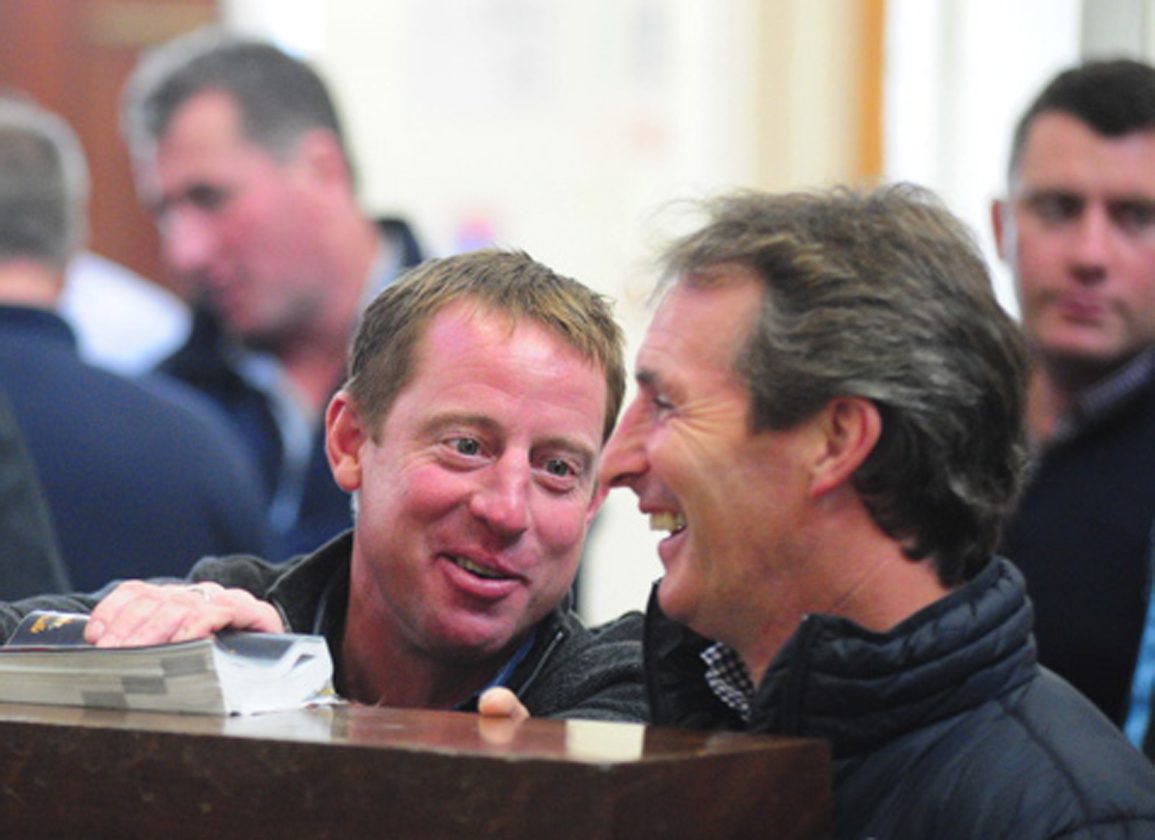
Johnny Collins and Norman Williamson | Tattersalls

“When I started breezing horses, we were buying ready-to-rock 2-year-olds. They were little five and six-furlong horses. It's changed an awful lot now. Look at last year for example, an Irish Guineas winner [Native Trail (GB) (Oasis Dream {GB})] and a St Leger winner [Eldar Eldarov (GB) (Dubawi {Ire})] came through the breeze-ups. It's amazing really.

“The yearlings were a great trade last year and it was hard to get them. I bought five at Book 2, two at Fairyhouse, two at the Somerville Sale, two at the Orby and the lads helped me out with six from America.”

The lads, as referenced by Collins, are international bloodstock agent Chad Schumer and his European representative Nancy Sexton, who have helped him to source stock from America while he was unable to travel to the States.

He continued, “I like a horse with a bit of strength and a bit of movement. There probably are sires who I wouldn't buy the progeny of because they haven't been lucky for me or they aren't commercial enough but I do try and go to the sales with as open a mind as possible. I'd cast a broad net and would look at as many as I could at a yearling sale.

“You can't overthink it, either. When you've your bundle of horses bought, you can only do the best with the horses you have. Of course it gets to you when they're not progressing the way you'd like them to be. For me, the beauty of it with the breezers is that I have a bunch of National Hunt horses to sell every year as well. So, even if you didn't have a great year with one code, you would be hoping to have a better year with the other. I'd be telling you a lie if I said that, coming close to the sales, there isn't an odd night where I'd be lying awake in bed thinking about it all. Of course there are.”

Collins endured his share of sleepless nights at the start. Whilst riding trackwork in America, he began to trade a few horses on the side but, by his own admission, was forced to learn by his mistakes.

“I went buying horses not really knowing what I was doing,” he explains. “I knew how to ride a horse but that was as far as it went. I had to make all of my own mistakes. I was at this a good while before I started making money. But, if you can sustain it, you won't keep making those mistakes. It would sharpen up your ideas and you won't make the same mistake twice. You get to look at your mistakes all year. Now, I wouldn't always buy a horse with perfect conformation but I'd know now what I could live with and what I could work with.”

So, when did the tide turn?

“For the first five or six years I really struggled. Even though I sold a couple of good horses, I was only barely making ends meet. The year I sold Mshawish, I also sold a horse by Street Boss, who made around €260,000. That really got the thing going.”

He added,  “I was only making enough to survive and that was with no staff. Hopefully we can keep it going now. It takes a while to break into it. You've to make a lot of mistakes and you need connections, too. It doesn't happen overnight. It takes time to build up a relationship and a bit of trust. It's easy to break it then as well.

“With the best will in the world, you can never be sure what a horse will do when it's put to the pin of its collar. You could have a horse working well but he might not deliver on a racecourse. That happens to trainers as well. You could genuinely think you have a good one but they let you down. Horses have a habit of doing that.

“When push comes to shove, they might not have the heart or the mind to go through with it. That's why it's so satisfying when they work out because, you know, everything is on the line as a trader. You have to experience the disappointment for when they don't work out to appreciate the satisfaction for when it does.”

Like most people who are good at what they do, Collins lives for his work and that passion fuels a hectic but rewarding lifestyle surrounded by horses.

“I love it. I enjoy this job, I must say. I like bringing on young horses and watching them progress. Even the National Hunt horses, I love bringing them on as well. And if they go on to do well for the next man, it's just a great feeling. That's what defines success for me but, at the same time, you can't do it if it's not financially viable.

“Especially when you start off, you need to have good results in the sales ring to keep the whole thing going and to develop the business. Luckily enough, we've sold a few nice horses but you're always looking for the next Cheltenham winner or the next good horse on the Flat.”

He added, “When you have the operation built up, bar you have it in your head to scale down, you have to buy the same amount of stock each year if you want to keep the same number of staff and the thing going the way you have it.

“Look it, I'm happy with the way I have it. As long as I have enough help, I've no interest in scaling back. I wouldn't see myself slowing down ever, as long as my health allows, because I do live for it. I could retire if I sold all my stock but it wouldn't make me happy.
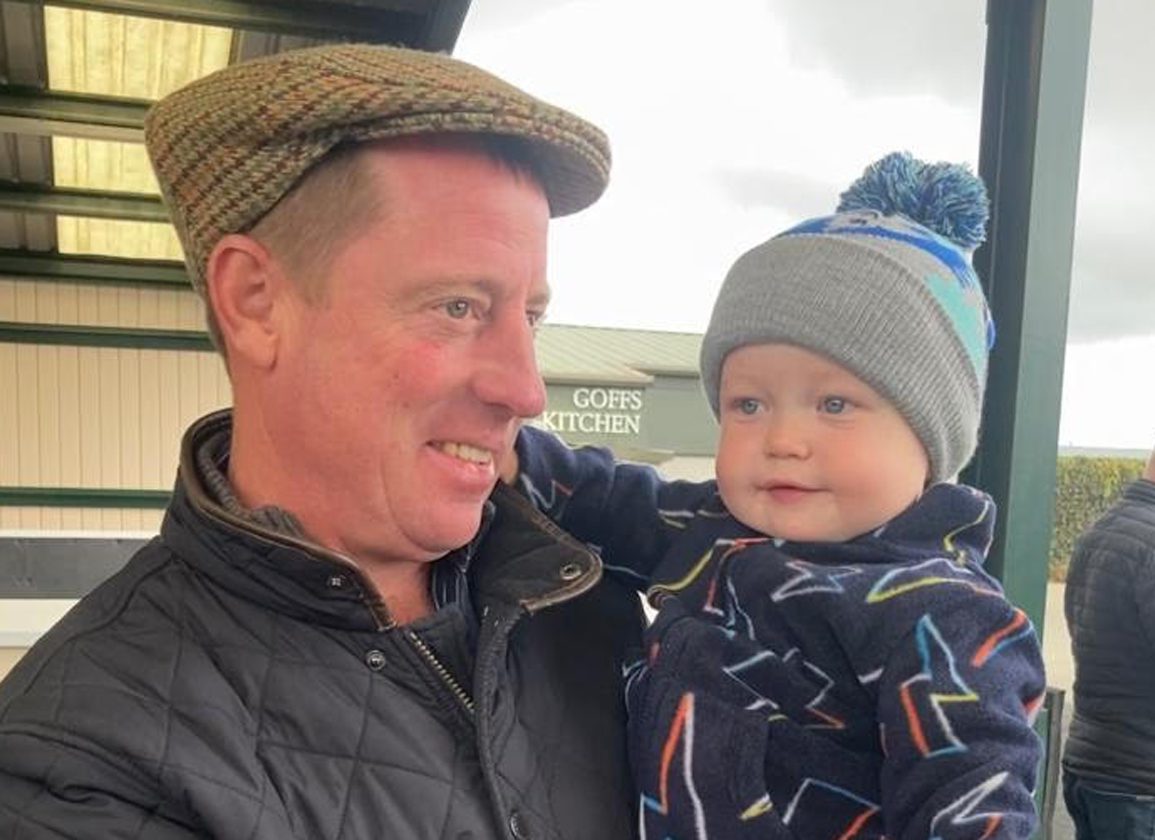
Johnny Collins with his son Daniel | Barbara Collins

“You could kick up your feet but what would you do then? I'm a late starter with regards to my family. My wife Barbara and I have a son, Daniel, and he's only 18 months old.

“I've a lot of friends working in jobs they don't like. They get up every morning to go to work and it's a struggle. I bounce out of bed every morning to go at this. It's not like work at all. It's very enjoyable.”

Facing the reality that comes with preparing over 120 horses for resale and the need to clear a couple of million euros annually to keep the business afloat would be enough to make most people baulk. Not Collins, whose search for a star–and to make a few quid along the way–sustains him.

“There was an old man I used to drink with below in the pub in Middleton, Denis Twomey was his name. He's since passed away but he used to have a great saying, and it stuck with me.

“He'd say, 'There are 20 years to come and there are 20 more to back it, now where is the man who can tell the man who wore the ragged jacket?' Every time I'd see Denis, I'd ask him to say it for me. No matter how many times I'd heard it before, I loved listening to it. It's a great saying, you know, and it's very true.”

The post Johnny Collins: ‘I Bounce Out Of Bed Every Morning – I Love This Job’ appeared first on TDN | Thoroughbred Daily News | Horse Racing News, Results and Video | Thoroughbred Breeding and Auctions.

Source of original post

Verified by MonsterInsights