Kentucky Horse Racing Commission Seeks To Hire Safety Steward

The Kentucky Horse Racing Commission (KHRC) is hiring a Safety Steward to oversee safety procedures and ensure compliance of both Horseracing Integrity and Safety Authority (HISA) and KHRC standards and rules at licensed Thoroughbred racetracks and training centers.

While the duties of the Safety Steward are currently being performed by KHRC staff, the creation of this new position puts a focus on safety protocols, establishes a lead position for safety compliance and ensures that information is being shared across all parties involved.

The executive level position will monitor daily activities both in the barn areas and on the racetrack. Some duties include:

  • Monitoring for compliance with therapeutic and race-day medication regulations and reporting any observation of an unsound horse to regulatory and track veterinarians;
  • Evaluating horse entries for drop in race class, poor performance, number of starts over a rolling 8-week period, veterinary treatment(s) and reporting any potential risk factors to the Board of Stewards for consideration to scratch;
  • Conducting pre-meet racetrack safety inspections with track maintenance personnel, including working with outriders to monitor compliance with racetrack rules during morning training, monitoring starting gate procedures, and monitoring ambulance and medical personnel protocols for horse and riders;
  • Assisting the state steward with Trainer Examinations, and during steward hearings,
  • Serving as a member of the Mortality Review Board; and
  • Conducting random inspections at racetracks and training centers to monitor regulatory and safety compliance.

The safety steward will also make recommendations to racetrack management and regulators for the welfare of horses and riders, integrity of racing and compliance with horse racing laws and regulations.

For more information and to apply for the position of Executive Advisor (Safety Steward), visit Kentucky's Personnel website, or KHRC.ky.gov

The post Kentucky Horse Racing Commission Seeks To Hire Safety Steward appeared first on Horse Racing News | Paulick Report.

Source of original post

Blue Grass Farms Charities Receives Grant From Kentucky Colonels To Buy Backpacks

 Blue Grass Farms Charities is proud to announce it received a grant from the Honorable Order of Kentucky Colonels (HOKC) in the amount of $6,354.00 to purchase 75 middle school backpacks and 200 grade school backpacks.  Blue Grass Farms Charities serves individuals and their families who work in the Central Kentucky Thoroughbred industry by providing health and human services in six counties.

HOKC awarded $3.1 million in grants supporting 343 non-profits, impacting more than 3.8 million Kentuckians.  Grants are made possible through donations from Kentucky Colonels from throughout the Commonwealth and around the world who chose to exercise the honor of being named a Kentucky Colonel in a meaningful way.

According to Commanding General Gary Boschert: “2022/2023 was another generous year for Colonels. We were able to award another $3.1 million dollars to 343 non-profits this year that helps them support over 3.8 million Kentuckians. Kentucky Colonels generosity is heartfelt and well spent on worthy agencies across the Commonwealth.   Our long-term efforts in both western and eastern Kentucky are ongoing with funds remaining for each effort. We work with other agencies to ensure Kentucky Colonels money is spent wisely and deliver goods and products needed for the rebuild.”

Blue Grass Farms Charities provides health and human services to those who work in the Central Kentucky area.  One of the most popular programs each year is the 'back-to-school backpack program.  This year the charity will distribute 1,100 backpacks to farm and backstretch workers' children from kindergarten to 8th grade.  “We are grateful for this grant award by the Honorable Order of Kentucky Colonels to help with the cost of such an important tool for students to have when school starts,” states Julie Kwasniewski, Director.

About the Honorable Order of Kentucky Colonels 

The Honorable Order of Kentucky Colonels is a 501(c) (3) entity dedicated to supporting charitable activities throughout the Commonwealth of Kentucky. The organization is governed by an all-volunteer Board of Trustees. The “Kentucky Colonel” commission is an honorary title granted by the Governor of the Commonwealth of Kentucky. Since 1951, the organization has pursued its mission through annual grants totaling $63 million to more than 1,700 nonprofits. Of those Colonels' contributions, each grant is thoroughly vetted by the trustees and staff. Though the corporate name is The Honorable Order of Kentucky Colonels, most know it by its long-term trademark, KENTUCKY COLONELS. Visit kycolonels.org to learn more. 

The post Blue Grass Farms Charities Receives Grant From Kentucky Colonels To Buy Backpacks appeared first on Horse Racing News | Paulick Report.

Source of original post

Your Questions About Racetrack Surfaces, Answered

Ahead of this week's Track Superintendent Field Day at Horseshoe Indianapolis, we asked our Patreon subscribers what they want to know about track maintenance. We brought your questions to Michael DePew, soil science consultant who led off the presentations Monday with an overview of how particle size and chemical properties impact track maintenance.

Here's what we learned:

Do track superintendents monitor race days for track bias and adjust maintenance to make the surface play “fair”?

Probably not in the way you're thinking of. DePew said track maintenance crews will keep an eye on lane bias. For example, in Quarter Horse races, wherein the field mostly remains spread across the width of the racetrack, they will be watching to see if there's a lane that's deeper or dryer than the others.

When it comes to monitoring for early speed bias versus closers, DePew said that's beyond his purview.

What does harrowing accomplish on a dirt track?

It's creating a cushion — the fluffy part that sits on the top of a track surface. When a horse's hoof hits the cushion, it compacts under the weight of the horse and softens the impact of the horse's leg to the ground. This cushion needs to be compactable in order to take that impact, but it also needs to be supportive enough when compacted to give the horse something to push off from when they go to take the next step.

The amount of moisture in a surface can impact this, too. DePew said that an ideally-composed dirt surface can handle a wide range of moisture amounts. Dirt surfaces that are less ideal in their mixing will have a more narrow range of moisture (from water trucks or from rainfall) that they can tolerate before they develop problems with cushion or slide.

-Which do track superintendents prefer for a dirt surface – irrigation or natural rainfall?

Perhaps surprisingly, DePew said he'd rather rely on his water trucks because he can control the amount, timing and volume of the water going onto the surface. The water quality of rainfall is definitely better for the track than what's coming from a lake or from ground water, but Mother Nature doesn't apply it evenly. For one thing, DePew said the larger tracks he's been to may be subject to cloudbursts where one part of the track gets rain and another doesn't.

For another, rainfall rates can be highly variable. Multiple, light rain events in a day soak in better than rainfall that's punctuated by heavier and lighter periods, as this changes the way the moisture moves through or over the top.

Support our journalism

If you appreciate our work, you can support us by subscribing to our Patreon stream. Learn more.

What about turf surfaces?

DePew said turf irrigation systems aren't always perfectly even; maintenance crews have to be aware of where there may be dry spots where irrigation doesn't reach. In this situation, areas that remain dry most of the time react differently to water when they do finally get it. They tend to have heavy rain run off the top quickly, rather than soaking through, compared to regularly-irrigated areas.

Turf tracks, predictably, often need more water than dirt tracks because of the demand of the root systems underneath. DePew recalled a day earlier this summer when the dirt track at Horseshoe Indianapolis got enough sudden rain that the top portion of it looked muddy, although the base underneath was stable. The turf track actually needed more moisture after that brief rainy period though so DePew was faced with the prospect of running the irrigation system after the day's races even though it had been stormy earlier.

What's the difference between “wet fast” and “sloppy” dirt tracks?

A lot of it is in the eye of the beholder. DePew leaves that designation to the racetrack for official purposes, but said that a very firm pad just under the harrow depth will make the track faster even when the cushion is wet. In fact, some tracks play faster when wet than dry because the water mixes with the cushion and makes it “splat” when the hoof hits, leaving the hoof to reach the pad more easily. Arguably, he said, that harder, firmer surface could be higher impact to the horse.

The post Your Questions About Racetrack Surfaces, Answered appeared first on Horse Racing News | Paulick Report.

Source of original post
Mountaineer Park Jockeys Refuse To Ride Because Of Slow Ambulance Response After Spill

Jockeys at Mountaineer Park in New Cumberland, W.Va., refused to ride Monday's eight-race card over concerns with the track ambulance and a delayed response time to a spill in the previous night's sixth race.

Apprentice German Terraza sustained a fractured collarbone Sunday night in a fall when his mount, Another Flirt, was squeezed at the top of the stretch and clipped heels after relinquishing the lead in a one mile conditioned claiming race for fillies and mares carrying a $4,000 tag. Esta Caliente, ridden by Jose Leon, was disqualified from her third-place finish and placed last for drifting out and causing interference.

Another Flirt did not suffer any apparent injuries.

Terraza was not attended to by medical personnel for several minutes, according to witnesses. The next race was delayed about 12 minutes while the ambulance took Terraza to a local hospital.

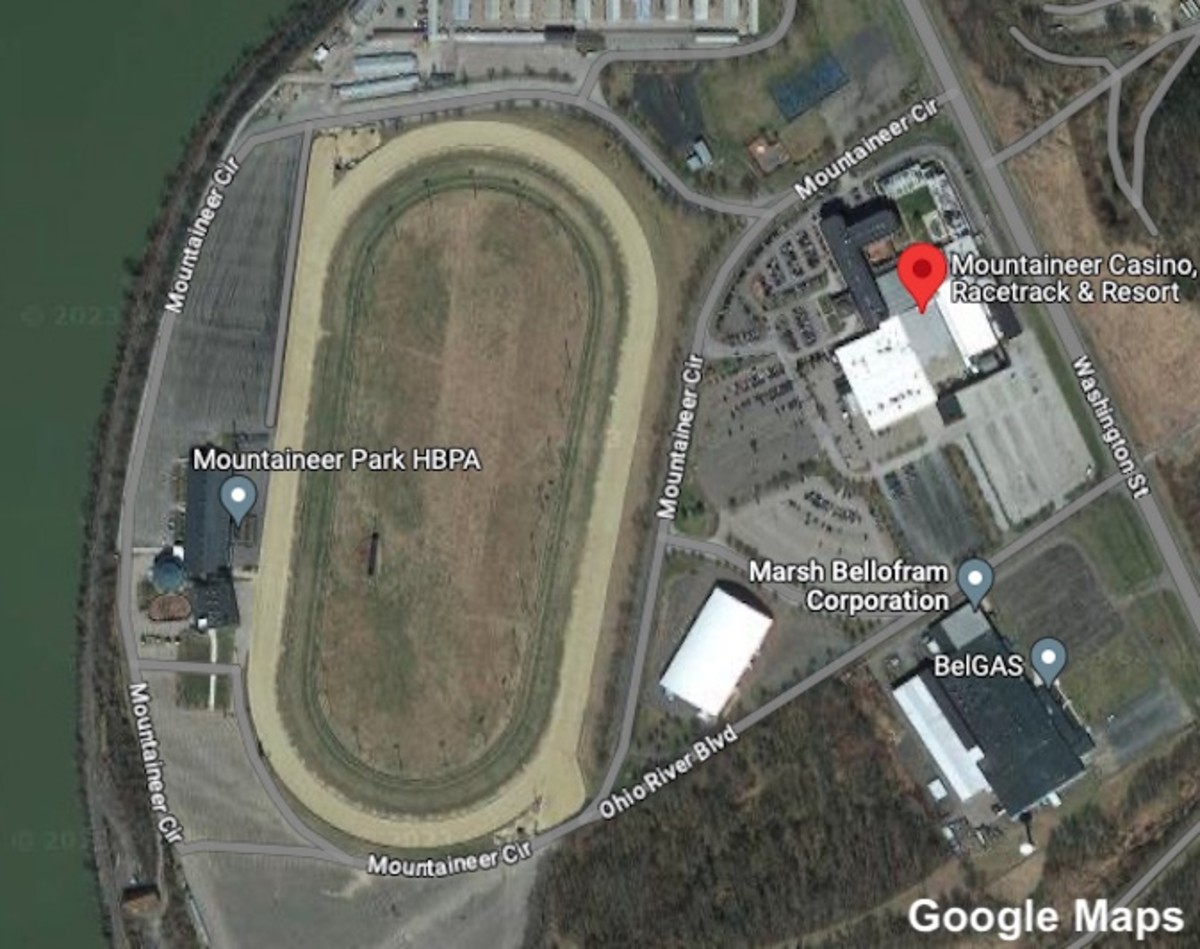
The ambulance at Mountaineer Park does not routinely follow the horses and jockeys as is standard at most North American tracks, receiving permission from the West Virginia Racing Commission to stay on a paved road that circles the track (see below).

Tracks in West Virginia currently are not subject to rules and regulations of the Horseracing Integrity and Safety Authority, having won a favorable ruling in a lawsuit to which they are a party. HISA has specific regulations regarding both the human  and equine ambulances, requiring the human ambulance to either follow the fields at a safe distance or be parked at an opening to the track.

Overview of Mountaineer Park shows the perimeter road used by the human ambulance

According to James Colvin, Mountaineer's director of racing, there was a “miscommunication” on Sunday that is now under investigation by the racing commission.

“We were following the protocols the jockeys agreed to,” Colvin said. “We did not break any rules.”

Colvin said the ambulance is not a four-wheel drive vehicle and has difficulty navigating the racetrack if it has moisture in it. The track condition on Sunday night was “good” for the race in which Terraza was injured.

As horses were approaching the starting gate for Monday night's first race, a five-furlong sprint, jockeys noticed the ambulance was positioned in the chute on the opposite side of the track near the quarter pole. They were told the ambulance would not follow the field.

As a result, they returned to the jockeys room and opted not to ride.

Agent Bobby Quinones said Terraza would miss six to eight weeks while his collarbone heals. The apprentice had only returned on May 6 from another collarbone fracture sustained at Turfway Park last Nov. 30.

Terraza, who began riding in July 2022, has recorded 21 career wins from 235 mounts.

The post Mountaineer Park Jockeys Refuse To Ride Because Of Slow Ambulance Response After Spill appeared first on Horse Racing News | Paulick Report.

Source of original post

Verified by MonsterInsights