Gural Reveals Indicted Trainer Allard Still Operating, Bans Horses And Owners From His Barn

Meadowlands owner Jeff Gural issued the following statement to media on March 6 regarding horses associated with Rene Allard. Harness trainer Rene Allard was included in a superseding indictment filed in federal court in December. The indictment was part of a drug adulteration and misbranding conspiracy case that also included Louis Grasso, Donato Poliseno, Thomas Guido III, and Richard Banca. The defendants were alleged to be involved in a scheme to “manufacture, distribute, and receive adulterated and misbranded PEDs and to secretly administer those PEDs to racehorses under scheme participants' control.”

The indictment revealed that an office at a Middletown, N.Y., training center where Allard operated was searched by federal agents who found bottles of injectable products labeled “for research purposes only.” That case was originally filed around the same time as a larger case brought by the U.S. Attorney for the Southern District of New York against alleged doping rings which included a number of Thoroughbred and harness trainers, assistants, and veterinarians.

Meadowlands management has become aware that Rene Allard is training a stable of horses in South Florida. As a result, The Meadowlands, Tioga & Vernon Downs will exclude any horse being trained or that has been trained in that stable in any stake and is actively investigating who owns the horses that are or have been in his stable this winter.

Those owners who currently have or have had horses in Allard's stable this winter are advised that all horses owned wholly or in part by them will be excluded from participation in all Meadowlands, Tioga & Vernon Downs races and that all of horses owned wholly or in part by them will be deemed ineligible to for any/all Meadowlands, Tioga & Vernon Downs administered stakes races for a minimum of three years.

If owners affected by the above are a minority partner on horses with owners that are not affected by the above and are being trained by accepted trainers, they must legitimately divest their interest in those horses, which will be required to be done and demonstrated to the satisfaction of The Meadowlands before the March 15 stakes payments will be accepted on those horses.

The affected owners should notify their partners on the horses that fall into the above category immediately.

“This news is particularly disturbing after the indictments of March and a later superseding charge in December of last year,” said Meadowlands President Jeff Gural. “We, along with the Thoroughbred Jockey Club, spent much time and money employing the Five Stones investigators to prepare a case to get the feds interested which led to all of those indictments. We will continue to partner with The Jockey Club to fund the continuing investigation by Five Stones. We could use support in this initiative and welcome anyone who would like to aid in the funding of this necessary and important endeavor.

“To learn that people actually give this guy horses to train after what was discovered by the federal investigation boggles the mind. The only reason to do this, that I do this, is to clean up racing so we might have a future and to protect the guys that do try to follow the rules.

“Horsemen seem to have this absurd unspoken bond that they protect each other. Well let me be perfectly clear, trainers that break the rules and use performance enhancing drugs (PEDs) are stealing from you, not me. They are beating your horse with a PED-enhanced horse then, they are buying or claiming your horse and them beating you with your own horse. I just don't get it.”

Meadowlands investigator Brice Cote will respond to questions at Bcote@playmeadowlands.com

The post Gural Reveals Indicted Trainer Allard Still Operating, Bans Horses And Owners From His Barn appeared first on Horse Racing News | Paulick Report.
Source of original post

‘The Buck Stops With Me’: O’Neill To Serve 10-Day Ban For Lidocaine Positive

Doug O'Neill will begin serving a 10-day suspension on Monday, March 8, as a result of a stipulated agreement with the California Horse Racing Board stemming from a positive post-race test for lidocaine on Oct. 9, 2020, according to Daily Racing Form. O'Neill was also fined $7,500.

Howbeit tested positive for the anesthetic after finishing second in a $40,000 claiming race at Santa Anita in Arcadia, Calif. It was O'Neill's first medication violation since a flunixin overage in April 2018, according to www.thoroughbredrulings.com. The ruling calls for a 30-day suspension, with 20 days stayed provided O'Neill does not have any Class 1, 2 or 3 violations between now and March 6, 2022.

Howbeit has won twice since the October violation, including a Feb. 13 victory while carrying a $32,000 tag at Santa Anita. He was claimed from that race by Mark Glatt.

O'Neill, who entered Sunday's program tied with Bob Baffert as leading trainer by wins with 20 victories from 140 starts, posted the following statement on his Facebook page:

“I take 100% responsibility for the minuscule (parts per trillion) amount of lidocaine detected in one of my horse's post-race. As the trainer of the horse, the buck stops with me. Lidocaine is prevalent in numerous over-the-counter medications used to relieve pain and itching caused by minor sun burns or other burns, insect bites and the like. Lidocaine is an ingredient in many human creams. I know with certainty that I have never administered lidocaine to any of my horses, ever, and that this has to be an environmental contamination. The amount involved would not affect a horse's performance.

“I must serve a 10- day suspension for this infraction.

“I am grateful to the CHRB for working with me to settle this matter and I will take the suspension and look forward to moving on from this unfortunate incident.

“As a trainer it's easy to accept the 'pats on the backs' and accolades, but we have to also accept the 'less than' moments, equally as well.”

The post ‘The Buck Stops With Me’: O’Neill To Serve 10-Day Ban For Lidocaine Positive appeared first on Horse Racing News | Paulick Report.

Source of original post

Four Trainers Receive One-Year Bans, $10,000 Fines For Texas Ractopamine Positives

The Texas Racing Commission in recent months has handed out one-year suspensions and $10,000 fines to four trainers whose horses tested positive for ractopamine, a Class 2 drug carrying a Class A penalty under the Association of Racing Commissioners International's Uniform Classification Guidelines.

Ractopamine is a feed additive for cattle and swine designed to create lean muscle. When used in horses, it reportedly acts similarly to anabolic steroids in building muscle mass. Ractopamine has also been found to be a contaminant in commercially sold horse feed manufactured by companies that also make additives for cattle and swine that contain the drug.

Jerenesto Torrez, who has been training since 1991, is the only one of the four trainers who primarily conditions Thoroughbreds. His sanctions stem from a positive post-race test for Mine Inspector, second-place finisher in the fourth race at Lone Star Park last July 27. His suspension began on Jan. 1 and runs through Dec. 31. Mine Inspector  was disqualified and also placed on the veterinarian's list for 90 days last Oct. 15 after a split sample confirmed the ractopamine finding.

The three others suspended for one year and fined $10,000 are primarily Quarter Horse trainers. They are:

  • Jorge L Muniz, whose My Famous Troubadour was disqualified from a Retama Park win in the fifth race on Aug. 13, 2020. Muniz' suspension runs from Nov. 20, 2020, through Nov. 19, 2021.
  • Xavier Alonzo Jr., whose Medicci was disqualified from a second-place finish at Lone Star Park on Sept. 26, 2020. His suspension runs from Jan. 23, 2021, through Jan. 22, 2022.
  • Jesus Marquez Meza, who had two ractopamine positives reported at the same time. The first was for A Louisiana Miracle, second-place finisher in the third race at Lone Star Park on Sept. 13, 2020. The second was for American Hussle, third in the 11th race at Lone Star Park on Sept. 19, 2020. Meza's suspension for both violations runs from Nov. 1, 2020, through Oct. 31, 2021.

All of the horses were required to go on the veterinarian's list and are required to pass an approved veterinary examination before being eligible to race.


The post Four Trainers Receive One-Year Bans, $10,000 Fines For Texas Ractopamine Positives appeared first on Horse Racing News | Paulick Report.

Source of original post

How It Works: A Look At How Jockeys Weigh Out

The subject of jockey weights has been a central part of the news in racing this week as reports circulated that Eclipse Award-winning apprentice jockey Alexander Crispin has been fined and suspended for carrying a lower weight than advertised in a race on Jan. 16.

Most people probably know that jockeys are weighed both before and after a race to ensure they are carrying the weight printed in the program or on the changes list, but unless you've spent time in the jocks' room, you may not know the finer points of how the process works.

First of all, it's important to understand the terminology. “Weighing out” refers to the process of recording a rider's weight before a race, when he or she is on their way out of the jockeys' room. “Weighing in” refers to recording their weight after the race, when they're on their way back inside.

The procedures in the jockeys' rooms vary somewhat between tracks and states, depending on the state rules and preferences of the racing officials at work in a given place.

Javier Torres, clerk of scales at Keeneland, Churchill Downs, and Kentucky Downs, said that riders at those tracks are required to check in at least 30 minutes before the first race where they are named to ride. They will consult a board where Torres has written the weights each rider must carry through the day. By the time they sign in, Torres said, jockeys already have a pretty good idea of what their weight will be that day. At sign-in, they're required to write down what their weight will be for the day and Torres uses that to calculate overweights, if necessary.

“Most of the jockeys, they know what they weigh, they know their bodies,” said Torres. “Most of them know, and I know, what they can do, what their lightest weight is they can do.”

If you sit in the grandstand throughout a race card, you may hear new overweights announced late into the card. Torres said that at the tracks where he works, that's probably because a rider didn't have a mount for the first few races and just signed in, not necessarily because they were struggling all afternoon to reduce weight or have ballooned after an earlier race.

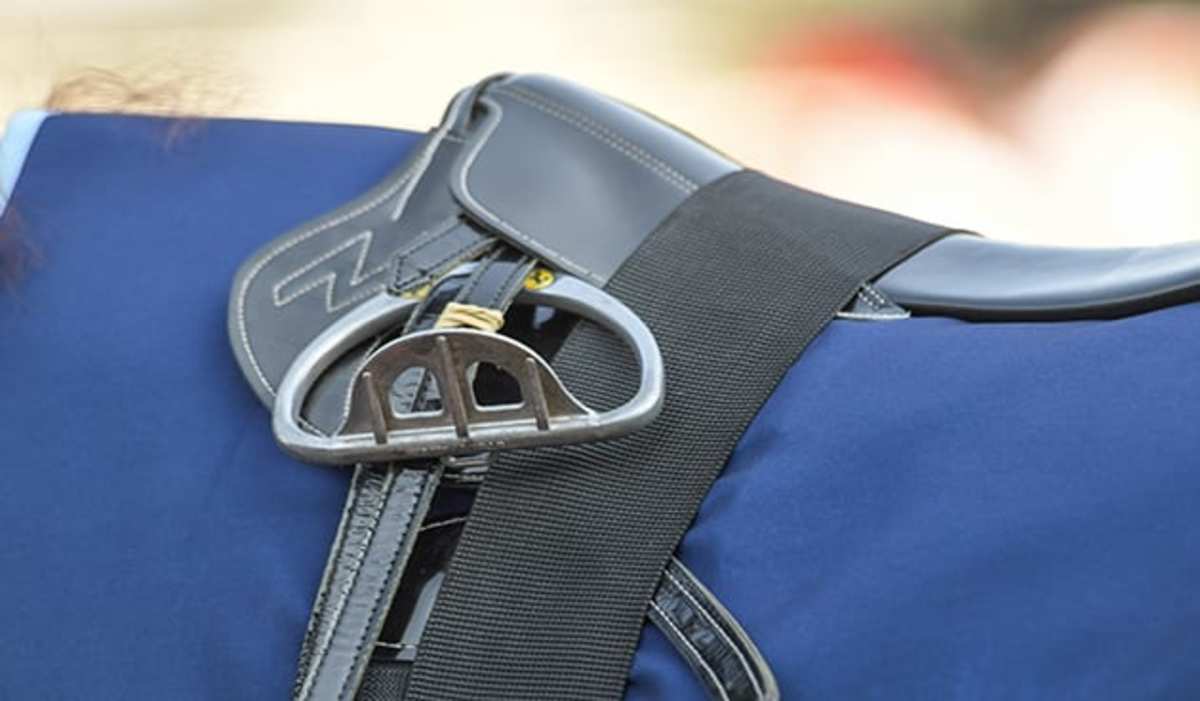
Of course, there will be some races where a rider has to carry more weight than others. There are a few different ways the clerk can add weight to a rider. In Kentucky, Torres uses rubber pads which sit between the saddle towel and the saddle and are designed to weigh between one and ten pounds. Some riders don't care for those pads because they feel the slick outer coating makes the saddle slip, so in some cases Torres will still allow use of lead weights, which are tucked into pockets under the saddle flap.

“Most jocks have three different saddles, depending on the weight they need,” said Torres. “The more weight, they go with the heavier saddle. Sometimes their heaviest saddle isn't big enough. John McKee, he might not even weigh 100 pounds. He has Pat Day's old saddle, and that saddle has the lead built into the actual saddle. I think it weighs 12 or 13 pounds.”

In New York, lead weights are still the preferred system to add weight to a rider unless a trainer supplies a weighted pad, which must be approved by the stewards and the clerk of scales.

Kentucky, California, and New York do not count safety equipment like vests or helmets against a rider's weight allowance. In New York, clerks can count some of the horse's equipment like martingale, breastplate, or other equipment toward a rider's weight allowance.

Scales and recordkeeping vary also. In Kentucky, riders are weighed with a digital scale 15 minutes before each race and the scale's readings feed into a computer system that keeps a running record of those weights. The same happens at NYRA facilities, but at Finger Lakes, weights are manually recorded by the clerk. In Kentucky, Torres and his assistants then place the rider's equipment on a table which is highly visible in the jockeys' room, and cover it with a saddle towel to indicate it has already been measured for the day. The scale and computer readings are verified by the stewards periodically.

In Kentucky, valets do not always saddle horses for the same rider ahead of each race. Torres randomly assigns numbers to valets each day and matches them to horses by post position order, which reduces the opportunity for a valet to collude with a rider ahead of time to change equipment or remove weights. In New York, clerks randomly assign valets to different riders each day.

After the race, riders weigh back in. Traditionally, Kentucky used to weigh only the top four finishers, but now weighs the top five due to certain types of exotic wagers that include the fifth-place entry. Kentucky also allows a rider to come back weighing up to six pounds heavier – three for equipment changes, and three for the accumulation of mud or water on the rider or their tack.

New York has detailed rules on the books prohibiting riders from touching any person or thing with their equipment after dismounting and prior to weigh in. Riders are also penalized in New York and in California for being more than one pound short of their weigh out weight, or for being more than two pounds over their weigh out reading.

The topic of rider weights has long been a heated one, with many riders advocating for a higher minimum through the years. Torres said he believes fewer riders are going to unhealthy extremes to reduce weight than they did when he started as a clerk of scales some 15 years ago. He can remember one rider routinely sweating off seven pounds in the sauna each day; the steam rooms have been closed since COVID-19 began, and he believes fewer riders are “flipping” (or inducing vomiting) than they once did.

“It's hard to go in there and pull weight,” said Torres. “I tell them, don't kill yourself. I'd rather be stronger than be lightheaded trying to pull weight. To me, over the years, the number of riders having to reduce really hard to make weight is less and less. I know a lot of guys who realize now it's going to affect them in the long run when they retire.”

This piece is part of an occasional series exploring the way different regulations and procedures in racing work. Want to know how something in racing works? Email us using the Ask Ray button in the red bar at the top of this page.

The post How It Works: A Look At How Jockeys Weigh Out appeared first on Horse Racing News | Paulick Report.

Source of original post

Verified by MonsterInsights