Minnesota Thoroughbred Association Stallion Season Auction Begins Jan. 3

The Minnesota Thoroughbred Association will conduct its 2021 Stallion Season Auction Jan. 3 through Jan. 11, featuring more than 50 premier stallions from Kentucky, Florida, Oklahoma and Minnesota. The on-line auction will be hosted at www.thoroughlybred.com.

A new incentive is also being offered for this year's auction from the Minnesota Breeders' Fund. Any breeder who purchases a stallion season through the 2021 MTA Stallion Season Auction and foals in Minnesota will receive a $1,000 check when the foal is registered with the Minnesota Racing Commission in 2022.

“As we leave 2020 behind, organizers at the Minnesota Thoroughbred Association are excited to provide breeders with many terrific stallions to build on in the future,” said Kay King, executive director of the MTA.

Bids will be placed on a rolling bases for all eight days of the sale. Stallion seasons can be searched by state or name on the website. New stallion seasons may continue to be added through the duration of the sale.

For the current Stallion Season Auction list, visit minnesotabred.com/.

The post Minnesota Thoroughbred Association Stallion Season Auction Begins Jan. 3 appeared first on Horse Racing News | Paulick Report.

Source of original post

Big Books and Breaking Records

The setting of new sire records in the modern era tends more than not to be a direct consequence of ever-greater book sizes. But they must still be acknowledged as legitimate breeding benchmarks as they will inevitably feature some outstanding performances. Just look at Mehmas (Ire)‘s tally of first-crop 2-year-old winners this term. Currently on 56 winners, he is already 17 clear of Iffraaj’s old record and in normal circumstances we might be entitled to expect his record to stand for many years. It may well do, but his strike rate of 53% winners to runners, achieved by quite a few other freshman sires down the years, suggests that the big total of winners is just as much a function of a big crop of runners. So, we cannot rule out another Mehmas-like total in the near future.

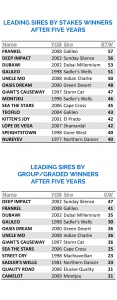
We could say the same about black-type records. Larger numbers of runners tend to be the reason why these records fall, but it’s not always so. Take the case of Frankel (GB), the sire who has posted the highest number of stakes winners (56) and group winners (41) of any European sire in the first five years of his career. Frankel has already eclipsed the previous records set by Dubawi after his first five years, which stood at 53 stakes winners and 35 group winners. Dubawi, in turn, took the record away from Galileo (Ire), who had amassed 51 stakes winners and 30 group winners after his first five years.

No one could accuse Frankel of relying on sheer numbers of runners to outpace Dubawi and Galileo. In fact, he has set the new standards with fewer runners than either of his major rivals. Hence he has posted superior strike rates–14.2% stakes and 10.4% group winners–than Dubawi and Galileo had at the same point in their careers. But Frankel really did get a head start on all his rivals by covering Europe’s best mares from the outset of his career, unlike either Galileo or Dubawi. As many as 62% of the mares that have produced Frankel’s runners so far can be classed as elite, which is in stark contrast to the corresponding percentages for the early runners by Dubawi (30%) and Galileo (35%). What’s certain is that Frankel will need to have very long innings at his current strike rate to overhaul Dubawi’s current mark of 171 stakes winners and, by my calculations, another 20-plus years to reach his sire’s tally of 298. It’s a sure sign of the times that Frankel not only has more group winners than Galileo after five years but also has nearly double the number of his grandsire Sadler’s Wells and has over three times what the great Northern Dancer had in their first five years.

Remarkably, there is yet another sire that can boast an even higher number of group winners in his first five years. Shadai’s Deep Impact (Jpn), the very definition of a big fish in a small pond, sired 47 group winners in his first five years with runners. The lack of serious competition among Japan’s stallion ranks possibly casts a shadow over such an achievement, as does the fact that Deep Impact’s percentage of group winners (7.4%) is not quite as good as the percentages posted by Frankel, Galileo or Dubawi all of whom average above 10% group winners to runners. To counter that argument, though, it must also be recognized that Japan has far fewer group races per head of population than Europe does. So, 47 group winners in five years is still a formidable achievement.

Not surprisingly, North America’s records for stakes winners and graded winners at the end of five years have also fallen quite recently. The phenomenal Uncle Mo set new standards at the end of 2019 with his 48 stakes winners and 26 graded winners. It’s hard to believe that there are now 19 sires with more stakes winners in their first five years than the great Danzig, but none will ever get close to his 21% strike rate.

Among sires who stood exclusively in America, few would have guessed that it wasn’t Speightstown, nor Distorted Humor, nor Scat Daddy that held the record prior to Uncle Mo, but the one and only Kitten’s Joy, a sire that perhaps still struggles for due recognition.

The post Big Books and Breaking Records appeared first on TDN | Thoroughbred Daily News | Horse Racing News, Results and Video | Thoroughbred Breeding and Auctions.

Source of original post

Making Claims: A Closing Argument To Put Awesome Again In The Hall Of Fame

In “Making Claims,” Paulick Report bloodstock editor Joe Nevills shares his opinions on the Thoroughbred industry from the breeding and sales arenas to the racing world and beyond.

From the centuries-old nurseries to the furthest-flung outposts, the goal of Thoroughbred breeding is to get a horse like Awesome Again – the kind of horse that secures a legacy for decades.

Awesome Again laid the foundation for over 20 years of high-level success for the Adena Springs operation as a runner and a stallion, and he provided one of the biggest victories in the storied career of owner Frank Stronach when he took the 1998 Breeders' Cup Classic. Though he stood just 16 hands tall, the 26-year-old left a massive footprint on the breed, and a hole just as big when he died on Dec. 15.

It sure feels like Awesome Again should be in the National Museum of Racing's Hall of Fame, but he isn't. In fact, he's been eligible for 17 years, and he's still on the wrong side of the velvet rope.

Awesome Again's recent death has the Thoroughbred world reflecting on his life and accomplishments, which means this is as good a time as there's going to be to stage a “last stand,” and make one final case for putting a deserving horse in the Hall of Fame.

To be sure, Awesome Again suffered no shortage of acclaim over the course of his life. He was named to Canada's Hall of Fame in 2001, and the Ontario-bred's achievements were so great, he was given a Special Sovereign Award in 1998 when he didn't have enough starts in his home country to qualify for the regular run of Sovereign Awards. More than two decades after making his final start, he remains the highest-earning Canadian-born Thoroughbred of all-time, amassing earnings of more than $4.3 million.

To determine why Awesome Again belongs in the Hall of Fame, I have identified some of the factors that go into my own Hall of Fame selection process when the ballot comes in the mail (chiefly, sustained high-level success and dominance over his opponents), and some potential shortcomings on Awesome Again's resume that have apparently kept him out. Then, I examine “The Bar:” the horses in the Hall of Fame who are perceived to have the least acclaim in a given category while still getting enshrined; and I identify how Awesome Again meets or exceeds that standard.

Before we dive in, it's important to note that Hall of Fame credentials are based on racetrack performance, meaning Awesome Again's outstanding stallion career, and his role in maintaining Adena Springs' high standing in the business, cannot be taken into consideration. Since 1990, the only horses to claim both a Hall of Fame spot and the leading North American sire title were Alydar and A.P. Indy; both of which earned their spots in the pantheon for their on-track exploits.

With that out of the way, let's poke some holes in the case against Awesome Again's Hall of Fame bid.

Standard: Sustained Success
Perceived Weakness: Awesome Again didn't beat Grade 1 competition until age four.
The Bar: Lava Man and Waya

It's easy to argue that Awesome Again had a lopsided career over the course of his two seasons on the track. He was a perfect six-for-six as a 4-year-old, and he didn't have a Grade 1 victory during his sophomore campaign. That 3-year-old run included wins in the Queen's Plate and the Grade 2 Jim Dandy Stakes, compared with five graded wins the following season.

It's unusual for a Hall of Famer to get in without a Grade 1-caliber 3-year-old campaign, but it has been done. Lava Man didn't win his first graded stakes race until the middle of his 4-year-old season, while the French mare Waya, a 2019 inductee, didn't get her first Grade 1 triumph until the end of her 4-year-old season. Like Awesome Again, both horses went on to become top-shelf runners once they matured.

The Hall of Fame loves a precocious horse, but that's not the only way through the door.

Standard: Sustained Success
Perceived Weakness: Awesome Again only had one season at the highest level
The Bar: Dance Smartly, A.P. Indy, and Winning Colors

Awesome Again was a Queen's Plate winner and took home a Grade 2 victory at three, and it's fair to count that as supporting evidence for a Hall of Fame resume, but not the meat of it. His ascent to the top of the handicap division took place during his 4-year-old season, when he went a perfect six-for-six. Among those wins during his 1998 campaign were triumphs in the Breeders' Cup Classic, the G1 Whitney Handicap, the G2 Stephen Foster and Saratoga Breeders' Cup Handicaps, and the G3 Hawthorne Gold Cup Handicap. Then, he retired, essentially leaving one season where he was a top threat.

One season at the very top of the mountain is admittedly pretty light for a Hall of Fame resume, but not entirely unheard of. Fellow Ontario-bred Dance Smartly was very good on her home turf at two, but she didn't hit her true ascent until age three when she won the Canadian Triple Crown and capped her season off with a Breeders' Cup Distaff score. She fell back to earth at four, and never won another graded stakes race.

Similarly, Winning Colors earned her first stakes victory in January of her sophomore season, and she never won another graded stakes race after she wowed in the Kentucky Derby, missing out in her next nine graded tries.

Just so we're not just picking on the fillies in this segment, consider A.P. Indy. His first graded stakes win came in the G1 Hollywood Futurity on Dec. 22 of his juvenile season. His run between that win and his Horse of the Year-clinching triumph in the 1992 Breeders' Cup Classic was remarkable, but it all happened within the span of less than 12 months.

If Awesome Again needed to stay competitive at the top for at least a calendar year, it's fair to start the clock with his third in the G1 Travers Stakes as a 3-year-old and run through his Breeders' Cup Classic score the following year, and that leaves his Queen's Plate and Jim Dandy out of the conversation. If one year at the top is enough, he's got it.

Standard: Sustained Success
Perceived Weakness: Awesome Again raced only 12 times
The Bar: 11 current Hall of Famers; Justify and American Pharoah in the near future

Yes, Awesome Again would be on the lower end of the spectrum among the Hall of Famers, a group that has eight members with 100 or more starts, led by 1899 Horse of the Year Imp with 171. However, he'd be far from the least experienced member of the group.

The great A.P. Indy made the cut with 11 starts. Ghostzapper, Awesome Again's greatest son, got the call to Saratoga Springs with the same number of starts.

The average is probably going to get even lower in the coming years, as Triple Crown winners American Pharoah and Justify all but certainly get their invitations. American Pharoah retired with 11 career starts, while Justify raced just six times. If and when Justify gets the call, he will have the fewest starts of any Hall of Famer, usurping 1800s stars Lexington and Sir Archy with seven each.

Standard: Dominance Over Competition
Perceived Weakness: No Eclipse Awards
The Bar: Alydar, Lava Man, Lure, Best Pal, Ancient Title, etc.

Sometimes, an all-time great has the misfortune of being in the same division as another all-time great, and there are only so many year-end honors to go around. There are a lot of good horses in the Hall of Fame without Eclipse Awards on their mantles, and there are a lot of good horses who might never get in who have one or more on their resumes – even Horses of the Year. Having one always helps, but it's not a prerequisite.

While we're on the subject, it's worth noting that Awesome Again finished second in the voting to Skip Away – a horse he beat in the Breeders' Cup Classic – in the 1998 Horse of the Year voting.

To save us all some writing and reading, this answers the question “Was Awesome Again considered at any point to be the best horse in his division, if not the best horse in training?” At least 34 voters thought so in 1998. For at least his straight-arrow stretch drive in the Classic, they were absolutely right.

Standard: Dominance Over Competition
Perceived Weakness: He only has two Grade 1 wins
The Bar: Xtra Heat

This is one of the biggest factors keeping Awesome Again out of the Hall of Fame, and it's understandable. There are Grade 1 win machines out there who would get laughed out of the building if they were considered for this lofty spot. Even though one of those wins was in the Breeders' Cup Classic, two Grade 1 victories would put Awesome Again near the bottom of the list if he made it in the club – counting horses that ran after the modern graded stakes system was implemented, of course.

But he wouldn't be at the very bottom.

Xtra Heat, who earned the champion 3-year-old filly title in 2001, was enshrined in 2015 with just one Grade 1 win to her name – the 2001 Prioress Stakes.

Granted, there are some other factors to consider here. Xtra Heat won loads of other graded stakes races, and she got achingly close to Grade 1 glory elsewhere, including missing out by a half-length when she tested male competition in the Breeders' Cup Sprint. The mare more than earned her spot among the immortals, but if the bar to get in is one Grade 1 score, Awesome Again doubled it.

Standard: Dominance Over Competition
Perceived Weakness: Who did he beat?
The Bar: We don't need no stinking bar.

Here is a list of the horses Awesome Again beat in the 1998 Breeders' Cup Classic alone:

– Hall of Famer and eventual 1998 Horse of the Year Skip Away
– Hall of Famer and dual classic winner Silver Charm
– Champion and Belmont Stakes winner Victory Gallop
– European champion Swain
– Argentine champion Gentlemen
– Belmont Stakes winner Touch Gold
– Grade 1 winners Coronado's Quest and Arch

Of course, if we let horses into the Hall of Fame off a single victory, even if it's against an incredibly deep field on the biggest stage, we'd be celebrating the career of figurative Hall of Famer Arcangues, and then we'd have to re-examine the entire admission process. So, I've put together a tale of the tape to display just who Awesome Again beat over the course of his career:

– Two Hall of Famers (and he beat Silver Charm twice)
– Three Eclipse Award winners (and he beat Silver Charm twice)
– Three international champions
– Three U.S. classic winners (and he beat Silver Charm twice)
– One Canadian classic winner
– 13 Grade/Group 1 winners
– 31 total graded/group stakes winners

Only two horses in that distinguished group got their revenge and finished ahead of Awesome Again in races he didn't win: Grade 1 winners Behrens and Precocity.

That's a lot of winning crammed into 12 races.

Make no mistake, Awesome Again is a fringe Hall of Fame candidate. He wouldn't still be waiting on his call, and I wouldn't have to argue this hard, if he wasn't. Still, if we're looking at what makes a Hall of Famer, it's fair to say he's at least done the minimum to get over the line, based on the ones already on the other side.

It's time to finally lift the hook off the velvet rope and let Awesome Again into the Hall of Fame club. Let's take one more look and see if he's on the list.

The post Making Claims: A Closing Argument To Put Awesome Again In The Hall Of Fame appeared first on Horse Racing News | Paulick Report.

Source of original post

Dazzling Falls, Nebraska’s Only Kentucky Derby Starter, Dies At Age 28

As Nebraska sits on the precipice of seismic change with its recent racino green-light, the state also lays to rest one of its greatest equine heroes.

Dazzling Falls, who became the only Nebraska-bred to compete in the Kentucky Derby when he finished 13th in 1995, was found dead in his field Tuesday in Mead, Neb., just outside Omaha, bringing to an end 28 years as the standard bearer for the Cornhusker State as a runner and a sire.

The son of Taylor's Falls competed as a homebred for Donald and Barbara Kroeger's Chateau Ridge Farm, and he lived out his final years at Rogers Ranch, supported financially by Barbara on behalf of her late husband. Dazzling Falls was handled for the bulk of his racing career by Omaha-born trainer Chuck Turco.

Dazzling Falls came into Turco's barn at Remington Park near the end of his 2-year-old season after establishing himself as a multiple stakes winner at Ak-Sar-Ben for trainer Robert Jorgensen. Turco could tell by the colt's ground-devouring stride that he could handle the deeper waters in Oklahoma, but he'd have to change up the gameplan from what won him races in his home state.

That decision likely took Dazzling Falls from a good state-bred horse to one that could compete with the best of his class.

“He was a front runner, and they sent him to Remington for the [Mathis Brothers Remington] Futurity, and I thought it was a lot to ask for him,” Turco said. “Plus, Evansville Slew was floating around town, so being another speedball wasn't going to help. We changed his style of running, and he just relished it. He'd get way behind, and then he was able to use the speed he was bred for in the last quarter-mile.”

The change in tactics saw immediate returns when the colt showed restraint, then blew away in the stretch to win the Prevue Stakes at Remington by 3 1/2 lengths. Old foe Evansville Slew got his revenge in the Remington Futurity, but Dazzling Falls finished the season on a high note with a win in the Hawthorne Juvenile Stakes in Illinois.

Dazzling Falls returned to Remington Park for his spring campaign and linked up with jockey Garrett Gomez, who would become his most successful partner.

After a couple in-the-money efforts in prep races, Dazzling Falls successfully dialed in his closing kick again in the Remington Park Derby. With the backing of fans from both Nebraska and Oklahoma, the colt entered the Grade 2 Arkansas Derby as one of the favorites two weeks later, and he emerged a 1 1/4-length winner.

All of a sudden, two Nebraska boys had the graded stakes earnings to enter the Kentucky Derby. While the buzz back home revolved around Ak-Sar-Ben's eventual sale, it was a needed morale boost for a state about to face some hard times.

With that being said, the culture shock of the spotlight was real.

“The thing about racing a horse from this part of the country in those kinds of races is they're just not used to the noise, the attention, the crowds, the bigger cities, the airplanes and helicopters,” Turco said. “Things are pretty quiet in Nebraska. He really handled it step-by-step as he got better. I remember him staring at me the first time we put him on an airplane like, 'Get me off this thing right now.'”

Turco said he expected the Nebraska-bred to stick out like a sore thumb in Louisville, given his unorthodox background, and the media machine rumbled to life by the time the colt was back to his stall after the Arkansas Derby. Despite coming into the Derby off an impressive win in his final prep, Dazzling Falls was still considered one of the field's biggest longshots.

“I think the question really was, 'Do you think a horse with this pedigree should go to Churchill Downs?'” Turco said. “I said, 'I'm an Italian from south Omaha, and my pedigree probably doesn't match up, either, but we're going.'”

Dazzling Falls' sire, Taylor's Falls, earned his most lucrative victory in the Beef State Handicap at Ak-Sar-Ben, and he never raced at a distance longer than six furlongs. He was a solid sire of stakes winners, and he even got four graded stakes winners over the course of his stud career, but classic success was certainly not expected of his foals.

Even though the horse and trainer were outsiders at Churchill Downs, that didn't mean they were completely separated from their people.

Tulsa-based sportscaster Chris Lincoln, a friend of Turco's from the races at Remington Park, was on the outside rail covering the Derby for ESPN that year. As the trainer prepared to compete on the biggest stage of his life, Lincoln gave him a daily reminder of his roots.

“About a week out from the race, I heard this music playing,” Turco said. “The closer we got to the ESPN scaffold there, we heard the (University of) Nebraska fight song playing. Here at Churchill, everybody was looking at us like we were yokels, but we had a hell of a football team that year. Every morning that we went to the track, he'd play that song, and we would fight off tears.”

Turco knew he had his horse trending in the right direction heading into the Derby, having righted the ship from his defeats earlier in the spring to get him to Louisville with a two-race winning streak. However, he also knew the road he took to get there wasn't easy. No matter what Dazzling Falls did in the race, it was probably going to use up whatever was left in his tank.

“He had 13 days between the Remington Derby and the Arkansas Derby, and he had another 14 days between Arkansas Derby and the Kentucky Derby,” the trainer said. “I knew if he won the Kentucky Derby, I was going to be the most unpopular trainer in the world, because there was no way I was going to run in the Preakness, because that was another two weeks away. Even back then, that was too much.”

With Gomez once again in the irons, Dazzling Falls left the gate in the 1995 Kentucky Derby at the field's longest price: 27-1 in a group that was diluted on the odds board by two pairs of coupled entries and six horses lumped together as “the field.”

By that standard, he outran his odds. That's pretty much where the positive comments on his Derby trip end. Knocked around out of the gate from the dreaded inside post, Dazzling Falls hugged the rail for most of the race before Gomez fanned him out widest of all for the stretch run. He picked up a few placings, but he was never any kind of threat for eventual winner Thunder Gulch, settling for 13th of the 19 starters.

Dazzling Falls got his break after the Kentucky Derby, then he traveled to the now-defunct Birmingham Turf Club and won the Alabama Derby in what would be his final start with Gomez. The colt continued to barnstorm graded stakes races around the country for the remainder of his 3-year-old season, then he raced twice at Oaklawn Park at age four before an injury ended his career. He finished with nine wins in 20 starts and he made $904,622, making him the highest-earning Nebraska-bred of all-time.

Turco and Dazzling Falls went their separate ways after the horse retired, as is the way of things. The trainer went back to his base at Remington Park to find the next one, and Dazzling Falls went off to begin his stud career, first in Oklahoma, before moving to Iowa, and finally Rogers Ranch in his native state.

Six or seven years passed, and Dazzling Falls was a cherished memory for Turco, but little else. Tied up with his growing stable, he didn't have time to visit his star runner. One day, that changed. Then, Turco changed.

“I was a young man, and was busy,” Turco said. “You go through a lot of horses when you're training, and there's mechanisms you have to turn your emotions off. When I did have the opportunity to see him, six or seven of us went out there the first time, and he was out in this big pasture. He ran the length of that thing right to me and stuck his tongue out. At that point, I thought, 'My God, he remembered me after all these years,' and I felt guilty as hell. After that, I went out any chance I had.”

Between his visits with Dazzling Falls, Turco kept himself busy with a handful of his star's foals, including the best one he ever put on the track, Diamond Joe.

Over the course of seven seasons, Diamond Joe won 24 of 56 starts, and earned $507,482, joining his sire among Nebraska's highest all-time moneymakers. Among his 21 career stakes wins was a victory in Nebraska's signature race, the 2013 Bosselman/Gus Fonner Stakes at Fonner Park.

While Dazzling Falls was Turco's highest-profile runner, the trainer considered Diamond Joe his tour-de-force; an overachiever who banked a ton of money in a state where the purse structure makes banking a ton of money incredibly hard to do.

Dazzling Falls (right) comes face-to-face with Diamond Joe at Horsemen's Park.

Once again, the blueprint for success meant teaching a speed horse to use his ability at the right time.

“For one thing, I knew Diamond Joe was from a speed-happy family, and I already did this once, so I told the riders when he was a baby, 'If you work him fast, I'll fire you in a heartbeat,'” Turco said. “We never asked Diamond Joe for anything. It got to the point where he wouldn't even get published workouts, but we kept that edge off him that way.”

Though he's been pensioned for five years, Dazzling Falls still had a small handful of runners compete this year. From 18 crops at stud, he had 165 foals and 90 winners with combined progeny earnings of more than $4.5 million. He never got a graded stakes winner, but he did send 19 foals to victory in stakes company.

Turco's production as a trainer has geared down in recent seasons, and after a training career that spanned 35 years, he has not had any starters in 2020. Dazzling Falls remains his highest earner and lone graded stakes winner.

Dazzling Falls was the figurehead for his trainer's ascent in the 1990s, then as a sire, he was the catalyst for Turco's resurgence in the 2010s. The horse called it a career at stud around the same time his trainer began sizing down his stable, and he died in a year where the trainer went fully dormant on the racetrack.

The bond between the trainer and his greatest charge was special. One glowing conversation with Turco about the horse made that abundantly clear. It was the way their lives continued to intertwine over the course of decades that truly made it once-in-a-lifetime.

“It's been good for my soul over the last 10, 15 years, just going out and seeing him,” Turco said. “A lot of people don't get to do that. Some don't care to. Some trainers are too busy, and everybody's different. Some owners don't want to spend the money to take care of a horse for the next 20 years. What a testament to the Kroegers for doing that.”

The post Dazzling Falls, Nebraska’s Only Kentucky Derby Starter, Dies At Age 28 appeared first on Horse Racing News | Paulick Report.

Source of original post
Verified by MonsterInsights
