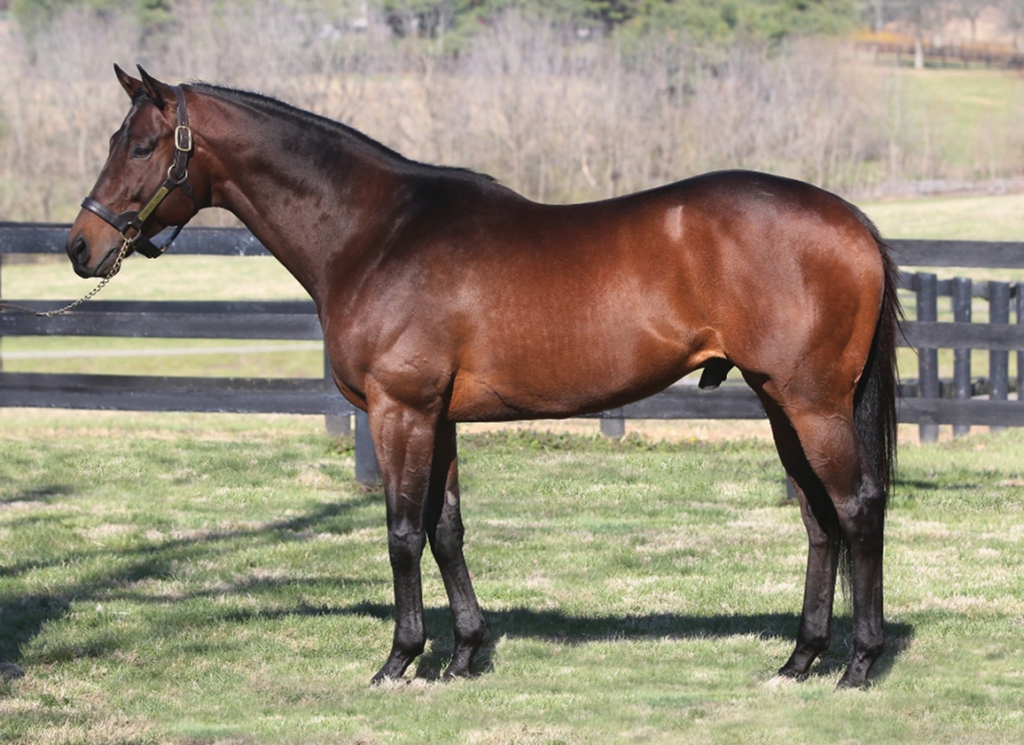
Air Force Blue Sold To Stand In Korea

Air Force Blue, a European champion and young sire, has been sold to continue his stud career at Peter Hill's Pegasus Farm in Korea, BloodHorse reports.

The 8-year-old son of War Front previously stood at Ashford Stud in Kentucky, where he retired to debut for the 2017 breeding season. His oldest foals are 3-year-olds of 2021.

Leading the way among Air Force Blue's runners is Haddassah, who won this year's Prince of Wales Stakes, a Canadian classic.

Bred in Kentucky by Stone Farm out of the stakes-placed Maria's Mon mare Chatham, Air Force Blue sold to the Coolmore partnership at the 2014 Keeneland September Yearling Sale. He'd go on to be named Europe's champion 2-year-old male of 2018 after a campaign that featured Group 1 victories in the Vincent O'Brien National Stakes and Phoenix Stakes in Ireland and the Dewhurst Stakes in England.

Air Force Blue retired with nine wins in four starts for earnings of $844,919.

Read more at BloodHorse.

The post Air Force Blue Sold To Stand In Korea appeared first on Horse Racing News | Paulick Report.

Source of original post

Value Sires for ’22, Part VII: Through the Crossroads

In reaching the penultimate instalment of our series, once again we are obliged by the steepening commercial gradient to combine different intakes–this time, those who have now launched between four and six juvenile crops–to ensure a suitably competitive podium. For by this stage of their career the majority of Kentucky start-ups will already have packed their bags for regional or overseas programs. One or two are still barely clinging on, their books plummeting, but overall we're now looking at those few who have bravely consolidated to the brink of inclusion among those we'll be featuring in the final leg of our series, as “Established Sires”.

Because while few have quite maintained their early book sizes, they have at least now had a fair opportunity to show their hand, with between three and five sophomore crops. We can no longer complain that their stock has been judged prematurely, especially given that they will typically have been given their biggest chance in their opening books. And since most will meanwhile have had their fees trimmed, simply to stay in the game, you could argue that this stage of a stallion's career tends to produce some of the very best value in the marketplace. Indeed, among these three intakes, Maclean's Music alone stands as high as $50,000, and he does so only by dint of doubling his fee for 2022–thanks to 221 mares last spring, followed in the summer by his breakout Grade I exacta.

Bearing in mind that he actually belongs to the most exposed of these three groups, Maclean's Music shows that stallions at this point have useful potential to get you ahead of the game. In surviving the commercial trauma of their stock's racetrack exposure, they have tended to establish a loyal base on which to build again. They have “come out the other side”, so to speak.

Even so, it becomes ever more difficult to agree quite what we mean by “value”. End users will be delighted to obtain inexpensively the services of what may now be considered relatively proven sires; but commercial breeders still need some residual market momentum–resilient yearling averages, maybe, or a filling “pipeline”–if they are to keep the faith.

So here, offered as subjectively as ever, are some that may achieve a happy medium.

Bubbling under: Let's hope Paynter gets due recognition for a Horse of the Year, because he's far from a one-trick pony with 20/38 stakes winners/performers at a clip that stands right up to, say, his more expensive classmate Violence (who does, in fairness, have five Grade I horses against just Knicks Go). One way or another Paynter continues to be commercially neglected, which does mean that he offers especially rare value, on $10,000 at WinStar, for the end-user.

That's exactly what The Factor has already proven himself to be–and he's set for another top 20 finish in the general sires' list, consistently punching way above belt on $17,500 at Lane's End. He's been doing that ever since his return from Japan and, while that year away will leave him treading water briefly (no sophomores in 2022), he will be kept in business by his older stock, not least in view of their trademark, teak soundness. Foals bred now will be well placed to capitalise on renewed momentum, with books of 150 and 135 in the pipeline. The Factor may be hard to keep off the podium among established sires this time next year.

Take Charge Indy has had to regroup from a rather longer exile, having spent three years in Korea before earning an unusual repatriation through the endeavors of stock he had left behind. He requires just a little patience, with his first juveniles since his return on line only for 2023, but meanwhile gets another attractive trim to $12,500 at WinStar and, while he didn't really have an adequate footprint to freshen up his resumé a great deal this year, his overall record leaves no doubt of his competence to convert that sumptuous pedigree into stakes horses. I suspect that those who stick with him now will soon find themselves catching a rising tide.

The only member of Take Charge Indy's class to get black-type horses at a superior rate is Jimmy Creed, who just needs to improve his conversion rate: he has outstanding ratios for stakes, graded stakes and Grade I performers and is surely due a spate of headliners to follow his first elite winner, Casa Creed, one of just three scorers from as many as 17 stakes placers in 2021. Remember that Jimmy Creed, having rallied from 67 mares in 2017 to 165 in 2018, also has numbers on his side–and not least of these is a fee of $10,000 at Spendthrift.

Union Rags | Sarah Andrew

Bronze: UNION RAGS (Dixie Union–Tempo, by Gone West)

$30,000 Lane's End

Has the time come to get back on board the Union Rags express? There's no point pretending that the halving of his fee from $60,000 last spring was purely a COVID concession. He had hoisted himself from an initial $35,000 with no fewer than four Grade I winners from his first two crops, but dropped to ninth in the fourth-crop table in 2019 and slipped to 111 mares in 2020. But his farm's businesslike response was immediately rewarded by a return to full subscription (by their commendably restrained standards, anyway) at 164 mares.

In terms of output, then, Union Rags has plenty to work with, if he can regroup now. And that is exactly what he has begun to do. In 2021, he's back at the top of the class by stakes winners (seven), graded stakes winners (four) and graded stakes performers (11). He's had a number of near-misses in resonant races: Express Train was foiled by half a length in the GI Santa Anita H., Dynamic One missed by a nose in the GII Wood Memorial, and Commandperformance finished second in the GI Champagne S. and fourth in the GI Breeders' Cup Juvenile on only his second and third starts. The $1-million baby Spielberg is back on the worktab, too.

It feels like the stock of Union Rags taper to a peak that is higher than it is wide. Cumulatively, his percentage of black-type action doesn't quite match classmate Creative Cause, for instance, and he stands at a quarter of the fee. But when Union Rags does connect, he can hit a long way. He has so far assembled as many as 12 Grade I performers among 29 placed at graded stakes level overall, at a ratio that measures right up to his universally admired studmate Twirling Candy.

Union Rags always promised to cover all bases as a fast juvenile (won GII Saratoga Special by seven lengths en route to GI Champagne S. success and a head defeat at the Breeders' Cup) who stretched his speed to win the GI Belmont S. on what sadly proved his final start. Though somewhat shaken by his ups and downs, the market maintains him with ample viability at this kind of fee (last two yearling crops averaged $87,024 and $106,000) and Union Rags, who has now been joined at stud by his imposing son Catalina Cruiser, is certainly a conduit of some venerable genes. His half-sister is the dam of an international force in Declaration of War (War Front) while his third dam is a British Classic winner by a son of Hyperion.

It goes without saying that a lot of the new sires corralling huge books this coming spring will never manage a single Grade I winner, never mind four, and it seems a little unfair to punish Union Rags for doing so well, so quickly, and then not repeating quickly enough. It takes a potent sire to do what he did, and he's the self-same package now–but at half the fee he could charge only a couple of years ago. Definite scope for Rags to riches, once again.

Cairo Prince | Sarah Andrew

Silver: CAIRO PRINCE (Pioneerof the Nile–Holy Bubbette, by Holy Bull)

$15,000 Airdrie

There's been an uncanny parity between the standout fourth-crop sires Goldencents (Into Mischief) and Cairo Prince, who from virtually the same number of named foals (454 and 450 respectively) have so far been precisely in step for black-type performers (38 apiece) and graded stakes winners (five each), their fees similarly settling at $15,000.

But while Goldencents was first to a Grade I breakout, it's the Airdrie stallion who has opened up daylight when measured by stakes winners (18 plays 13) and graded stakes horses (13 against eight)–and, critically, he is due for fresh impetus.

Because now is the time Cairo Prince can start to register the upgrade in his mares following his sensational sales debut in 2017, when his first yearlings averaged 15 times conception fee. In 2018, he received the rare accolade of a second fee increase before he had even had a runner, to $25,000 from an opening $10,000.

The first foals resulting from that heightened demand are this year's juveniles and we can already see the dividends. True, some of the most accomplished of his youngsters were bred at Airdrie, such as stakes winner/GI Starlet S. runner-up Cairo Memories; and recent runaway Churchill debut winner Park On the Nile. But already Cairo Prince has sired 29 winners from 57 starters in this crop, including seven black-type performers, putting him behind only Into Mischief himself in the juvenile standings. And the champion stallion has needed 86 starters for his 33 winners!

Something is stirring with Cairo Prince, then–already anticipated at the 2-year-old sales, where his average basically doubled on the previous crop. And his stock should continue to thrive, too: Cairo Prince was all set to build on his early foundations (won GII Nashua S. on second start, romped in GII Holy Bull S.) when derailing in the GI Florida Derby. His dam was a stakes winner at four, after all, and his family has just the kind of copper-bottomed seeding we know to expect at this farm: third and fourth dams, indeed, are by Nearctic and Native Dancer. Closer up, Cairo Prince is a half-brother to the Grade I-placed dam of Grade I winner and promising WinStar sire Outwork (Uncle Mo).

It's pretty rare for the market to “find” a new stallion the way it did this one, being generally inclined slavishly to obey the values implied by covering costs. Yet Cairo Prince, partly as a result of last year's COVID cuts, has come back down in fee even if his “pipeline” has become ever more loaded. As a result, those who breed to him now have a low-stakes opportunity to cash in as this second, better-bred cycle starts to do its stuff. With his lamented sire a premature loss, the Prince looks ready to accede to the throne.

Dialed In winning the 2011 Florida Derby | Coglianese

Gold: DIALED IN (Mineshaft–Miss Doolittle, by Storm Cat)

$15,000 Darby Dan

Now here's a horse whose every step takes him forward, with only his fee standing still. No surprise, certainly, that his second Grade I winner should also be a graduate of his 2017 book, which soared giddily to 231 mares from 105 the previous year.

That surge came after he had topped the freshmen prizemoney table; also top by wins and second (missed by one) by individual winners, despite fielding only 40 starters against 53, 57 and 56 for the next three in the table–and all from an opening fee of just $7,500.

Dialed In's next four books have brought in another 542 mares but his fee, having meanwhile touched $25,000, has been allowed to drift down again. We know that the market always needs encouragement, pending the maturing of a new cycle in a stallion's career; and of course he also participated in the COVID concessions made last year. But the upswing could already be read at the yearling sales this year, where Dialed In catapulted his average from $41,462 in 2020 to $71,000, processing no fewer than 36 of 39 into the ring. That's a really significant vote of confidence in a stallion at this stage of his career.

Those of us who have long nursed high hopes for Dialed In could salute Get Her Number's juvenile Grade I success last year as a sign of things to come and, sure enough, his sophomores in 2021 included not just GI Arkansas Derby winner Super Stock but also Mr. Wireless, who paired the GIII Indiana Derby and GIII West Virginia Derby. Moreover their sire, for all the precocity he injected into his freshmen's title, has also established his ability to maintain the output of his maturing stock: his first headliner Gunnevera, for instance, was still going strong at five.

I do admire the way Dialed In has pulled himself up by his bootstraps. He had been something of a forgotten horse when starting out at a basement fee, having failed to reward perseverance on the track (single disappointing start at four) after dropping out the previous summer for removal of a chip. He had earned favoritism for the first Saturday in May in winning the GI Florida Derby, only to get stuck out the back before finishing strongly; before then doing the same in the GI Preakness.

But he has always had terrific physical charisma–as a $475,000 Saratoga yearling, he was the most expensive of the crop for his stalwart sire–and there's no doubt that this is a true aristocrat. His pedigree has a beautiful shape, with an Eclipse champion as second dam, and he has raised up some pretty humble mares. Get Her Number's dam, for example, had changed hands for $1,300, while Chalon, beaten a head for the GI Breeders' Cup Filly and Mare Sprint and a few cents off millionaire status, is out of a $20,000 mare. The dam of Gunnevera, himself a $16,000 yearling who banked over $5.5 million, had been sold for $13,000.

Dialed In already has 22 graded stakes performers, at a pretty respectable ratio, but only now is he starting to reap the rewards he earned in seizing his first opportunities so eagerly. If you want to use a literal speed-Dial, there's now a full signal.

The post Value Sires for ’22, Part VII: Through the Crossroads appeared first on TDN | Thoroughbred Daily News | Horse Racing News, Results and Video | Thoroughbred Breeding and Auctions.

Source of original post

Value Sires, Part VI: Earning their Stripes

This can be a terrifying business. Here we are, for the first time in this series, assessing stallions that have at least put some sophomores through the starting gate. And already, commercially, the game appears to be up for many. So much so, in fact, that to give adequate competitive depth to our value podium, we're going to combine the consecutive intakes who were in 2021 respectively contesting the second- and third-crop championships.

Here's just one example of how ruthless the market is. I won't name the stallion, because he doesn't deserve the ignominy: I have long thought him exactly the type we should be embracing, amply satisfying the criteria of pedigree, performance and physique. But anyone who can be bothered to do a couple of minutes' research will soon figure it out. All I'll say is that since a brilliant sales debut, amply vindicating his status as one of the most expensive freshmen, he has produced three Grade I winners from three crops: the same as American Pharoah and one more than the acknowledged breakout of their class, Constitution. In 2021, he was down to 29 mares.

Perhaps he can still renew momentum as he merits. In principle, however, his treatment shows how this marketplace can menace a stallion with commercial extinction virtually overnight. Sure, as we've previously acknowledged in this series, it's fair enough to reach some tentative early conclusions about a stallion if he can't make the most of the huge opportunity that breeders, in their dread of exposure on the racetrack itself, will give to new sires. But we should at least allow their first couple of crops time to mature before making any such judgement. As it is, we tend to anoint just one or two immediate achievers in each intake, and dump the rest more or less on the spot. The commercial highwire tapers to a thread very quickly.

And the whole process, of course, becomes self-fulfilling. You might still get lucky, might still come up with a champion from a handful of mares, but this is a numbers game and the odds obviously steepen with the loss of volume. Little wonder so many stallions at this stage tend to disappear into overseas or regional programs.

At the other end of the scale, the chosen few tend to be very few indeed. With one or two marginal exceptions lower down, of this year's leading second-crop sires only Nyquist and Not This Time have managed to move up their opening fees; and among the preceding group, only Constitution, Liam's Map and Daredevil. The latter's history is a cautionary one, of course, the market having exceptionally repented of his banishment abroad.

So how do we identify value? Many stallions we might consider unfairly neglected could only be recommended to end-users, who might like to breed a runner for a cheap fee, as their sales trajectory is pointing to the door. The few who retain commercial credibility, meanwhile, are generally charged at a corresponding rate. Constitution, for instance, has made the grade in utterly convincing fashion, but he's no longer very accessible as a result. With even more than the usual diffidence, then, here are one or two subjective discoveries of residual value across these two groups.

Bubbling under: Okay, so most of us can't even think about paying $55,000 to cover a mare. But value is relative, and those who can afford to play at this level will be grateful for Darley's immediate retraction of Nyquist's fee hike to $75,000 last year (from $40,000). Because even though he had to wait until the other day for his first graded stakes winner since, when Slow Down Andy advertised his Derby credentials in the GII Los Alamitos Futurity, Nyquist has been extremely consistent in producing horses of elite caliber.

While he has so far managed to get no more than 125 of his 197 named foals onto the track, he now has no fewer than 22 stakes performers, 14 placed in graded company and six at Grade I level. He hasn't converted that presence to winners as efficiently as Not This Time–a horse we have esteemed from the start, and likely to do better yet with the improvement in his book quality–but there's no doubt that Nyquist has secured commercial viability, with his third crop of yearlings averaging $158,442; and his 2-year-olds $342,043, third among all sires in 2021.

No young stallion is more obviously equipped to get you a runner–literally–than Upstart, who has put 118 of 149 named foals onto the racetrack already, a dozen of them placed at stakes level. He was multiple Grade I-placed at two, three and four, so expect his stock to keep thriving. And while his third crop of yearlings were processed modestly enough, pinhookers will surely have noticed his fantastic yields at the 2-year-old sales: $113,250 this spring, after clocking $107,791 with his first crop. Stay on board, definitely, at $10,000 with Airdrie.

Firing Line | Crestwood

Bronze: FIRING LINE (Line of David–Sister Girl Blues, by Hold for Gold)
$5,000 Crestwood

Now here's an intriguing animal. You have to go some way down the second-crop table to find him, but that's no less than you would expect of a stallion with just 38 starters to date. But not only have 22 of them won; two members of Firing Line's second crop have placed in significant Grade II races.

The homebred Venti Valentine was runner-up in the Demoiselle S., having won a maiden and then a Listed race on her first two starts, while $25,000 yearling Nakatomi has also won in stakes company since finished third in the Saratoga Special S. Plenty of Firing Line's rivals, launched with industrial books, could do with that kind of footprint–not to mention a $210,000 2-year-old like Oscarette, who recently won her maiden at Churchill.

Firing Line missed a juvenile Grade I by a nose, won the GIII Sunland Park Derby by 14 lengths (track record) and was beaten only by a Triple Crown winner on the first Saturday in May. He derailed in the Preakness, failed to reward perseverance with a single disappointing start at four, and was doubtless further held back by a commercially unfamiliar sire and damsire. But he was actually working with a serious genetic package: out of a Grade I-placed half-sister to the dams of two Grade I-winning milers from a line tracing to matriarchs Kamar and Square Angel.

Firing Line is in exemplary hands, but has obviously only mustered very small books so far. Breeders of sufficient imagination and adventure will surely want to explore the way he has seized such limited opportunities at this budget fee.

Silver: TONALIST (Tapit–Settling Mist, by Pleasant Colony)
$10,000 Lane's End 

It has been uphill nearly all the way for this fellow, whose fee has come down yet again, but I have admired him throughout and he has had another solid year, maintaining black-type action at essentially the same ratio as Liam's Map. Few would dispute that his lauded studmate has earned his fee, which is four times higher, not least with his useful habit of hitting the bull's-eye with his best runners. It was typical of the understated style of Tonalist, in contrast, that after Country Grammer gave him a deserved Grade I breakthrough in the Hollywood Gold Cup, he promptly disappeared and has only just returned to the worktab.

Tonalist's 11 graded stakes performers through three crops represent 4.33% of named foals, almost exactly in step with Liam's Map (a dozen at a 4.17%). There are plenty of others in this intake, charging far more than Tonalist, who can't even nudge two percent.

Tonalist's books have been up and down but he does have one of 122 to keep him in the game with his 2022 yearlings, and their breeders can take heart from a median of $35,000 for the preceding crop. That's not at all bad for a sire standing at this kind of money, at this challenging stage of his career. But no bones about it, the real appeal of Tonalist is that he is shaping up as a sire who can outpunch his fee on the racetrack. Remember he reached his own peak at four and he has still only had one crop reach that stage of maturity, including his first Grade I winner.

Tonalist has always looked a quarry of old-school virtue, extending the same Toll Booth-Missy Baba line as Havre de Grace (Saint Liam) and author of 11 triple-digit Beyers in a $3.6-million career. Here was a horse that never stopped trying and breeders wanting to tap into Tapit, at an affordable fee, should take a similar approach.

Gold: KARAKONTIE (Jpn) (Bernstein–Sun Is Up (Jpn), by Sunday Silence)
$10,000 Gainesway

Have Antony Beck and his Gainesway team pulled off what has lately come to seem nearly impossible, and found a viable niche for a young turf stallion in Kentucky?

Karakontie has only been credited with 143 named foals to date but he has mustered seven black-type winners, four in graded stakes including Princess Grace, winner of two Grade IIs, two Grade IIIs and last month placed in her debut at the elite level. With his cosmopolitan pedigree, moreover, Karakontie has pushed the boundaries in terms of racing surface, too. Another Grade II winner, None Above the Law, has scored on turf, dirt and synthetics, while Sole Volante put himself on the Derby trail in the Florida preps last year.

Their sire has meanwhile maintained a useful sale ring capacity to hit one out of the park. He sold a $310,000 colt at Keeneland September, to follow on from yearlings that raised $500,000 and $220,000 at the same auction the previous year. And he has also consolidated quietly after suffering the customary slide from a three-figure debut book to just 43 mares in his third season. He has since covered 69, 88 and 76 mares, which may not look spectacular but suggests that people noticed his early achievements–like two first-crop yearlings, $6,000 apiece, making the gate for the G1 2,000 Guineas and GI Kentucky Derby–and gives him a legitimate foothold in a notoriously hostile environment even to the most eligible of turf stallions.

And that is just what he is, remember, having made his own stellar contributions to one of the most illustrious families in the breed today–his third dam is Miesque herself, so this is the Kingmambo clan–as a Group 1 winner at two and elite miling sophomore (French Classic/Breeders' Cup winner, 110 Beyer). This is a conduit of pure class, every way you cut it, and he has shown that he will take such chances as he's given.

Having this year started just nine juveniles (four winners so far, one stakes-placed) from that small third book, he has now got over the biggest bump in his road. And I'd be interested in odds about him siring a Grade I winner before the foals he breeds this coming spring go under the hammer. Overall this is a horse that really does offer hope that he can overcome the self-destructive prejudices of commercial breeding in Kentucky.

The post Value Sires, Part VI: Earning their Stripes appeared first on TDN | Thoroughbred Daily News | Horse Racing News, Results and Video | Thoroughbred Breeding and Auctions.

Source of original post

Boisterous Moves To Alberta For 2022 Breeding Season

The Grade 1-winning millionaire Boisterous, will be standing at Merv Lansing's farm in Daysland, Alberta for the upcoming season.

The Distorted Humor son is a seven-time graded stakes winner with wins in the Grade 1 Man o' War Stakes, the G2 Monmouth Stakes, back-to-back wins in the G2 Red Smith Handicap and three Grade 3 wins for career earnings of $1.46 million. Boisterous is out of the multiple stakes placed mare, Emanating ($273,030) and is from a strong female line.

Boisterous entered stud in 2015 and stood most of his stallion career at Tommy Town Thoroughbreds where he was a champion first-crop sire in California. The stallion was moved to Diamond B Farm in Pennsylvania last season and was a top-five active sire there in 2021.

Boisterous sired the graded stakes-placed runner California Kook ($266,489), second in the 2020 G1 Del Mar Oaks. In 2021, he had the stakes winner graded stakes-placed runner Give Me The Lute ($209,823) and the multiple stakes winner Loud Mouth ($375,070). Boisterous is also the sire of Southern California stakes winner Kookie Gal ($128,136).

Boisterous will stand at Merv Lansing's farm in Daysland, Alberta with a 2022 stud fee of $3,000 (Canadian) S&N.

The post Boisterous Moves To Alberta For 2022 Breeding Season appeared first on Horse Racing News | Paulick Report.

Source of original post

Verified by MonsterInsights