It’s a tough game, selling nominations; and, except for those sparkly new stallions, getting tougher all the time. So we should have every sympathy with the farms trying to drum up custom. True, WinStar doesn’t hold back in introducing Paynter on his homepage as “one of the most popular and courageous runners in racing history.” But if that’s a pretty heady claim, even for a horse whose recovery from desperate illness so captured the hearts of the racing public, then the son of Awesome Again has certainly moved the conversation on. Because whatever else he may be, Paynter is now the sire of the fastest miler in Keeneland history–even as he takes his latest cut in fee, to just $7,500.
Okay, they laid out a conveyor belt for the Breeders’ Cup this year. Knicks Go, in the GI Big Ass Fans Dirt Mile, set only one in a blurred sequence of track records. (New benchmarks were also reached on the day at six, seven and 10 furlongs.) Even within that context, however, Knicks Go needs credit for the electrifying fashion in which he saw off a horse as fast as Complexity (Maclean’s Music), kicking again off fractions of 21.98, 44.40 and 1:08.25 for a final time of 1:33.85. Bottom line is that we need to respect any stallion that can get a horse of such flair, out of Maryland, with first four dams by Outflanker, Allen’s Prospect, Medaille d’Or and Cloudy Dawn.
Actually this is the second time Knicks Go has demanded a fresh look at his sire. In 2018, following a low-key launch by his first juveniles the previous year, Paynter mustered just 34 mares at $12,500. In fairness, if anything he had resisted the usual drag better than most young sires, having maintained a book of 103 at $20,000 the previous spring. That reflected a positive reception for that first crop at the yearling sales, where they had parlayed his $25,000 opening fee into an average return of $83,853.
Having accumulated 438 covers across his first three seasons, however, Paynter was seemingly now being drawn into the deadly commercial vortex so familiar in a world where breeders flit nervously from new sire to new sire. Quite what precocious detonation people had expected in Paynter’s first juveniles, when both he and his sire had been unraced at two, is hard to say.
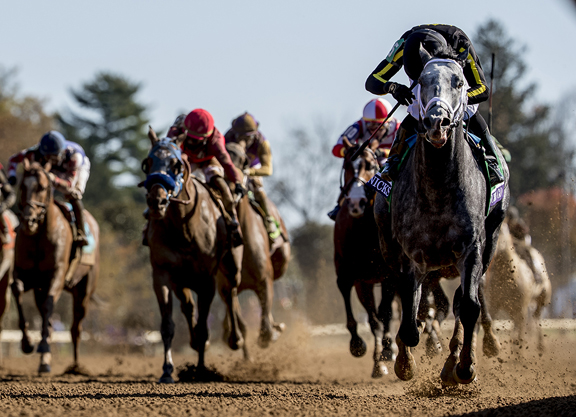
Knicks Go blazed home in the Dirt Mile | Breeders’ Cup/Eclipse Sportswire
But then Paynter, from his second crop, pulled Knicks Go out of his hat. After scoring on debut at Ellis Park, he appeared to be put in his place when tried in stakes company, only to establish what is plainly a particular affinity with Keeneland by winning the GI Claiborne Breeders’ Futurity S. by 5 1/2 lengths at 70-1. If that performance came out of the blue, he then proved its substance by heading over to Churchill and beating all bar Game Winner (Candy Ride {Arg}) in the GI Breeders’ Cup Juvenile.
While it is always true that a single star can outshine a multitude of dimmer talents, Paynter had some useful volume behind him and finished behind only Violence (Medaglia d’Oro) in the second-crop sires’ prize money table. He was back in the game. After welcoming 97 partners in 2019, he kept solid interest at 71 this year. In the prevailing climate, admittedly, a further easing of his fee was fairly inevitable. But hopefully that will assist him through the gate that divides the stallion who’s still trying to make his name from the one who can be considered relatively proven, while yet remaining highly accessible. That’s an elusive combination, making Paynter’s credentials seem well worth revisiting.
The Dirt Mile success of Knicks Go has elevated his sire past Violence to head the fourth-crop table as the year draws to a close. But he would still be a clear second without his standard-bearer, who after all was otherwise confined only to a couple of allowance wins, eight months apart, following his transfer to Brad Cox. Given the stellar achievements of Violence this year, with Grade I winners from three different crops, it would have reflected very creditably on Paynter even to remain in his vicinity.
The key now is for Knicks Go not to turn into a burden, by appearing freakishly out of line with the rest of his sire’s output. Paynter has so far assembled another 14 black-type winners at a perfectly respectable ratio, to named foals, of 4%. (That’s a match, browsing stallions at a similar stage of their careers, even for Union Rags {Dixie Union} and Dialed In {Mineshaft}–never mind many others who have not approached their excellence.) And if none of these are in the same league as his kingpin, the success of Harpers First Ride in the GIII Pimlico Special last month was his eighth in 15 starts.

Harpers First Ride took the Pimlico Special last month | Horsephotos
Liam O’Rourke, director of stallion sales at WinStar, emphasizes the solidity of Paynter’s body of work behind his trailblazer.
“I think it’s important to recognize both aspects of his production,” O’Rourke observes. “Paynter is able to get an elite, championship-level racehorse like Knicks Go and also have the depth to be the only top 20 general sire standing for less than $15,000. He’s in the top 15 by winners, and just outside the top 10 (11th) by percentage of black-type horses. This combination should spell an upward commercial trajectory.”
One thing is for sure: nobody could be surprised that a stallion recycling the kind of genes packaged by Paynter should have come up with a horse as talented as Knicks Go. He is out of a full-sister to Tiznow, and therefore also to Grade II winners Budroyale and Tizdubai; not to mention their unraced sister whose own mating with Paynter’s sire produced GI Preakness S. winner Oxbow (Awesome Again).
Like Oxbow, Paynter finished second in the GI Belmont S., in his case caught close home by Union Rags. He got his Grade I next time, albeit his Haskell S. performance in hindsight appears to be better measured by the clock than by the depth of competition. But where he really showed his fighting qualities was in then rallying from the brink in consecutive battles with colitis, colonic surgery and laminitis. Remarkably, between the skills of his veterinarians and his own resilience, he was able to clock a 114 Beyer on his resumption at four; and then late chased home Mucho Macho Man (Macho Uno) in an apt bid for the GI Awesome Again S.
Already as a yearling his physique had received a valuable testimonial, in being picked out of Book 1 at Keeneland September by no less a judge than David Ingordo, for $325,000. Everything was in place, then. And, while obviously no stallion is a cookie-cutter, O’Rourke sees the robustness that served Paynter so well as something of a trademark. “Paynter gives a horse depth and class,” he notes. “They are very strong with a good heart girth and a good presence. They are athletes.”
Certainly that dappled streak, Knicks Go, gives smaller breeders something to dream about as they contemplate his new fee. As has been well documented, Knicks Go was co-bred against the odds by Sabrina Moore and her mother Angie, who were grazing a grand total of three mares on their GreenMount Farm in Reisterstown, Md. One of these mares was Kosmo’s Buddy, a daughter of Outflanker opportunely claimed for $40,000 at Monmouth Park in 2010. That was her 36th start and by then she had amply established both toughness and quality, with two wins and as many as a dozen placings in black-type company. Credit for Knicks Go must also be shared, then, between his accomplished dam; and, in turn, the Maryland stalwart who sired her. (Though Outflanker contested ten maidens without success, his fine pedigree has played through at stud.)

Paynter, at home at WinStar | WinStar photo
But there’s no denying the pivotal importance of the resulting talent to his sire; nor, presumably, of his sire to that talent. And the more a stallion like Paynter can achieve commercial traction, the more sustainable the industry becomes for breeders like the Moores, who are very much its lifeblood. Logically, after all, a sire should have no more “commercial” propensity than producing runners at an affordable rate.
“We were thrilled for Angie and Sabrina to breed such a great horse from their small but growing operation,” O’Rourke says. “Of course the market probably disagrees with me, when you see certain proven sires not get enough respect in the sales ring, but I think planning to breed a ‘race’ horse and planning to breed a ‘sales’ horse aren’t mutually exclusive things. The best thing for a mare’s pedigree is to produce good horses: black-type horses. When you do so, you increase the value of your mare and each subsequent foal she produces. The Moores raised a great runner and it created commercial opportunities.”
Paynter has more than once had his back to the wall, but has fought his way back every time. “He definitely finds a sweet spot in the market,” says O’Rourke. “It’s an uncertain business in a good year, and even more so at the moment, but a sire like Paynter–who’s so reliable, so well-priced and has shown he can get you that elite type–can take some of the risk out of it for the breeder. He’s priced at a level where he can be important to your breeding plans, whether you have two or 20-plus mares.”

The post Knicks Go Adds Dash to Paynter’s Palette appeared first on TDN | Thoroughbred Daily News | Horse Racing News, Results and Video | Thoroughbred Breeding and Auctions.
Source of original post
