Saturday’s Insights: Expensive Quality Road Colts Square Off at Gulfstream

Sponsored by Alex Nichols Agency

2nd-Gulstream Park, $50k, Msw, 2yo, 6f, post time: 12:35 p.m.
Todd Pletcher saddles firster PRIME FACTOR (Quality Road) for China Horse Club and WinStar Farm. The bay colt was a $900,000 purchase at last year’s Keeneland September sale. He is out of Haylie Brae (Bernardini), a half-sister to graded-winning freshman sire Speightster and a granddaughter of blue hen mare Classy ‘n Smart (Smarten). Christophe Clement sends out Shel Evans’s Broadway (Quality Road), a $500,000 purchase at last year’s Fasig-Tipton Saratoga Yearling Sale. The juvenile is the first foal out of Etiquette (Tapit), a half-sister to graded winner Pleasant Prince (Indy King) and from the family of Canadian champion Holy Helena. TJCIS PPs

7th-Gulfstream Park, $50k, Msw, 2yo, 1m, post time: 3:08 p.m.
Godolphin’s ALEXANDER VALLEY (Medaglia d’Oro) makes his first trip to the post for trainer Bill Mott. Purchased for $2.15-million at the 2019 Keeneland September sale, the bay colt is the first foal out of Grade I winner Tara’s Tango (Unbridled’s Song). TJCIS PPs

The post Saturday’s Insights: Expensive Quality Road Colts Square Off at Gulfstream appeared first on TDN | Thoroughbred Daily News | Horse Racing News, Results and Video | Thoroughbred Breeding and Auctions.

Source of original post

Notable US-Bred & -Sired Runners in Japan: Dec. 12 & 13, 2020

In this continuing series, we take a look ahead at US-bred and/or conceived runners entered for the upcoming weekend at the tracks on the Japan Racing Association circuit, with a focus on pedigree and/or performance in the sales ring. Here are the horses of interest for this weekend running at Chukyo and Hanshin Racecourses:

2nd-HSN, ¥9,680,000 ($93k), Maiden, 2yo, 1800m
AMERICAN PEACE (c, 2, Tapit–La Cloche, by Ghostzapper) is one of at least four runners by this sire entered this weekend for owner Katsumi Yoshizawa of Master Fencer (Jpn) fame and is the early 1-2 favorite off a strong runner-up effort when trying the dirt for the first time at Chukyo Oct. 4 (video, gate 10). The $325K Keeneland September yearling, a full-brother to GSW Bellevais, is out of a Grade III-winning daughter of MGISW Memories of Silver (Silver Hawk), herself the dam of MGISW Winter Memories (El Prado {Ire}) and granddam of MSW & MGSP ‘TDN Rising Star’ Winter Sunset (Tapit). This is also the female family of ‘Rising Star’ Hawkish (Artie Schiller). Don Alberto Corp. acquired La Cloche for $2.4m in foal to Tapit at Fasig-Tipton November in 2014. B-Don Alberto Corporation (KY)

5th-HSN, ¥13,400,000 ($129k), Newcomers, 2yo, 1800m
MOZU LADY MO (f, 2, Uncle Mo–Czarina, by Bernardini) cost $375K at KEESEP in 2019 and is out of a full-sister to MGISW To Honor and Serve and GISW Angela Renee; and a half to SW & GISP Elnaawi (Street Sense). The filly’s third dam was responsible for MGSW India (Hennessy), whose MG1SW son Mozu Ascot (Frankel {GB}) was recently retired to stand the 2021 breeding season at Arrow Stud. The March foal is bred on the same cross responsible for GISW Mo Town and GSW Modernist. B-Rigney Racing LLC (KY)

Sunday, December 13, 2020
4th-HSN, ¥13,400,000 ($129k), Newcomers, 2yo, 1800m
YORIKUN ROAD (JPN) (c, 2, Quality Road–Hymnotic, by War Front) is the first produce for his dam, a full-sister to SW & G1SP Whitecliffsofdover, who was purchased for $240K with this foal in utero at KEENOV in 2017. The colt’s second dam Orate (A.P. Indy) also produced SW & GISP Endless Chatter (First Samurai) and is a full-sister to the late, influential sire Pulpit. Since her export to Japan, Hymnotic has foaled colts by Horse of the Year Kitasan Black (Jpn) (Black Tide {Jpn}) each of the last two years. B-Yanagawa Bokujo

10th-CKO, ¥19,110,000 ($184k), Allowance, 2yo, 1400mT
MOON BEAD (JPN) (f, 2, American Pharoah–Evening Jewel, by Northern Afleet) overcame a wide trip from the 18 hole to graduate by a half-length going this distance on Niigata debut Oct. 17 (see below) and should enjoy a softer run in this more compact field. Shadai Farm acquired this MGISW dam for $950K at KEENOV in 2016 and the mare foaled a Pioneerof the Nile colt the following spring. She was bred to American Pharoah and was exported before producing this filly in March 2018. Evening Jewel is the dam of a yearling Deep Impact (Jpn) colt and was covered this past season by Duramente (Jpn). B-Shadai Farm


The post Notable US-Bred & -Sired Runners in Japan: Dec. 12 & 13, 2020 appeared first on TDN | Thoroughbred Daily News | Horse Racing News, Results and Video | Thoroughbred Breeding and Auctions.

Source of original post

Local Route to Pegasus Goes Through Fort Lauderdale

Trainer Todd Pletcher will saddle a pair of runners in Saturday’s GII Fort Lauderdale S. at Gulfstream Park, the local prep for the Jan. 23 GI Pegasus World Cup Invitational. Harrell Ventures’ Halladay (War Front), winner of the Aug. 22 GI Fourstardave H. set the pace before fading to sixth in the Nov. 7 GI Breeders’ Cup Mile last time out. The 4-year-old is three-for-three over the Gulfstream lawn where he won the Tropical Park Derby last December and this year’s Sunshine Forever S. Stablemate Largent (Into Mischief) has won three of four starts over the Hallandale turf course and will be stepping up to the graded stakes ranks after a pair of 2020 stakes wins. He captured the July 29 Edward P Evans S. at Colonial Downs and the Oct. 9 Bert Allen S. at Laurel.

“This is going to be a tough race. This is a prep with some real teeth to it,” Pletcher said. “I think if either one of them were able to perform well in here it would certainly tell us that they belong in the Pegasus.”

Halladay will be making his first start beyond 1 1/16 miles in the nine-furlong Fort Lauderdale as connections look ahead to the 1 3/16-miles Pegasus next month.

“We’re interested in trying to stretch him out. We know that he’s fond of the Gulfstream course so we felt like this was sort of a good opportunity to see how he would handle a little more distance,” Pletcher said. “If this were to go really well it would put the Pegasus Turf in play, so that’s what we’re trying to find out.”

Eclipse Thoroughbred Partners and Twin Creeks Racing Stables’ Largent will also be looking to stretch out beyond 1 1/16 miles fo the first time in the Fort Lauderdale.

“He’s super consistent, always shows up and runs well. He, too, has always liked Gulfstream. He’s definitely one that is capable on the day,” Pletcher said of Largent. “I think as he’s matured he’s settled a little better, as has Halladay, I think that gives them both the chance of handling the added distance.”

Trainer Mike Maker, who won last year’s Pegasus with Zulu Alpha (Street Cry {Ire}), also has two entered in the Fort Lauderdale. Three Diamonds Farm’s Tide of the Sea (English Channel), purchased for $80,000 at last year’s Keeneland November Breeding Stock Sale, will be making his stakes debut Saturday. The 4-year-old was a front-running winner of a 12-furlong allowance at Keeneland last time out Oct. 7. Skychai Racing and David Koenig’s Somelikeithotbrown (Big Brown), gate-to-wire winner of the July 26 GII Bernard Baruch H., is coming off a win over New York-bred foes in the Oct. 24 Mohawk S. at Belmont Park.

“We’re going to give both of them a shot,” Maker said. “It would be great to get back to the Pegasus.”

The post Local Route to Pegasus Goes Through Fort Lauderdale appeared first on TDN | Thoroughbred Daily News | Horse Racing News, Results and Video | Thoroughbred Breeding and Auctions.

Source of original post

This Side Up: The Elusive Lesson of ‘Can’t Miss’ Sires

He has trademarked the move, his name reliably invoked whenever a horse picks off his rivals with the kind of flair that luminously separates him from the herd. Yet just about the only time I ever saw one glide through an elite field with quite the same extraterrestrial contempt as Arazi (Blushing Groom {Fr}) in the 1991 GI Breeders’ Cup Juvenile was the following May, at the same track, when that nimbus-among-the-shadows exhibition was reprised along the backstretch by a horse called… Arazi.

His discovery of mortal limitations, both in his second season and then at stud, has become so integral to the Arazi narrative that we tend to forget how he maintained the exquisite illusion until suddenly exchanging the wings of an angel for feet of clay at the top of the stretch in the GI Kentucky Derby. (Or, strictly, knees of clay.)

The whole story, with all the symmetrical and didactic properties of parable, came back to me this week on learning of the death of Congaree–a charismatic creature in his own right, who shouldered nearly alone the burden of his sire’s honor. For even Arazi’s decline on the track could not prepare us for the anti-climax of a stud career that took him ever more forlornly from Newmarket to Kentucky, Japan and even Switzerland.

Congaree, in turn, proved a disappointing stallion. Between Kentucky, New York and Texas, he mustered just 13 stakes winners. That was still two more than dad. Hardly the dividends anticipated from horses packaging so many attributes that any right-thinking breeder would seek to replicate. Congaree, remember, was in training for five seasons; he contested 22 consecutive graded stakes, winning five Grade Is besides placing in two Classics; and his 1:33.11 in the first of consecutive wins in the GI Cigar Mile (a unique distinction) was the fastest dirt mile of 2002.
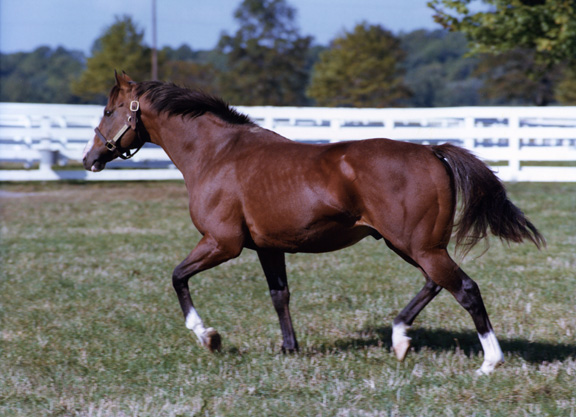
Congaree at Del Mar in 2003 | Horsephotos

It so happens that his loss coincided with my resumption of an annual ritual: a comprehensive survey of the Kentucky stallion market, which we began yesterday and today with newcomers for 2021.

While their track achievements will clearly govern both quality and quantity in their opening books, in principle these horses have all been brought back to a new starting gate. The world is at their feet, each and every one launched with impassioned conviction by farms across the Bluegrass. And while the promotional material sometimes succeeds in stirring only a wholesome scepticism, you always retain in the back of your mind the way Into Mischief or Tapit looked when they first arrived at stud.

Assessing new stallions, some people are credulous enough to buy into ostensibly sophisticated predictive tools. But most horsemen know these shortcuts for what they are. All you can do, at the outset, is weigh the evidence with due vigilance on behalf of the breed. That might not always get you aboard the elevator on the ground floor. But it’s better to wait for more tangible evidence, from early stock and runners, than to corral huge books of mares for a new stallion that happens to claim a superficial resemblance to some commercial template.

My instinct, for instance, is that the entire European gene pool will ultimately forfeit its present strength–easily measurable, on turf at any rate, by the recent success of imports to America, whether from the yearling sales or the racetrack–by the opportunist recycling of garbage that catches a plausible glister from a passing sunbeam, and is duly presented as sharing the same, immanent glow of some authentically potent predecessor.

North America’s current top sire, Into Mischief | David Coyle

In Britain and Ireland, especially, the most marginal accomplishment in juvenile sprints has become an unthinking formula for the siphoning of mares, literally in their thousands, away from alternatives with at least some eligibility to produce a Classic racehorse. The result is a virtual Classic monopoly for the same blood, often concentrated in the same hands; and a ticking time bomb that will eventually pulverise the European breed to the point that its sharpest horsemen will belatedly recognize a cue for speed-carrying American blood, much as happened with the Northern Dancer dynasty.

On both sides of the ocean, unexpected success for a stallion can launch phony imitations by the dozen. Personally, however naively, I prefer to adhere to the time-honored precepts of pedigree, physique and performance. But even the few stallions that unhesitatingly tick all three boxes bring no guarantees.

Arazi lacked size, of course, but that didn’t stop his sire Blushing Groom (Fr) nor his damsire Northern Dancer. There was also a conformation issue, judging from that notorious knee surgery the winter after the Breeders’ Cup. Yet it still seemed as though appropriate matings could not fail to draw out the seams of gold in his pedigree.

In counterweight to his damsire, Arazi’s top line took the other (Nasrullah) highway to Nearco. There were other striking echoes within his family tree: Native Dancer figured both through Northern Dancer’s mother Natalma and Arazi’s third dam, who was by Raise a Native; while there was a variegating top-and-bottom footprint for Wild Risk (Fr), as damsire of Blushing Groom and grandsire of Arazi’s second dam, who was by Le Fabuleux (Fr).

Wild Risk apart, Arazi’s phenomenal talent could not have had a more obvious genetic bedrock: not least through his second dam, whose kinship to many classy performers and producers was crowned by her sibling Ajdal (Northern Dancer), another highly flamboyant European champion.
Northern Dancer | Tony Leonard

Ajdal, the most expensive yearling buyback in history before his private acquisition by Sheikh Mohammed, certainly went to stud lavishly equipped with the three P’s. (Performance was briefly an issue, until he famously dropped from 12 furlongs at Epsom to six in the G1 July Cup)! Sadly, he shattered a leg after a single season at stud, which in those days still translated into just 35 foals. Remarkably, three daughters would go on to produce Group 1 winners.

Congaree, for his part, did have a curious pedigree, loading Northern Dancer 3×3 through his forgotten damsire Mari’s Book. But anyone who claims that Arazi’s failure was predictable to anyone with the right software is peddling snake oil.

I prefer to view him as another of those lessons in humility so routinely handed out by the Thoroughbred. Ultimately, after all, we’re talking about flesh and blood. Happily, in fact, we are still doing so–even as the venerable creature approaches his 32nd birthday. In retirement Arazi has enjoyed exemplary care at Stockwell Farm in Australia, still adored for a performance far more dramatic than anything authored even by Frankel (GB) (Galileo {Ire}), say, with his brutal, pour-it-on style; but essentially given the same respect and attention as we owe to any of these animals that so absorb our dreams, our toil, our craft–animals of uniform nobility, wherever they might rank in performance.

The three P’s need to work out often enough to keep our business viable; to keep the rich guy sticking up his hand for seven-figure yearlings at Keeneland or Saratoga. But actually it’s their scrambling that makes the whole game function. So long as outcomes sometimes remain unaccountable, whether in success or failure, then we’ve all got half a chance.


The post This Side Up: The Elusive Lesson of ‘Can’t Miss’ Sires appeared first on TDN | Thoroughbred Daily News | Horse Racing News, Results and Video | Thoroughbred Breeding and Auctions.

Source of original post

Verified by MonsterInsights