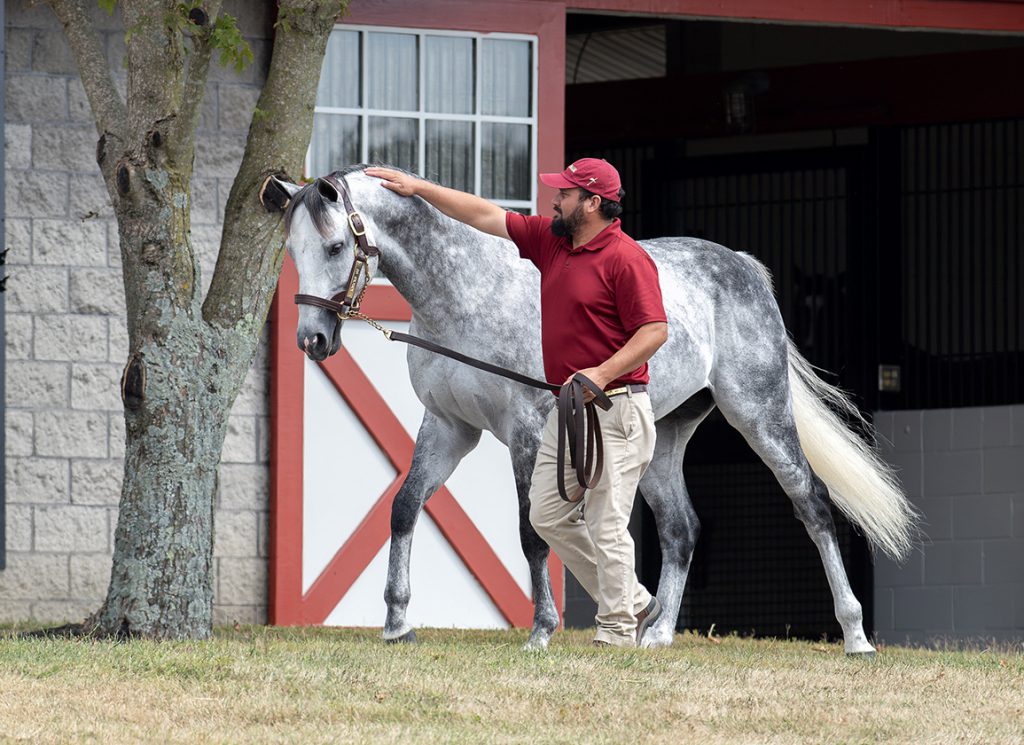
Pat Day Joins The TDN Writers’ Room Podcast

Just a few days removed from his 70th birthday, Pat Day joined the TDN Writers' Room podcast presented by Keeneland to talk his career, what he's been up to since retiring in 2005 and, most of all, the Breeders' Cup. Day rode Wild Again to victory in the inaugural GI Breeders' Cup Classic in 1984 and it was an historic win that helped turn the future Hall of Famer into one of the biggest stars in the sport. Day was this week's Green Group Guest of the Week.

“What that race meant for my career was monumental,” Day said. “First of all, let me back up. In January of 84, that was when I came to Christ. I was a stone alcoholic and a drug addict and was still highly successful in the midst of that. On January 27th of 1984, I accepted Christ into my life and got set free from that addictive lifestyle. I recognized that God had blessed me with tremendous talent and ability and opportunities and I started treating that with the respect that it deserved. Subsequently, I had an incredible year capped by the victory with Wild Again in the inaugural Breeders' Cup. That helped secure my first of four Eclipse Awards. I don't know that you could put a price on just what that did for my career. It was tremendous and catapulted me to the next level. I started getting opportunities after that to participate in the major races all over the country and to ride some of the top choices in those races.

If the Wild Again win was Day's top Breeders' Cup moment, his loss to Sunday Silence aboard Easy Goer in the 1989 Classic was surely his worst.

“When they came off the turn, Easy Goer was slow to change leads,” Day said. “He finally did. When he did, he caught on and accelerated, but obviously it was too little, too late. There was just so much hanging in the balance. The Eclipse Award for top 3-year-old. Horse of the Year. There were some tremendous accolades that hung in the balance. That Breeders' Cup was hard and the second hardest pill to swallow with him would have been the Preakness. I think I rode a horrible race and I think that I cost him the race in the Preakness. Easy Goer was a great horse. The best I ever rode. I know the record doesn't reflect it but I still think he was better than Sunday Silence.”

Who was his toughest opponent?

“Day in and day out, the smartest, strongest rider I rode against on a regular basis was Jerry Bailey,” Day said. “He would draw up a game plan and he was able to implement that game plan just about every time.”

Who was the most competitive rider he ever went up against?

“With that subject, Angel Cordero's name always comes up,” he said. “We would laughingly say he could ride two or three horses in a race. Angel, I love you, man. He was an astute handicapper. And if he handicapped the race and he felt that you had the horse to beat, he was going to beat you. He felt like if he beat you he would win the race. He was very competitive.”

Elsewhere on the podcast, which is also sponsored by 1/ST Racing, the Pennsylvania Horse Breeders Association, WinStar Farm, the KTOB, XBTV and West Point Thoroughbreds, the team of Zoe Cadman, Randy Moss and Bill Finley discussed Frankie Dettori's decision to postpone his retirement and focus on U.S. racing in 2024 and the GI Kentucky Derby. The team agreed that Dettori, who has been riding in top form this year, deserved at least one more year. Finley predicted he might decide to keep riding for two or three more years. They also reviewed last week's action which included a win by European shipper Mawj (Ire) (Exceed and Excel {Aus}) in the GI Queen Elizabeth Challenge Cup S. at Keeneland and the ultra-impressive win by City of Troy (Justify) in the G1 Dewhurst S. at Newmarket.

To watch the Writers' Room, click here. To view the show as a podcast, click here.

The post Pat Day Joins The TDN Writers’ Room Podcast appeared first on TDN | Thoroughbred Daily News | Horse Racing News, Results and Video | Thoroughbred Breeding and Auctions.

Source of original post

Keeneland Breeder Spotlight: Humphrey and Arnold: A Connection That Goes Well Beyond Racing

Two Labradors grace the front steps of the main house at Shawnee Farm. Their dark coats glossy in the sunlight, the affable mother-daughter pair are among the eight generations of hunting dogs bred by G. Watts Humphrey Jr. and his wife Sally.

As much as the sport of horse racing has been an unwavering passion for the Humphreys throughout their many years together, so too has their shared penchant for bird hunting. In fact, the sport led them into forming a business relationship that evolved into a lifelong friendship–one that has now surpassed even their own generation.

Gathered around their trophy-adorned living room to reflect on a few of the best homebreds to come off the surrounding 1,000-plus acres of Shawnee Farm, the Humphreys are joined by their daughter Vicki Oliver and their good friends George “Rusty” Arnold and his wife Sarah.

Rusty and Sarah Arnold, Watts and Sally Humphrey, and their daughter Vicki Oliver at Shawnee Farm | Sara Gordon


Humphrey met Arnold, a fellow third-generation horseman, at a dove shoot in 1991. At the time Arnold, who saddled his first winner back in 1975, was racing in Kentucky and New York–two places that Humphrey wanted to race, and win.

“They came and interviewed me at my barn at Saratoga a few months later and the interview evidently went well,” Arnold said with a wry, sidelong glace at Humphrey. “That fall they sent me three horses.”

Three horses soon became 10 or 12 and the numbers have continued to grow from there. While keeping the majority of his fillies to race and with an emphasis on developing families, Humphrey's distinguished breeding program is one that any trainer would be glad to represent.

“It's an honor, actually,” said Arnold. “They provide me with these well-bred horses and you're not in a rush with them. You're trying to establish the future. A lot of people don't have the patience for that, but I think that's his background in the industry of developing families. If you develop a horse over a period of time, you aren't pressed to have her at her very best the first time she runs. He lets you build a horse's career.”

Such was the story for one filly that, looking back, Arnold considers to be the first top-level horse that he ever trained.

It took two attempts for Clear Mandate (Deputy Minister) to break her maiden and it wasn't until almost a year later that she won her first graded stake, but the homebred would go on to be a glowing success for Humphrey, winning Grade I races at two of his most beloved racetracks and eventually retiring to Shawnee and producing Grade I winner and sire Strong Mandate (Tiznow).

Clear Mandate hailed from one of Humphrey's finest foundation families that was highlighted by Grade I winner and Classic producer Likely Exchange (Terrible Tiger).

As Humphrey recalls, Likely Exchange's dam was field bred to Terrible Tiger when she was having trouble getting in foal. The resulting filly was Likely Exchange, the dam of 1985 GI Belmont S. winner Crème Fraiche who was doubly special for Humphrey as she was the great-granddaughter of a mare purchased by Humphrey's grandfather George M. Humphrey.

“They were all lovely horses,” Humphrey said of the family. “Great attitutudes. They all tried.”

Likely Exchange's granddaughter was no exception. Bred by Humphrey and his aunt Pamela Firman, Clear Mandate earned over $1 million and claimed a trio of Grade I victories.

Perhaps the most memorable of those wins was the 1997 John A. Morris H.–now the Personal Ensign S.–where the 5-year-old chestnut sped away to win by five lengths.

“I didn't want to run her that day,” Arnold admitted, laughing as he added that he ultimately wound up going with his boss's gut and keeping her entered. “We had thought we had a big chance to win the Alabama two years before and it came up sloppy and she didn't run well. Then the day of the Personal Ensign, it came up sloppy again. I thought the track was going to get better and it never did, but it didn't matter because she ran the best race that she ever ran.”

Later that year Clear Mandate would score again in the Spinster S., giving both Humphrey and Arnold their first Grade I win at their home track.
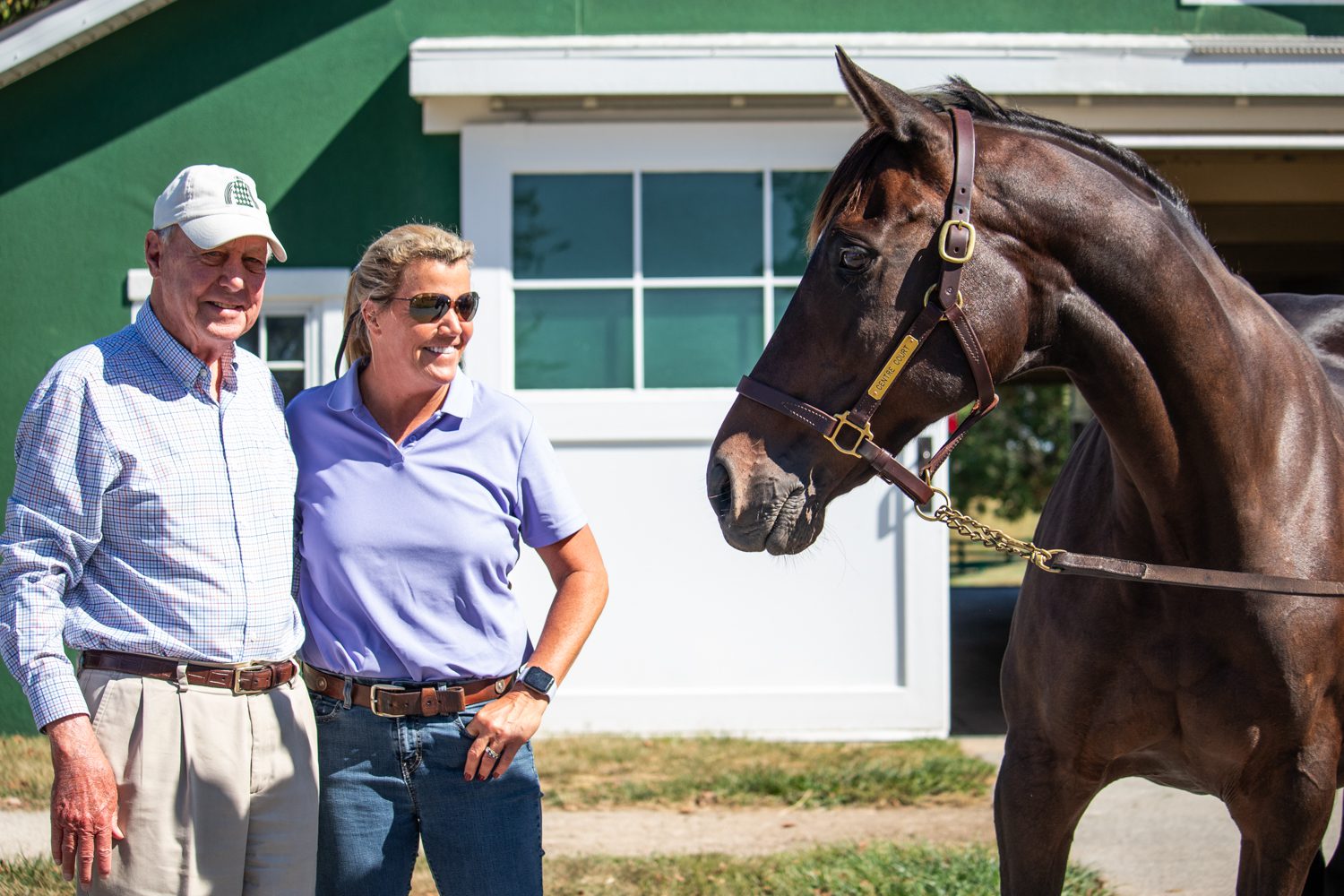
Humphrey and Oliver with Grade I victress Centre Court | Sara Gordon

“The Spinster was special because it was here at Keeneland,” Humphrey admitted. “But all of her wins were great.”

The summer before Clear Mandate's brilliant 5-year-old campaign, Humphrey and Arnold were a short walk down the hill from the Keeneland winner's circle at the sales pavilion, where they attended one of their first yearling auctions together. There at the 1996 Keeneland July Sale, they purchased a filly from one of the early crops of A.P. Indy for $350,000. Named Let, she would run a close second in the 1998 GI Ashland S. and later claim the 1999 GII Churchill Downs Distaff H.

Soon after retiring from the racetrack, Let produced Ravel (Fusaichi Pegasus), a $950,000 Keeneland September yearling who won the 2007 GIII Sham S. But it was later on in Let's breeding career that she brought Humphrey his stable star Centre Court (Smart Strike).

Again, Humphrey and Arnold's patience was rewarded. It took a year and four tries for the turf specialist to find the winner's circle, but from there Centre Court reeled off a series of six graded stakes wins highlighted by the 2013 GI Jenny Wiley S.

Humphrey's proudest accomplishment with the Let line came two years ago, when Centre Court's daughter Navratilova (Medaglia d'Oro) captured the GIII Valley View S. The victory marked the eighth graded stakes win for Humphrey at Keeneland. As the 23rd owner in history to reach the milestone, he earned a commemorative Keeneland Tray that now sits in the front foyer of the family's home.

“They were all a little different,” Arnold said when comparing the family line. “Let was beautiful, that's why we paid a lot of money for her as a yearling. Centre Court is probably more like her sire, a strong-looking horse. Navratilova is very attractive but is a finer version.”

“For her to be the third generation in the family to get a graded stakes win is special,” he added, and then laughed. “It means I didn't screw it up.”

While Arnold's father and grandfather both focused their careers primarily on the breeding sector of the industry, Arnold was always drawn to the racetrack. The horseman only ventured to the other side once, but the decision has paid dividends.

When Humphrey's mother Louise Humphrey passed away in 2012, a number of the horses they owned in partnership were put up for sale. There was one in Arnold's stable at the time that he just couldn't let go. He bought half of Halloween Party (Mr. Greeley) and soon had his first broodmare.

“She had won a couple of allowances, nothing fabulous, but she was tough,” Arnold recalled. “When she ended her career I was able to breed one with Watts and I co-bred a graded stakes horse from my one-horse broodmare band.”

Centre Court and Morticia at Shawnee Farm | Sara Gordon

That first foal was Morticia (Twirling Candy). She was named at the Humphreys' annual Halloween party, where they came dressed as the Addams family, and it soon became apparent that the filly was aptly named.

“She called the shots,” said Sarah Arnold, who by then was retired from exercise riding for her husband but joked that she probably wouldn't have attempted to ride the filly anyway. “She didn't like to be by herself. She was one of those fillies that really didn't care much about people, but she loved to be with other horses whether it was a workout buddy or a pony. She was fearless in the afternoon, just not so much in the morning.”

“She was definitely a handful,” Rusty confirmed. “But she took us on one hell of a ride.”

A case of shins kept the filly from the track most of her juvenile career, but it was an upward trajectory from there. A stakes winner at three, four and five, Morticia earned blacktype victories at eight different racetracks, including the 2017 GIII Buffalo Trace Franklin S. at Keeneland–winning on Friday, October 13th, much to the delight of her connections–and the 2019 GIII Ladies Sprint S. at Kentucky Downs. The consistent turfer retired in 2020 as a millionaire, having placed in all but 7 of her 29 career starts.

The Humphreys will attest that as a broodmare, Morticia's personality has become much more agreeable.

“She's really very sweet here,” Sally said. “She likes being a mom because she has her own built-in buddy with her all the time.”

Morticia's first foal, a filly by Nyquist, has developed into such an impressive yearling this year that she has led the Humphreys and Arnolds into making a difficult decision. Morticia will go through the ring at the upcoming Keeneland November Sale.

“I'm a trainer,” Arnold explained. “I love the racing part. This is going to allow me to race the foal. It's tough to keep them both. It becomes a business decision so that we are able to race the others. I've been very fortunate and Watts is the greatest partner in the world. We wouldn't have sold her without keeping a filly, who will be going right into the stable and we hope someday she can breed this family's ability into the next generation.”

In foal to Golden Pal, Morticia is among the rarest gems of Humphrey's broodmare band and she may be Arnold's first and only broodmare.

“I don't think I'm a broodmare type of guy,” admitted the veteran conditioner. “I like the racetrack. The breeding business has been very good to me, but we're more interested in racing.”

Arnold and Humphrey check in with Morticia | Sara Gordon

Humphrey has spent decades hoping to perfect a delicate balance of retaining his prized race mares to progress their families and selling some when other members of the family come along.

“You don't want to have so much of the same family,” Vicki said, explaining the important lesson she has learned from her father. “It would be awesome to keep them all, but you have to diversify your families.”

And so another stable standout will also go through the Keeneland sales ring now that her graded stakes-winning daughter Navratilova has recently entered the Shawnee broodmare band. With an Essential Quality colt on the ground this year and carrying a foal by Flightline, Centre Court highlights the old adage that Humphrey adopted as his philosophy.

“Breed the best to the best and hope for the best,” recited Humphrey.

“That's about the speech he gave when we first started together,” Arnold added. “He said to take care of the horses the best you can and then we will hope for the best with how they run. That philosophy has never wavered.”

And the philosophy has proven to be more than fruitful. Humphrey has developed a breeding program comparable to few others in the upper echelon of racing, but in his characteristically astute, thoughtful manner–the one that served him so well in another world as an investor and entrepreneur–Humphrey's leadership as a public servant of the racing industry has left a far greater impact.

But when it comes to his racing stable, the septuagenarian is not done yet. He may not come out and say it, but his family and friends in the room will speak up for him concerning the goal still in the back of their minds.

“I know that winning the Kentucky Oaks would be fun for him,” Vicki said. “Especially with as many fillies as he's had over the years.”

Oliver has a similar goal herself. While she got her first stakes win at Keeneland just this spring with BBN Racing's Mo Stash (Mo Town) in the GIII Transylvania S., many of her top earners, including her first Grade I winner in 2014 Del Mark Oaks victress Personal Diary (City Zip), are fillies she trains for her father.

Humphrey splits most of his homebreds between his daughter and Arnold, but there is far from a competitive fervor, much less any animosity, between the two stables.

“We've become friends with Vicki as she's grown through the business,” Arnold explained. “Watts is 10 to 12 years older than me and I'm more-years-than-that older than Vicki. It's evolved into another very good friendship.”

Hardly a day goes by that the Humphrey and Arnold clans are not in communication, whether it's Humphrey stopping by the barn at Saratoga or Keeneland or the Arnolds visiting the farm in Harrodsburg.

“Rusty and Sarah and all the people that work for him have taken great care of these horses and they care about them,” Humphrey said. “He's always had special people working for him, which is very important to us.”

But it goes even deeper than that. The families have shared decades of golf outings and quiet dinners at the farm, spent countless holidays together, and even taken annual hunting trips to the Humphreys' family plantation in north Florida, where they take a pause from racing to enjoy the sport that brought them all together in the first place.

“We've had a lot of fun together,” Sarah reflected. “They've always treated us like family.”

“A relationship like this is extremely rare in the business we're in,” Arnold added. “It's very special.”

The post Keeneland Breeder Spotlight: Humphrey and Arnold: A Connection That Goes Well Beyond Racing appeared first on TDN | Thoroughbred Daily News | Horse Racing News, Results and Video | Thoroughbred Breeding and Auctions.

Source of original post

Another Chapter in Taylor Made’s Breeders’ Cup Story

Celebrating 40 Years of the Breeders' Cup

Can you imagine being a horse racing-crazy kid with a ringside seat to the creation of the Breeders' Cup? Mark Taylor can, because he was.

Fast forward more than four decades and now he is president and CEO of the Central Kentucky farm that is believed to have raised and/or sold more Breeders' Cup winners than any other. There's also the matter of having stood the Breeders' Cup winner who currently holds the record for siring the most Breeders' Cup winners in turn. And, oh yes, there's also Knicks Go, another Breeders' Cup winner, in the farm's stud barn right now, as well as a few in the fields. Yes, surely Taylor can be excused if his reverence for the Breeders' Cup might be even greater than usual.

“Listen, the [Kentucky] Derby is amazing, but if you're in this industry, the Breeders' Cup is the real deal,” said Taylor. “Every division: turf, dirt, 2-year-olds, 3-year-olds, older horses, all coming together and laying it all on the line.”

Taylor's father was the legendary farm manager Joe Taylor, whose fortunes coincided with that of Gainesway. Many will remember Gainesway under John Gaines and the elder Taylor together. At one point the farm on Paris Pike stood 40 stallions and bred over 2,000 mares a year. This was all the more remarkable considering it was in the days when stallion books were much smaller and reproductive work wasn't quite so advanced, often necessitating multiple covers per mare.

In addition to owning one of the most successful stallion stations in our sport's history, Gaines is also credited with the conception of the Breeders' Cup. Joe Taylor was at his side for all of it. Although they were farm owner and employee, the two men were far closer than that, said Mark Taylor.

“Mr. Gaines and my dad were like brothers in a lot of ways,” he said. “Mr. Gaines was a brilliant business guy and the visionary. My dad was the diplomat and the horseman. My dad was really gratified for Mr. Gaines when he got it all together and got the Breeders' Cup done. What an amazing thing.”

Knicks Go at Taylor Made | Sarah Andrew

Taylor said he was the youngest of eight kids and a young teenager when Gaines hatched the idea behind the Breeders' Cup.

“I feel like I got a front-row seat,” said Taylor. “I was the last kid still in the house in those years where the Breeders' Cup was really coming to fruition. I could hear my dad in there on the phone with Mr. Gaines and the two of them brainstorming.

“It was like political warfare, getting everyone on board. For Mr. Gaines to try to bring this concept to fruition he deserves some sort of Nobel Peace Prize. I don't know how he got it done.”

All these years later, Taylor still marvels at the unobstructed view he received.

“It's really amazing. I feel like of all the thousands and thousands of people in this industry, I got to see this and I was just a 13- or 14-year-old kid. I had a really unique view of this thing coming together. I was really into horse racing. I'd be waiting for the Blood-Horse or Thoroughbred Record every week, and the race results in the Herald-Leader every day. The TDN wasn't around yet.

“It was kind of cool watching it all come together. I love the Breeders' Cup. It's one of my favorite days of the year. Watching what it's become is really special.

“I'll never forget that first Breeders' Cup Classic. That wild stretch drive. I think it was more than Mr. Gaines could have dreamt up the way it came together.

“What a privilege to see it all come together.”

Sarah Andrew

After witnessing something so special, no wonder Taylor–along with his older brothers–would later found Taylor Made Farm, today a diverse operation which has conquered the worlds of boarding, selling, stallions, and more. No fewer than 20 individual Breeders' Cup winners have been raised or sold by Taylor Made. Lest one think those eventual winners simply passed through sales barns, a full 11 of those 20 spent their formative years cavorting through Taylor Made pastures. Among those raised on Taylor Made's land were Triple Crown winner American Pharoah and leading sire Unbridled's Song. The latter also spent his entire stud career at Taylor Made and would sire six individual Breeders' Cup winners. Long before he sired a foal, Unbridled's Song was tied to Taylor Made.

“It's a long story,” said Taylor. “We had Unbridled's Song here on the farm when he was a weanling owned by Mandysland Farm. They were dispersing; ultimately he was bought by someone else and they took him to Saratoga where he sold as a yearling, but was sent back to Taylor Made for some R&R. Ernie Pargallo's Paraneck Stable and Buzz Chace bought him.

“Back then, Taylor Made sold 2-year-olds in training. We obviously didn't have a training center, so we were the marketing arm. I never will forget when Unbridled's Song breezed, he was just this big, gray monster. He breezed so effortlessly. As he crossed the line, the announcer said, 'He went so fast the infield trees swayed.'”

Sarah Andrew

Unbridled's Song brought $1.4 million in 1995 at the Barretts March sale. At the time, it was a world record for a 2-year-old in training. However, there was a hitch. A chip was found in the colt's hind ankle and the buyer, according to Taylor, tried to negotiate a reduced price.

“We had an anxiety attack,” said Taylor. “Here we'd spent all this money going to California–we'd flown all the way to Barretts to sell him–and our big horse was being turned back. Ernie Paragallo said, 'Don't worry about it. We're going to win the Breeders' Cup with him.' The rest is history.”

Sure enough, Unbridled's Song did just that. About seven months later, he captured the GI Juvenile in a spectacular stretch duel with Hennessy.

“That was amazing. Of course, he came here [after his racing career], led the general sires list, and was a tremendous sire for us,” said Taylor. “He really put our stallion operation on the map. He had so much speed for a big horse and could carry it two turns. He also had such a sweet disposition, not a mean bone in his body.

“And he died with that chip in his hind ankle!”

Knicks Go with Ernesto Martinez  | Sarah Andrew

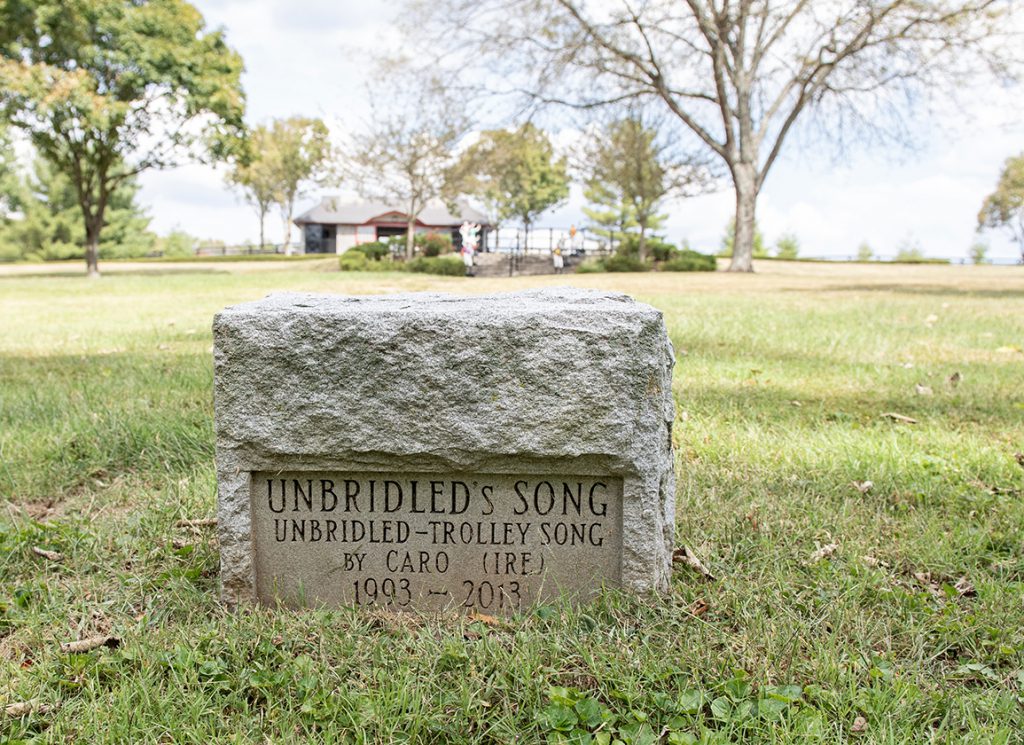
Unbridled's Song passed away in 2013 at the age of 20. Another Breeders' Cup winner, 2021 Classic winner and 2020 Dirt Mile winner Knicks Go, is currently in the stallion barn.

“Several farms were after him, so the fact that we were able to get the horse was very exciting,” said Travis White, director of sales at Taylor Made. “It's not often you get a horse like that. For us he checked a lot of boxes. We feel so fortunate and excited to have him.

“The Breeders' Cup is the Super Bowl of our sport. Anytime you can get a horse of that caliber, the best of the best, proven on the world's biggest stage, it's a great addition to a stallion roster. You're going to attract the top breeders in the world.”

Knicks Go was just history's sixth horse to find the winner's circle in two different Breeders' Cup races, but there was almost a third Breeders' Cup win on his CV. It's often lost among the Eclipse championships and two championship day wins, but Knicks Go also finished runner-up as a 2-year-old in the 2018 Juvenile behind eventual champion Game Winner.

“I think a lot of people forget he was a Grade I winner at two and that he won or placed in three different Breeders' Cup races,” said White. “It is extremely rare for a horse to be as precocious as he was and then come back and win two different Breeders' Cup races as an older horse. Most horses have a niche–they can't go two turns, can't come from off the pace, have to have things go their own way–but he was able to do it all. Hats off to Brad Cox and his crew for doing such a great job with him.”

White said it's an honor to have Knicks Go in the stallion barn at Taylor Made. “Anytime you have a horse with his accomplishments and accolades, it means the world.”

Knicks Go isn't the only Breeders' Cup winner currently on the farm. The most high-profile Breeders' Cup-winning mare at Taylor Made at the moment is undoubtedly Blue Prize (Arg), winner of the 2019 Distaff and a $5-million purchase out of Fasig-Tipton by OXO Equine. However, it is Miss Macy Sue who holds pride of place.

Miss Macy Sue at Taylor Made last month | Sarah Andrew

Miss Macy Sue, a graded winner who was third in the 2007 Breeders' Cup Filly & Mare Sprint, had five foals to race. Four were stakes winners, including GI Breeders' Cup Dirt Mile winner Liam's Map (who is by Taylor Made's Unbridled's Song) and Not This Time, who was runner-up by a neck in the Breeders' Cup Juvenile and is now king of the stallion barn at Taylor Made.

“She is pensioned and still lives here,” said Taylor. “She is the grand dame of Taylor Made. Almost two Breeders' Cup winners. What an achievement. Stallions get to produce hundreds and hundreds of foals every year, but mares get one chance a year for maybe 10 or 15 years. For her to have that kind of strike rate in the Breeders' Cup is just incredible.”

Taylor Made has had a lot of significant moments in the Breeders' Cup, but there was one that might have been a little extra special. In the 2004 edition at Lone Star Park, two mares grazing in Taylor Made paddocks both had Breeders' Cup winners. Silken Cat and Goulash produced Sprint winner Speightstown and Distaff winner Ashado, respectively. Now the mares are buried next to each other at Taylor Made.

Silken Cat's grave at Taylor Made | Sarah Andrew

“Both were bred by Aaron and Marie Jones, long-time customers. That day was incredible,” remembered Taylor. “We raised them both here and they were on opposite ends of the spectrum price-wise. Speightstown was a $2-million Keeneland July yearling and Ashado brought $170,000 at Keeneland September. And yet they both turned into champions. Later we resold Ashado for a then world-record $9 million.”

It's probably safe to say Taylor Made's story in the Breeders' Cup is far from over. Whether future chapters will be written from the mare side or the sales division or even by horses standing in the stallion barn remains to be seen, but the touch of Taylor Made will likely continue to be felt alongside the Breeders' Cup. What could be more fitting for a kid with a front-row seat to the birth of racing's championship days?

The post Another Chapter in Taylor Made’s Breeders’ Cup Story appeared first on TDN | Thoroughbred Daily News | Horse Racing News, Results and Video | Thoroughbred Breeding and Auctions.

Source of original post
Riding Six Tracks In Six Days, Conner’s Mileage Surpassed Only By His Work Ethic

When Penn National shut down for a one-month planned break Sept. 23, Tyler Conner, the track's third-leading rider this year in both wins and earnings, wasn't sure what he'd do to keep his income flowing.

Yet the 30-year-old jockey, who is soft-spoken but highly driven, managed to build enough out-of-town business to the point where he has just completed a demanding six-day run of riding at six different tracks in the Northeast and Canada.

His whirlwind tour included more than 1,800 miles of driving, nearly all of which he accomplished solo Oct. 11-16 while amassing a 2-4-2 mark from 14 mounts at Parx, Laurel, Delaware, Aqueduct, Woodbine and Presque Isle.

“Anyone have a helicopter I can borrow?” Conner had humorously asked on Twitter during the midway point of his journey.

And no, on the seventh day Conner did not rest. TDN spoke to him via phone Oct. 17 while he was driving 110 miles from his home on a small farm near Penn National to ride at Parx, where the six-day streak had first begun Oct. 11.

Conner said the extensive travel was worth it, although maybe more in terms of getting his name out there and getting noticed rather than money.

“I was a little worried the last couple of weeks before we shut down, because I didn't have a plan. I didn't really know what business would be like with the break. Winning when you have to ship in from out of town is always tough,” Conner said.

And what fueled him on his rigorous commutes beyond aspirations of bettering himself?

“Good music and podcasts,” Conner said. “And I definitely drank too much Mountain Dew to keep me awake and focused. For most of the week it was rainy, kind of gloomy. So it wasn't the best driving, but nothing crazy happened. That's always helpful.”

“But it's been pretty good,” Conner continued. “I've been really, really busy. Busier than I've been all year, honestly. And the horses are running well, so that helps. [The week on the road]  paid for the trip, and a little more.”

The day after Penn went on hiatus, Conner had four mounts on the GI Pennsylvania Derby card at Parx, where his best finish was third aboard Mish (Field Commission) in the $300,000 Parx Dirt Mile S.

Honor D Lady | Coady Photography

That mount was for trainer Saffie Joseph, Jr., who also sent Conner to ride in Oklahoma the next night, Sept. 24, aboard Honor D Lady (Honor Code), who won the GIII Remington Park Oaks at 7-1 odds.

“Winning the Oaks was huge,” Conner said. “That really helped, being off for the month.”

Conner returned home and rode at various mid-Atlantic tracks over the next two weeks. His calendar then came together better than he expected it would in the second week of October.

He began the six-tracks-in-six-days tour with 220 miles of round-trip driving Oct. 11 and a third-place finish in a Parx starter-allowance with a $26,000 purse.

The next day, Oct. 12, the 240-mile round trip to Laurel netted Conner a second and a win, with the victory coming in a $60,940 allowance/optional claimer.

On Friday the 13th, Conner trekked 170 miles round-trip to Delaware, riding fifth with one mount, then second with another in a starter-allowance with a $30,000 purse.

“Parx, Laurel, Delaware, I just go back and forth for those as day trips,” Conner said as if racking up 630 collective miles on three consecutive days constituted normal workday commuting.

On Saturday, Oct. 14, Conner drove 180 miles to Aqueduct to ride Salvaje (Kantharos) in the $125,000 Floral Park S. The field scratched down to four as an off-the-turfer, and he managed third with his 6-1 shot behind a 3-10 winner.

“I drove to Woodbine from there. It was about nine hours, and I got to Woodbine around midnight,” Conner said of the 500-mile trek that included an international border crossing. “Then I just slept in until 10 in the morning and got some rest.”

Those two Woodbine mounts (one in a stakes) again came courtesy of trainer Joseph.

Conner explained that after he won the GII Penn Mile for a different trainer in 2022, Joseph had contacted him with praise for his riding, and had offered to give him business if he switched his tack to Gulfstream, where Joseph is based.

Conner tried it for a weekend in June 2022 and won a race, but respectfully declined the offer to move to Florida full-time because he thought it would be too tough to get additional mounts on that highly competitive circuit beyond those that Joseph offered.

“Saffie has helped me a lot,” Conner said. “He's been so good to me, and given me an opportunity to ride a lot of nice horses. I tell people all the time I'll go anywhere he wants me to go, just to have those opportunities. Now he sends me where it fits for him and when I'm available. It's been good riding for new people at new tracks and to get recognized a little bit outside of the usual.”

At Woodbine Oct. 15, Conner was second aboard the 15-1 Mystic Lake (Mo Town) in the $125,000 Glorious Song S., and he ran fourth with his 18-1 shot in a maiden allowance.

Woodbine to Presque Isle meant another border crossing and 180 more miles. Out of six mounts for six different trainers on the Oct. 16 card there, Conner won a $30,000 maiden allowance and finished second in a maiden-claimer.

Tyler Conner | Lauren King

On the 310-mile drive back home in the dark, Conner said he got help splitting time behind the wheel from a Penn-based buddy who had also been up at Presque Isle to race.

“I'm actually enjoying the traveling right now,” Conner said. “I would hopefully like to keep riding at other bigger tracks and ride in more big races. I'm working on getting to Kentucky. But I'm just kind of waiting on an answer from an agent right now, and depending on what he wants to do, I'll go from there.”

Conner was born into a racing family. His father, John Conner, is a former trainer who now owns horses and is an in-demand farrier. His mom, Sandra Conner, rode regularly from 1989 up until Tyler was born in 1993. His stepmom, Erin McClellan, currently trains at Penn.

Yet Conner said he didn't gravitate to becoming a jockey until after he had quit high school and earned his GED while working as a groom. Prior to that, ever since he was about age five, his passion had been motocross.

“That's all I did growing up, was ride motorcycles. I still do, on occasion,” Conner said. “I guess I figured I'd try riding horses out of necessity. I kept getting hurt on the motorcycles, and I had to find a job that would pay better than grooming, so I started riding. I had never been on a horse before that.”

Conner laughed politely at the suggestion that not too many jockeys find their calling in race-riding because they think it's a less dangerous option than what they had been doing.

“I know anything can happen, but riding horses is definitely safer at this point. The chances of injury are a lot lower, it seems like,” Conner said.

Wednesday, Oct. 18, was technically Conner's first day off in a week. But that just meant he wouldn't have mounts booked in afternoon or evening races.

“Oh, yeah, I'll still go to work at Penn for morning training, for sure,” Conner said.

The post Riding Six Tracks In Six Days, Conner’s Mileage Surpassed Only By His Work Ethic appeared first on TDN | Thoroughbred Daily News | Horse Racing News, Results and Video | Thoroughbred Breeding and Auctions.

Source of original post
Verified by MonsterInsights