So here we are at last, rounding the home turn. This series has unfolded in familiar fashion, with an initial stampede of unproven young stallions progressively thinned out by the impatience of a commercial sector operating in ever decreasing cycles. Today we finish with a selection from those admirable stallions who have survived the ruthless attrition, and created a viable niche at various levels of the market.
The odds they have overcome, to get here, are such that the long-term health of the breed is clearly being treated as something our grandchildren can worry about instead. Yes, action is now being taken by the industry, notably on book sizes and medication. But the onus for change is not so much on regulators as on those directing investment. So long as the bloodstock agents (and racing managers and all the rest) keep funneling the budget into untested stallions, then farms can't be blamed for industrial exploitation of flimsy rookies perceived as “commercial” before discarding them to overseas or regional programs. And nor can breeders and pinhookers be blamed for supporting them.
The standard defense, of course, is that you have no choice but to try new stallions unless you can afford the proven operators in the six-figure elite. If that were truly so, however, why don't they support stallions in their third, fourth and fifth years? Why don't they tell their patrons that the time to get real value is when they're cooling off: you could get to Into Mischief for just $7,500 after he had sold his first yearlings, remember, and Tapit for $12,500.
We all know why. It's because professional advisers are too nervous of having their judgement exposed. They daren't risk telling their patrons that now is the time to roll with a slower-burning stallion, in case his first couple of crops go so quietly that he's dispatched to Turkey or Pennsylvania. And of course that becomes self-fulfilling.
Instead they behave as though the sieves of quality and value, between pedigree and conformation and all the rest of it, suddenly cease functioning once a stallion is about to launch his stock. That way they can say: “Don't blame me that this stallion didn't work out. You saw how hot his yearlings were. All the other experts agreed.”
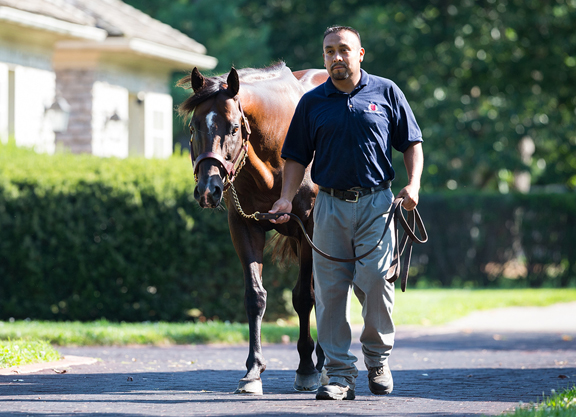
Sky Mesa's lifetime percentages remain tremendous for this level | EquiSport Photos
On that basis, we've already explored some of the best value in the marketplace. But today we're going to browse some of those who, often by combining merit with timely fortune, have come out the other side of this winnowing process. They set a standard that will be met by very few of the new stallions annually flooding the market. As such, in fact, they provide what should (in a sane industry) be the most commercial service of all–by offering tangible, legible prospects of decorating your mare with a stakes winner or two.
The nature of this particular beast means we'll be revisiting some who have featured in years past. One or two have meanwhile faded, naturally; one or two have elevated themselves beyond the reach of “value.” But consistency is what keeps the rest in our esteem, and we'll repay them in kind.
As a general principle, older stallions are a good place to start. I realize that many people are convinced that these greybeards lose their potency, but I suspect this to be one of those self-fulfilling prejudices; not least because ageing achievers often face competition from more affordable sons. There are simply too many top-class runners (and stallions) from the last books of their sires to be dismissed merely as exceptions that prove the rule. And it's certainly splendid to see Speightstown, with four individual Grade I winners in 2020, earn a fee hike from $70,000 to $90,000 at the age of 23!
As ever, anyone in this business who proposes an inviolable “rule” on the basis of a software program should be treated with suspicion; but they do kindly enable some stallions of proven, elite caliber to slip into reach, especially at a time when many farms are cutting fees across the roster.
For instance, do we really think Malibu Moon (A.P. Indy–Macoumba, by Mr. Prospector) a bust, now that he's down to $35,000? This sire of 17 Grade I winners–a tally exceeded among active rivals only by Tapit ($185,000), War Front ($150,000), Medaglia d'Oro ($150,000) and Speightstown himself, who's a year his junior–admittedly had a relatively quiet 2020 on the track, with just a couple of graded stakes winners. But his yearlings were still turning over a six-figure average in a squeezed market, and he's long established the efficacy of his aristocratic genes in producing dirt horses ideally adapted to the demands of Classic racing.
Unlike a lot of veteran sires, moreover, Malibu Moon is not going to run dry of material to keep his name in lights: he has been covering triple-digit books like clockwork, and his imminent juveniles crop comprised 103 live foals. And they're all out of mares deemed worthy of a $75,000 cover. What a terrific price he is now, to prove a young mare!
If you're a breeder, moreover, you'd be willing to retain one of his daughters in the hope of her someday producing another Stellar Wind (Curlin), Girvin (Tale of Ekati) or Bellafina (Quality Road). In that capacity, mind you, we're reluctant to look past another by the same breed-shaping sire.
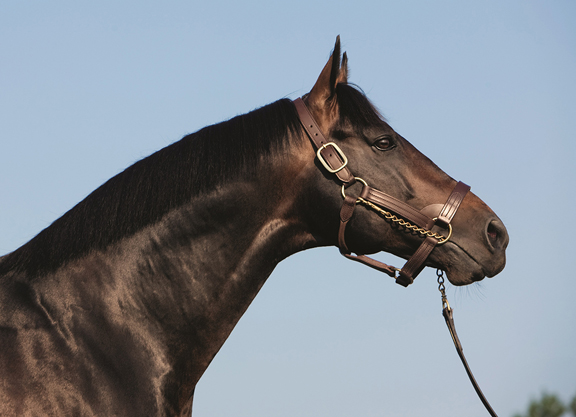
Bernardini | Darley
For Bernardini (A.P. Indy–Cara Rafaela, by Quiet American) is also down to $35,000 at Darley. That's a milder trim, from $40,000, and presumably prompted primarily by a troubled market environment–but it's also a fourth cut in four years. He was still at six figures as recently as 2017, and as high as $150,000 in his pomp. Having only just turned 18, however, he remains ahead of a genuinely historic curve as a broodmare sire: his daughters have produced more Grade I, graded stakes and black-type winners than any stallion in history, at this stage.
Yet his headline act in 2020 was a colt, Art Collector, who beat Swiss Skydiver (Daredevil) comprehensively in the GII Toyota Blue Grass S. during a spree that qualified him as one of the best sophomores around. He tapered off somewhat, and Micheline's narrow defeat in the GI Queen Elizabeth II Cup meant that their sire could not add to his 10 domestic Grade I winners (plus three in Australia/one apiece in Italy and Dubai).
Nonetheless, Bernardini has confirmed himself still perfectly capable of producing on the track, doubtless with more to follow given that he's routinely covering books in the 130s. And then there's the extraordinary precocity of his damsire credits, which can be shared between both sides of his pedigree: A.P. Indy's established a formidable distaff influence both through his own daughters and now those of his sons, unsurprising given the Secretariat–Buckpasser combination behind his own dam; while damsire Quiet American is a unique genetic dynamo.
Physically, of course, Bernardini is himself so beautiful a specimen that you're tempted to use adjectives typically reserved for femininity. And if commercial nerves about his recent performance reached his yearlings in the COVID market, then it shouldn't be forgotten that he has always been a lucrative performer in a sales environment that prizes deeds even above those looks: his 2-year-olds last year averaged $176,265, and only Storm Cat beats his 25 lifetime juveniles at $500,000-plus. Bottom line is that any breeder inclined to retain a filly will not get better value than Bernardini, perhaps anywhere in the world.
Mind you, end-users simply looking for a runner won't even have to leave Jonabell for a fine alternative at the same peg in Hard Spun (Danzig–Turkish Tryst, by Turkoman). His own excellence on the track, of course, reinforces our earlier defense of senior stallions (conceived when Danzig was 26) and Hard Spun continues to punch way above weight at $35,000, charitably clipped from $40,000 despite following up his stellar 2019 (three Grade I winners, all from his first crop since returning from that unhelpful sojourn in Japan) with another top 10 finish in the general sires' table.
This sire of 10 Grade I winners has assembled his 129 lifetime black-type performers at 11.5%–a tick behind Uncle Mo, for instance, who has advanced his fee to $175,000 with eight Grade I winners and 12% stakes performers. And Hard Spun has an exciting sophomore in Smarty Jones S. winner Caddo River, as high as No. 2 in colleague T.D. Thornton's Derby Top 12.
Despite the quirky damsire, it's all good stuff along that Darby Dan bottom line, with a half-sister to Little Current as close up as second dam; while Hard Spun's half-sister has refreshed the family page in more recent times as second dam of Improbable (City Zip). Above all, Hard Spun throws us as short a lifeline as we have, and at a fraction of the cost of War Front, to their breed-shaping sire.
Moreover he is parlaying his genes into such diverse disciplines and environments that he really should be much higher on the list for European breeders, as well. (Good to see one daughter, pinhooked as a $70,000 Keeneland September RNA, making 375,000gns at the Tattersalls Breeze-Ups last summer; she duly won her only start.)

Blame | Claiborne
Another whose fee trim for 2021 ($30,000 from $35,000) must be accounted simply a friendly gesture to a difficult trading environment is Blame (Arch–Liable, by Seeking the Gold). Because the Claiborne stallion has long passed the stage when he needs that kind of help. In fact, he has become a tribute to exemplary management, rebuilding in pretty spectacular fashion from a point where he did appear to be in a spot of trouble.
That was in 2018, when his fee was halved to $12,500. At that stage, he had made a similarly quiet start to that once made by his own sire on the same farm, and was down to just 48 mares the previous year–albeit he promptly had a breakthrough Classic success in Europe. Since then, he has left no doubt that he is successfully replicating the elite genetic wares that underpinned nine consecutive triple-digit Beyers and a historic distinction as the only horse ever to beat Zenyatta (Street Cry {Ire}).
Though unlucky to have soon lost the services of his fifth elite winner, Nadal, Blame had nine other graded stakes performers in 2020. Actually, Blame's overall output, after eight crops, is now strikingly similar to that of Quality Road, who started at the same time and smoothly elevated himself to $150,000 thanks to 11 Grade I winners at a ratio surpassing nearly all comers. For Blame can otherwise nearly match him for the across-the-board consistency: by stakes winners, Quality Road's 6.5% plays 6% for Blame (black-type performers (12.5 and 12.2%); they respectively stand at 3.7 and 3.3% for graded stakes winners, and 6.2 and 6.4% for graded stakes horses; while their overall Grade I performers measure up at 2.5 and 2.3%.
Again, this comparison is only intended to magnify Blame and not belittle a top-class alternative, and it must be said that their latest yearling averages (as so often tends to be the case) dutifully reflect the difference in fees. True, even a $57,884 average for Blame looked after their $12,500 conception fee very nicely–and that, in itself, is a reminder that Blame's revival since should be sustained, in terms of racetrack headlines, by the improved quality and size (now routinely in three figures) of his books.
Having just turned 15, Blame is entering his prime. So forget Quality Road for a minute. As a percentage of named foals, despite that sticky start, Blame now measures up to Into Mischief for Grade I winners; Ghostzapper for Grade I horses; More Than Ready for graded stakes winners; Kitten's Joy for graded stakes horses; Uncle Mo for stakes horses; and Candy Ride (Arg) for stakes winners. Oh yes, and he just had his fee cut. That either shows you prove anything with statistics, or that he deserves gold on our final “value podium.” (See below…)
None of this is hard to explain: Blame has a for-the-ages pedigree, with fourth dam Thong standing opposite Courtly Dee in Arch's maternal line. That's like a time capsule for everything we need to retain in the breed. Sure enough, he's obviously another who would make any breeder glad to retain a filly.
We don't need too much detail on the eligibility of English Channel (Smart Strike–Belva, by Theatrical {Ire}) for this list, having so recently celebrated his breakthrough turf championship (by domestic and/or Northern Hemisphere earnings). We remarked then that if Kitten's Joy has been crazily undervalued by European prospectors, we should be outright scandalized by neglect of a stallion whose lifetime percentages either match or (mostly) surpass that acknowledged turf Titan, right across the board.
We know that the commercial market has an infantile terror of grass, but the combined class and durability of stallions like these are precisely what the breed overall requires most urgently. These days Calumet may sing from a rather different hymnsheet from most commercial horsemen, but at $27,500 (down from $35,000) English Channel is an imperative option for end users–most obviously, if by no means exclusively, those eager to exploit the expanding turf program.
For a long time, we were able to bracket another by the same stallion, Lookin At Lucky (Smart Strike–Private Feeling, by Belong to Me) with his Ashford buddy Munnings (Speightstown) as a pair who together represented great value at a similar level. The Munnings train has meanwhile left town: nobody ever needed telling about him, to be honest, because everyone already seemed to know. His books have been soaring, in quality and quantity, and now the dividends are there for Kentucky's No. 7 stallion by earnings in 2020, with six graded stakes winners.
But poor old Lookin At Lucky remains grievously underrated, whatever he does. He's still stranded at $20,000, a fee now doubled by Munnings, and received 113 mares last spring compared with 207 for his uber-fashionable rival. And, cursed by a self-fulfilling reputation (“not a sales sire”), his yearlings averaged $33,777 even as Munnings swaggered his way up to $80,932.
But Lookin At Lucky's record is so much better than many a “sales sire” that he points an accusing finger at the whole business. Just what are these guys looking for? A racehorse, or a pretty model for art students? His cumulative achievements, even now, keep him on a par with Munnings himself. Okay, so he is outpunched on stakes winners (6.7 versus 4.7% of named foals), but other indices keep the ugly duckling right alongside the swan. Lookin At Lucky gets black-type horses at 10.3 against 10.7%; graded stakes winners at 2.5 against 2.6%; graded stakes performers at 4.9 against 4.4%; Grade I horses at 2.2 against 1.2%.
And while Munnings still has just two elite scorers from 685 named foals, Lookin At Lucky (553) has come up with winners of the Breeders' Cup Classic, the Kentucky Derby and a Beldame winner who then ran Monomoy Girl (Tapizar) to a length in the Breeders' Cup Distaff. When he connects, Lucky hits as hard as anyone. Those who quibble over the promotion of Country House, incidentally, should remind themselves that he was not the only son of Lookin At Lucky to have passed the post second in the one race everyone claims to have in mind when they go to Keeneland in September.
It's nuts, really. Here's a stallion who has repeatedly produced elite two-turn horses, from mares on a $20,000 covering budget, and still a lot of agents put an automatic line through his yearlings. But that's fine. See you guys in the winner's circle. Because Lookin At Lucky doesn't have to get mad. He can just get even.
The Factor (War Front–Greyciousness, by Miswaki) had another productive campaign in 2020, just cents off the top 10 among living Kentucky stallions, but Lane's End held him at $17,500. That's doubtless because this last yearling cycle was the one he missed through his season in Japan, so he'll be quieter on the track this time round, but patience will bring its rewards: his book last spring rocketed to 150, from 80 in his comeback year.
In fact, patience has been the key throughout. The Factor lost early momentum when his first crop, conspicuously well received at the sales, turned out not to be the sharp and early types everyone had anticipated. But they proved worth the wait, and The Factor's cumulative percentages now stack up very closely with those of his flourishing studmate Twirling Candy, who deservedly commands a fee of $40,000. The Factor is surely just refueling at this kind of fee, and can be expected to motor upwards once back on the highway.
A half-sister to The Factor wrote an important new chapter for Midnight Lute (Real Quiet–Candytuft, by Dehere) in 2020 when her daughter Keeper Ofthe Stars became the Hill 'n' Dale stallion's fourth Grade I winner. It was a good campaign all round for Midnight Lute, with three others adding elite podiums to Grade II success. That's especially important for one who has produced such an extravagant talent in Midnight Bisou that people don't always recognize his breadth of achievement. As a turf miler, moreover, Keeper Ofthe Stars reiterated the versatility of a horse who was celebrated on the track as very fast, and very tall, but who very adaptably recycles a ton of Classic genes and all-round physical quality.
Another old pal is Sky Mesa (Pulpit–Caress, by Storm Cat). Good to see that he welcomed a three-figure book to Three Chimneys last year, up from 59 in 2019. Admittedly he had a quiet campaign, with just three stakes winners, but his page has been freshened up by Maxfield (Street Sense), who is out of a half-sister, and he gets a helpful trim to $12,500 (from $15,000). His lifetime percentages remain tremendous, for this level: black-type winners/horses to named foals at 6.5 and 12.7% respectively, which is as much as can be said even for stallions as accomplished as, for instance, Candy Ride (Arg), Street Sense or Flatter.
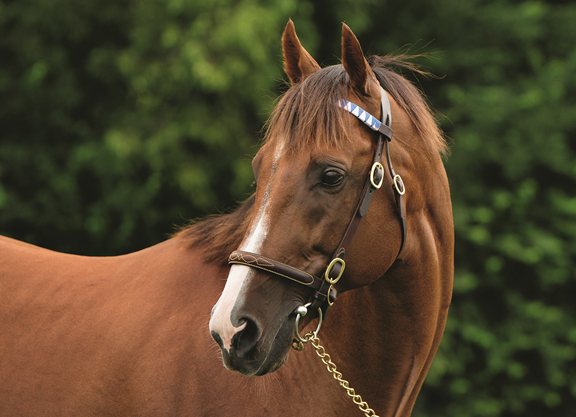
Midshipman | Darley
Midshipman (Unbridled's Song–Fleet Lady, by Avenue of Flags) meanwhile continued his metronomic service at Darley, another eight stakes winners in 2020 maintaining his unbelievable consistency for one operating at this end of the market: he, too, has lifetime stakes performers at 12% of named foals. To ease him a little to just $7,500, when routinely covering three-figure books, is really looking after the working breeder at a difficult time. I really look forward to the day when Midshipman gets the domestic Grade I success that is surely, given his achievements with such limited mares, well within his competence.
Mind you, Mizzen Mast (Cozzene–Kinema, by Graustark) has had eight of those! Here's another big firm looking after the little guy, with Juddmonte standing this venerable creature at the same bargain fee. He's a versatile influence in everything with the class that has united achievers in every theatre–short and long, turf and dirt–and he's now of an age where his daughters can show the same merit, most recently through Ete Indien (Summer Front), Nashville (Speightstown) and Classic-placed European filly Quadrilateral (GB) (Frankel {GB}).
So having started with a veteran, we finish with one, too. Because for a fee you could carry into the farm office in a cigar box, you can still tap into a grandson of Caro (Ire), with first two dams by Graustark and Tom Fool. Show me something like that in the freshman's table, and you get my attention.
CHRIS McGRATH'S VALUE PODIUM
Gold: Blame ($30,000, Claiborne)
Now nearing elite status by any measure but price.
Silver: Lookin At Lucky ($20,000, Coolmore)
Seems that nobody is ever Lookin' hard enough.
Bronze: Mizzen Mast ($7,500, Juddmonte)
Hurry for those genes while they last!

The post Kentucky Sires for 2021: Established Stallions appeared first on TDN | Thoroughbred Daily News | Horse Racing News, Results and Video | Thoroughbred Breeding and Auctions.
Source of original post