The California Series: John Shirreffs

In a new TDN series, we curry lessons and wise counsel from veteran Californian figures who, like gold nuggets panned from the Tuolomne River in the High Sierras, have unearthed career riches on arguably the toughest circuit in the States. We begin this series with John Shirreffs.

Born at Fort Leavenworth, Kansas, Shirreffs was raised around horses on his family farm, and was deployed to Vietnam with the Marine Corps before embarking on a career in racing, using a 10-year stint at the Loma Rica Horse Ranch in Northern California as a springboard to a training career that would see him sift one of the rarest jewels of all.

Part I

Amid the tall spiking pines and jutting mountain cathedrals of Northern California's Grass Valley back when the sprawling Loma Rica Horse Ranch still hummed with activity and where the transatlantic phenom Noor would later be interred–to haunt the barns, some say–one stubborn son-of-a-gun yearling colt gave a young John Shirreffs an abject lesson in obstinance.

“He's in the stall rearing up and striking and I can't get the bridle on him,” said Shirreffs, remembering the scene from the safe hindsight of some five decades. The memory remains sharp, however.

Rolling up his sleeves, the young Shirreffs sniffed a challenge, which quickly turned from a wily game of wits into a war of muscle. He jumped on the colt bareback. He grabbed his ears. “We're having this Battle Royale.”

After a fashion, though, Shirreffs waved the white flag and with ego deflated turned to Henry Freitas, the farm's storied manager, for pointers on a less adversarial approach.
“Henry said, 'John, just stop all the B.S. Just go down the stall and put the bridle on the horse and quit all that crap you're doing.'”

Shirreffs was unimpressed. “I'm walking down the shedrow thinking to myself, 'what kind of help was that?'” Still, the relationship between pupil and master was one of deference to experience–decades worth, in the case of Freitas–and so, Shirreffs dutifully obliged.

“I went in the stall, put the bridle on the horse–the horse never moved. It was over.”

And what was the main takeaway? “The value of a timeout with horses,” he replied. “When you're caught up in the moment and things aren't working out, the best thing to do is just stop and give yourself and the horse a chance to have a moment of thought to recover.”
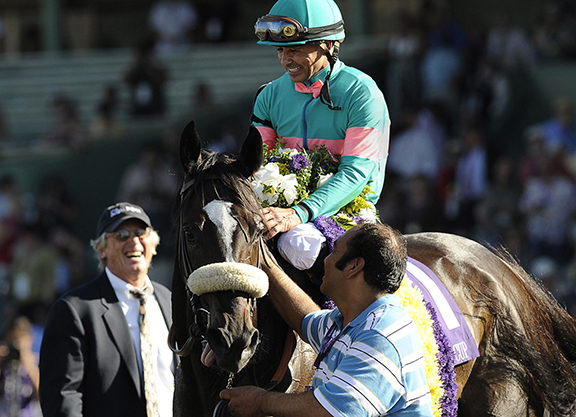
Shirreffs after the Breeders' Cup Distaff with Zenyatta | Sarah Andrew

Shirreffs imparted the story one recent morning in his office at Santa Anita, the nearby San Gabriel Mountains draped in a cold, grey drizzle like a soggy blanket, as the veteran trainer reflected on a 45-year career looped into which is a Kentucky Derby win and multiple Breeders' Cups and the sort of horse in Zenyatta (Street Cry {Ire}) that comes along about as often as Halley's Comet.

This nugget of barn-spun wisdom also provides a useful barometer of the trainer's evolution as a horseman, familiar sounding to anyone long enough in the tooth to know that any career with racehorses is akin to a college course without end.

“When I was younger, I could dominate a horse, right? I could handle them pretty well through strength. But as I got older, horses started getting a lot stronger than I was. Most of them were starting to outsmart me. So, I learned over the years what a mental game it is.”

Indeed, from a world in which the economics of high-level competition has sprouted large military-run outfits–those where routine and repetition are bywords for necessity and thrift–the Shirreffs barn offers a refreshing alternative, where morning training is approached with the same certitude of an explorer setting foot on virgin terrain.

But while Cook and Columbus had in the North Star their guiding light, Shirreffs has for his something altogether more fluid and transactional.

“It's always about building the bond,” said Shirreffs, focusing in on what appears a central conceit of his.

“You have to build a bond between the horse and the person. I have to find a way where that horse has trust in whoever's handling him or doing something with them. So, it's always about the bond, because if that horse trusts the groom or trusts the person with them, then they will behave much better than if all they're thinking about is being nervous, being anxious about what's coming next.”

Big range of emotions

Wander down any shedrow and you'll hear horse behavior equated with everything from wayward teens to recalcitrant spouses to loving sweethearts. This isn't new–the instinct to anthropomorphize is as ancient as civilization itself.

What's unusual is to hear any trainer–especially those operating within the upper echelons of a sport where a business degree can sometimes feel like the most instructive qualification–talk of the complex emotional bandwidth of a racehorse, as Shirreffs does.

The foundations of this clearly stem from those early days under Freitas at Loma Rica Ranch, a 600-acre university for horsemanship, home as it was to stallion and mare, yearling and breaker, lay-up and foal.

“I think somebody should spend an hour in the stall with a stud, just to understand the range of emotion that an animal can have,” he said. “Sometimes, the thing that amazes me about horses is how much they are willing to communicate and how much they're studying us.
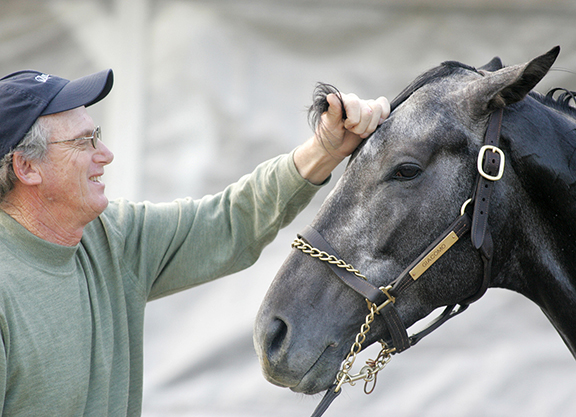
It's a matter of getting to know your horse: Shirreffs with Giacomo | Horsephotos

He added, “You have to realize that they are trying to make their environment as good as they can. And we are the biggest thing in their environment that they have to control. Right?” he added. “We're the ones that could endanger them. So, obviously they're studying what type of a relationship they're going to have with us.”

Like all relationships, the means define the ends. Of course, when it comes to understanding quirks and foibles, there are few substitutes for patience. “It's a matter of getting to know your horse,” he said.

“It's fun to watch the horses to pick up on their habits–I have the time to do that, when the work gets done and everyone's gone to lunch, I have that opportunity, when it's quiet, to watch the horses and see how they're behaving, see what's different about one or the other.”

This, he says, is particularly instructive to the early diagnosis of injury–arguably the biggest culprit of sleepless nights among insomniac license-holders.

“Horses are very stoic, right? You don't have an obvious sense of what's bothering them in the beginning [of injury], before there's any heat or any inflammation or anything like that,” he explained. “But how he eats is a good indication of how he's feeling, not only emotionally but also physically.

“Even then, by the time you notice that something's going on, he's probably been dealing with pain for probably quite some time.”

Such close scrutiny of behavior feeds into what he terms the “bio-rhythm” of a horse–the idea that a racehorse can be brought to peak performance only when, like a maestro vigilant of each section of the orchestra, they're mentally, physically and emotionally in balance.

“You have to figure out how to get things flowing together,” Shirreffs explained. “So, when they're physically at their peak they might not be mentally at their peak because you've trained them really hard, but mentally they're tired or emotionally they're off–you know, upset about being pushed so hard.

He continued, “So, you're going to have to lose a little bit of conditioning maybe to bring them up mentally and emotionally, right? It's always: How close you can get everything?

“That's the one great thing about campaigning a horse, because when they're campaigning they're conditioning–they're physically staying at a pretty high level. And as they campaign, and as they get used to the rigors of racing and training, mentally they're getting stronger, too. And then, if there's some sort of pleasure involved–some sort of reward for the horse–then they're emotionally getting better.

“So, it's all a question of balancing these three different things.”

The real pleasure a trainer gets

In those early days at Loma Rica Horse Ranch, Freitas came down with a nasty bout of flu, giving Shirreffs an early glimpse into the peculiar juggling act that operating a barn necessitates. Though perhaps baptism of fire would be more apropos.

“I knew the routine, right? I knew how everything ran. So, I was fine for about two or three days because I knew exactly what Henry would do.

“But suddenly, after about three or four days, I had to make new decisions based on ones I made a couple of days ago. That's when I got into trouble because I didn't have Henry to ask.”

Now, many an analogy befits a well-run stable, all shaped around a certain triangular hierarchy–an ant colony, for example, of an aforementioned branch of the military.

It's instructive then to hear Shirreffs explain the roles he's carved out for him and staff.

“I don't really need to know veterinary medicine, right? I don't need to know the name of drugs, all that kind of stuff,” he said. “[Veterinarians], they go to school, they know that. But I can learn what the shoer does, right? I can watch what they do.

“I can feel legs, and the difference between one leg and another and study those things. I can watch the horse and see if he's acting colicky or a little upset because of something else going on. So, I thought in the beginning that was where I would best spend my time to become a better trainer.”

Part of that process of self-evaluation has involved holding a mirror to his own failings–his own Achilles heels-as typified, for example, in the way he has, at times, placed individuals in charge of identifying soft tissue injuries.

“As a trainer, you go in and you're checking behind the saddle, but I'm always thinking it doesn't feel too bad because I want to train that horse, right? I have to have somebody put the brakes on. I have to have my own sort of checks and balances.”

At the same time, “You can't put demands on people, right? Because I think a certain way, and I react a certain way, I can't demand that other person be like me and react the way I would react.

“Let's take the exercise rider or jockey or whatever, you have to understand where they are [ability wise], what are their strong points and how you can best use them to accomplish what you need to accomplish with the horse.”

In an industry that often calibrates professional achievement and pleasure through the narrow aperture of race-day honors, it's refreshing, then, to hear someone no stranger to laurel wreath and garland talk of their other important metrics of success.

“It's so difficult to win a race–in California, especially. So somewhere along the way, if you're going to be in this business, you have to derive some pleasure from somewhere else, right?
“So, the real pleasure a trainer gets is seeing the growth in the horse. Or having somebody, like a rider, start to develop and understand his relationship with the horse, see what impact that person can make on how that horse is going to handle the stresses of racing.

“It's really a pleasure when you suddenly see a guy realize that if he didn't pull on this horse so hard and just kind of released the reins a little bit, the horse starts to relax. He realizes, 'Oh, it's not all muscle, it's a little bit of a finesse.'

“I think those are really fun things.”

Part II of this story will run in next week's TDN.

The post The California Series: John Shirreffs appeared first on TDN | Thoroughbred Daily News | Horse Racing News, Results and Video | Thoroughbred Breeding and Auctions.

Source of original post

Notable US-Bred & -Sired Runners in Japan: March 20 & 21, 2021

In this continuing series, we take a look ahead at US-bred and/or conceived runners entered for the upcoming weekend at the tracks on the Japan Racing Association circuit, with a focus on pedigree and/or performance in the sales ring. Here are the horses of interest for this weekend running at Chukyo and Hanshin Racecourses:

Saturday, March 20, 2021
1st-CKO, ¥9,680,000 ($89k), Maiden, 3yo, 1800m
NEFERTARI (JPN) (f, 3, American Pharoah–What a Spot, by Arch) finished a close third on career debut going this trip at Hanshin Nov. 22 (video, gate 8) and was a midfield eighth when last seen over that track and distance Dec. 20. The late April foal is out of a winning half-sister to GISWs Coil (Point Given) and Chiropractor (Kitten's Joy); MGSP Decorating (Galileo {Ire}); and MSP Ellyb (Pioneerof the Nile) and was acquired in utero for $225K at the 2017 Keeneland November sale. The filly's third dam produced champion Possibly Perfect (Northern Baby). Christophe Lemaire has the call. B-Hattori Bokujo

11th-HSN, Wakaba S.-Listed, ¥38m ($349k), 3yo, 2000mT
AMERICAN MACH (c, 3, Kitten's Joy–Cat On a Tin Roof, by Catienus) failed to handle the local dirt track in a pair of starts at this venue late last year, but has–not surprisingly–gone much better on the grass, including a near-miss second over the course and distance Feb. 28 (see below, gate 10), enough to earn a green light for this test as a four-start maiden. The $310K KEESEP acquisition is a full-brother to SW Sniper Kitten and is out of a full-sister to MSW and English G1SP Cannonball. The female family inclides GSW/GISP Emotional Kitten (Kitten's Joy) and MSW & GISP Unspoken Word (Catienus). B-Kenneth & Sarah Ramsey (KY)


Sunday, March 21, 2021
3rd-HSN, ¥9,680,000 ($89k), Maiden, 3yo, 1800m
ROSE EMPEROR (c, 3, Medaglia d'Oro–Arch Support, by Arch) has one previous start to his credit, a strong runner-up effort over this track and distance on debut Feb. 14 (see below, gate 10). A $220K KEESEP RNA turned $350K OBS March breezer (:10 1/5), the dark bay colt is out this breeder's Arch Support, runner-up to the exceptional Winter Memories (El Prado {Ire}) in the 2010 GIII Miss Grillo S. on the Belmont Park turf course. Yutaka Take sees fit to ride. B-Lee Pokoik (KY)


The post Notable US-Bred & -Sired Runners in Japan: March 20 & 21, 2021 appeared first on TDN | Thoroughbred Daily News | Horse Racing News, Results and Video | Thoroughbred Breeding and Auctions.

Source of original post

‘Up’ and Coming Son of American Pharoah Set for Hong Kong Derby

Jan Vandebos and her late husband Robert Naify paid a visit to Coolmore on a trip to Ireland several years ago, fueling a desire to seed her high-quality broodmare band with a mare by the world's most dominant stallion. That rendezvous set in motion a chain of events that will see the RanJan Racing-bred Congratulation (American Pharoah), the former 'TDN Rising Star' Monarch of Egypt, take part in one of the world's richest age-restricted events, the HK$24-million (US$ 3.09 million) BMW Hong Kong Derby (NH/SH 4-year-olds only, 2000mT) Sunday afternoon at Sha Tin Racecourse.

“I fell in love with Galileo (Ire) and Montjeu (Ire), when he was still alive on our visit,” she said. “We were just getting started in bloodstock and studied the pedigree and we had decided at the time that we wanted to find a great Galileo mare. I looked for six or seven years at mares that were presented to me from Europe and I didn't see anything I liked.”

That all changed when Galileo's then newly turned 6-year-old daughter Up (Ire) was entered for the 2015 Keeneland January Sale. A half-sister to Group 1-winning juvenile and sire Dutch Art (GB) (Medicean {GB}), Up–fourth to Stephanie's Kitten (Kitten's Joy) in the 2011 GII Breeders' Cup Juvenile Fillies' Turf–was runner-up for the Coolmore ownership group in the 2012 G1 Poule d'Essai des Pouliches (French 1000 Guineas) and was a two-time winner at group level at The Curragh after a sixth against older females in the GI Beverly D. S. She was retired following a seventh-place effort in that year's GI Breeders' Cup Filly & Mare Turf and was covered by War Front in early 2013.

Having produced a filly to the Claiborne stallion, she was bred back to the Danzig son and was consigned to the 2015 January Sale by Four Star Sales.

“I saw her walking video and I'd never seen anything like it,” Vandebos said. “Never seen a shoulder like that or a hip or a walk. I said to [Taylor Made's] Frank [Taylor], 'I think this is the one,' and, on one bid, I was able to get her. She's pure class, she's a lovely, lovely mare. She's not large–she's probably only 15.2 to 15.3, but everything she's produced has been pretty good-sized.”

Taylor signed the sales-topping ticket at $2.2 million.

“That's about where we pegged her,” Taylor told the TDN's Brian DiDonato of Up, whose War Front filly was the top-selling short yearling at the same sale when hammering for $800,000 to Solis/Litt on behalf of LNJ Foxwoods. “We looked at some comparable mares–some of those mares by Galileo in foal to War Front were bringing a lot of money, so we thought that was a fair price.”

Up was among the first book of mares to visit Coolmore America's American Pharoah in 2016 and produced a colt by the Triple Crown winner Mar. 31, 2017. The colt they nicknamed 'six-pack' was raised at Taylor Made by Naify and Marshall Taylor, son of Taylor Made President and CEO Duncan Taylor.

“He was pretty spectacular from the day he was born,” Vandebos said. “Very muscular, very intelligent, everything was just in the perfect place. We sold him well.”

Monarch of Egypt, a $750,000 purchase by M. V. Magnier and Peter Brant's White Birch Farm at KEESEP in 2018, became his sire's first winner from that first crop when scoring by 2 3/4 lengths on debut at Naas to earn his 'Rising Star.' Second to the talented future G1 Irish 2000 Guineas hero Siskin (First Defence) in the G2 Railway S. and G1 Keeneland Phoenix S. at two, Monarch of Egypt was a cracking runner-up in a soft-ground renewal of the G3 Jersey S. at Royal Ascot last June. Sold to Hong Kong interests, the bay gelding was a sound fifth, beaten just over four lengths, in the Class 1 Chinese New Year Cup H. (1400m) at Sha Tin Feb. 14 (video) for former leading jockey and now trainer Douglas Whyte.

“I really thought he would be a 2 1/2 to 3-year-old because of what the dam had done at the races,” Vandebos said. “I honestly don't think he's reached his full potential and I am really excited about this race. I don't really think he's a sprinter, but I think it's very interesting that he's in Hong Kong.”

Up was entered for, but was withdrawn from another trip through the Keeneland sales pavilion in November 2017 when carrying to Pioneerof the Nile. That proved a fruitful decision when that produce, a colt, was sold for $1 million at the 2019 September sale. Now named Khartoum, he is a maiden winner in two starts for Aidan O'Brien.

Up's foal of 2019 is a Medaglia d'Oro filly Vandebos proudly describes as “one of the most–if not the most–beautiful filly I've ever owned.” Vandebos elected to take her home after bidding stalled out at $575,000 at KEESEP last fall. The filly, named Star of India, is with Dr. Barry Eisaman in Ocala, but “I am in no rush with her,” Vandebos said.

Next in the pipeline is a now-yearling filly by Quality Road that will most likely be offered at Keeneland this fall, “unless I fall in love with her before then, which is quite likely!”

Up was not bred in 2020 and was recently covered once again by Medaglia d'Oro. And to bring it all full-circle, Up's first foal is now the dam of the 2-year-old colt Direct (Aus) (Siyouni {Fr}), who was third in the G2 Silver Slipper S. at Rosehill in Sydney last month.

Vandebos, who also bred the late Roaring Lion (Kitten's Joy), keeps her 10-strong broodmare band at Lane's End. One of RanJan's most beloved producers, Cambiocorsa (Avenue of Flags), is likely to be pensioned this year to live out her days at Lane's End, Vandebos said.

“I want to keep it small,” she said. “I have a boutique operation that I manage myself. I am back and forth to Kentucky, I spend a week at a time back there about every other month. It's what I love. It's not about the business. It's about breeding the horses and being proud of my mares and their progeny. It's really a labor of love for me. I don't consider it a business, although my accountant tells me I need to start considering it as a business! But I've had good luck. I just hope my horses and mares stay healthy and they can show the world what we can do.”

The field for the BMW Hong Kong Derby will be drawn Thursday at midday (local time).

The post ‘Up’ and Coming Son of American Pharoah Set for Hong Kong Derby appeared first on TDN | Thoroughbred Daily News | Horse Racing News, Results and Video | Thoroughbred Breeding and Auctions.

Source of original post

Letter to the Editor: Macagone’s Tribe

This past Saturday, we witnessed some great racing and stellar racehorses, but a group of horsepeople who work in racing were focused on the evening's 4th race at Turfway Park.

A few weeks earlier, a fellow “racetracker” and friend had posted on her social media page that she needed help. Laura Tilbury, “Tils” to everyone who knows her, has worked in racing for four decades, as an exercise rider and assistant trainer in New York and Florida. She is spending the winter in Aiken with her own horse Jack, but as always, she keeps a close watch on a few of her old favorite horses that she has worked with in the past. Tils had gotten an alert that one of her favorites, 10-year-old Macagone, was entered in a $5,000 claiming race at Turfway Park. Tils had galloped “Mac” years ago and fell in love with this classy turf stakes horse. His career began in 2014 and after a successful run for a number of trainers who had him, winning 11 of his 47 starts, earning Beyers of over 100 in 19 of those races and $654,981 in earnings for his owners and trainers, here he was in a bottom-level claiming. Tils knew it was time to help him.

She made contact immediately with his current trainer asking to buy him before the race, but unfortunately it was a hard `no.' She had already asked her Facebook clan to help with raising the funds to buy him and since that wasn't going to happen, she wanted to claim him and the wave of the tribe began. The power of the horse community is a beautiful thing. Within a few days, the money was promised–$20, $50, $100, and more–all from those in the racing industry workforce. Exercise riders, grooms, retired backstretch workers, trainers and others were contributing to help this old warrior retire. An upstate New York nonprofit racehorse rescue, Inherit the Gold Foundation, offered him a home to retire at Haven Oaks Farms. Morriseys Horse Pullmans was quick to offer him a courtesy van ride from Kentucky to New York, and many others asked how they could help. Then the morning of the race, he was scratched.

Tils was devastated; what would happen now? Another week passed and then came the alert that Mac was back in the entries, again for $5,000 at Turfway. The tribe regrouped, a trainer in Kentucky answered the call to make the claim and the hope and love from Mac's Tribe proved to be stronger than even imagined. As everyone was ready to watch the fourth race that night, praying all going in favor for Team Mac, Tils got a 4 p.m. phone call that Mac had again been scratched.

As it was a late scratch, she was nervous and decided to just make the call to the trainer right away and try to get him. The conversation was short and sweet. She told him she wanted him to retire, she had someone to come get him that evening, the ride to his new home was already in place and with that, the trainer decided to give him to Tils for free.

It was sweeter than ever imagined. Just like that, Buff Bradley, who had kindly offered to help in Kentucky, walked Mac from the stall where he was preparing for the race over to his barn. Mac was safe and on his way to a well-deserved new life. After a few days with Buff, Mac left Kentucky last night and has just arrived at Haven Oaks Farm. He walked off the van with his regal head high, almost knowing that he had a whole tribe of love with him. The folks at the farm were delighted to meet him and he happily received a blanket and mints. He is settling in very well and has already had a roll in the round pen at his new home. Mac will begin a new chapter in his life, one that all racehorses deserve.

The big hearted horse and his angel Tils are so grateful to the racing community. The heart and passion of people who work in racing is undeniable. We care to no end, the majority would do anything for the horse and this tale of a 10-year-old racehorse is proof. Actually, almost daily you can find someone from the racetrack community posting on social media about a horse that needs a home, one who needs to be rescued from a kill pen, and every day, racetrackers are putting their hands and hearts out to help. THIS IS HORSE RACING, the backbone and heart of a sport at its finest.

–Amanda Roxborough

The post Letter to the Editor: Macagone’s Tribe appeared first on TDN | Thoroughbred Daily News | Horse Racing News, Results and Video | Thoroughbred Breeding and Auctions.

Source of original post

Verified by MonsterInsights